
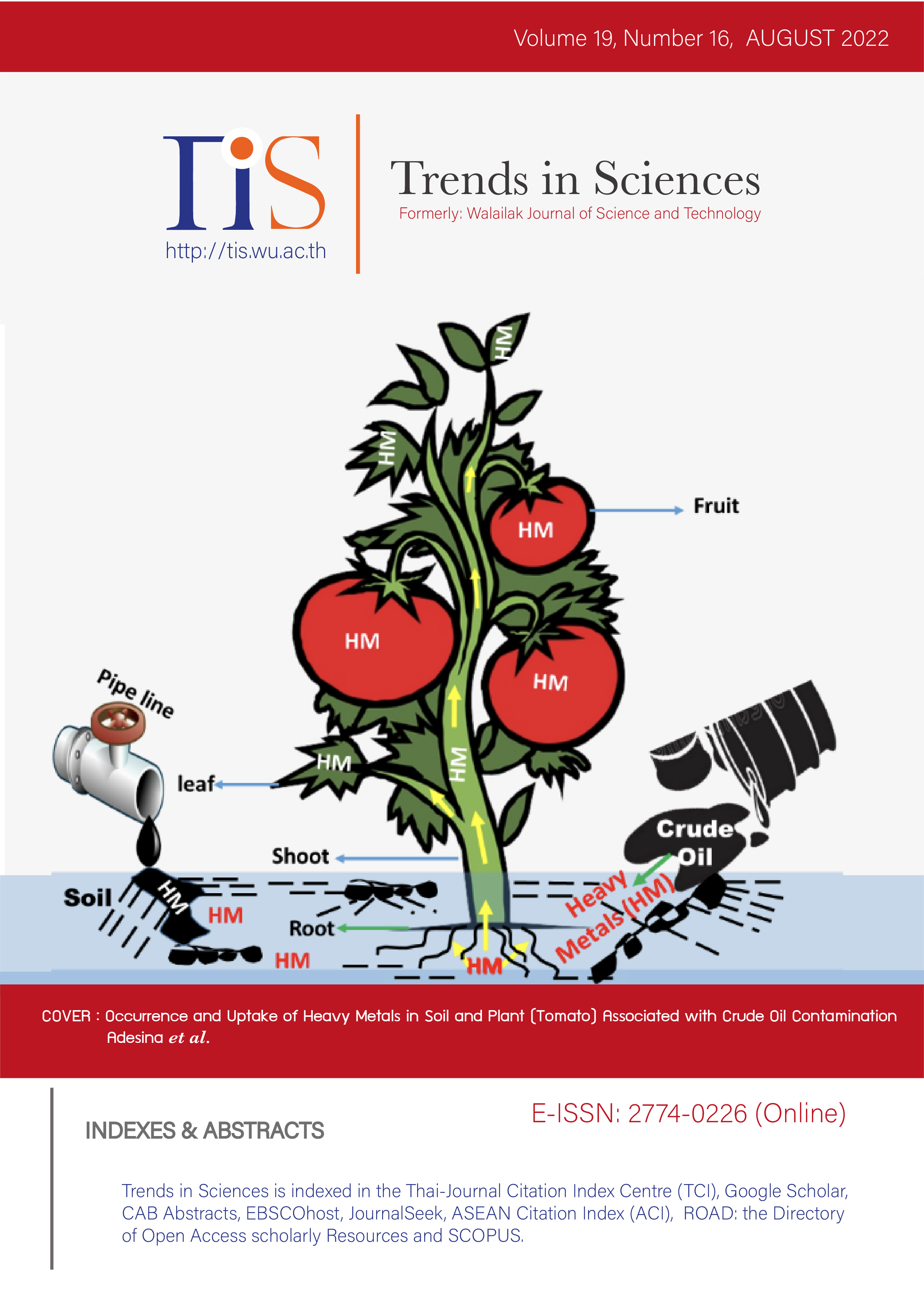
Occurrence and Uptake of Heavy Metals in Soil and Plant (Tomato) Associated with Crude Oil Contamination
DOI:
https://doi.org/10.48048/tis.2022.5684Keywords:
Heavy metals, Oil spillage, Soil pollution, Bioaccumulation, Ecotoxicity and TomatoAbstract
The general increase of heavy metal content in the soil has been largely caused by crude oil spillage. This study investigates the possibility of tomato (Lycopersicon esculentum Miller) to sorb heavy metals present in crude oil. Crude oil of 0 mL (control), 75 and 150 mL were mixed thoroughly with 15 kg of loamy soil (dry weight) in perforated plastic buckets, as the experimental pots and left for 4 days before transplanting tomato seedlings. After 12 weeks of transplanting, heavy metals analysis was carried out on plant’s fruits, leaves, stems and roots. Physicochemical analyses show that control soil had the lowest organic carbon (3.07 %) while 150 mL had the highest mean organic carbon content (8.24 %). The silt, clay and sand constituents were not significantly different (p > 0.05) in both treated and untreated soil. The control had the least pH value (6.1) while the lead (Pb) content in soil was highest in 150 mL (0.33 mg/kg) but was not significantly different (p > 0.05) from control (0.26 ) and 75 mL (0.30 mg/kg). Lead (Pb) and Cadmium (Cd) were not detected in leaves and fruits. However, bioaccumulation factor (BAF) of Cd and Ni in stem were greater than 1. Although, the concentrations of these heavy metals falls below toxic levels, its consumption could lead to adverse health effects in both man and animals through bioaccumulation or biomagnification.
HIGHLIGHTS
- Countries with poor hydrocarbon pollution regulation are more challenging with oil spills, either through accidental discharges or indiscriminate disposal of hydrocarbon waste
- Plants essentially need some metals such as iron, copper among others, for their growth and other metabolic activities. However, at excess of specific limits, these metals adversely affect plant growth
- In this study, bioaccumulation factors (BAF) of Cd and Ni in the stem were greater than 1, this shows that the tomato plant is a hyperaccumulator of Cd and Ni from the soil
GRAPHICAL ABSTRACT
Downloads
References
JH Duffus. “Heavy metals” a meaningless term? (IUPAC Technical Report). Pure Appl. Chem. 2002; 74, 793-807.
IY Zakka, KI Omoniyi and H Musa. A study of the uptake of heavy metals by plants near metal scrap dumpsite in Zaria, Nigeria. J. Appl. Chem. 2014; 2014, 394650.
H Ali, E Khan and I Ilahi. Environmental chemistry and ecotoxicology of hazardous heavy metals: Environmental persistence, toxicity, and bioaccumulation. J. Chem. 2019; 2019, 6730305.
V Masindi and KL Muedi. Environmental contamination by heavy metals. In: H El-Din M Saleh and RF Aglan (Eds.). Heavy metals. IntechOpen, London, 2018.
OT Aladesanmi, JG Oroboade, CP Osisiogu and AO Osewole. Bioaccumulation factor of selected heavy metals in Zea mays. J. Health Pollut. 2019; 9, 191207.
J Briffa, E Sinagra and R Blundell. Heavy metal pollution in the environment and their toxicological effects on humans. Heliyon 2020; 6, e04691.
GO Anoliefo and DE Vwioko. Effects of spent lubricating oil on the growth of Capsicum annum L. and Lycopersicon esculentum mill. Environ. Pollut. 1995; 88, 361-4.
BS Al-Ali, HJ Al-Aradi, DD Al-Khion and HT Al-Saad. Petroleum hydrocarbons in water, soil and tomato plant (Lycopersican esculentum L.) at Basra City, Iraq. J. Biol. Agr. Healthc. 2016; 6, 55-64.
MRA Al-Qahtani. Effect of oil refinery sludge on plant growth and soil properties. Res. J. Environ. Sci. 2011; 5, 187-93.
EO Ohanmu, SP Bako, E Ohanmu and OO Ohanmu. Environmental implications, properties and attributes of crude oil in the oil-producing states of nigeria. Ecologia 2019; 9, 1-9.
BE Udom, AO Ano and W Chukwu. Contaminant limit (c/p index) of heavy metals in spent oil contaminated soil bioremediated with legume plants and nutrients. J. Soil. Sci. 2012; 22, 144-52.
FP Adesina and MO Ashamo. Assessment of growth of D. bulbifera (L.) on contaminated soil (Spent Engine Oil) and industrial effluent. Int. Res. J. Environ. Sci. 2019; 8, 1-6.
Y Olaranont, AB Stewart and P Traiperm. Effects of crude oil on plant growth and leaf anatomical structures in a common coastal plant. Int. J. Phytoremed. 2021; 23, 162-70.
F Abbasian, R Lockington, M Mallavarapu and R Naidu. A comprehensive review of aliphatic hydrocarbon biodegradation by bacteria. Appl. Biochem. Biotechnol. 2015; 176, 670-99.
RN Hazim and MA Al-Ani. Effect of petroleum hydrocarbons contamination on soil microorganisms and biodegradation. Rafidain J. Sci. 2019; 28, 13-22.
Food and Agriculture Organisation of the United Nations - FAO (2015), land and soils, Available at: http://www.fao.org/sustainable-development-goals/overview/fao-and-the-post-2015-development-agenda/land-and-soils/en, accessed April 2021.
B Ikhajiagbe, GO Anoliefo, MA Jolaoso and EO Oshomoh. Phytoassessment of a waste engine oil-polluted soil exposed to two different intervals of monitored natural attenuation using african yam bean (Sphenostylis stenocarpa). Pakistan J. Biol. Sci. 2013; 16, 680-5.
ID Dulama, IV Popescu, C Stihi, C Radulescu, GV Cimpoca, LG Toma, R Stirbescu and O Nitescu. Studies on accumulation of heavy metals in Acacia leaf by EDXRF. Rom. Rep. Phys. 2012; 64, 1063-71.
N Oladejo, B Anegbe and O Adeniyi. Accumulation of heavy metals in soil and maize plant (Zea mays) in the vicinity of two government approved dumpsites in Benin City, Nigeria. Asian J. Chem. Sci. 2017; 3, 1-9.
RW Hammond. Economic significance of viroids in vegetable and field crops. Viroids Satellites 2017; 5-13.
E Ebimieowei and E Ebideseghabofa. Postharvest quality of commercial tomato (Lycopersicon Esculentum Mill.) fruits brought into yenagoa metropolis from northern nigeria. J. Biol. Agr. Healthc. 2013; 3, 49-54.
AO Adepoju. Post-harvest losses and welfare of tomato farmers in ogbomosho, Osun state, Nigeria. J. Stored Prod. Postharvest Res. 2014; 5, 8-13.
NM Salem, LS Albanna and AM Awwad. Toxic heavy metals accumulation in tomato plant (Solanum lycopersicum). ARPN J. Agr. Biol. Sci. 2016; 11, 399-404.
FA Andal. Assessment of the possible utilization of tomato as a phytoremediant in soils artificially contaminated with heavy metals. Int. J. Appl. Environ. Sci. 2016; 11, 193-209.
GK Kinuthia, V Ngure, D Beti, R Lugalia, A Wangila and L Kamau. Levels of heavy metals in wastewater and soil samples from open drainage channels in Nairobi, Kenya: Community health implication. Sci. Rep. 2020; 10, 8434.
M Mahurpawar. Effects of heavy metals on human health. Int. J. Res. Granthaalayah 2015; 10, 1-7.
G Mansourri and M Madani. Examination of the level of heavy metals in wastewater of bandar abbas wastewater treatment plant. Open J. Ecol. 2016; 6, 55-61.
S Sobhanardakani, L Tayebi and SV Hosseini. Health risk assessment of arsenic and heavy metals (Cd, Cu, Co, Pb, and Sn) through consumption of caviar of Acipenser persicus from Southern Caspian Sea. Environ. Sci. Pollut. Res. 2018; 25, 2664-71.
GM Harry, SB Sujitha, MP Jonathan, SK Sarkar, MM Fairy, AM Helcias, MM Gladis and AM Laura. Mercury levels in human population from a mining district in western colombia. J. Environ. Sci. 2018; 68, 83-90.
A James, M Percy, OS Ameh and C Buggy. Heavy metals pollution status of the katima mulilo urban open land wastewater disposal centre and the immediate vicinity. Cogent Environ. Sci. 2020; 6, 1726093.
SE Abiya, BO Odiyi, FA Ologundudu, OJ Akinnifesi and S Akadiri. Assessment of heavy metal pollution in a gold mining site in Southwestern Nigeria. J. Cell Biol. Genet. 2018; 1, 30-5.
MHH Ali, KM Al-Qahtani. Assessment of some heavy metals in vegetables, cereals and fruits in Saudi Arabian markets. Egypt. J. Aquat. Res. 2012; 38, 31-7.
ED Vwioko, ME Osawaru and OL Eruogun. Nickel and chromium concentration in the plant tissues of six accession of okra (Abelmoschus esculetus L. Moench) grown in soil contaminated with paint waste. Afr. J. Gen. Agr. 2008; 4, 27-37.
M Marinescu, M Toti, V Tanase and V Carabulea. An assessment of the effects of crude oil pollution on soil properties. Annu. Rev. Food Sci. Tech. 2010; 11, 94-9.
D Okoro, PO Oviasogie and FE Oviasogie. Soil quality assessment 33 months after crude oil spillage and clean-up. Chem. Speciation Bioavailability 2011; 23, 1-6.
SP Bako, SJ Oniye and LSP Bako. Threat and potentials of invasive macrophtye species to inland freshwaters in relation to changing climate in Northern Nigeria. In: Proceedings of the 54th Symposium of the International Association for Vegetation Science, Lyon, France. 2011.
E Ohanmu, S Bako and M Adelanwa. Effect of oil spillage on the productivity of pepper (Capsicum spp). Lambert Academic Publishing, Saarbrücken, Germany, 2017.
AJ Baker, SP Megrath, M Reeves and JA Smith. Metal accumulator review of the ecology and physiology of a biological resource for phytoremediation of metal polluted soils. In: N Terry and G Banuelos (Eds.). Phytoremediation of contaminated soil and water, London, 2000.
S Murtić, Ć Zahirović, H Čivić, L Karić and J Jurković. Uptake of heavy metals by tomato plants (Lycopersicum esculentum Mill.) and their distribution inside the plant. Agr. Forest. 2018; 64, 251-61.
V Radovanovic, I Djekic and B Zarkovic. Characteristics of cadmium and lead accumulation and transfer by chenopodium quinoa will. Sustainability 2020; 12, 3789.
United Nations Environment Programme. Commission Regulation (EC) No. 1881/2006 setting maximum levels for certain contaminants in foodstuffs. United Nations Environment Programme, Nairobi, Kenya, 2006, p. 5-24.
M Patra, N Bhowmik, B Bandopadhyay and A Sharma. Comparison of mercury, lead and arsenic withrespect to genotoxic effects on plant systems and the development of genetic tolerance. Environ. Exp. Bot. 2004; 52, 199-223.
J He, ZX Ji, QZ Wang, CF Liu and YB Zhou. Effect of Cu and Pb pollution on the growth and antionxidant enzyme activity of Suaeda heteroptera. Ecol. Eng. 2016; 87, 102-9.
H Oliveira. Chromium as an environmental pollutant: Insights on induced plant toxicity. J. Bot. 2012; 2012, 375843.
World Health Organization. Summary and conclusions. In: Proceedings of the 53rd Meeting of the Joint FAO/WHO expert committee on food additives, Rome, Italy. 1999.
J Yoon, X Cao, Q Zhou and LQ Ma. Accumulation of Pb, Cu, and Zn in native plants growing on a contaminated Florida site. Sci. Total Environ. 2006; 368, 456-64.
L Correia, P Marrocos, DMM Olivares, FG Velasco, FHM Luzardo and RMD Jesus. Bioaccumulation of nickel in tomato plants: Risks to human health and agro-environmental impacts. Environ. Monit. Assess. 2018; 190, 317.
KK Tiwari, S Dwivedi, NK Singh, UN Rai and RD Tripathi. Chromium (VI) induced phytotoxicity and oxidative stress in pea (Pisum sativum L.): Biochemical changes and translocation of essential nutrients. J. Environ. Biol. 2009; 30, 389-94.
P Sundaramoorthy, A Chidambaram, KS Ganesh, P Unnikannan and L Baskaran. Chromium stress in paddy: (i) nutrient status of paddy under chromium stress; (ii) phytoremediation of chromium by aquatic and terrestrial weeds. Compt. Rendus Biol. 2010; 333, 597-607.
JE Gall and N Rajakaruna. The physiology, functional genomics, and applied ecology of heavy metal-tolerant Brassicaceae. In: M Lang (Ed.). Brassicaceae: Characterization, functional genomics and health benefits. Nova Science Publishers, New York, 2013, p. 121-48.
S Neilson and N Rajakaruna. Phytoremediation of agricultural soils: Using plants to clean metal-contaminated arable lands. In: A Ansari, S Gill, R Gill, G Lanza and L Newman (Eds.). Phytoremediation: Management of environmental contaminants. Springer, Berlin, Germany, 2015, p. 159-68.
N Adimalla. Heavy metals contamination in urban surface soils of medak province, India, and its risk assessment and spatial distribution. Environ. Geochem. Health 2020; 42, 59-75.
International Agency for Research on Cancer. IARC monographs on the evaluation of carcinogenic risk to human. International Agency for Research on Cancer, Lyon, France, 2012.
HS Kim, YJ Kim and YR Seo. An overview of carcinogenic heavy metal: Molecular toxicity mechanism and prevention. J. Canc. Prev. 2015; 20, 232-40.
G Yua, F Chena, H Zhang and Z Wang. Pollution and health risk assessment of heavy metals in soils of Guizhou, China. Ecosys. Health Sustain. 2021; 7, 1859948.
QY Chen, T DesMarais and M Costa. Metals and mechanisms of carcinogenesis. Annu. Rev. Pharmacol. Toxicol. 2019; 59, 537-54.
G Genchi, A Carocci, G Lauria, MS Sinicropi and A Catalano. Nickel: Human health and environmental toxicology. Int. J. Environ. Res. Publ. Health 2020; 17, 679.
G Genchi, MS Sinicropi, G Lauria, A Carocci and A Catalano. The effects of cadmium toxicity. Int. J. Environ. Res. Publ. Health 2020; 17, 3782.
RT Achmad, Budiawan and EI Auerkari. Effects of chromium on human body. Ann. Rev. Res. Biol. 2017; 13, 1-8.
B Yaman. Health effects of chromium and its concentrations in cereal foods together with sulfur. Expo. Health 2020; 12, 153-61.
Downloads
Published
How to Cite
Issue
Section
License

This work is licensed under a Creative Commons Attribution-NonCommercial-NoDerivatives 4.0 International License.





