
Spatio-Temporal Variations of Climate Variables and Extreme Indices over the Aral Sea Basin during 1960 - 2017
DOI:
https://doi.org/10.48048/tis.2023.5664Keywords:
Nukus branch of Tashkent University of Information Technologies named after Muhammad-al Khorezmi, Tashkent, UzbekistanAbstract
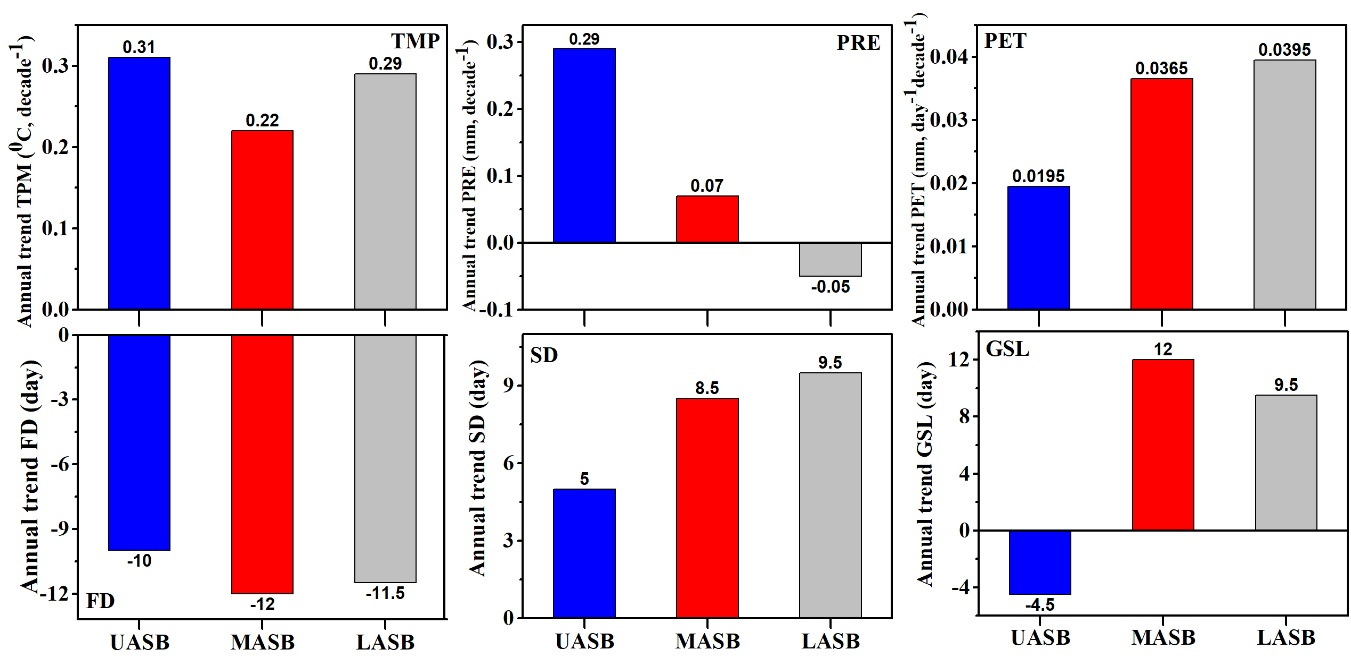
The Aral Sea plays a key role in the socio-economic development of Central Asia. In the past few decades, with the combined effects of global warming and human activities, the ecological environment of the Aral Sea has undergone significant changes, such as the reduction of the basin area and the drop in water levels. In this study uses the observed climate data, combined with remote sensing to systematically analyze the characteristics of changes in climate in the Aral Sea Basin (ASB). We used linear regression, Pearson's correlation and Pettit's test to determine climate change. The main conclusions are as follows. Based on the analysis of the temporal and spatial changes of temperature, precipitation, and potential evapotranspiration in the Aral Sea Basin from 1960 to 2017, it was found that the annual average temperature, precipitation, and potential evapotranspiration increased by 0.32 ℃ decade-1, 0.16 mm decade-1, and 0.04 mm day-1 decade-1, respectively. In addition, the changes of these climatic variables were different in the growing season (April - September) and the non-growing season (October - March). Temperature and potential evapotranspiration increased in both growing and non-growing seasons; however, the precipitation decreased (increased) in the growing (non-growing) season. This means that the climate in the growing season showed a warming and drying trend.
HIGHLIGHTS
- In this study, we present the complex and detailed analysis that we performed by combining temporal and spatial changes in key climate parameters temperature, precipitation and potential evapotranspiration and change of climate extreme indices in the entire Aral Sea Basin and its sub-regions.
GRAPHICAL ABSTRACT
Downloads
References
Haag, I., P.D. Jones, and C. Samimi, Central Asia’s Changing Climate: How Temperature and Precipitation Have Changed across Time, Space, and Altitude. Climate, 2019. 7(10).
Giorgi, F., Climate change hot-spots. Geophysical Research Letters, 2006. 33(8).
de Beurs, K.M., et al., Large scale climate oscillation impacts on temperature, precipitation and land surface phenology in Central Asia. Environmental Research Letters, 2018. 13(6).
Zhang, M., et al., Tracking climate change in Central Asia through temperature and precipitation extremes. Journal of Geographical Sciences, 2019. 29(1): p. 3-28.
Hu, Z., et al., Temperature Changes in Central Asia from 1979 to 2011 Based on Multiple Datasets*. Journal of Climate, 2014. 27(3): p. 1143-1167.
Chen, F., et al., Spatiotemporal precipitation variations in the arid Central Asia in the context of global warming. Science China Earth Sciences, 2011. 54(12): p. 1812-1821.
Reyer, C., et al., Climate change impacts in Central Asia and their implications for development. Regional Environmental Change, 2015.
Bernauer, T. and T. Siegfried, Climate change and international water conflict in Central Asia. Journal of Peace Research, 2012. 49(1): p. 227-239.
Xenarios, S., et al., Climate change and adaptation of mountain societies in Central Asia: uncertainties, knowledge gaps, and data constraints. Regional Environmental Change, 2019. 19(5): p. 1339-1352.
Bhutiyani, M.R., V.S. Kale, and N.J. Pawar, Climate change and the precipitation variations in the northwestern Himalaya: 1866–2006. International Journal of Climatology, 2010. 30(4): p. 535-548.
Bolch, T., Climate change and glacier retreat in northern Tien Shan (Kazakhstan/Kyrgyzstan) using remote sensing data. Global and Planetary Change, 2007. 56(1): p. 1-12.
Gafforov, K.S., et al., The Assessment of Climate Change on Rainfall-Runoff Erosivity in the Chirchik–Akhangaran Basin, Uzbekistan. Sustainability, 2020. 12(8).
Feng, R., et al., Spatial and temporal variations in extreme temperature in Central Asia. International Journal of Climatology, 2018. 38(S1): p. e388-e400.
Aizen, E.M., et al., Precipitation and atmospheric circulation patterns at mid-latitudes of Asia. International Journal of Climatology, 2001. 21(5): p. 535-556.
Begjanova, Z., et al., Spatial hydrological GIS analysis in the Aral Sea Basin, in Збірник наукових праць SCIENTIA. 2021: Sidney, Australia.
Nietullaeva, S., et al., An Investigation into the Hydro-Climate Processes Impacting Aral Sea Region in Central Asia. Annals of the Romanian Society for Cell Biology, 2021. 25(4): p. 11692–11703.
Yao, J. and Y. Chen, Trend analysis of temperature and precipitation in the Syr Darya Basin in Central Asia. Theoretical and Applied Climatology, 2015. 120(3): p. 521-531.
Berdimbetov, T., et al., Climatic Change and Human Activities Link to Vegetation Dynamics in the Aral Sea Basin Using NDVI. Earth Systems and Environment, 2021. 5(2): p. 303-318.
Harris, I., et al., Updated high-resolution grids of monthly climatic observations – the CRU TS3.10 Dataset. International Journal of Climatology, 2014. 34(3): p. 623-642.
Schneider, U., et al., GPCC's new land surface precipitation climatology based on quality-controlled in situ data and its role in quantifying the global water cycle. Theoretical and Applied Climatology, 2013. 115(1-2): p. 15-40.
Simpson, J., et al., On the Tropical Rainfall Measuring Mission (TRMM). Meteorology and Atmospheric Physics, 1996. 60(1): p. 19-36.
Hu, Z., et al., Climate changes in temperature and precipitation extremes in an alpine grassland of Central Asia. Theor Appl Climatol 2015. 126: p. 519-531.
Xu, M., et al., Detection of spatio-temporal variability of air temperature and precipitation based on long-term meteorological station observations over Tianshan Mountains, Central Asia. Atmospheric Research, 2018. 203: p. 141-163.
Berdimbetov, T., et al., Identifying Land Degradation and its Driving Factors in the Aral Sea Basin From 1982 to 2015. Frontiers in Earth Science, 2021. 9.
Berdimbetov, T.T., et al., Impact of Climate Factors and Human Activities on Water Resources in the Aral Sea Basin. Hydrology, 2020. 7(2).
Berdimbetov, T.T., et al., Analysis of Impact of Aral Sea Catastrophe on Anomaly Climate Variables and Hydrological Processes. Elsevier, International Journal of Geoinformatics, 2021. 17(1).
Felix, M.L., et al., Detailed Trend Analysis of Extreme Climate Indices in the Upper Geum River Basin. Water, 2021. 13(22).
Mitchell, T.D. and P.D. Jones, An improved method of constructing a database of monthly climate observations and associated high-resolution grids. International Journal of Climatology, 2005. 25(6): p. 693-712.
Chen, Y., et al., Changes in Central Asia's Water Tower: Past, Present and Future. Sci Rep, 2016. 6: p. 35458.
Guo, H., et al., Spatial and temporal characteristics of droughts in Central Asia during 1966-2015. Science of the Total Environment, 2019. 628: p. 1523-1538.
Sillmann, J., et al., Climate extremes indices in the CMIP5 multi-model ensemble. Part 1: Model evaluation in the present climate. J. Geophys. Res., 2013a.
Sillmann, J., et al., Climate extremes indices in the CMIP5 multi-model ensemble. Part 2: Future projections. J. Geophys. Res., 2013b.
Duulatov, E., et al., Projected Rainfall Erosivity Over Central Asia Based on CMIP5 Climate Models. Water, 2019. 11(897).
Xu, H.-j., X.-p. Wang, and X.-x. Zhang, Decreased vegetation growth in response to summer drought in Central Asia from 2000 to 2012. International Journal of Applied Earth Observation and Geoinformation, 2016. 52: p. 390-402.
Peterson, T.C., Climate Change Indices. WMO Bulletin, 2005. 54(2): p. 83-86.
Pettitt, A.N., A Non-Parametric Approach to the Change-Point Problem. Journal of the Royal Statistical Society. Series C (Applied Statistics), 1979. 28(2): p. 126-135.
Jiang, L., et al., Monitoring land sensitivity to desertification in Central Asia: Convergence or divergence? Sci Total Environ, 2019. 658: p. 669-683.
Easterling D. R., Meehl G. A., and P.C. S., Climate extremes: Observations, modeling, and impacts. Science, 2000. 289: p. 2068-2074.
Groisman, P. and E. Rankova, Precipitation trends over the Russian permafrost-free zone: Removing the artifacts of preprocessing. Int. J. Climatology, 2001. 21(6): p. 657-678.
Meehl, G.A., J.M. Arblaster, and D.M. Lawrence, Monsoon regimes in the CCSM3. J. Climate, 2006. 19(2): p. 2482-2495.
Karl, T.R., N. N., and G. A., CLIVAR/GCOS/WMO workshop on indices and indicators for climate extremes: Workshop summary. Climatic Change, 1999. 42: p. 4.
Bohovic, R., P. Dobrovolny, and D. Klein, The Spatial and Temporal Dynamics of Remotely-sensed Vegetation Phenology in Central Asia in the 1982–2011 Period. European Journal of Remote Sensing, 2016. 49(1): p. 279-299.
Ibragimov, N., et al., Water use efficiency of irrigated cotton in Uzbekistan under drip and furrow irrigation. Agric. Water Management, 2007. 90 (1–2): p. 112–120.
Lioubimtseva, E., Environmental changes in arid Central Asia inferred from remote sensing data and ground observations. Arid Ecosyst, 2005. 11(26-27): p. 67-72.
Ayzel , G. and A. Izhitskiy, Climate Change Impact Assessment on Freshwater Inflow into the Small Aral Sea. Water, 2019. 11(2377).

Downloads
Published
How to Cite
Issue
Section
License
Copyright (c) 2022 Walailak University

This work is licensed under a Creative Commons Attribution-NonCommercial-NoDerivatives 4.0 International License.





