
Design, Synthesis, Spectral Characterization, DNA Binding and Antibacterial Studies of Ternary Metal Complexes with 1,10 Phenanthroline and 2-Acetylthiophene-4-phenyl-3-thiosemicarbazone
DOI:
https://doi.org/10.48048/tis.2022.5653Keywords:
2-Acetylthiophene-4-phenyl-3-thiosemicarbazone, Ternary transition metal complexes, Cyclic voltammetry, DNA binding, Antibacterial activityAbstract
Bivalent metal complexes having the composition M(Phen)Cl2 (where, M = Cu(II), Ni(II) and Co(II); Phen = 1,10-Phenonthroline) are reacted with 2-acetylthiophene-4-phenyl-3-thiosemicarbazone (ATPT) to produce ternary complexes with molecular formula [M(Phen)(ATPT)Cl2] H2O. The complexes are characterized using physical (molar conductivity) and spectral (mass spectra, infrared and electronic spectroscopies) methods. Electrochemical behavior of complexes was uncovered using cyclic voltammetry. DNA binding properties of the complexes are determined by using absorption UV-Visible spectrophotometry. Metal complexes are screened for their antibacterial activity by using agar well diffusion method against pathogenic bacterial strains viz. Gram–ve such as Escherichia coli, Klebsiella Pneumonia and Gram+ve such as Staphylococcus aureus, Bacillus cereus. The [Ni (Phen)(ATPT)Cl2] 0.5 H2O complex inhibits bacteria more stronger than any other complex.
HIGHLIGHTS
- Ternary Metal Complexes with 1,10 Phenanthroline and 2-Acetylthiophene-4-phenyl-3-thiosemicarbazone are synthesized
- The complexes are characterized using physico-chemical, spectral and electrochemical methods
- DNA binding properties of the complexes are determined
- Metal complexes are screened for their antibacterial activity
- The [Ni (Phen)(ATPT)Cl2] 0.5 H2O complex inhibits bacteria more effectively
GRAPHICAL ABSTRACT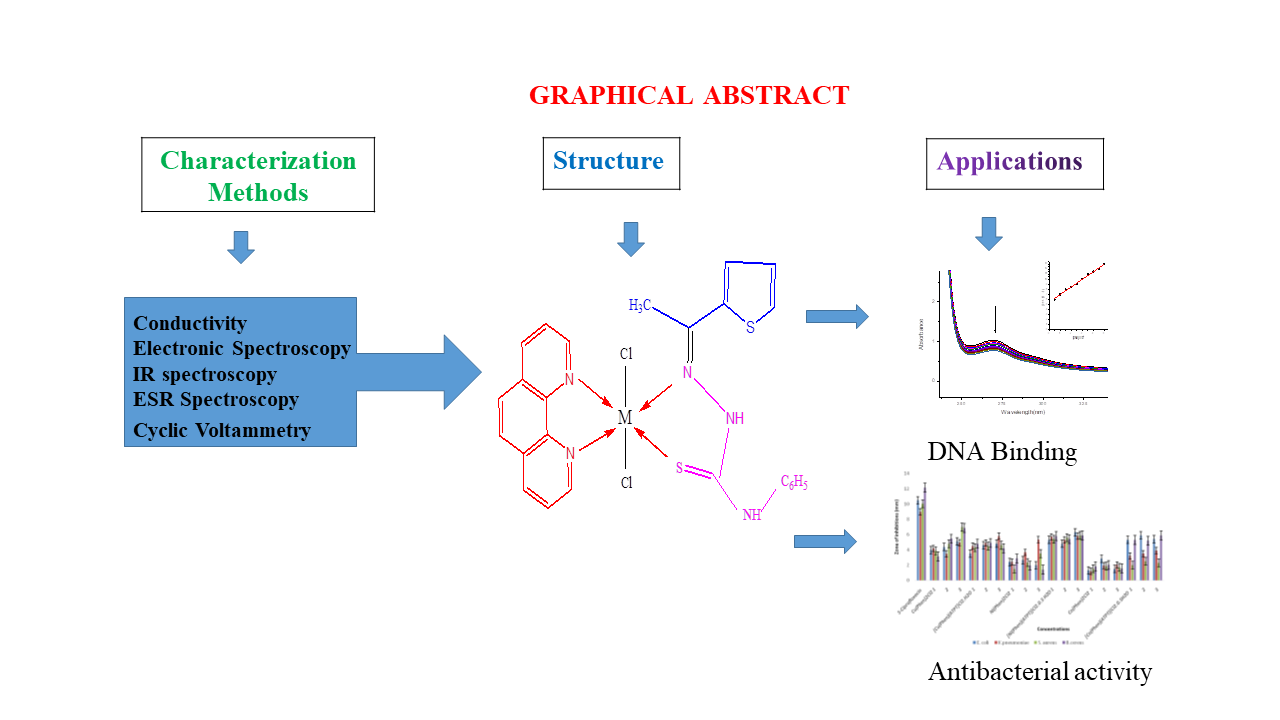
Downloads
References
MJM Campbell. Transition metal complexes of thiosemicarbazide and thiosemicarbazones. Coord. Chem. Rev. 1975; 15, 279-319.
S Padhye and GB Kauffman. Transition metal complexes of semicarbazones and thiosemicarbazones. Coord. Chem. Rev. 1985; 63, 127-60.
KH Reddy and DV Reddy. Analytical data comparison of analytical potentialities of thiosemicarbazones and semicarbazones. Quaterly Chem. Rev. 1985; 1, 47-98.
PM Krishna and KH Reddy. Synthesis, single crystal structure and DNA cleavage studies on first 4N-ethyl substitutedthree coordinate copper(I) complex with thiosemicarbazone. Inorg. Chim. Acta 2009; 362, 4185-90.
PR Haribabu and KH Reddy. DNA binding and cleavage activity of cationic dinuclear copper(II) and nickel(II) complexes with novel oxime-thiosemicarbazones. Indian J. Chem. 2011; 50A, 996-1001.
Y Prashanthi, K Kiranmai and K Sathishkumar. Spectroscopic characterization anbiological activity of mixed ligand complexes of Ni(II) with 1,10-phenanthroline and heterocyclic Schiff bases. Bioinorg. Chem. Appl. 2012; 2012, 948534.
R Mahalakshmi and N Raman. A therapeutic journey of mixed ligand complexes containing 1,10-phenanthroline derivatives: A review. Int. J. Curr. Pharm. Res. 2016; 8, 1-6.
KH Sugiyarto, C Kusumawardani, H Wigati and H Sutrisno. structural study of the powder complex of Cu(II)-1,10-phenanthroline- trifluoroacetate. Orient. J. Chem. 2019; 35, 325-31.
A Oveisikeikha and H Saravani. Synthesis and characterization of new binuclear chromium, cadmium complexes based on terpyridine and phenanthroline. Orient. J. Chem. 2018; 34, 1323-7.
RKR Al-shemary, LKA Karem and FH Ghanim. Structure, and in vitro antimicrobial and antifungal evaluation of some amino benzoic acids, derived ligand Schiff base and their mixed complexes with Cu(II), Hg(II), Mn(II), Ni(II) and Co(II). Orient. J. Chem. 2018; 34, 1105-13.
NBL Prasad. 2001, Spectrophotometric determination of Cu(II) and Ni(II) in edible oils using oxime-thiosemi-carbazones. Master Thesis. Sri Krishnadevaraya University, India.
GMD Lima, JL Neto, H Beraldo, HGL Siebald and DJ Duncalf. Structural and spectral studies of thiosemicarbazones derived from 2-acetylthiophene. J. Mol. Struct. 2002; 604, 287-91.
M SayajiRao, NBL Prasad and KH Reddy. Spectrophotometric determination of copper(II) in alloys and edible oils using 2-acetylthiophene thiosemicarbazone. Indian J. Chem. 2006; 45A, 1659-62.
VS Shivankar, RB Vaidya, SR Dharwadkar and NV Thakkar. Synthesis, characterization and biological activity of mixed ligand Co(II) complexes of 8-hydroxyquinoline and some amino acids. Synth. React. Inorg. Met. Org. Chem. 2003; 33, 1597-622.
A Adkhis, S Djebbar, O Benali-Baïtich, A Kadir, MA Khan and G Bouet. Synthesis, characterization, and electrochemical behavior of mixed‐ligand complexes of cobalt(III) with dimethylglyoxime and some amino acids. Synth. React. Inorg. Met. Org. Chem. 2003; 33, 35-50.
KH Reddy. Bioinorganic chemistry. New Age International Publishers, New Delhi, India, 2020.
D Dornala, HR Katreddi, A Kandukuri, S Kummara and NY Balaramaiah. Synthesis, characterization, deoxyribonucleic acid binding and antimicrobial activity of bivalent metal complexes with 2-acetylpyridine isonicotinoylhydrazone. J. Appl. Pharm. Sci. 2021; 11, 84-92,
YB Nagamani, KH Reddy, K Srinivasulu, D Dhanalakshmi and K Anuja. Antibacterial activity and DNA binding properties of bivalent metal complexes with cuminaldehyde benzoylhydrazone (CABH). Int. J. Pharm. Res. 2021; 12, 188-95.
D Dhanalakshmi, KH Reddy, K Srinivasulu, K Anuja, YB Nagamani and P Shravya. DNA binding and antibacterial activity studies on transition metal complexes with 2-formylpyridine isonicotinoyl hydrazone. Res. J. Chem. Environ. 2020; 24, 130-40.
WJ Geary. The use of conductivity measurements in organic solvents for the characterization of coordination compounds. Coord. Chem. Rev. 1971; 7, 81-122.
C Tu, X Wu, Q Liu, X Wang, Q Xu and Z Guo. Crystal structure, DNA-binding ability and cytotoxic activity of platinum (II) 2,2’dipyridylaminecomplexes. Inorg. Chim. Acta 2004; 357, 95-102.
E Szlyk, A Surdykowski, M Barwiołek and E Larsen. Spectroscopy and stereochemistry of the optically active copper(II), cobalt(II) and nickel(II) complexes with Schiff bases N,N′-(1R,2R)-(−)-1,2-cyclohexylenebis(3-methylbenzylideneiminato) and N,N′-(1R,2R)-(−)-1,2-cyclohexylenebis(5-methylbenzylideneiminato). Polyhedron 2002; 21, 2711-7.
L Mitu, R Natarajan, A Kriza, N Stanica and M Dianu. Synthesis, characterization and antimicrobial activity of Cu(II), Ni(II), Co(II), Zn(II) complexes with isonicotinoylhydrazone-4-benzyloxy- benzaldehyde. Asian J. Chem. 2009; 21, 5749-56.
P Chattopadhyay and C Sinha. Synthesis and characterization of uranyl complexes and their peroxo derivatives with some thiosschiff bases. Indian J. Chem. 1996; 35, 523-6.
B Dede, I Ozmen and F Karipcin. Synthesis, characterization, catalase functions and DNA cleavage studies of new homo and heteronuclear Schiff base copper(II) complexes. Polyhedron 2009; 28, 3967-74.
XD Peizhi and Boz. Transition metal complexes of isonicotinoyl-hydrazone-4-diphenylamino benzaldehyde: Synthesis, characterization and antimicrobial studies. Asian J. Chem. 2005; 17, 969.
D Kivelsonand and R Neiman. Line shapes in glasses of copper complexes. J. Chem. Phys. 1961; 35, 156-61.
IM Procter, BJ Hathaway and P Nicholis. The electronic properties and stereochemistry of the copper(II) ion. Part V. The tetra-ammine complexes. J. Chem. Soc. A 1969. DOI: doi.org/10.1039/J 19690000065.
S Usha and M Palaniandavar. Influence of chelate-ring size and number of sulfur-donor atoms on spectra and redox behaviour of copper(II) bis(benzimidazolyl) tetra- and penta- thioether complexes. J. Chem. Soc. Dalton Trans. 1994; 15, 2277-83.
M Sirajuddin, S Ali and A Badshah. Drug-DNA interactions and their study by UV-Visible, fluorescence spectroscopies and cyclic voltammetry. J. Photochem. Photobiol. B 2013; 124, 1-19.
Downloads
Published
How to Cite
Issue
Section
License

This work is licensed under a Creative Commons Attribution-NonCommercial-NoDerivatives 4.0 International License.





