
Study of Structural, Morphological and Electrochemical Properties of Multilayer Nanowires
DOI:
https://doi.org/10.48048/tis.2022.5617Keywords:
Multilayer nanowires, Cu/Ni, pH, Polycarbonate membrane, Electrochemical depositionAbstract
Ni/Cu nanowires were fabricated by electrodeposition in potentiostatic mode, into the pores of polycarbonate membrane. In present work metallic multilayer nanowires were deposited in polycarbonate membrane having pore size of 400 nm. It is found that the growth of nanowires is not constant, it varies with the pH values of electrolyte used for the deposition. Scanning electron microscopy (SEM) confirmed formed nanowires are cylindrical in shapes, dense and homogeneous for low pH depostion. X-ray diffraction technique is used to study the morphology and structure of fabricated Ni/Cu nanowires and found nanowires have FCC structure. An energy dispersive X-ray spectroscopy (EDS) is used to study the composition of multilayer nanowires. The electrochemical impedance spectroscopy has been carried out to study the in-situ growth process of multilayer nanowires.
HIGHLIGHTS
- Fabricated Ni/Cu nanowires using electrodeposition method in potentiostatic mode, into the pores of polycarbonate membrane
- Scanning electron microscopy (SEM) confirmed that the fabricated nanowires are cylindrical in shape, dense and homogeneous for low pH value
- XRD study reveals FCC structure of fabricated nanowires
GRAPHICAL ABSTRACT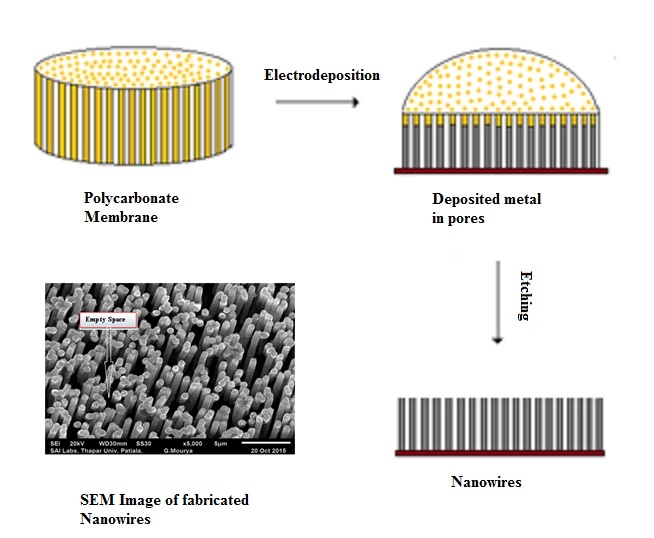
Downloads
References
J Romo-Herrera, M Terrones, H Terrones, S Dag and V Meunier. Covalent 2D and 3D networks from 1D nanostructures: Designing new materials. Nano Letters 2007; 7, 570-6.
A upgade and P Nagarajan. Bactericidal action of E. coli mediated nanoparticle coated medical dressings. Walailak J. Sci. Technol. 2014; 11, 803-7.
K Xu, M Purahmad, K Brenneman, X Meshik, S Farid, S Poduri, P Pratap, J Abell, Y Zhao and B Nichols. Design and applications of nanomaterial-based and biomolecule-based nanodevices and nanosensors. In: J Seminario (Ed.). Design and applications of nanomaterials for sensors. Springer, Dordrecht, the Netherlands, 2014, p. 61-97.
A Greer and F Spaepen. Synthetic modulated structures. In: LL Chang and BC Giessen (Eds.). Materials science and technology series, Academic Press, Florida, 1985, p. 516.
BJ Thaler, JB Ketterson and J Hilliard. Enhanced magnetization density of a compositionally modulated CuNi thin film. Phys. Rev. Lett. 1978; 41, 336.
LL Chang and BC Giessen. Synthetic modulated structures: Materials science and technology series. Elsevier, Amsterdam, the Netherlands, 2013, p. 502.
E Gyorgy, JRJ Dillon, D McWhan, JRL Rupp, L Testardi and P Flanders. Magnetic properties of compositionally modulated Cu-Ni thin films. Phys. Rev. Lett. 1980; 45, 57.
S Eugénio, T Silva, M Carmezim, R Duarte and M Montemor. Electrodeposition and characterization of nickel-copper metallic foams for application as electrodes for supercapacitors. J. Appl. Electrochem. 2014; 44, 455-65.
B Hong, CH Jiang and XJ Wang. Influence of complexing agents on texture formation of electrodeposited copper. Surf. Coat. Technol. 2007; 201, 7449-52.
C Schönenberger, BVD Zande, L Fokkink, M Henny, C Schmid, M Krüger, A Bachtold, R Huber, H Birk and U Staufer. Template synthesis of nanowires in porous polycarbonate membranes: Electrochemistry and morphology. J. Phys. Chem. B. 1997; 101, 5497-505.
B Terris and T Thomson. Nanofabricated and self-assembled magnetic structures as data storage media. J. Phys. D: Appl. Phys. 2005; 38, R199.
TM Chen, FM Pan, JY Hung, L Chang, SC Wu and CF Chen. Amorphous carbon coated silicon nanotips fabricated by MPCVD using anodic aluminum oxide as the template. J. Electrochem. Soc. 2007; 154, D215.
G Zhang and J Chen. Synthesis and application of La0.59Ca0.41CoO3 nanotubes. J. Electrochem. Soc. 2005; 152, A2069.
R Inguanta, C Sunseri and S Piazza. Photoelectrochemical characterization of Cu2O-nanowire arrays electrodeposited into anodic alumina membranes. Electrochem. Solid-State Lett. 2007; 10, K63.
R Kaur, N Verma, S Kumar and S Chakarvarti. Fabrication of copper microcylinders in polycarbonate membranes and their characterization. J. Mater. Sci. 2006; 41, 3723-8.
R Inguanta, S Piazza and C Sunseri. Novel procedure for the template synthesis of metal nanostructures. Electrochem. Commun. 2008; 10, 506-9.
T Gupta, S Sharma, T Rajvanshi and H Shukla. Fabrication of cu nano wires at different ph: Effect, structure, and morphological studies. Int. J. Nanosci. Nanotechnol. 2021; 12, 23-30.
M Vedpathak, S Basu and S Kulkarni. Characterization of nickel-copper multilayer and copper thin film using neutron reflectivity measurements. Appl. Surf. Sci. 1997; 115, 311-6.
A Saedi and M Ghorbani. Electrodeposition of Ni-Fe-Co alloy nanowire in modified AAO template. Mater. Chem. Phys. 2005; 91, 417-23.
G Riveros, H Gomez, R Schrebler, RE Marotti and EA Dalchiele. An in-situ EIS study during the electrochemical growth of copper nanowires into porous polycarbonate membranes. Electrochem. Solid-state Lett. 2007; 11, K19.

Downloads
Published
How to Cite
Issue
Section
License

This work is licensed under a Creative Commons Attribution-NonCommercial-NoDerivatives 4.0 International License.





