
Identifying Radical Activity on Social Digital Platform: A Machine Learning Approach
DOI:
https://doi.org/10.48048/tis.2022.5611Keywords:
Sentimental analysis, Radical activity, Machine learning, Deep learningAbstract
The social media in digital form over internet is getting popularity in recent years. This digital platform is being used by many to share their thought or opinion. Though these social media had given results too many good causes, there are some users are present on these platforms for radical activities. In this paper, the tweets form the digital social platform twitter is taken for analysis based on radical keywords. The data is collected in form of tweets are analyzed using different machine learning algorithms and a comparative analysis is done. The proposed work concludes the best machine learning algorithms for analysis of such data and the new words came in light for the collected dataset. The deep learning model are also implemented and tested for sentimental analysis.
HIGHLIGHTS
- Radical keywords-based message collection from social platforms
- Application of various machine learning and deep learning algorithms trained using collected datasets
- Discovery of new temporal words
- Identification of radical messages floating on social platforms
- Identifying the best performing machine learning and deep learning algorithm for radical message analysis
GRAPHICAL ABSTRACT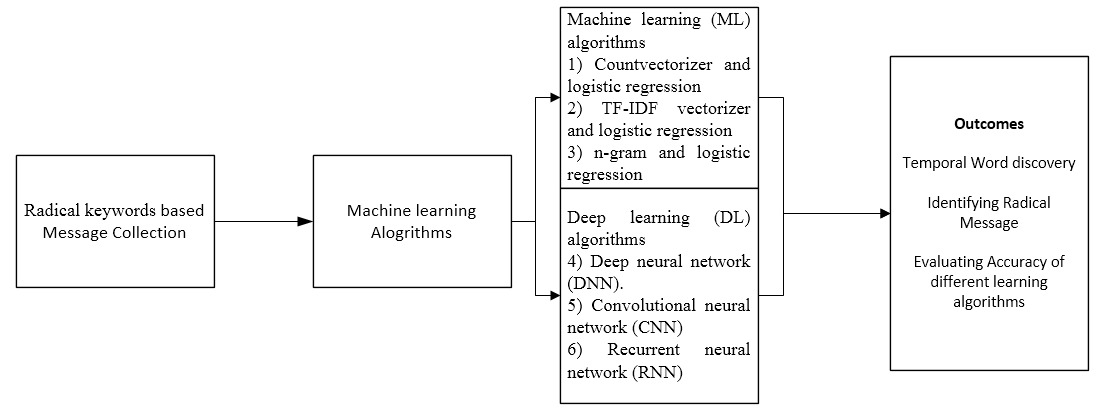
Downloads
References
S Valenzuela S Puente and PM Flores. Comparing disaster news on twitter and television: An intermedia agenda setting perspective. J. Broadcast. Electron. Media 2017; 61, 615-37.
ES Tellez, S Miranda-Jiménez, M Graff, D Moctezuma, OS Siordia and EA Villaseñor. A case study of spanish text transformations for twitter sentiment analysis. Expert Syst. Appl. 2017; 81, 457-71.
M Conway, M Khawaja, S Lakhani, J Reffin, A Robertson and D Weir. Disrupting daesh: Measuring takedown of online terrorist material and its impacts. Stud. Conflict Terrorism 2019; 42, 141-60.
M Ashcroft, A Fisher, L Kaati, E Omer and N. Prucha. Detecting jihadist messages on twitter. In: Proceedings of the 2015 European Intelligence and Security Informatics Conference, Manchester. 2016, p. 161-4.
P Gupta, P Varshney and MPS Bhatia. Identifying radical social media posts using machine learning. GitHub, California, 2017.
G Kalpakis, T Tsikrika, I Gialampoukidis, S Papadopoulos, S Vrochidis and I Kompatsiaris. Analysis of suspended terrorism-related content on social media. In: G Leventakis and M Haberfeld (Eds.). Community-oriented policing and technological innovations. Springer, Cham, 2018, p. 107-18.
S Agarwal and A Sureka. Using knn and svm based one-class classifier for detecting online radicalization on twitter. Vol 8956. In: R Natarajan, G Barua and MR Patra (Eds.). Lecture notes in computer science, Springer, Cham, 2015, p. 431-42.
M Rowe and H Saif. Mining pro-ISIS radicalisation signals from social media users. In: Proceedings of the 10th International AAAI Conference on Web and Social Media. Cologne, Germany. 2016, p. 329-38.
M Nouh, JRC Nurse and M Goldsmith. Understanding the radical mind: Identifying signals to detect extremist content on twitter. In: Proceedings of the 2019 IEEE International Conference on Intelligence and Security Informatics, Shenzhen, China. 2019, p. 98-103.
M Ashcroft, A Fisher, L Kaati, E Omer and N Prucha. Detecting jihadist messages on twitter. In: Proceedings of the 2015 European Intelligence and Security Informatics Conference, Manchester. 2015, p. 161-4.
R Lara-Cabrera, AG Pardo, K Benouaret, N Faci, D Benslimane and D Camacho. Measuring the radicalisation risk in social networks. IEEE Access 2017; 5, 10892-900.
TB Mirani and S Sasi. Sentiment analysis of ISIS related tweets using absolute location. In: Proceedings of the 2016 International Conference on Computational Science and Computational Intelligence, Nevada. 2016, p. 1140-5.
SR Shah, A Kaushik, S Sharma and J Shah. Opinion-mining on marglish and Devanagari comments of youtube cookery channels using parametric and non-parametric learning models. Big Data Cognit. Comput. 2020; 4, 3.
SM Asiful Huda, MM Shoikot, MA Hossain and IJ Ila. An effective machine learning approach for sentiment analysis on popular restaurant reviews in bangladesh. In: Proceedings of the 1st International Conference on Artificial Intelligence and Data Science, Ipoh, Malaysia. 2019, p. 170-3.
SK Lora. A comparative study to detect emotions from tweets analyzing machine learning and deep learning techniques. Int. J. Appl. Inform. Syst. 2020; 12, 6-12.
J Pamina and B Raja. Survey on deep learning algorithms. Int. J. Emerg. Tech. Innovat. Eng. 2019; 5, 38-43.
W Liu, Z Wang, X Liu, N Zeng, Y Liu and FE Alsaadi. A survey of deep neural network architectures and their applications. Neurocomputing 2017; 234, 11-26.
AH Khan and M Zubair. Classification of multi-lingual tweets, into multi-class model using Naïve bayes and semi-supervised learning. Multimed. Tool. Appl. 2020; 79, 32749-67.
S Sperandei. Understanding logistic regression analysis. Biochemia Medica 2014; 24, 12-8.
Downloads
Published
How to Cite
Issue
Section
License

This work is licensed under a Creative Commons Attribution-NonCommercial-NoDerivatives 4.0 International License.





