
An Experimental Study on Corex (Steel) Slag Reinforced with Terrazyme Treated Clay for Improvement of Soft Soil
DOI:
https://doi.org/10.48048/tis.2022.5605Keywords:
Corex slag, Model test, Soft soil, Terrazyme, UCS, Rest on the sandAbstract
Stability and settlement problems are common for foundations constructed on soft soils. In major parts of the world, ground improvement techniques have been used to mitigate these challenges. This research aims to stabilize the soft soils using corex steel slag blended with terrazyme treated clay. The corex steel slag is an industrial waste formed during the extraction of steel from ores through the corex process. The corex slag of sand size in the form of columns have been used to improve the load-carrying capacity of the soft soils and to control the settlement. To increase the stiffness of the corex slag columns, the terrazyme treated clay was mixed with the corex slag. The terrazyme is an eco-friendly and sustainable organic liquid and it is fully soluble in water. To prepare the terrazyme-processed clay gel 0 to 3 % of terrazyme dissolved in water was used. Maximum Dry Density (MDD) and Optimum Moisture Content (OMC) for terrazyme treated clay were determined through the compaction tests. Appropriate proportions of corex slag and terrazyme treated clay with a suitable curing period were obtained from unconfined compression tests. A series of laboratory model plate load tests for 3 foundation shapes were performed on soft soil, stabilized with a blend of corex slag and terrazyme treated clay. Improvement in the MDD with a reduction in OMC was noticed when terrazyme was added to soft soil. Unconfined Compressive Strength (UCS) value for corex slag increased with an increase in the content of terrazyme treated clay. Model plate load tests showed significant improvement in the load-carrying capacity of soft soil.
HIGHLIGHTS
- Stability and settlements are the major problems for foundation constructed on soft soil
- Corex (Steel) slag blended with terrazyme treated clay is utilized to stabilize the soft soil
- The specimens prepared with corex steel slag and terrazyme treated clay demonstrate remarkable improvement in UCS value at 21 to 28 days of curing
- The soft soil stabilize with specimens in group reveled remarkable improvement in load-carrying capacity of soft soil
GRAPHICAL ABSTRACT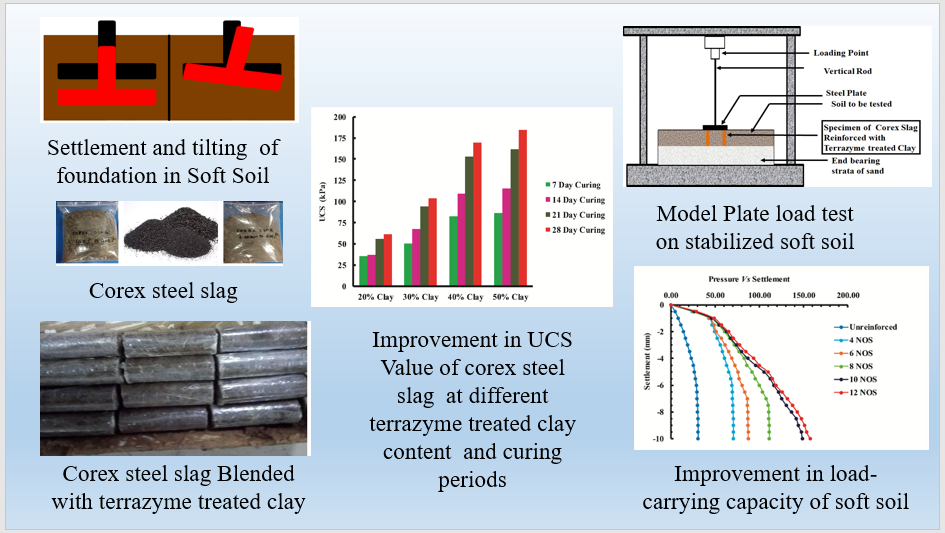
Downloads
References
P Agarwal and S Kaur. Effect of bio-enzyme stabilization on unconfined compressive strength of expansive soil. Int. J. Res. Eng. Technol. 2014; 3, 30-3.
J Sen and JP Singh. Stabilization of black cotton soil using bio- enzyme for a highway material. Int. J. Innov. Res. Sci. Technol. 2015; 4, 12453-9.
MR Taha, TA Khan, IT Jawad and AA Firoozi. Recent experimental studies in soil stabilization with bio-enzymes-a review. Electron. J. Geotech. Eng. 2013; 18, 3881-94.
V Saini and P Vaishnava. Soil stabilization by using terrazyme. Int. J. Adv. Eng. Technol. 2015; 8, 566-73.
S Athira, BK Safana and K Sabu. Soil stabilization using terrazyme for road construction. Int. J. Eng. Res. 2017; 6, 547-9.
GN Eujine, L Somervell, S Chandrakaran and N Sankar. Enzyme stabilization of high liquid limit clay. Electron. J. Geotech. Eng. 2014; 19, 6989-95.
C Venkatasubramanian and G Dhinakaran. Effect of bio-enzymatic soil stabilisation on unconfined compressrve strength and California Bearing Ratio. J. Eng. Appl. Sci. 2011; 6, 295-8.
L Yue-Jun, L Liang and D Han-Cheng. Study on application of TerraZyme in road base course of road. Appl. Mech. Mater. 2011; 97-98, 1098-108.
S Muguda and HB Nagaraj. Effect of enzymes on plasticity and strength characteristics of an earthen construction material. Int. J. Geo-Eng. 2019; 10, 2.
T Suresh, Y Balakrishna and K Nitesh. Improving the properties of black cotton soil using terrazyme as a admixture. Int. J. Eng. Tech. 2017; 3, 96-105.
TA Khan and MR Taha. Effect of three bioenzymes on compaction, consistency limits, and strength characteristics of a sedimentary residual soil. Adv. Mater. Sci. Eng. 2015; 2015, 798965.
M Umar, KA Kassim and KTP Chiet. Biological process of soil improvement in civil engineering: A review. J. Rock Mech. Geotech. Eng. 2016; 8, 767-74.
AG Thomas and BK Rangaswamy. Strength behavior of enzymatic cement treated clay. Int. J. Geotech. Eng. 2019; 21, 259-72.
V Rajoria and S Kaur. A review on stabilization of soil using bio-enzyme. Int. J. Res. Eng. Technol. 2014; 3, 75-8.
MV Sravan and HB Nagaraj. Potential use of enzymes in the preparation of compressed stabilized earth blocks. J. Mater. Civil Eng. 2017; 29, 04017103.
W Frikha, F Tounekti, W Kaffel and M Bouassida. Experimental study for the mechanical characterization of Tunis soft soil reinforced by a group of sand columns. Soils Found. 2015; 55, 181-91.
T George and G Hari. Bearing capacity effect of soft clay with sand compaction piles. Int. J. Sci. Res. 2016; 5, 1132-5.
U Kumar, Y Tandel and CH Solanki. Behavior of geosynthetic encased sand column in soft soil. Int. J. Eng. Res. Technol. 2013; 2, 2545-8.
NK Samadhiya, P Maheshwari, P Basu and M bhushan. Load settlement characteristics of granular piles with randomly mixed fibres. Indian Geotech. J. 2008; 38, 345-54.
AK Nazir and WR Azzam. Improving the bearing capacity of footing on soft clay with sand pile with/without skirts. Alexandria Eng. J. 2010; 49, 371-7.
SV Abhishek, K Rajyalakshmi and MR Madhav. Bearing capacity of strip footing on reinforced foundation bed over soft ground with granular trench. Indian Geotech. J. 2015; 45, 304-17.
S Naseer, MS Faiz, S Iqbal and SM Jamil. Laboratory and numerical based analysis of floating sand columns in clayey soil. Int. J. Geo-Eng. 2019; 10, 10.
VRP Koteswara, H Padavala and H Chennarapu. Experimental and numerical investigation of pile group with and without building frame subjected to axial load. Indian Geotech. J. 2019; 50, 473-84.
Downloads
Published
How to Cite
Issue
Section
License

This work is licensed under a Creative Commons Attribution-NonCommercial-NoDerivatives 4.0 International License.





