
Optimization of A Solar Ejector Refrigeration System in the Region of Adrar, Algeria
DOI:
https://doi.org/10.48048/tis.2022.5604Keywords:
Ejector refrigeration systems, Solar energy, Performance, Simulation, OptimizationAbstract
This study aims to simulate a solar ejector refrigeration system in the region of Adrar (27.82 N, 0.18 W). It is the first investigation of such refrigeration system in this region, the importance of this study is to benefit from the free intense solar energy for cooling and air conditioning and reduce using electrical energy produced by thermal power station which is harmful to the environment and causing warming global. It is a theoretical study using real gas equation (REFPROP database). The system is inspected for various evaporator temperatures from 0 to 30 °C and for various condenser temperatures from 25 to 50 °C. For each situation, the system is optimized by choosing the best ejector parameters and the ideal generator temperature. Different refrigerants are used as R11, R134a and R717 (ammonia). The last one is observed to be the best fluid in all the working conditions. More explicitly, the highest COPs is 0.28 when the system produces refrigeration at 30 °C and the boiler temperature is 90 °C. The COPs values are acceptable and very interesting, and it’s higher than other cities in the world like Athens, this study can be generalized in other hot regions. The examination is performed with a code written in Fortran.
HIGHLIGHTS
- The importance of this study is to benefit from the free intense solar energy for cooling and air conditioning and reduce using electrical energy
- For each situation, the system is optimized by choosing the best ejector parameters and the ideal generator temperature. Different refrigerants are used as R11, R134a and R717 (ammonia). The last one is observed to be the best fluid in all the working conditions
- More explicitly, the highest COPs is 0.28 when the system produces refrigeration at 30 °C and the boiler temperature is 90 °C
- This study can be generalized in other hot regions
GRAPHICAL ABSTRACT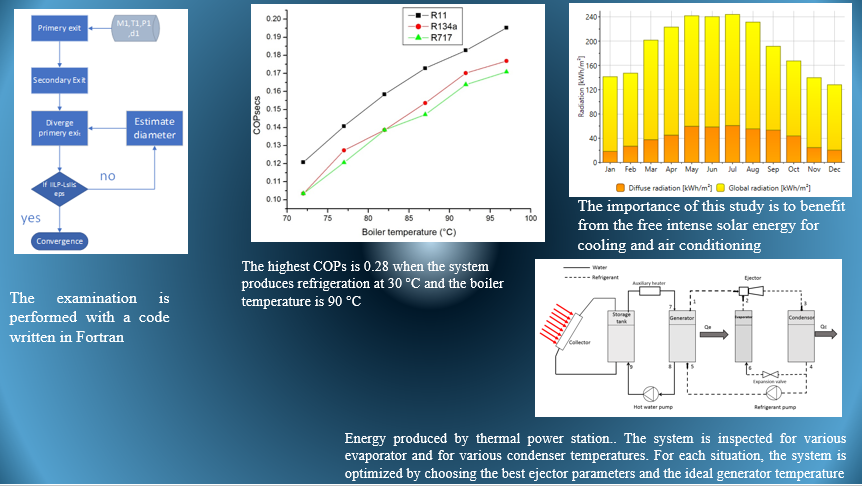
Downloads
References
R Tang, S Wang, K Shan and H Cheung. Optimal control strategy of central air-conditioning systems of buildings at morning start period for enhanced energy efficiency and peak demand limiting. Energy 2018; 151, 771-81.
D Coulomb. Refrigeration Main Challenges. International Institute of Refrigeration, Available at https://energy-learning.com/index.php/opinion/78-what-s-new/108-refrigeration-main-challenges, accessed June 2020.
B Belabes, A Youcefi, O Guerri, M Djamai and A Kaabeche. Evaluation of wind energy potential and estimation of cost using wind energy turbines for electricity generation in north of Algeria. Renew. Sustain. Energ. Rev. 2015; 51, 1245-55.
TG Hovgaard, LFS Larsen, MJ Skovrup and JB Jørgensen. Power consumption in refrigeration systems - modeling for optimization. In: Proceedings of the 2011 International Symposium on Advanced Control of Industrial Processes, Hangzhou, China. 2011, p. 234-9.
N Al-khalidy. Experimental investigation of solar concentrating collectors in a refrigerant ejector refrigeration machine. Int. J. Energ. Res. 1997; 21, 1123-31.
BJ Huang, JM Chang, VA Petrenko and KB Zhuk. A solar ejector cooling system using refrigerant R141b. Sol. Energ. 1998; 64, 223-6.
GK Alexis and EK Karayiannis. A solar ejector cooling system using refrigerant R134a in the Athens area. Renew. Energ. 2005; 30, 1457-69.
E Nehdi, L Kairouani and M Elakhdar. A solar ejector air-conditioning system using environment-friendly working fluids. Int. J. Energ. Res. 2008; 32, 1194-201.
J Guo and HG Shen. Modeling solar-driven ejector refrigeration system offering air conditioning for office buildings. Energ. Build. 2009; 41, 175-81.
S Varga, AC Oliveira and B Diaconu. Analysis of a solar-assisted ejector cooling system for air conditionin. Int. J. Low-Carbon Tech. 2009; 4, 2-8.
AJ Meyer, TM Harms and RT Dobson. Steam jet ejector cooling powered by waste or solar heat. Renew. Energ. 2009; 34, 297-306.
MR Salimpour, A Ahmadzadeh and AT Al-Sammarraie. Comparative investigation on the exergoeconomic analysis of solar-driven ejector refrigeration systems. Int. J. Refrigerat. 2019; 99, 80-93.
M Ouzzane and Z Aidoun. Model development and numerical procedure for detailed ejector analysis and design. Appl. Therm. Eng. 2003; 23, 2337-51.
VO Petrenko and OS Volovyk. Theoretical study and design of a low-grade heat-driven pilot ejector refrigeration machine operating with butane and isobutane and intended for cooling of gas transported in a gas-main pipeline. Int. J. Refrigerat. 2011; 34, 1699-706.
R Dorantes, 1992. Performances theoriques et experimentales d’une machine frigorifique tritherme a ejecto-compression: Influence de la nature du fluide de travail: Analyses energetique et exergetique. Ph. D. Dissertation. The Institut National des Sciences Appliquées de Lyon, Villeurbanne, France.
BJ Huang, VA Petrenko, IYA Samofatov and NA Shchetinina. Collector selection for solar ejector cooling system. Solar Energ. 2001, 71, 269-74.
M Capderou. Atlas Solaire de l’Algérie, modèles théoriques et expérimentaux. Office des Publications Universitaires, Ben Aknoun, Algeria. 1987.
NIBK Bouchouicha and M Bellaoui. Cartography of Global solar radiation over Adrar. In: Proceedings of the International Conference of the Green Energy Environ. 2010, p. 1-6.
A Fiksel, JW Thornton, SA Klein and WA Beckman. Developments to the TRNSYS simulation program. J. Sol. Energ. Eng. 1995; 117, 123-7.
Downloads
Published
How to Cite
Issue
Section
License

This work is licensed under a Creative Commons Attribution-NonCommercial-NoDerivatives 4.0 International License.





