
Testing the Concept of Mitigating Urban Flooding with Permeable Road: Case Study of Tong Wei Tah Street, Kuching City, Sarawak, Malaysia
DOI:
https://doi.org/10.48048/tis.2022.5592Keywords:
Drain, Flash flood, Permeable road, River, Stormwater detention, Urban runoffAbstract
This paper describes the investigation of permeable road as a mitigation measure for urban flooding. The study involves the reconstruction of a historical case of inundation, namely the 11 December 2019 flood event along the Tong Wei Tah Street in Greater Kuching City, Sarawak, Malaysia. The Storm Water Management Model version 5.0 was used as the platform to describe the flooding at the selected site and the functionality of permeable road to alleviate flooding. A permeable road with a dimension of 200 m long, 6 m wide and 1 m deep was simulated along the whole stretch of Tong Wei Tah Street. The model results show that flooding was caused by a backwater effect in the drainage system. Models predicted 0.1 to 0.5 m flood depths which matched the observed 0.3 m flood depth account of a local resident. The permeable road exhibited capability to absorb all the out-of-drain floodwaters, leaving no water due to the 11 December 2019 flood on the street. Modelling efforts demonstrated that the floodwater hydrographs in the drain rose and fell within 7 h, while the underground storage, filled and drained within 13 h. Moreover, the storage of permeable road was found to fill up to 75 %, reserving the unfilled 25 % for adverse weathers.
HIGHLIGHTS
- It was demonstrated in the case study of Tong Wei Tah Street that waterproof tarred road could be changed to permeable road that consists of permeable pavement layer and underground storage as urban flood mitigation strategy
- Through modelling efforts of a flooding event along Tong Wei Tah Street and its associated drainage systems, any spill of running water from the urban drains could be directed to the permeable road for temporary storage and conveyance
- It was found that floodwater on the road could be adsorbed by the permeable road structure itself, and as such, lessening the hydraulic burden of urban drains
GRAPHICAL ABSTRACT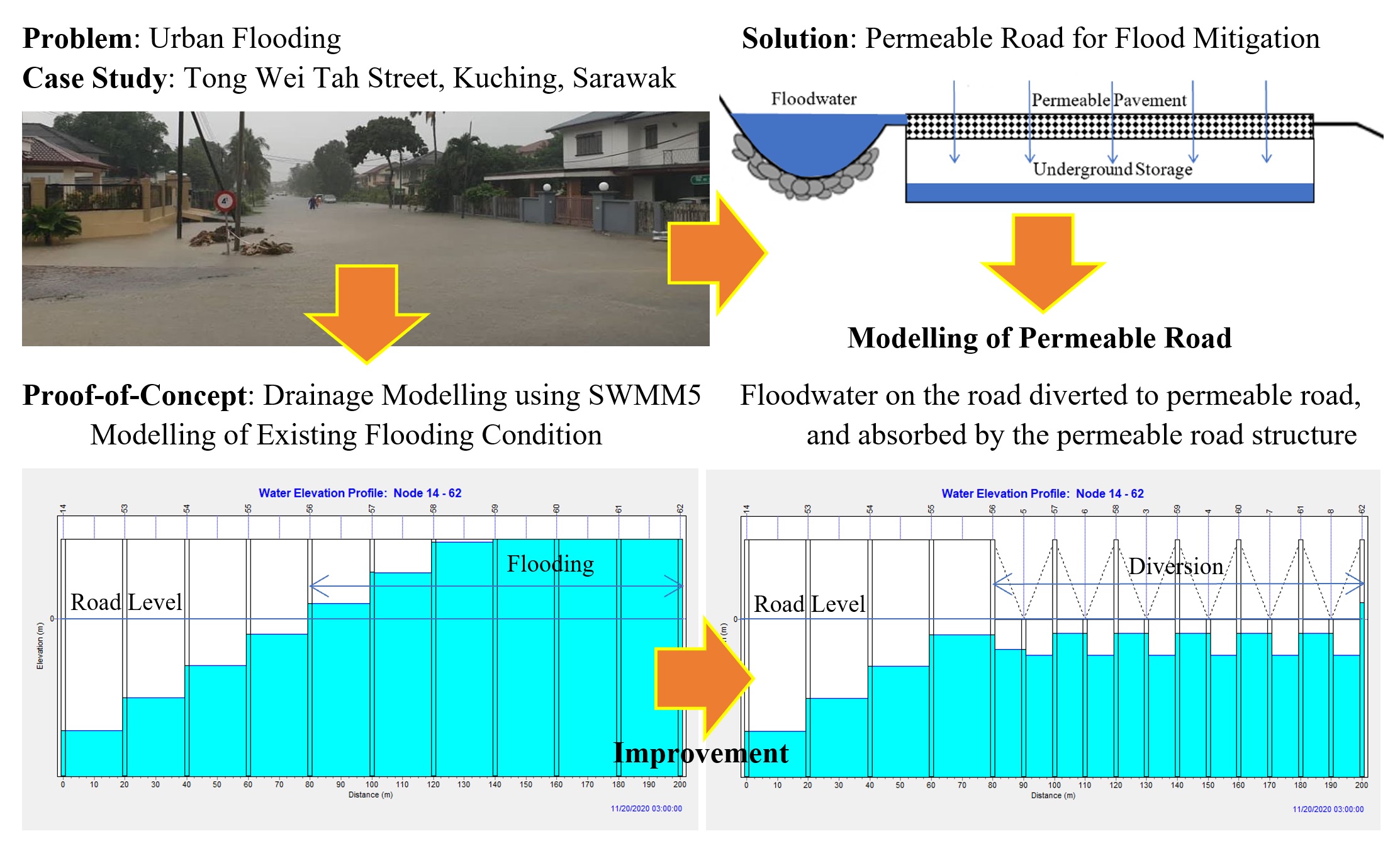
Downloads
References
M Hu, X Zhang, Y Li, H Yang and K Tanaka. Flood mitigation performance of low impact development technologies under different storms for retrofitting an urbanized area. J. Clean. Prod. 2019; 222, 373-80.
D Satria, SM Jalil and R Munadi. Implementation of communication systems based on global system for mobile communications in flood monitoring application with web-based geospatial information. Int. J. Emerg. Trends Eng. Res. 2020; 8, 510-4.
A Awad, FA Bajari and FA Adday. A case study on rainwater harvesting and reuse in Jordan. Int. J. Emerg. Trends Eng. Res. 2019; 7, 398-402.
X Guo, J Zhang, B Zhou, W Liu, J Pei and Y Guan. Sponge roads: The permeable asphalt pavement structures based on rainfall characteristics in central plains urban agglomeration of China. Water Sci. Technol. 2019; 80, 1740-50.
L Hou, Y Wang, F Shen, M Lei, X Wang, X Zhao, S Gao and A Alhaj. Study on variation of surface runoff and soil moisture content in the subgrade of permeable pavement structure. Adv. Civil Eng. 2020; 2020, 8836643.
AS Alon, JN Mindoro, CD Casuat, MAF Malbog and JAB Susa. An inference approach of flood level detection and alert system: Flood-induced simulated environment. Int. J. Adv. Trends Comput. Sci. Eng. 2020; 9, 2259-64.
DYS Mah, RA Bustami, FJ Putuhena and MA Dianty. Testing the concept of mitigating overflowing urban drain with permeable road. Int. J. Adv. Trends Comput. Sci. Eng. 2020; 9, 7878-82.
N Bateni, SH Lai, FJ Putuhena, DYS Mah, MA Mannan and RJ Chin. Hydrological performances on the modified permeable pavement with precast hollow cylinder micro detention pond structure. KSCE J. Civil Eng. 2019; 23, 3951-60.
TT Nguyen, HH Ngo, W Guo, XC Wang, N Ren, G Li, J Ding and H Liang. Implementation of a specific urban water management - sponge city. Sci. Total Environ. 2019; 652, 147-62.
J Liu, H Li, Y Wang and H Zhang. Integrated life cycle assessment of permeable pavement: Model development and case study. Transp. Res. Part D: Transp. Environ. 2020; 85, 102381.
SB MacLean, A Vytiniotis and DW Sykora. Laboratory testing and engineering analysis of an underground stormwater detention system. In: Proceedings of the Geo-Congress 2020, Minneapolis, Minnesota. 2020, p. 60-9.
Department of Irrigation and Drainage Sarawak. iHYDRO - online rainfall and water level data, official website of Department of Irrigation and Drainage Sarawak, Available at: http://ihydro. sarawak.gov.my, accessed December 2019.
Y Bai, N Zhao, R Zhang and X Zeng. Storm water management of low impact development in urban areas based on SWMM. Water 2019; 11, 33.
DYS Mah, JOK Ngu, PD Caroline and MA Malek. Catchment size to effective tank volume relationships for individual lot stormwater detention system in Malaysian detached house. Int. J. Adv. Trends Comput. Sci. Eng. 2020; 9, 8358-63.
JM Sadler, JL Goodall, M Behl, MM Morsy, TB Culver and BD Bowes. Leveraging open source software and parallel computing for model predictive control of urban drainage systems using EPA-SWMM5. Environ. Model. Softw. 2019; 120, 104484.
DYS Mah, JOK Ngu, SNL Taib and MA Mannan. Modelling of compartmentalized household stormwater detention system using SWMM5. Int. J. Emerg. Trends Eng. Res. 2020; 8, 344-9.
CV Liow, DYS Mah and MRRBMA Zainol. Modelling of StormPav green pavement: Inlet and outlet of integrated permeable road and stormwater detention system. Int. J. Civil Eng. Technol. 2019; 10, 966-76.
DYS Mah, JOK Ngu, RA Bustami and FJ Putuhena. Case study of modular pre-cast concrete on-site stormwater detention system during monsson season in Southeast Asia. Appl. Environ. Res. 2021; 43, 28-40.

Downloads
Published
How to Cite
Issue
Section
License

This work is licensed under a Creative Commons Attribution-NonCommercial-NoDerivatives 4.0 International License.





