
Comparison of Modifiers for Coal Gangue Biochar Modification to Improve the Absorption of Heavy Metals from Aqueous Solution
DOI:
https://doi.org/10.48048/tis.2023.5447Keywords:
Gangue coal modification, Pb, Cd, and Cu metals removal competitive, Physicochemical adsorbent properties investigation and competitionAbstract
In this paper, gangue Coal biochar GCC was developed to absorb heavy metals from an aqueous solution. There is currently insufficient information on the identification of the best biochar modifiers for the purpose of removing heavy metals as well as changes in physicochemical and morphological compositions after modification. For this purpose, after physical treatment GCC ware modified with 5 different offending chemical methods (GCCacidic), (GCCalkaline), (GCCoxidic), (GCCMnOx), and (GCCFeOx). Physical and chemical changes in Both modified and unmodified GCC properties were investigated by using (XRF), (FT-IR), (XRD), (SEM-EDX), and (BET) assortment. Adsorption tests of 3 heavy metals (Cu, Pb, and Cd) ions under different conditions, ion concentration, pH, Adsorbent dosage, and contact time were investigated in batch experiments. Improved post-modification GCC properties, especially (GCCalkaline) and (GCCMnOx) Significant changes in its surface area as well as functional groups (hydroxyl group, and Manganese oxide group). To will know adsorption capacity of every modified GCC, experimental data were placed in Langmuir and Freundlich’s isotherms models. The GCC process follows pseudo-second-order and pseudo-first-order kinetic curves with linear regression. GCC modified with Manganese oxide shows it has the best adsorbent for adsorption of Pb and GCC modified with alkaline is the best adsorbent for adsorption of Cd and Cu metals. For adsorption of mixed metals solution (Pb, Cd, and Cu) GCCMnOx was more suitable than other GCC and modified GCCs biochars. The results show that GCC modified with an acidic component is the worst attraction for removing heavy metals from an aqueous solution.
HIGHLIGHTS
- Coal gangue modified with 5 deferent chemical methods Acidic, alkaline, oxidic, MnOx, and FeOx
- Physicochemical Properties and heavy metals removals Competition of adsorbent
- Coal gangue modified with MnOx and alkaline improves their functions group, surface area and better for heavy metals removal, and the worst was modified Coal gangue with Acidic
GRAPHICAL ABSTRACT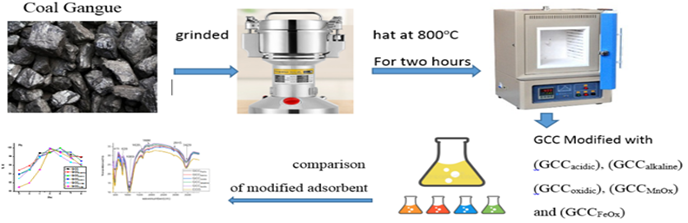
Downloads
References
ME Mahmoud, GM Nabil, MM Zaki and MM Saleh. Starch functionalization of iron oxide by product from steel industry as a sustainable low cost nanocomposite for removal of divalent toxic metal ions from water. Int. J. Biol. Macromol. 2019; 137, 455-68.
WW Tang, GM Zeng, JL Gong, J Liang, P Xu, C Zhang and BB Huang. Impact of humic/fulvic acid on the removal of heavy metal ls from aqueous solutions using nanomaterials: A review. Sci. Total Environ. 2014; 468, 1014-27.
AE karkouri, K Harboul, H Arroud and ME Hassouni. Hexavalent chromium removal from a tannery effluent by a bacterial consortium. Moroccan J. Chem. 2019; 7, 615-23.
AB Duwiejuah, SJ Cobbina and N Bakobie. Review of eco-friendly biochar used in the removal of trace metals on aqueous phases. Int. J. Environ. Bioremediation Biodegradation 2017; 5, 27-40.
M Hamed, IM Ahmed and SS Metwally. Adsorptive removal of methylene blue as organic pollutant by marble dust as eco-friendly sorbent. J. Ind. Eng. Chem. 2014; 20, 2370-7.
J Yan, G Lan, H Qiu, C Chen, Y Liu, G Du and J Zhang. Adsorption of heavy metals and methylene blue from aqueous solution with citric acid modified peach stone. Separ. Sci. Tech. 2018; 53, 1678-88.
I Anastopoulos and GZ Kyzas. Composts as biosorbents for decontamination of various pollutants: A review. Water Air Soil Pollut. 2015; 226, 61.
AE Burakov, EV Galunin, IV Burakova, AE Kucherova, S Agarwal, AG Tkachev and VK Gupta. Adsorption of heavy metals on conventional and nanostructured materials for wastewater treat- ment purposes: A review. Ecotoxicol. Environ. Saf. 2018; 148, 702-12.
WW Ngah, LC Teong and MM Hanafiah. Adsorption of dyes and heavy metal ions by chitosan composites: A review. Carbohydr. Polymer. 2011; 83, 1446-56.
J Ma, X Wang, Q Fu, Y Si, J Yu and B Ding. Highly carbonylated cellulose nanofibrous membranes utilizing maleic anhydride grafting for efficient lysozyme adsorption. ACS Appl. Mater. Interfac. 2015; 7, 15658-66.
BJ Ni, QS Huang, C Wang, TY Ni, J Sun and W Wei. Competitive adsorption of heavy metals in aqueous solution onto biochar derived from anaerobically digested sludge. Chemosphere 2019; 219, 351-7.
S Li, S Harris, A Anandhi and G Chen. Predicting biochar properties and functions based on feedstock and pyrolysis temperature: A review and data syntheses. J. Cleaner Prod. 2019; 215, 890-902.
B Ahmed, JL Zhou, HH Ngo, W Guo and M Chen. Progress in the preparation and application of modified biochar for improved contaminant removal from water and wastewater. Bioresource Tech. 2016; 214, 836-51.
H Li, X Dong, EBD Silva, LMD Oliveira, Y Chen and LQ Ma. Mechanisms of metal sorption by biochars: Biochar characteristics and modifications. Chemosphere 2017; 178, 466-78.
I Inyang, B Gao, Y Yao, Y Xue, A Zimmerman, A Mosa, P Pullammanappallil, YS Ok and X Cao. A review of biochar as a low-cost adsorbent for aqueous heavy metal removal. Crit. Rev. Environ. Sci. Tech. 2016; 46, 406-33.
J Wu, T Wang, J Wang, Y Zhang and WP Pan. A novel modified method for the efficient removal of Pb and Cd from wastewater by biochar: Enhanced the ion exchange and precipitation capacity. Sci. Total Environ. 2021; 754, 142150.
T Chen, Y Zhang, H Wang, W Lu, Z Zhou, Y Zhang and L Ren. Influence of pyrolysis temperature on characteristics and heavy metal adsorptive performance of biochar derived from municipal sewage sludge. Bioresource Tech. 2014; 164, 47-54.
H Wu, Q Feng, H Yang, E Alam, B Gao and D Gu. Modified biochar supported Ag/Fe nanoparticles used for removal of cephalexin in solution: Characterization, kinetics and mechanisms. Colloid. Surface. Physicochem. Eng. Aspect. 2017; 517, 63-71.
T Sizmur, T Fresno, G Akgül, H Frost and E Moreno-Jiménez. Biochar modification to enhance sorption of inorganics from water. Bioresource Tech. 2017; 246, 34-47.
H Lu, W Zhang, Y Yang, X Huang, S Wang and R Qiu. Relative distribution of Pb2+ sorption mechanisms by sludge-derived biochar. Water Res. 2012; 46, 854-62.
A Sari, M Tuzen, OD Uluözlü and M Soylak. Biosorption of Pb (II) and Ni (II) fromaqueous solution by lichen (Cladonia furcata) biomass. Biochem. Eng. J. 2007; 37, 151-8.
LG Boutsika, HK Karapanagioti and ID Manariotis. Aqueous mercury sorption by biochar from malt spent rootlets. Water Air Soil Pollut. 2014; 225, 1805.

Downloads
Published
How to Cite
Issue
Section
License
Copyright (c) 2022 Walailak University

This work is licensed under a Creative Commons Attribution-NonCommercial-NoDerivatives 4.0 International License.





