
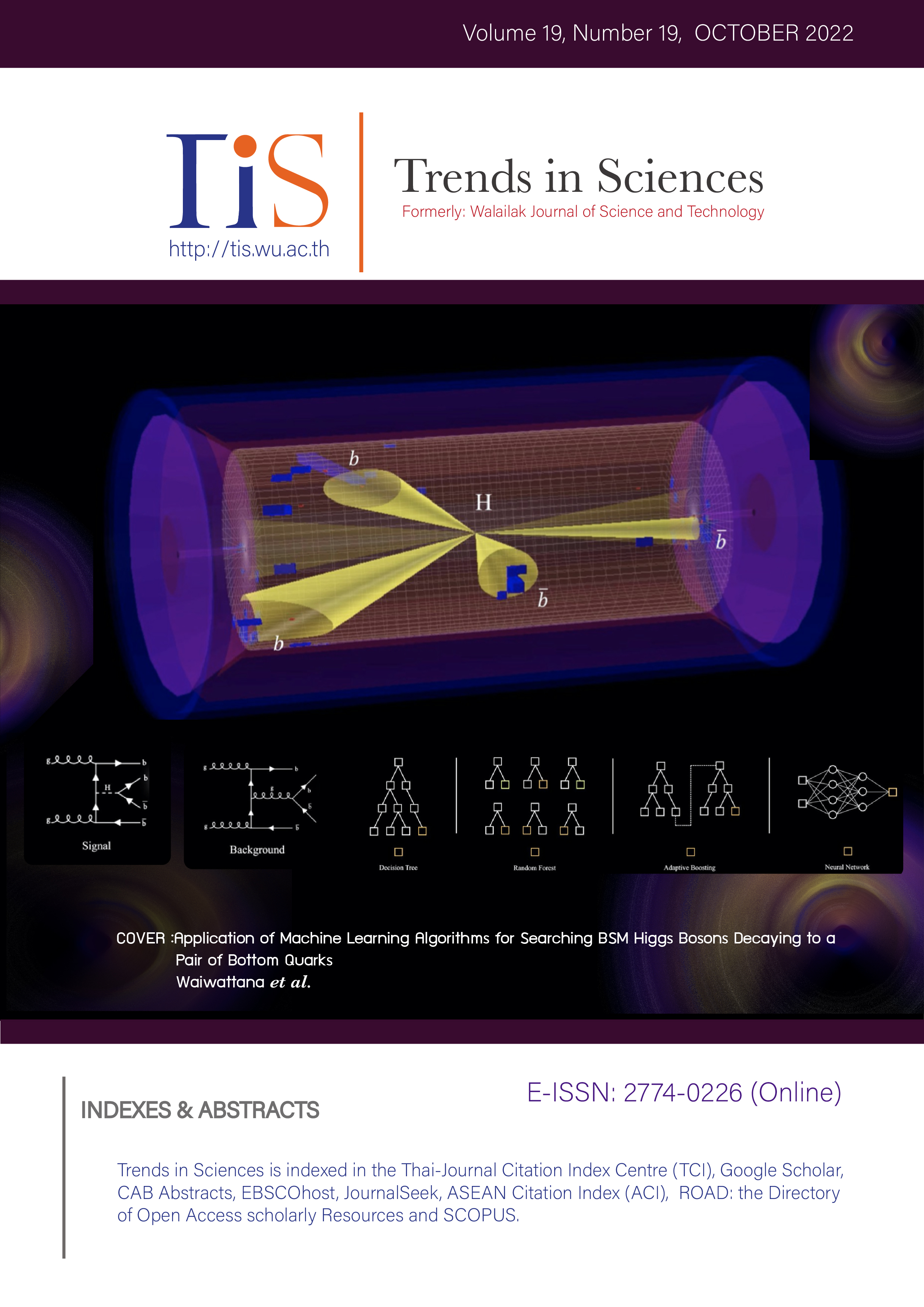
Application of Machine Learning Algorithms for Searching BSM Higgs Bosons Decaying to a Pair of Bottom Quarks
DOI:
https://doi.org/10.48048/tis.2022.5373Keywords:
Beyond the Standard Model, Higgs bosons, Compact Muon Solenoid, Neural Networks, Decision Tree, Random Forest, Adaptive BoostingAbstract
Although the discovery of the 125 GeV Higgs boson confirms the Higgs mechanism of the Standard Model (SM), many theories beyond the SM have been introduced to address several phenomena yet to be explained by the SM. For instance, the 2-Higgs Doublet Models is the simplest extension of the SM Higgs sector and predicting the existence of additional Higgs bosons at different states. The aim of this study is to search for machine learning (ML) algorithms which have been widely used in High Energy Physics. This will improve the sensitivity of the search for BSM Higgs bosons produced in association with a bottom quark () that then decays into a pair of bottom quarks (); the predominant decay channel of the Higgs boson, though, buried by a large multi-jet background process. In this study, we train 2 different ML algorithms: Tree-based models and Neural Networks, to classify signal and background events collected by the Compact Muon Solenoid detector from proton-proton collisions at 13 TeV. The evaluation metrics are calculated to provide classification efficiencies from different models. The results show that the classification of signal and background processes can be improved using ML techniques. Neural Networks reported the highest AUC score of 0.951 which is comparable with Adaptive Boosting model, while Decision Trees (DTs) and Random Forest models slightly underperformed by 2 - 3 %. We therefore can make use of the trained models as signal vs background classifiers to perform further statistical analysis searches for BSM Higgs bosons.
GRAPHICAL ABSTRACT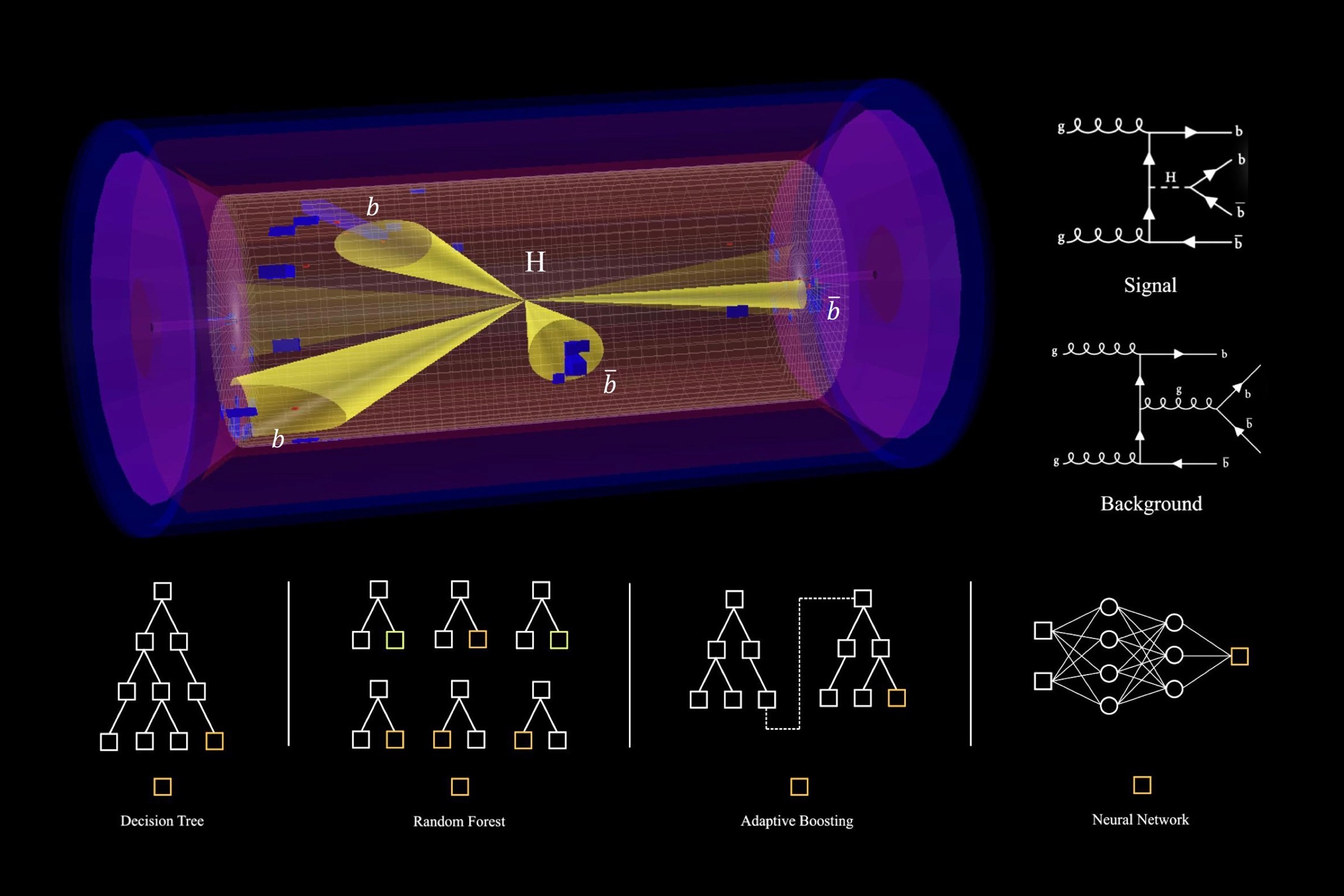
Downloads
References
ATLAS Collaboration. Observation of a new particle in the search for the Standard Model Higgs boson with the ATLAS detector at the LHC. Phys. Lett. B 2012; 716, 1-29.
CMS Collaboration. Observation of a New Boson at a mass of 125 GeV with the CMS experiment at the LHC. Phys. Lett. B 2012; 716, 30-61.
ATLAS and CMS Collaborations. Combined measurement of the Higgs boson mass in pp collisions at √s = 7 and 8 TeV with the ATLAS and CMS experiments. Phys. Rev. Lett. 2015; 114, 191803.
ATLAS Collaboration. Measurements of the Higgs boson production and decay rates and coupling strengths using pp collision data at √s = 7 and 8 TeV in the ATLAS experiment. Eur. Phys. J. C 2016; 76, 6.
CMS Collaboration. Study of the mass and spin-parity of the Higgs boson candidate via its decays to Z boson pairs. Phys. Rev. Lett. 2013; 110, 081803.
H Yukawa. On the interaction of elementary particles. Proc. Phys. Math. Soc. Jpn. 1935; 17, 48-57.
ATLAS and CMS Collaborations. Measurements of the Higgs boson production and decay rates and constraints on its couplings from a combined ATLAS and CMS analysis of the LHC pp collision data at √s = 7 and 8 TeV. J. High Energy Phys. 2016; 2016, 45.
ATLAS Collaboration. Observation of H→bb ̅ decays and VH production with the ATLAS detector. Phys. Lett. B 2018; 786, 59-86.
CMS Collaboration. Observation of Higgs boson decay to bottom quarks. Phys. Rev. Lett. 2018; 121, 121801.
CMS Collaboration. Search for invisible decays of the Higgs boson produced via vector boson fusion in proton-proton collisions at √s = 13 TeV. Phys. Rev. D 2022; 105, 092007.
A Djuadi. The anatomy of electro-weak symmetry breaking. Tome II: The Higgs bosons in the Minimal Supersymmetric Model. Phys. Rep. 2008; 459, 1-241.
GC Branco, PM Ferreira, L Lavoura, MN Rebelo, M Sher and JP Silva. Theory and phenomenology of two-Higgs-doublet models. Phys. Rep. 2011; 516, 1-102.
CMS Collaboration. Search for a Higgs boson decaying into a b-quark pair and produced in association with b quarks in proton-proton collisions at 7 TeV. Phys. Lett. B 2013; 722, 207-32.
CMS Collaboration. Search for neutral MSSM Higgs bosons decaying into a pair of bottom quarks. J. High Energy Phys. 2015; 2015, 71.
CMS Collaboration. Search for beyond the standard model Higgs bosons decaying into a 𝑏b ̅ pair in pp collisions at √s = 13 TeV. J. High Energy Phys. 2018; 2018, 113.
ATLAS Collaboration. Search for heavy neutral Higgs bosons produced in association with b-quarks and decaying to b-quarks at √s = 13 TeV with the ATLAS detector. Phys. Rev. D 2020; 102, 032004.
CMS Collaboration. Search for Higgs boson decay to a charm quark-antiquark pair in proton-proton collisions at √s = 13 TeV. Phys. Rev. Lett. 2022. DOI: 10.48550/arXiv.2205.05550.
P Baldi, P Sadowski and D Whiteson. Searching for exotic particles in high-energy physics with deep learning. Nat. Commun. 2014; 5, 4308.
J Alwall, R Frederix, S Frixione, V Hirschi, F Maltoni, O Mattelaer, HS Shao, T Stelzer, P Torrielli and M Zaro. The automated computation of tree-level and next-to-leading order differential cross sections, and their matching to parton shower simulations. J. High Energy Phys. 2014; 2014, 79.
T Sjöstrand, S Ask, JR Christiansen, R Corke, N Desai, P Ilten, S Mrenna, S Prestel, CO Rasmussen and PZ Skands. An introduction to PYTHIA 8.2. Comput. Phys. Commun. 2015; 191, 159-77.
JD Favereau, C Delaere, P Demin, A Giammanco, V Lemaître, A Mertens and M Selvaggi. DELPHES 3: A modular framework for fast simulation of a generic collider experiment. J. High Energy Phys. 2014; 2014, 57.
DE Hinkle, W Wiersma and SG Jurs. Applied statistics for the behavioral sciences. Rand McNally College Publishing, Chicago, Illinois, 1998.
F Pedregosa, G Varoquaux, A Gramfort and V Michel, B Thirion, O Grisel, M Blondel, P Prettenhofer, R Weiss, V Dubourg, J Vanderplas, A Passos and D Coutnapeau. Scikit-learn: Machine learning in python. J. Mach. Learn. Res. 2011; 12, 2825-30.
F Chollet and others. Keras. Available at: https://keras.io, accessed 2015.
J Waiwattana, P Saksirimontri, N Pitakkultorn, C Asawatangtrakuldee, V Wachirapusitanand and J Puntree. Search for BSM Higgs bosons with machine learning techniques. In: Proceedings of the Siam Physics Congress 2022, Nakhon Ratchasima, Thailand, 2022.
Downloads
Published
How to Cite
Issue
Section
License
Copyright (c) 2022 Walailak University

This work is licensed under a Creative Commons Attribution-NonCommercial-NoDerivatives 4.0 International License.





