
Powder Qualities of Foam-Mat Dried Mango
DOI:
https://doi.org/10.48048/tis.2023.5308Keywords:
Foam-mat dried mango, Foaming agent, Drying technology, Mango powderAbstract
The objectives of this study are to demonstrate powder qualities of foam-mat dried mango using different foaming agents and then compare mango powder qualities of foam-mat drying method to that of the studies in other drying methods. Fresh puree of Mahajanaka mango (Mangifera indica L.) grown in the north of Thailand is mixed with glyceryl monostearate (GMS), sugar and soybean isolated (SBI) in different ratios as foaming agents, after that is dried at 70 °C in a tray dryer for 5 h. The color and % foam overrun revealed that GMS with sugar treatments contribute a decent quality more than that with SBI. Therefore, powder qualities of foam-mat dried mango using GMS with sugar are analyzed. Different ratios of GMS and sugar are not affected by their moisture content, solubility, and hygroscopicity values. The best powder quality is found when added 1 % GMS with 5 % sugar during storage at 90 %RH, and 38 ± 2 °C. Comparing the foam-mat dried mango qualities to other drying methods. It was found that foam-mat dried mango indicated a similarity appearance and moisture to spray dried and freeze-dried mango. The disadvantage of foam-mat drying method is a lowest solubility and hygroscopicity, but the more advantage of this method could be a low operation and maintenance cost. Therefore, good qualities of foam-mat dried mango powder with a cost-effective production would be a commercial potential for small-medium enterprise or community enterprise utilization.
HIGHLIGHTS
- Mango powder qualities produced by a foam-mat drying as good as that 1 manufacturing using freeze drying and spray drying
- Foam-mat drying technology is a cost-effective production proper for a small-medium community enterprise especially in Thailand
- Foam-mat mango powder can apply for ingredients in a food manufacturing such as bakery, ice-cream, instant drinking and so on. This could be created mango usage diversity
GRAPHICAL ABSTRACT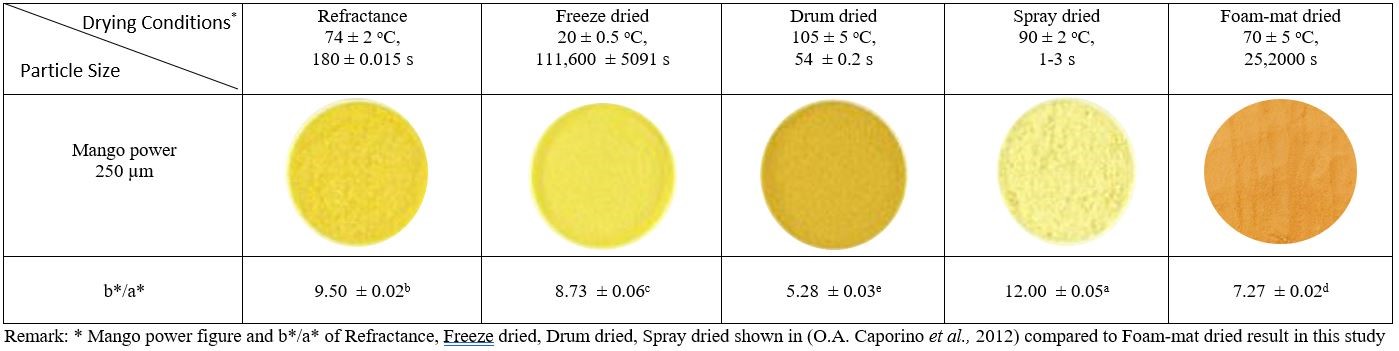
Downloads
References
M Shahbandeh, Global mango production 2000-2020, Available at: https://www.statista.com/statistics/577951/world-mango-production, accessed March 2022.
RA Wilson, DM Kadam, S Chadha, MK Grewal and M Sharma. Evaluation of physical and chemical properties of foam-mat dried mango (Mangifera Indica) powder during storage. J. Food Process. Preservation 2014; 38, 1866-74.
N Chomchalow and PN Songkhla. Thai mango export: A slow-but-sustainable development. AU J. Tech. 12; 1, 1-8.
OA Caparino, J Tang, CI Nindo, SS Sablani, JR Powers and JK Fellman. Effect of drying methods on the physical properties and microstructures of mango (Philippine ‘Carabao’ var.) powder. J. Food Eng. 2012; 111, 135-48.
W Thepyotin, N Chammuseab and M Keawfo. Effect of foaming agents on the quality of Mahajanaka mango by foam-mat drying. In: Proceedings of The 5th Rajamangala University of Technology National Conference, Pathum Thani, Thailand, 2015, p. 308-18.
IP Tonin, CC Ferrai, GD Silva, MLD Oliveira, MI Berto, VMD Silva and SPM Germer. Performance of different process additives on the properties of mango powder obtained by drum drying. Drying Tech. 2018; 36, 355-65.
T McHugh. The significance of spray-drying, Available at: http://www.ift.org/news-and- publications/food -technology- magazine/issues/2018/april/columns/processing-spray-drying-in the-food- industry, accessed March 2022.
CI Nido and J Tang. Refractance window dehydration technology: A novel contact drying method. Drying Tech. 2017; 25, 37-48.
CH Chang, HY Lin, CY Chang and YC Liu. Comparisons on the antioxidant properties of fresh, freeze-dried, and hot-air-dried tomatoes. J. Food Eng. 2006; 77, 478-85.
A Sangamithra, V Sivakumar, GJ Swamy and K Kannan. Foam mat drying of food materials: A
review. J. Food Process. Preservation 2015; 39, 3165-74.
IM Javed, A Aleem, R Hamad, NM Furgan and R Ammad. A review paper on foam-mat drying of fruits and vegetables to develop powders. MOJ Food Process. Tech. 2018; 6 (6), 465-7.
S Saentaweesuk. A production of Indian gooseberry instant powder by Foam-mat drying. Suan Sunandha Rajabhat University, Bangkok, Thailand, 2555.
Z Inzadi, M Mohebbi, F Shahidi, M Varidi and MR Salahi. Cheese powder production and characterization: A foam-mat drying approach. Food Bioproducts Process. 2020; 123, 225-37.
S Jaya and H Das. Accelerated storage, shelf life and color of mango powder. J. Food Process. Preservation 2005; 29, 45-62.
S Jaya and H Das. Effect of maltodextrin, glycerol monostearate and tricalcium phosphate on vacuum dried mango powder properties. J. Food Eng. 2004; 63, 125-34.
NK Mahanti, SK Chakraborty, A Sudhakar, DK Verma, S Shankar, M Thakur, S Smita, T Soubhagya, AK Gupta and PP Srivastav. Refractance WindowTM-Drying vs. other drying methods and effect of different process parameters on quality of foods: A comprehensive review of trends and technological developments. Future Foods 2021; 3, 100024.
Mango market is projected to grow with magnificent CAGR, Available at: https://www.rivercountry.newschannelnebraska.com, accessed August 2022.
Vantage market research. Available at: https://www.globalnewswire.com, accessed August 2022.
Future market insights. Available at: http://www.futuremarketinsights.com, accessed August 2022.

Downloads
Published
How to Cite
Issue
Section
License
Copyright (c) 2022 Walailak University

This work is licensed under a Creative Commons Attribution-NonCommercial-NoDerivatives 4.0 International License.





