
Antimicrobial and Radical Scavenging Activitıes of Essential Oils from Kaempferia larsenii Sirirugsa
DOI:
https://doi.org/10.48048/tis.2023.5212Keywords:
ABTS radical scavenging activity, Antimicrobial activity, DPPH radical scavenging activity, essential oil, Hydroxyl radical scavenging activity, Kaempferia larsenii, Radical scavenging activity, ZingiberaceaeAbstract
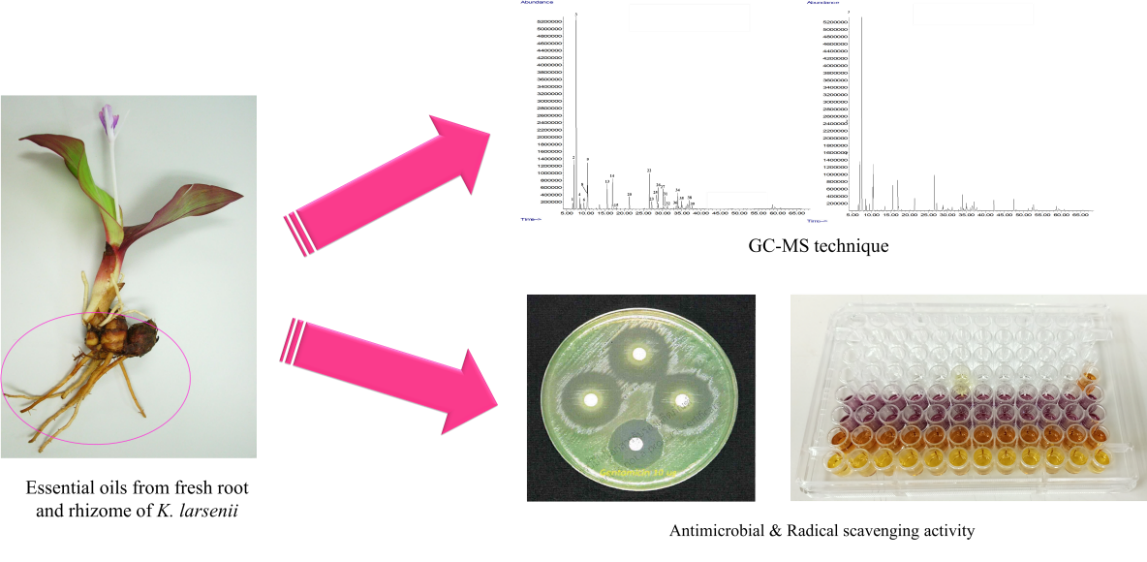
Introduction: K. larsenii (Zingiberaceae) is an endemic and rare species in Thailand. There have been no previous reports on chemical compositions and biological properties of essential oils from the fresh root and rhizome. This research aims to investigate the chemical compositions, antimicrobial and radical scavenging activities of essential oils from the fresh root and rhizome of K. larsenii. Materials and methods: The chemical compositions of hydrodistilled essential oils were analysed by GC-MS technique. The antimicrobial activity was tested by the disc diffusion assay. The Minimum inhibitory concentration (MIC) and minimum bactericidal concentration (MBC) values were also evaluated. The radical scavenging activities were evaluated using ABTS, DPPH and hydroxyl radical scavenging activity assay. Results and discussion: Camphene was considered as the main component in root and rhizome essential oils (36.35 and 48.00 %, respectively). The essential oils showed strong antimicrobial activity against S. aureus. The rhizome essential oil showed strong DPPH and hydroxyl radical scavenging activities while the root essential oil exhibited strong hydroxyl radical scavenging capacity. Conclusions: The essential oils exhibit strong antimicrobial especially Gram-positive bacteria and antioxidant activity. Therefore, it might be used as a potential source of natural antidiarrheal and antioxidant substances for food and cosmeceutical product industries.
HIGHLIGHTS
- The essential oils were obtained from hydrodistillation of the fresh root and rhizome of K. larsenii
- Camphene was the major component in both root and rhizome essential oils
- The root and rhizome essential oils showed strong antimicrobial on Gram-positive bacteria and radical scavenging activities
- This is the first report on the biological activities of the fresh root and rhizome essential oils of larsenii
GRAPHICAL ABSTRACT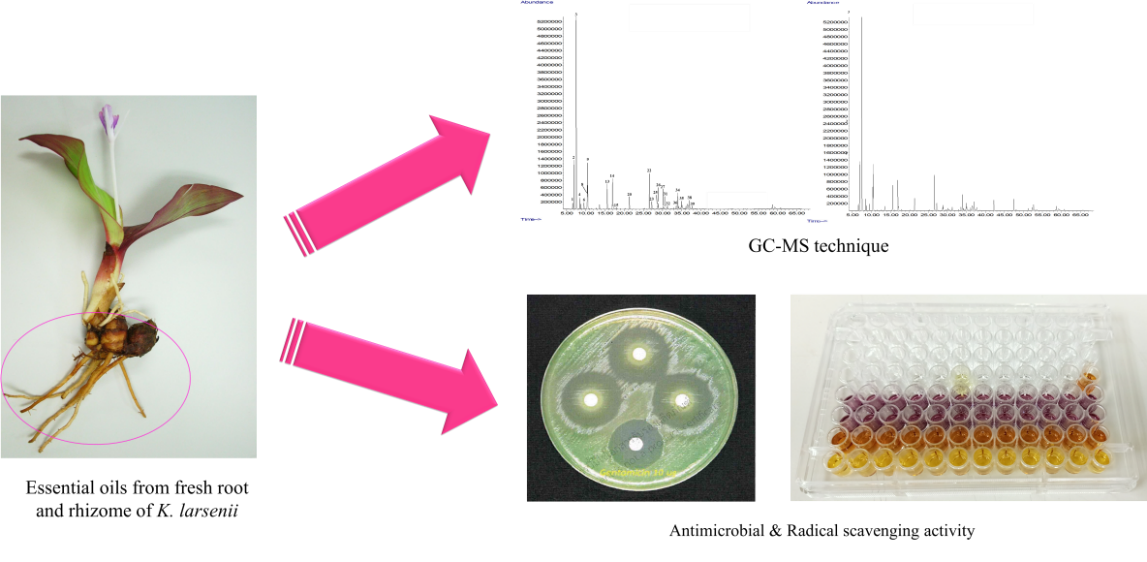
Downloads
References
BB Mathew, A Tiwari and SK Jatawa. Free radicals and antioxidants: A review. J. Pharm. Res. 2011; 4, 4340-3.
G Martemucci, C Costagliola, M Mariano, L D’andrea, P Napolitano and AG D’Alessandro. Free radical properties, source and targets, antioxidant consumption and health. Oxygen 2022; 2, 48-78.
MS Brewer. Natural antioxidants: Sources, compounds, mechanisms of action, and potential applications. Compr. Rev. Food Sci. Food Saf. 2011; 10, 211-47.
SB Nimse and D Pal. Free radicals, natural antioxidants, and their reaction mechanisms. RSC Adv. 2015; 5, 27986-8006.
AV Ivanov, B Bartosch and MG Isaguliants. Oxidative stress in infection and consequent disease. Oxidative Med. Cell. Longevity 2017; 2017, 3496043.
AC Guimarães, LM Meireles, MF Lemos, MCC Guimarães, DC Endringer, M Fronza and R Scherer. Antibacterial activity of terpenes and terpenoids present in essential oils. Molecules 2019; 24, 2471.
FQ Zaman, R Ridzuan and AHA Abdelmageed. Chemical composition, antioxidant and antimicrobial activities of the essential oils from rhizomes and leaves of Alpinia conchigera Griff. (Zingiberaceae). J. Essent. Oil Bearing Plants 2021; 24, 1311-22.
S Sahoo, S Singh and S Nayak. Chemical composition, antioxidant and antimicrobial activity of essential oil and extract of Alpinia malaccensis Roscoe (Zingiberaceae). Int. J. Pharm. Pharmaceut. Sci. 2014; 6, 183-8.
GA Avci, E Avci, GO Cilak and SC Cevher. Antimicrobial and antioxidant activities of Zingiber officinale (Ginger) and Alpinia officinarum (Galangal). Hittite J. Sci. Eng. 2020; 7, 45-9.
SD Byahatti and D Thangadurai. Chemical constituents, antimicrobial potential and antioxidantefficacy of essential oil from Boesenbergia pulcherrima (Wall.) Kuntze. Plant Arch. 2019; 19, 515-21.
H Xiang, L Zhang, Z Yang, F Chen, X Zheng and X Liu. Chemical compositions, antioxidative, antimicrobial, anti-inflammatory and antitumor activities of Curcuma aromatica Salisb. essential oils. Ind. Crop. Prod. 2017; 108, 6-16.
BH Kebede, SF Forsido, YB Tola and T Astatkie. Free radical scavenging capacity, antibacterial activity and essential oil composition of turmeric (Curcuma domestica) varieties grown in Ethiopia. Heliyon 2021; 7, e06239.
V Chairgulprasert, S Prasertsongskun, S Junpra-Ob and M Sangjun. Chemical constituents of the essential oil, antioxidant and antibacterial activities from Elettariopsis curtisii Baker. Songklanakarin J. Sci. Tech. 2008; 30, 591-6.
GS El-Baroty, HHA El-Baky, RS Farag and MA Saleh. Characterization of antioxidant and antimicrobial compounds of cinnamon and ginger essential oils. Afr. J. Biochem. Res. 2010; 4, 167-74.
Y Bellik. Total antioxidant activity and antimicrobial potency of the essential oil and oleoresin of Zingiber officinale Roscoe. Asian Pac. J. Trop. Dis. 2014; 4, 40-4.
J Leong-Skornickova and MF Newman. Ginger of Cambodia, Laos & Vietnam. Royal Botanic Gardens Edinburgh Edinburgh, Scotland, 2016.
R Pooma and S Suddee. Tem Smitinand’s Thai plant names, revised edition 2014. Office of the Forest Herbarium, Department of National Parks, Wildlife and Plant Conservation, Bangkok, Thailand, 2014.
N Nopporncharoenkul and T Jenjittikul. Kaempferia noctiflora (Zingiberaceae), a new species from northern Thailand. Phytotaxa 2017; 316, 67-72.
T Boonma, S Saensouk and P Saensouk. Two new species of Kaempferia L. (Zingiberaceae) from Thailand. Taiwania 2020; 65, 371-81.
N Nopporncharoenkul, T Somnoo, W Tanming and C Maknoi. Kaempferia jenjittikuliae (Kaempferia subg. protanthium: Zingiberaceae), a new, endangered species endemic to Thailand. Edinb. J. Bot. 2021; 78, 350.
P Saensouk and S Saensouk. Taxonomy, cytology and palynology of Kaempferia pseudoparviflora (Zingiberaceae), a new and rare species from northern Thailand. Asian J. Plant Sci. 2021; 20, 414-20.
W Chuakul and A Boonpleng. Survey on medicinal plants in Ubon Ratchathani province (Thailand). Thai J. Phytopharm. 2004; 11, 33-54.
P Partha and ABME Hossain. Ethnobotanical investigation into the Mandi ethnic community in Bangladesh. Bangladesh J. Plant Taxonomy 2007; 14, 129-45.
Tushar, S Basaka, GC Sarma and L Rangan. Ethnomedical uses of Zingiberaceous plants of Northeast India. J. Ethnopharmacol. 2010; 132, 286-96.
A Nuammee, K Seraypheap, S Yannawat and T Seelanan. Ethnobotany of Hmong at Ban Pang Chang, Pong Subdistrict, Santisuk District, Nan Province. Thai J. Bot. 2012; 4, 177-211.
S Sudeesh. Ethnomedicinal plants used by Malayaraya tribes of Vannapuram village in Idukki, Kerala, India. Indian J. Sci. Res. Tech. 2012; 1, 7-11.
P Daimei and Y Kumar. Ethnobotanical uses of gingers in Tamenglong district, Manipur, Northeast India. Genet. Resour. Crop Evol. 2013; 61, 273-85.
HJ Woerdenbag, T Windono, R Bos, S Riswan and WJ Quax. Composition of the essential oils of Kaempferia rotunda L. and Kaempferia angustifolia Roscoe rhizomes from Indonesia. Flavour Fragrance J. 2004; 19, 145-8.
S Tewtrakul, S Yuenyongsawad, S Kummee and L Atsawajaruwan. Chemical components and biological activities of volatile oil of Kaempferia galanga Linn. Songklanakarin J. Sci. Tech. 2005; 27, 503-7.
N Vipunngeun, C Palanuvej and N Ruangrungsi. Essential oil from Kaempferia angustifolia rhizome: Chemical compositions and antimicrobial activities. J. Health Res. 2007; 21, 275-8.
S Saensouk. Endemic and rare plants of Ginger Family in Thailand. KKU Res. J. 2011; 16, 306-30.
W Chuakul and A Boonpleng. Ethnomedical uses of Thai Zingiberaceous plant (1). Thai J. Phytopharm 2003; 10, 33-9.
Department of Medical Sciences, Ministry of Public Health. Thai herbal pharmacopoeia. Kaewjawjom Printing & Publishing Suan Sunandha Rajabhat University Nonthaburi, Bangkok, Thailand, 2018.
O Theanphong. 2013, Chemical constituents of essential oils and RAPD fingerprints of Curcuma and Kaempferia plants in Thailand. Ph. D. Dissertation. Chulalongkorn University, Bangkok, Thailand.
Clinical and Laboratory Standards Institute. Performance standards for antimicrobial disk susceptibility tests; approved standard-eleventh edition. CLSI document M02-A11. Clinical and Laboratory Standards Institute, Pennsylvania, 2012.
Clinical and Laboratory Standards Institute. Methods for dilution antimicrobial susceptibility tests for bacteria that grow aerobically; approved standard. CLSI document M07-A9. Clinical and Laboratory Standards Institute, Pennsylvania, 2012.
I Biskup, I Golonka, A Gamian and Z Sroka. Antioxidant activity of selected phenols estimated by ABTS and FRAP methods. Adv. Hyg. Exp. Med. 2013; 67, 958-63.
G Sudha, MS Priya, RI Shree and S Vadivukkarasi. In vitro free radical scavenging activity of raw Pepino fruit (Solanum muricatum Aiton). Int. J. Curr. Pharmaceut. Res. 2011; 3, 137-40.
O Theanphong, C Palanuvej, N Ruangrungsi, K Rungsihirunrat and W Thanakijcharoenpath. Essential oil compositions of Kaempferia larsenii Sirirugsa and Kaempferia marginata Carey rhizomes from Thailand. In: Proceedings of the Pure and Applied Chemistry International Conference 2014, Khon Kaen, Thailand, 2014, p. 256-7.
AC Figueiredo, JG Barroso, LG Pedro and JJC Scheffer. Factors affecting secondary metabolite production in plants: Volatile components and essential oils. Flavour Fragrance J. 2008; 23, 213-26.
SM Al-Reza, A Rahman, MA Sattar, MO Rahman and HM Fida. Essential oil composition and antioxidant activities of Curcuma aromatica Salisb. Food Chem. Toxicol. 2010; 48, 1757-60.
I Bajalan and AG Pirbaloutic. Variation in chemical composition of essential oil of populations of Lavandula × intermedia collected from Western Iran. Ind. Crop. Prod. 2015; 69, 344-7.
S Tewtrakul, S Yuenyongsawad, S Kummee and L Atsawajaruwan. Chemical components and biological activities of volatile oil of Kaempferia galanga Linn. Songklanakarin J. Sci. Tech. 2005, 27, 503-7.
D Trombetta, F Castelli, MG Sarpietro, V Venuti, M Cristani, C Daniele, A Saija, G Mazzanti and G Bisignano. Mechanisms of antibacterial action of three monoterpenes. Antimicrob. Agents Chemother. 2005; 49, 2474-8.
NA Mahizan, S Yang, C Moo, AA Song, CM Chong, C Chong, A Abushelaibi, SE Lim and K Lai. Terpene derivatives as a potential agent against antimicrobial resistance (AMR) pathogens. Molecules 2019; 24, 2631.
JE Patterson, L McElmeel and N Wiederhold. In vitro activity of essential oils against gram-positive and gram-negative clinical isolates, including carbapenem-resistant Enterobacteriaceae. Open Forum Infect. Dis. 2019; 6, ofz502.
NY Saad, CD Muller and A Lobstein. Major bioactivities and mechanism of action of essential oils and their components. Flavour Fragrance J. 2013; 28, 269-79.
Z Li, M Cai, Y Liu, P Sun and S Luo. Antibacterial activity and mechanisms of essential oil from Citrus medica L. var. sarcodactylis. Molecules 2019; 24, 1577.
L Zhang, X Liang, Z Ou, M Ye, Y Shi, Y Chen, J Zhao, D Zheng and H Xiang. Screening of chemical composition, anti-arthritis, antitumor and antioxidant capacities of essential oils from four Zingiberaceae herbs. Ind. Crop. Prod. 2020; 149, 112342.
O Theanphong and W Mingvanish. Antioxidant activities of essential oils from Kaempferia angustifolia Roscoe roots and rhizomes. In: Proceedings of the 11th Botanical Conference of Thailand: BCT11 and The First Junior Botanical Conference of Thailand: Junior BCT1, Bangkok, Thailand, 2017, p. 173-8.
J Grassmann. Terpenoids as plant antioxidants. Vitam. Horm. 2005; 72, 505-35.
KA Wojtunik-Kulesza, K Kasprzak, T Oniszczuk and A Oniszczuk. Natural monoterpenes: Much more than only a scent. Chem. Biodiversity 2019; 16, e1900434.
MA Andrade, MG Cardoso, J Andrade, LF Silva, ML Teixeira, JMV Resende, ACS Figueiredo and JG Barroso. Chemical composition and antioxidant activity of essential oils from Cinnamodendron dinisii Schwacke and Siparuna guianensis Aublet. Antioxidants 2013; 2, 384-97.
Downloads
Published
How to Cite
Issue
Section
License
Copyright (c) 2022 Walailak University

This work is licensed under a Creative Commons Attribution-NonCommercial-NoDerivatives 4.0 International License.





