
An Optimized Model of Single Phase Self Excited Induction Generator
DOI:
https://doi.org/10.48048/tis.2022.5101Keywords:
Single-phase self-excited induction generator (SEIG), Design and development, Capacitor self-excitation, Matlab, Autonomous power generation, Total harmonic distortionAbstract
This paper illustrates the newly developed specially designed single phase self excited induction generator. All possible configurations for winding arrangement have been attempted to obtain the best output from the model. The earlier configurations were found incomplete to obtain the optimum output from the single phase induction machine as an induction generator. The proposed model is unified, optimum and accurate for inculcating the performance of single phase induction generator. The model design as well as its development of 3.7 kW, 50 Hz and 4-pole single phase SEIG is presented using simulink in MATLAB. The 4 possible configurations are designed for single phase SEIG, the objective function is to reduce total harmonic distortion (THD) and optimize the model parameter. The results were demonstrated experimentally validated using SPEED software. A standard available IEC 132 frame size is used for development of proposed model and the results found are prominent.
HIGHLIGHTS
- It is found that there is heavy demand for small capacity power generation in single phase rating as almost electrical appliances are operated on single phase supply. The main objective of this research is to develop a novel and a specially designed SEIG and to analyze its performance analysis
- The 1-phase SEIG is proposed with rating 3 - 5 kW. The input parameter for single phase SEIG such as power, voltage, impedance, frequency, pole pair the stator/rotor resistance etc are theoretically analyzed
- Afterwards the parameters are act as input for SPEED software the results are obtained and found to be impressive one with practical applications
- Four possible configurations for a single phase SEIG are proposed. The four possible configurations have been attempted to achieve the objective of research. On comparing the performance of these models, it has been observed that the model - “Short pitch (1-8) Double layer distributed winding” gives good performance in terms of reduced THD, sinusoidal m.m.f. waveforms
GRAPHICAL ABSTRACT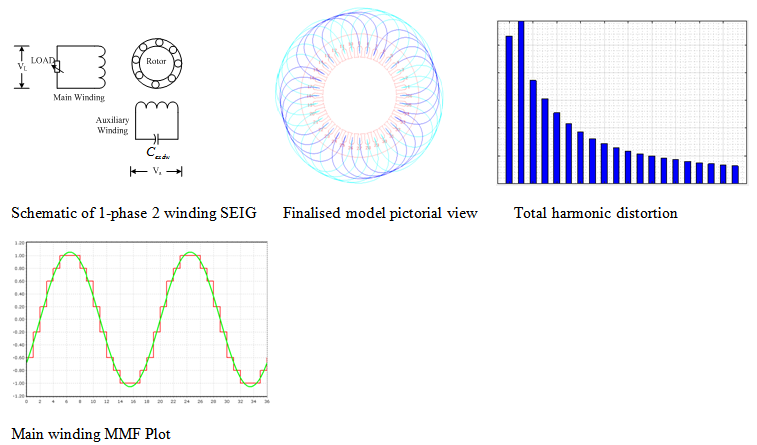
Downloads
References
RK Jardan, P Stumpf, Z Varga and I Nagy. Novel solutions for high-speed self-excited induction generators. IEEE Trans. Ind. Electron. 2015; 63, 2124-32.
KS Sakkoury, S Emaraand MK Ahmed. Analysis of wind driven self-excited induction generator supplying isolated DC loads. Int. J. Electron. Syst. Inform. Technol. 2017; 4, 257-68.
UK Kalla, B Singh and SS Murthy. Intelligent neural network-based controller for single-phase wind energy conversion system using two winding self-excited induction generator. IEEE Trans. Ind. Inform. 2016; 12, 1986-97.
A Upasan and Y Kumsuwan. Closed loop speed control of induction generator with scalar-control inverters.Int. J. Energy Proc., 2013; 34, 371-81.
NA Iqteit and AK Daud. A new model of self-excited induction generator to feed a single phase load with an application in lighting animal farm.Int. J. Power Energy Convers. 2019; 10, 32-50.
CP Ion and I Serban. Self-excited induction generator based microgrid with super capacitor energy storage to support the start-up of dynamic loads.Int. J. Adv. Electron. Comput. Eng. 2018;18, 51-61.
K Makowski and A Leicht. Behaviour of single-phase self-excited induction generator during short-circuit at terminals. Int. J. Comput. Math.Electr.Electron.Eng.2018; 37, 1815-23.
K Makowski and A Leicht. Comparative analysis of single-phase self-excited induction generators of various rotor cages.Int. J. Electron. Eng.2019; 101, 805-12.
P Mehta, P Bhatt and V Pandya. Optimized coordinated control of frequency and voltage for distributed generating system using Cuckoo Search Algorithm.Ain Shams Eng. J. 2018; 9, 1855-64.
UK Kalla, B Singh and SS Murthy. Green controller for efficient diesel engine driven single-phase SEIG using maximum efficiency point operation. IEEE Trans. Ind. Electron. 2016; 64,264-74.
UK Kalla,B Singhand SS Murthy. Modified electronic load controller for constant frequency operation with voltage regulation of small hydro-driven single-phase SEIG.IEEE Trans. Ind. Appl.2016;52, 2789-800.
AS Satpathy, D Kastha and K Kishore. Control of a STATCOM-assisted self-excited induction generator-based WECS feeding non-linear three-phase and single-phase loads. IET Power Electron. 2018; 12, 829-39.
LG Scherer, RV Tambara and RF de Camargo. Voltage and frequency regulation of standalone self-excited induction generator for micro-hydro power generation using discrete-time adaptive control.IET Renew. Power Gener. 2016; 10,531-40.
UK Kalla, B Singh and SS Murthy. Slide mode control of microgrid using small hydro driven single-phase SEIG integrated with solar PV array.IET Renew. Power Gener. 2017; 11, 1464-72.
Y Zidani, S Zouggarand A Elbacha. Steady-state analysis and voltage control of the self-excited induction generator using artificial neural network and an active filter. Iran. J. Sci. Technol. - Trans. Electr. Eng. 2018; 42, 41-8.
H Arabaci. An iterative solution approach for steady state analysis of self-excited induction generator. Int. J. Intell. Eng. Inform. 2019; 7, 309-22.
M Arbi, K Marwa, BS Mouldi and BFH Rhaoulia. Performance evaluation of self-excited DSIG as a stand-alone distributed energy resources. Int. J. Electr. Eng. 2016; 98, 159-67.
SMS Salem. Study of wind turbine based self-excited induction generator under nonlinear resistive loads as a step to solve the Egypt electricity crisis.Int. J. Electr. Comput. Eng. 2016; 51,1-11.
AS Kumar, J Munda and G Singh. Wind-driven stand-alone six-phase self-excited induction generator transients under different loading conditions.Int. J. Electr. Eng. 2015; 97.
LG Scherer, CB Tischer and RF de Camargo. Power rating reduction of distribution static synchronous compensator for voltage and frequency regulation of stand-alone self-excited induction generator.Int. J. Electr. Power Syst. Res. 2017; 149, 198-209.
MM Basic and D Vukadinović. Online efficiency optimization of a vector controlled self-excited induction generator. IEEE Trans. Energy Convers. 2015; 31, 373-80.
FD Wijaya and H Prabowo. Voltage control of single-phase two winding self excited induction generator using SVC-MERS for isolated system. Int. J. Power Electron. Drive Syst. 2016;7, 901.
WE Vanco, FB Silva, FA Goncalves and CA Bissochi. Evaluation of the capacitor bank design for self-excitation in induction generators. IEEE Lat. Am. Trans. 2018; 16, 482-8.
HM Hasanien and GM Hashem. A cuckoo search algorithm optimizer for steady-state analysis of self-excited induction generator. Ain Shams Eng. J. 2018; 9, 2549-55.
LG Scherer, RV Tambara and RFD Camargo. Voltage and frequency regulation of standalone self-excited induction generator for micro-hydro power generation using discrete-time adaptive control. IET Renew. Power Gener. 2016; 10, 531-40.
UK Kalla, B Singh and SS Murthy. Intelligent neural network-based controller for single-phase wind energy conversion system using two winding self-excited induction generator. IEEE Trans. Ind. Inform. 2016; 12, 1986-97.
A Krishnan, K Anusha, N Kumaresan and S Senthil Kumar. Simplified methods for the analysis of self-excited induction generators. IET Electr. Power Appl. 2017; 11, 1636-44.
SS Murthy, B Singh and VSandeep. Experience in developing a single-phase two winding 5 kW self-excited induction generator for off-grid renewable energy based power generation. J. Inst. Eng. (India): B. 2016; 97, 127-37.
LG Scherer, CB Tischer and RFD Camargo. Power rating reduction of distribution static synchronous compensator for voltage and frequency regulation of stand-alone self-excited induction generator. Electr. Power Syst. Res. 2017; 149, 198-209.
Downloads
Published
How to Cite
Issue
Section
License

This work is licensed under a Creative Commons Attribution-NonCommercial-NoDerivatives 4.0 International License.





