
Antioxidant, Anti-Oral Cancer, and Antimicrobial Activity of Medicinal Plant Extracts: Development of Mouthrinse Formulations
DOI:
https://doi.org/10.48048/tis.2023.4785Keywords:
Alpinia officinarum, Cinnamon, Cinnamaldehyde, Phenolics, Flavonoids, Mouthwash, TanninsAbstract
Nowadays, there is growing interest in using medicinal plants as antimicrobial agents to treat microbial infections in the oral cavity. This study was aimed to evaluate phytochemical properties, anti-oral cancer and antimicrobial activity against C. albicans and some potential oral lactic acid bacteria (Lactobacillus casei and Lactobacillus plantarum). Plant extracts including Cinnamomum verum (cinnamon), Acorus calamus (sweet flag), Hibiscus sabdariffa (roselle), Zingiber officinale (ginger) and Alpinia officinarum (lesser galangal) were tested and used to formulate mouthrinses for oral health care. Cinnamon extract possessed the highest phenolic, flavonoid and tannin content, and antioxidant activity (1,152.58 mg ascorbic acid equivalent/g by phosphomolybdenum assay and 39.64 % nitric oxide radical scavenging activity), while roselle extract had the highest total alkaloids. Only lesser galangal extract displayed anti-oral cancer activity with 97.83 % cytotoxicity. High performance liquid chromatography (HPLC) analysis revealed the presence of galangin and kaempferide in the lesser galangal rhizome extract. The cinnamon extract showed the strongest inhibitory activity against Candida albicans (4 mg/mL MIC). Cinnamon extract (24 mg/mL) and cinnamaldehyde (0.08 mol/L) exhibited the best killing effect and the highest cellular protein leakage in C. albicans. In addition, these plant extracts were used to develop mouthrinse formulations. The extracts of cinnamon and ginger at 10 % in mouthrinse formulations could strongly inhibit the growth of C. albicans. In comparison, 8 and 10 % roselle extracts showed the best inhibitory effect against Lactobacillus casei. In summary, cinnamon and lesser galangal were potential plants with antimicrobial, antioxidant, anti-biofilm and anti-oral cancer activities, and thus can be utilized to formulate oral care products.
HIGHLIGHTS
- Lesser galangal was found to be a prominent anti-oral cancer plant
- Cinnamon was shown to be an interesting anti-Candida albicans plant
- Cinnamon, ginger and roselle extracts at 10 % in mouthrinse formulations exhibited strong antimicrobial activity. These plants can be used to incorporate into oral care products for treatment and prevention of oral diseases
GRAPHICAL ABSTRACT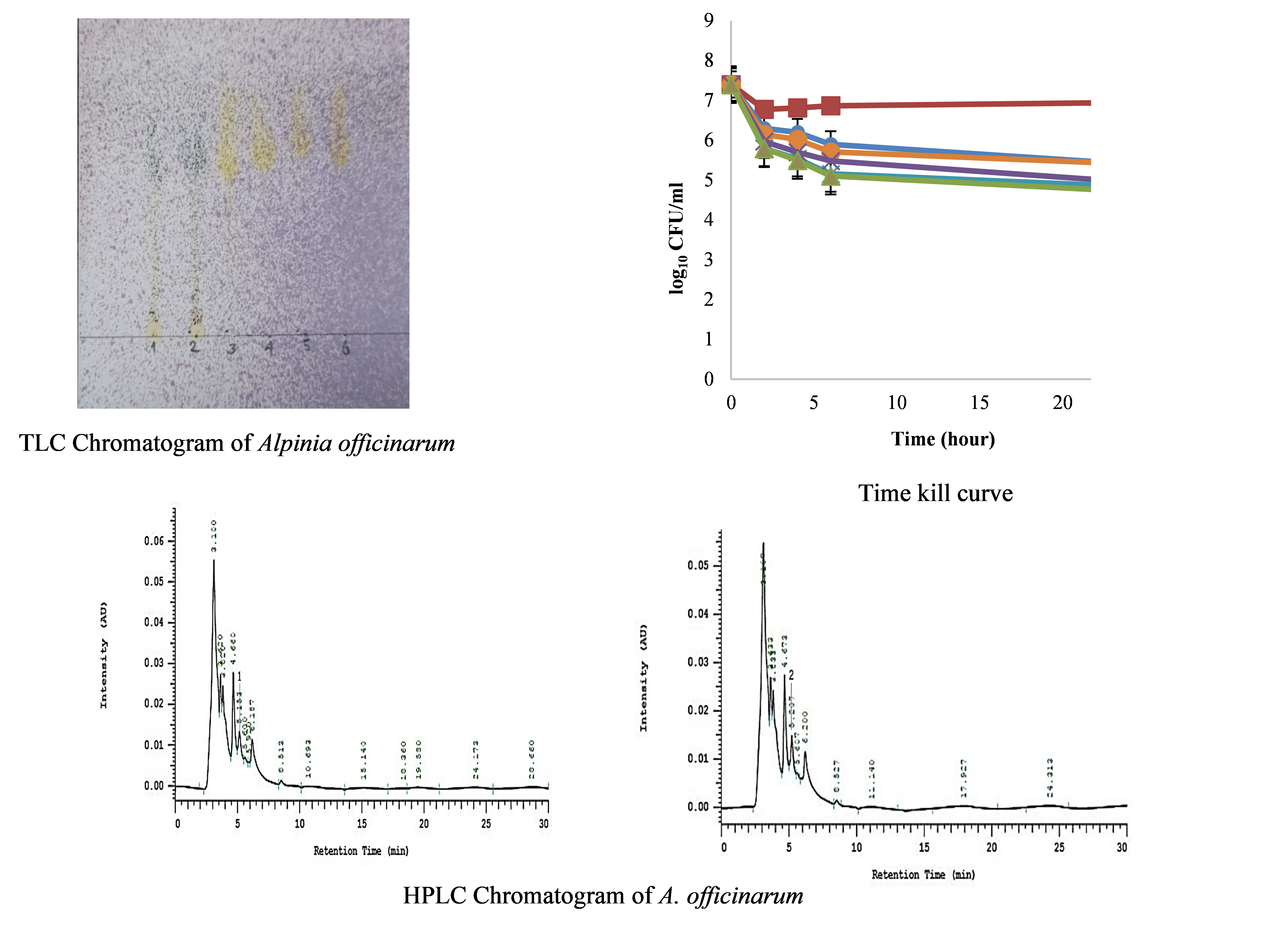
Downloads
References
WH Bowen, RA Burne, H Wu and H Koo. Oral biofilms: Pathogens, matrix, and polymicrobial interactions in microenvironments. Trends Microbiol. 2018; 26, 229-42.
KA Toenjes, SM Munsee, AS Ibrahim, R Jeffrey, JE Edwards and DI Johnson. Small molecule inhibitors of the budded to hyphal form transition in the pathogenic yeast Candida albicans. Antimicrob. Agents Chemother. 2005; 49, 963-72.
M Gulati and CJ Nobile. Candida albicans biofilms: Development, regulation, and molecular mechanisms. Microb. Infect. 2016; 18, 310-21.
Z Li, Y Liu and L Zhang. Role of the microbiome in oral cancer occurrence, progression and therapy. Microb. Pathog. 2022; 169, 105638.
D Schmiege, M Evers, T Kistemann and T Falkenberg. What drives antibiotic use in the community? A systematic review of determinants in the human outpatient sector. Int. J. Hyg. Environ. Health 2020; 226, 113497.
MZ Aumeeruddy and MF Mahomoodally. Global documentation of traditionally used medicinal plants in cancer management: A systematic review. S. Afr. J. Bot. 2021; 138, 424-94.
KC Chinsembu. Plants and other natural products used in the management of oral infections and improvement of oral health. Acta Trop. 2016; 154, 6-18.
K Neha, MR Haider, A Pathak and MS Yar. Medicinal prospects of antioxidants: A review. Eur. J. Med. Chem. 2019; 178, 687-704.
K Srinivasan. Antimutagenic and cancer preventive potential of culinary spices and their bioactive compounds. PharmaNutrition 2017; 5, 89-102.
P Prieto, M Pineda and M Aguilar. Spectrophotometric quantitation of antioxidant capacity through the formation of a phosphomolybdenum complex: Specific application to the determination of vitamin. Anal. Biochem. 1999; 269, 337-41.
VK Baipai, KH Baek and SC Kang. Antioxidant and free radical scavenging activities of taxoquinone, a diterpenoid isolated from Metasequoia glyptostroboides. S. Afr. J. Bot. 2017; 111, 93-8.
VL Singleton, R Orthofer and R Lamuela-Raventós. Analysis of total phenols and other oxidation substrates and antioxidants by means of Folin-Ciocalteu reagent. Meth. Enzymol. 1999; 299, 152-78.
A Kathirvel and V Sujatha. In vitro assessment of antioxidant and antibacterial properties of Terminalia chebula Retz. leaves. Asian Pac. J. Trop. Biomed. 2012; 2, S788-95.
F Shamsa, H Monsef, R Ghamooshi and M. Verdian-rizi. Spectrophotometric determination of total alkaloids in some Iranian medicinal plants. Thai J. Pharmaceut. Sci. 2008; 32, 17-20.
J O’Brien, I Wilson, T Orton and F Pognan. Investigation of the alamar blue (resazurin) fluorescent dye for the assessment of mammalian cell cytotoxicity. Eur. J. Biochem. 2000; 267, 5421-6.
N Soonthornchareonnon, U Sotanaphun and P Wongsinkongman. TLC: A simple method for quanlitative analysis of Thai crude drugs. Mahidol University, Bangkok, Thailand, 2011.
I Weigand, K Hilpert and REW Hancock. Agar and broth dilution methods to determine the minimal inhibitory concentration (MIC) of antimicrobial substances. Nat. Protocol. 2008; 3, 163-75.
O Tabbene, S Azaiez, AD Grazia, I Karkouch, IB Slimene, S Elkahoui, MN Alfeddy, B Casciaro, V Luca, F Limam and ML Mangoni. Bacillomycin d and its combination with amphotericin B: promising antifungal compounds with powerful antibiofilm activity and wound-healing potency. J. Appl. Microbiol. 2015; 120, 289-300.
SF Banu, D Rubini, P Shanmugavelan, R Murugan, S Gowrishankar, SK Pandian and P Nithyanand. Effects of patchouli and cinnamon essential oils on biofilm and hyphae formation by Candida species. J. Mycolog. Médicale 2018; 28, 332-9.
ME Klepser, EJ Ernst, RE Lewis, ME Ernst and MA Pfaller. Influence of test conditions on antifungal time-kill curve results: Proposal for standardized methods. Antimicrob. Agents Chemother. 1998; 42, 1207-12.
MM Bradford. A rapid sensitive method for the quantification of microgram quantities of protein utilizing the principle of protein-dye binding. Anal. Biochem. 1976; 72, 248-54.
A Vonasorn, S Chuntranuluck, W Setthapun and W Rakwichian. Development of mouth care product mixing with Boesenbergia pandurata extract for inhibiting of Streptococcus mutans. Asian J. Appl. Sci. 2013; 6, 90-8.
NH Yim, YP Jung, WK Cho, T Kim, A Kim, M Im and JY Ma. Screening of aqueous extracts of medicinal herbs for antimicrobial activity against oral bacteria. Integr. Med. Res. 2013; 2, 18-24.
N Singh, AS Rao, A Nandal, S Kumar, SS Yadav, SA Ganaie and B Narasimhan. Phytochemical and Pharmacological review of Cinnamomum verum J. Presl- a versatile spice used in food and nutrition. Food Chem. 2021; 338, 127773.
D Chandra and K Prasad. Phytochemicals of Acorus calamus (sweet flag). J. Med. Plants Stud. 2017; 5, 277-81.
R Barbieri, E Coppo, A Marchese, M Daglia, E Sobarzo-Sánchez, SZ Nabavi and SM Nabavi. Phytochemicals for human disease: An update on plant-derived compounds antibacterial activity. Microbiol. Res. 2017; 196, 44-68.
AA Mariod, HE Tahir and GK Mahunu. Composition of Hibicus sabdariffa calyx, pigments, vitamins. In: C Newman (Ed.). Roselle (Hibicus sabdariffa): Chemistry, production, products, and utilization. Academic Press, London, 2021.
O Bekkouch, M Harnafi, I Touiss, S Khatib, H Harnafi, C Alem and S Amrani. In vitro antioxidant and in vivo lipid-lowering properties of Zingiber officinale crude aqueous extract and methanolic fraction: A follow-up study. Evid. Base. Compl. Alternative Med. 2019; 2019, 9734390.
AA Yusuf, B Lawal and AN Abubakar. In-vitro antioxidants, antimicrobial and toxicological evaluation of Nigerian Zingiber officinale. J. Biochem. 2018; 4, 1-8.
IB Abubakar, I Malami, Y Yahaya and SM Sule. A review on the ethnomedicinal uses, phytochemistry and pharmacology of Alpinia officinarum Hance. J. Ethnopharmacol. 2018; 224, 45-62.
FA Alasmary, EA Assirey, RM El-Meligy, AS Awaad, LA El-sawaf, MM Allah and SI Alqasoumi. Analysis of Alpinia officinarum hance, chemically and biologically. Saudi Pharmaceut. J. 2019; 27, 1107-12.
R Robeiro-Santos, M Andrade, NRD Melo, FRD Santos, IDA Neves, MGD Carvalho and A Sanches-Silva. Biological activities and major components determination in essential oils intended for a biodegradable food packaging. Ind. Crop. Prod. 2017; 97, 201-10.
MS Elshikh, E Rani, DAA Farraj, FMA Al-Hemaid, MRA Gawwad, TRJJ Malar, L Dyona and P Vijayaraghavan. Plant secondary metabolites extracted from Acorus calamus rhizome from Western Ghats, India and repellent activity on Sitophilus oryzae. Physiol. Mol. Plant Pathol. 2022; 117, 101743.
D Barreca, D Trombetta, A Smeriglio, G Mandalari, O. Romeo, MR Felice, G Gattuso and SM Nabavi. Food flavonols: Nutraceuticals with complex health benefits and functionalities. Trends Food Sci. Tech. 2021; 117, 194-204.
M Bacanli, AA Başaran and N Başaran. Galangin as a plant phenolic and usage in health and disease. In: RS Watson, VR Preedy, S Zibadi (Eds.). Polyphenols: Prevention and treatment of human disease. Elsevier Inc., Amsterdam, Netherlands, 2018.
S Rampogu, RG Gajula and KW Lee. A comprehensive review on chemotherapeutic potential of galangin. Biomed. Pharmacother. 2021; 141, 111808.
R Essid, D Gharbi, G Abid, I Karkouch, TB Hamouda, N Fares, D Trabelsi, H Mhadhbi, S Elkahoui, F Limam and O Tabbene. Combined effect of Thymus capitatus and Cinnamomum verum essential oils with conventional drugs against Candida albicans biofilm formation and elucidation of the molecular mechanism of action. Ind. Crop. Prod. 2019; 140, 111720.
K Hoover. Antifungal activity of Alpinia officinarum Hance against Candida albicans. Master Thesis. Suranaree University, Nakhon Ratchasima, Thailand, 2013.
R Zhang, Y Cui, M Cheng, Y Guo, X Wang and J Wang. Antifungal activity and mechanism of cinnamon essential oil loaded into mesoporous silica nanoparticles. Ind. Crop. Prod. 2021; 171, 113846.
S Waty, D Suryanto and Yurnaliza. Antibacterial activity of cinnamon ethanol extract (Cinnamomum burmannii) and its application as a mouthwash to inhibit Streptococcus growth. IOP Conf. Earth Environ. Sci. 2018; 130, 012049.

Downloads
Published
How to Cite
Issue
Section
License
Copyright (c) 2022 Walailak University

This work is licensed under a Creative Commons Attribution-NonCommercial-NoDerivatives 4.0 International License.





