
Antibacterial Activity of Synthesized Silver Nanoparticle from Polyherbal Extract against Human Pathogens
DOI:
https://doi.org/10.48048/tis.2022.4643Keywords:
Polyherbal formulation, Silver nanoparticles, Bacterial pathogens, Agar well diffusion, Antibacterial activityAbstract
Polyherbal formulations are known for various medicinal properties. The aim of this study was to biosynthesis of Silver nanoparticle (AgNps) using polyherbal extract and to evaluate their effect on human bacterial pathogens. Polyherbal extract silver nanoparticles were synthesized and the presence of AgNPs was confirmed by UV-Visible (UV-VIS) spectrophotometer and Scanning Electron Microscopic (SEM) analysis. The effect of polyherbal AgNps were evaluated against human bacterial pathogens by agar well diffusion method. The UV-VIS spectrophotometer, SEM analysis and the agar well diffusion method confirmed the potential antibacterial activity of biosynthesized polyherbal AgNPs against common bacterial pathogens such as Staphylococcus aureus, Streptococcus pyogenes, Escherichia coli, Pseudomonas aeruginosa, Bacillus cereus, Propionibacteriun acnes, Streptococcus oralis, Enterobacter feacalis, Proteus vulgaris, Aeromonas hydrophila, Corynebacterium diphtheriae and Actinomycetes Sp. Therefore, we suggest that polyherbal AgNPs can be used for the treatment of bacterial diseases.
HIGHLIGHTS
- Preparation of polyherbal formulation from selected traditional medicinal plants (Caesalpinia bonduc, Morinda citrifolia and Nigella sativa)
- Green synthesis and characterization of silver nanoparticles synthesized using polyherbal aqueous extract and evaluate its antibacterial activity against human pathogens
- The biosynthesized silver nanoparticles that use the extract of polyherbal formulations have proven excellent antibacterial activity against human pathogens through Disc diffusion method
- The present study demonstrated a quick, rapid, and economical way of synthesizing silver nanoparticles.
- Synthesized polyherbal nanoparticles can be used against human pathogens acts as antimicrobial drug
GRAPHICAL ABSTRACT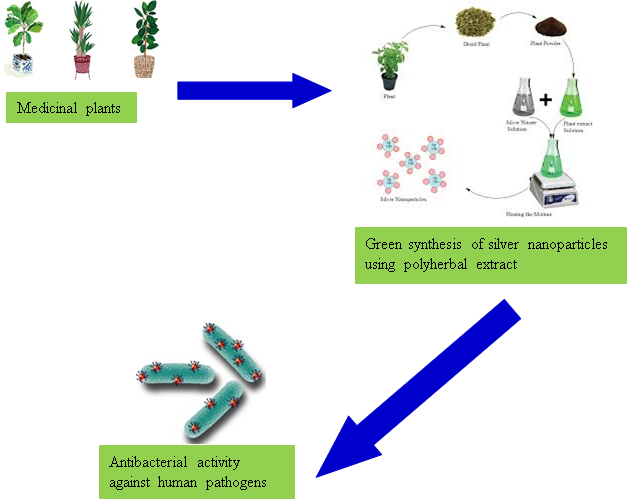
Downloads
References
S Senapati. 2005, Biosynthesis and immobilization of nanopaticles and their applications. Ph. D. Dissertation. University of Pune, Maharashtra, India.
MC Daniel and D Astruc. Gold nanoparticles: Assembly, supramolecular chemistry, quantum-size related properties, and applications toward biology, catalysis, and nanotechnology. Chem. Rev. 2004; 104, 293-346.
K Bogunia-Kubik and M Sugisaka. From molecular biology to nanotechnology and nanomedicine. Biosystems 2002; 65, 123-38.
VP Zharov, JW Kim, DT Curiel and M Everts. Self-assembling nanoclusters in living systems: application for integrated photothermal nanodiagnostics and nanotherapy. Nanomedicine 2005; 1, 326-45.
M Tan, G Wang, Z Ye and J Yuan. Synthesis and characterization of titania-based monodisperse fluorescent europium nanoparticles for biolabeling. J. Lumin. 2006; 117, 20-8.
HY Lee, Z Li, K Chen, AR Hsu, C Xu, J Xie, S Sun and X Chen. PET/MRI dual-modality tumor imaging using arginine-glycine-aspartic (RGD)-conjugated radiolabeled iron oxide nanoparticles. J. Nucl. Med. 2008; 49, 1371-9.
D Pissuwan, SM Valenzuela and MB Cortie. Therapeutic possibilities of plasmonically heated gold nanoparticles. Trends Biotechnol. 2006; 24, 62-7.
S Panigrahi, S Kundu, S Ghosh, S Nath and T Pal. General method of synthesis for metal nanoparticles. J. Nanoparticle Res. 2004; 6, 411-4.
S Iravani. Green synthesis of metal nanoparticles using plants. Green Chem. 2011; 13, 2638-50.
S Qayyum, M Oves and AU Khan. Obliteration of bacterial growth and biofilm through ROS generation by facilely synthesized green silver nanoparticles. PLos One 2017; 12, e0181363.
M Oves, M Aslam, MA Rauf, S Qayyum, HA Qari, MS Khan, MZ Alam, S Tabrez, A Pugazhendhi and IMI Ismail. Antimicrobial and anticancer activities of silver nanoparticles synthesized from the root hair extract of Phoenix dactylifera. Mater. Sci. Eng. C 2018; 89, 429-43.
P Singh, YJ Kim, D Zhang and DC Yang. Biological synthesis of nanoparticles from plants and microorganisms. Trends Biotechnol. 2016; 34, 588-99.
NY Yount and MR Yeaman. Emerging themes and therapeutic prospects for anti-infective peptides. Annu. Rev. Pharmacol. Toxicol. 2012; 52, 337-60.
S Pal, YK Tak and TM Song. Does the antibacterial activity of silver nanoparticles depend on the shape of the nanoparticle? A study of the gram-negative bacterium Escherichia coli. Appl. Environ. Microbiol. 2007; 73, 1712-20.
K Markowska, AM Grudniak and KI Wolska. Silver nanoparticles as an alternative strategy against bacterial biofilms. Acta Biochim. Pol. 2013; 60, 523-30.
I Sondi and B Salopek-Sondi. Silver nanoparticles as antimicrobial agent: A case study on E. coli as a model for gram-negative bacteria. J. Colloid Interface Sci. 2004; 275, 177-82.
SM Dizaj, F Lotfipour, M Barzegar-Jalali, MH Zarrintan and K Adibkia. Antimicrobial activity of the metals and metal oxide nanoparticles. Mater. Sci. Eng. C 2014; 44, 278-84.
SK Kailasa, TJ Park, JV Rohit and JR Koduru. Antimicrobial activity of silver nanoparticles. In: AM Grumezescu (Ed.). Nanoparticles pharmacother. William Andrew, New York, 2019, p. 461-84.
R Usha, S Sangeetha and M Palaniswamy. Antimicrobial activity of a rarely known species, Morinda citrifolia L. Ethnobotanical Leaflets 2010; 14, 306-11.
N Mathivanan, G Surendiran, K Srinivasan, E Sagadevan and K Malarvizhi. Review on the current scenario of noni research: Taxonomy, distribution, chemistry, medicinal and therapeutic values of Morinda citrifolia. Int. J. Noni Res. 2005; 1, 1-16.
V Singh and PK Raghav. Review on pharmacological properties of Caesalpinia bonduc L. Int. J. Med. Aromatic Plants 2012; 2, 514-30.
A Ahmad, P Mukherjee, S Senapati, D Mandal, Ml Khan, R Kumar and M Sastry. Extracellular biosynthesis of silver nanoparticles using the fungus Fusarium oxysporum. Colloid. Surface. B Biointerfaces 2003; 28, 313-8.
BM Ravindra, LN Seema, TM Neelambika, SM Gangadhar, K Nataraja and KS Vijaya. Silver nanoparticles synthesized by in vitro derived plants and Callus culture of Clitoria ternatea; evaluation of antimicrobial activity. Res. Biotechnol. 2012; 3, 26-38.
A Singh, PK Gautam, A Verma, V Singh, PM Shivapriya, S Shivalkar, AK Sahoo and SK Samanta. Green synthesis of metallic nanoparticles as effective alternatives to treat antibiotics resistant bacterial infections: A review. Biotechnol. Rep. 2020; 25, e00427.
J Chen, H Peng, X Wang, F Shao, Z Yuan and H Han. Graphene oxide exhibits broad-spectrum antimicrobial activity against bacterial phytopathogens and fungal conidia by intertwining and membrane perturbation. Nanoscale 2014; 6, 1879-89.
R Veerasamy, TZ Xin, S Gunasagaran, TFW Xiang, EFC Yang, N Jeyakumar and SA Dhanaraj. Biosynthesis silver nanoparticles using mangosteen leaf extract and evaluation of their antimicrobial activities. J. Saudi Chem. Soc. 2011; 15, 113-20.
G Singhal, R Bhavesh, K Kasariya, AR Sharma and RP Singh. Biosynthesis of silver nanoparticles using Ocimum sanctum (Tulsi) leaf extract and screening its antimicrobial activity. J. Nanoparticle Res. 2011; 13, 2981-8.
J Huang, G Zhan, B Zheng, D Sun, F Lu, Y Lin, H Chen, Z Zheng, Y Zheng and Q Li. Biogenic silver nanoparticles by Cacumen Platycladi extract: Synthesis, formation mechanism, and antibacterial activity. Ind. Eng. Chem. Res. 2011; 50, 9095.
TNVKV Prasad and E Elumalai. Biofabrication of Ag nanoparticles using moringa oleifera leaf extract and their antimicrobial activity. Asian Pac. J. Trop. Biomed. 2011; 1, 439-42.
O Mahapatra, M Bhagat, C Gopalakrishnan and KD Arunachalam. Ultrafine dispersed CuO nanoparticles and their antibacterial activity. J. Exp. Nanosci. 2008; 3, 185-93.
EK Elumalai, TNVKV Prasad, J Hemachandran, S Viviyan Therasa, T Thirumalai and E David. Extracellular synthesis of silver nanoparticles using leaves of Euphorbia hirta and their antibacterial activities. J. Pharmaceut. Sci. Res. 2010; 2, 549-54.
H Charkhian, A Bodaqlouie, E Soleimannezhadbari, L Lotfollahi, N Shaykh-Baygloo, R Hosseinzadeh, N Yousefi and M Khodayar. Comparing the bacteriostatic effects of different metal nanoparticles against Proteus vulgaris. Curr. Microbiol. 2020; 77, 2674-84.
M Danilczuk, A Lund, J Sadlo, H Yamada and J Michalik. Conduction electron spin resonance of small silver particles. Spectrochim. Acta Mol. Biomol. Spectros. 2006; 63, 189-91.
JS Kim, E Kuk, KN Yu, JH Kim, SJ Park, HJ Lee, SH Kim, YK Park, YH Park, CY Hwang, YK Kim, YS Lee, DH Jeong and MH Cho. Antimicrobial effects of silver nanoparticles. Nanomedicine 2007; 3, 95-101.
M Rai, S Deshmukh, A Ingle and A Gade. Silver nanoparticles: The powerful nanoweapon against multidrug-resistant bacteria. J. Appl. Microbiol. 2012; 112, 841-52.
TC Dakal, A Kumar, RS Majumdar and V Yadav. Mechanistic basis of antimicrobial actions of silver nanoparticles. Front. Microbiol. 2016; 7, 1831.
Downloads
Published
How to Cite
Issue
Section
License

This work is licensed under a Creative Commons Attribution-NonCommercial-NoDerivatives 4.0 International License.





