
CFD Simulation and Experimental Results Validation of Slurry Erosion Wear using Slurry Pot Test Rig
DOI:
https://doi.org/10.48048/tis.2022.4524Keywords:
Slurry pot, Slurry erosion, Prediction, Validation, CFD simulationAbstract
Erosion wear is a severe issue in different industrial applications results in economic costs and operational failure. In most of the industry pipelines are used to handle the slurry during industrial process, the slurry handling pipeline is failure due to erosion wear. The slurry pot test rig is developed and fabricated for investigating the erosion wear rate of different material and solid particles used in the slurry pipeline with various working conditions. The various influencing parameters such as solid particle flow velocity, impact angle, solid particle size, and concentration are responsible for the rate of material loss and erosion wear mechanisms. The present study is based on experimental work and its validation of results of slurry erosion wear for slurry handling pipeline using slurry pot test rig and CFD simulation. For experimentation, mild steel is used as pipeline material and coal bottom ash is used as solid particles for simulating slurry handling pipeline use in a thermal power plant. The experimentation is performed on the slurry pot test rig. The computational fluid dynamics (CFD) tool is used to predict and simulate the experimental results of the slurry pot test rig. The simulation results compared with experimental results and check the percentage of errors with both the results. The simulation results show a similar kind of trend for erosion wear behavior of mild steel as per the experimental results. Simulation results show the average error up to ± 21% variation with the experimental result. The simulation results give the position of erosion wear over the sample surface.
HIGHLIGHTS
- Erosion wear is the major problem in slurry handling industries (thermal power plant, chemical industries, hyro-power plants, coal minis) and components (Pipelines, Centrifugal pumps, flow control valve, turbines etc.)
- Experimental worked conducted to find the erosion wear rate and material removal mechanism of pipeline material (MS) with simulating thermal power plant conditions. Similarly software simulation analysis performed for same conditions
- The experimental results give the exact value of erosion wear rate but it does not show the position of maximum wear over the sample surface. Therefore, the experimental results are used for finding the erosion wear rate i.e. value of the sample and simulation results are used for finding the position of maximum erosion wear over the target sample
GRAPHICAL ABSTRACT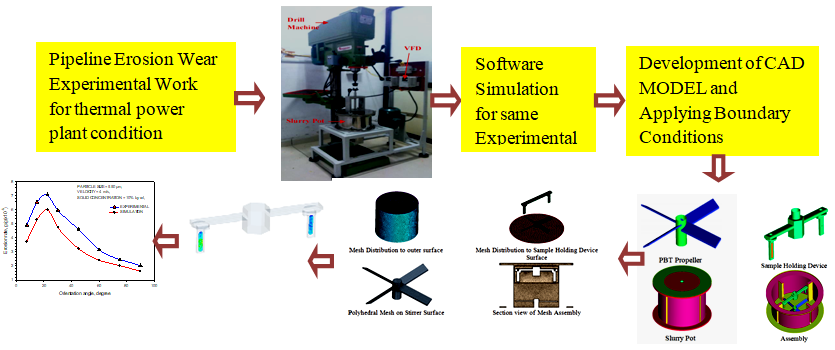
Downloads
References
V Javaheri, D Porter and VT Kuokkala. Slurry erosion of steel -review of tests, mechanisms and materials. Wear 2018; 408-409, 248-73.
S R More, D V Bhatt and J V Menghani. Recent research status on erosion wear - an overview. Mater. Today Proc. 2017; 4,257-66.
A Mansouri, H Arabnejad, SA Shirazi and BS McLaury. A combined CFD/experimental methodology for erosion prediction. Wear 2015; 332-333, 1090-7.
P Frawley, J Corish, A Niven and M Geron. Combination of CFD and DOE to analyse solid particle erosion in elbows. Int. J. Comput. Fluid Dyn. 2009; 23, 411-26.
C Y Wong, C Solnordal, A Swallow and J Wu.Experimental and computational modeling of solid particle erosion in a pipe annular cavity. Wear 2013; 303, 109-29.
AI Shahata, MT Youssef, KM Saqr and M Shehadeh. CFD investigation of slurry seawater flow effect in steel elbows. Int. J. Eng. Tech. Res. 2014; 3, 364-70.
MA Habib, R Ben-Mansour, HM Badr and ME Kabir. Erosion and penetration rates of a pipe protruded in a sudden contraction. Comput. Fluids 2008; 37, 146-60.
V Kannojiya, S Kumar, M Kanwar and SK Mohapatra. Simulation of erosion wear in slurry pipe line using CFD. Appl. Mech. Mater. 2016; 852, 459-65.
HS Grewal, A Agrawal and H Singh. Experimental and computational modelling of solid particle erosion in a pipe annular cavity. Tribol. Lett. 2013; 51, 1-7.
JH Kim, HG Joo and KY Lee. Simulation of solid particle erosion in WC-Ni coated wall using CFD. J. Mater. Proc. Technol. 2015; 224, 240-5.
L Ma, C Huang, Y Xie, J Jiang, KY Tufa, R Hui and ZS Liu. Modelingof erodent particle trajectories in slurry flow. Wear 2015; 334-335, 49-55.
A Mansouri, H Arabnejad, S Karimi, SAShirazi and BS McLaury. Improved CFD modeling and validation of erosion damage due to fine sand particles. Wear 2015; 338-339, 339-50.
M Azimian and H J Bart. CFD simulation and experimental analysis of erosion in a slurry tank test rig. Eur. Phys. J. Conf. 2013; 45, 01009.
DD Deshmukh and VD Kalyankar. Deposition characteristics of multitrack overlay by plasma transferred arc welding on SS316L with Co-Cr based alloy - influence of process parameters. High Temp. Mater. Process. 2019; 38, 248-63.
HV Naik, DD Deshmukh and VD Kalyankar. Study of heat treatment effect on microstructure of PTA weld deposited surface of SS 316L steel. In: M Shunmugam and M Kanthababu (Eds.). Advances in additive manufacturing and joining.Lecture notes on multidisciplinary industrial engineering. Springer, Singapore, 2020.
VD Kalyankar and DD Deshmukh. Failure investigations of failed valve plug SS410 steel due to cracking. IOP Conf. Ser.: Mater. Sci. Eng. 2017; 282, 012007.
SR More, DV Bhatt and JV Menghani. Study of the parametric performance of solid particle erosion wear under the slurry pot test rig. Tribol. Ind. 2017; 39, 471-81.
SR More, SP Ingole, DV Bhatt and JV Menghani. The study of slurry erosion wear behaviour of coal bottom ash slurry handling pipeline. In: TMS 2019 148th annual meeting & exhibition supplemental proceedings. The minerals, metals & materials series. Springer, Cham, Switzerland, 2019, p. 697-710.
SR More, DV Bhatt and JV Menghani. Failure analysis of coal bottom ash slurry pipeline in thermal power plant. Eng. Fail. Anal. 2018; 90, 489-96.
D Bree, WF Rosenbrand and AWJD Gee. On the erosion resistance in water-sand mixtures of steels for application in slurry pipelines. In: Proceedings of 8thHydrotransport of Solids in Pipes, BHRA Fluid Engineering, Johannesburg, South Africa. 1982.
GR Desale, BK Gandhi and SC Jain. Particle size effects on the slurry erosion of aluminium alloy (AA 6063). Wear 2009; 266, 1066-71.
I Finnie. Erosion of surfaces by solid particles. Wear 1960; 3, 87-103.
Downloads
Published
How to Cite
Issue
Section
License

This work is licensed under a Creative Commons Attribution-NonCommercial-NoDerivatives 4.0 International License.





