
Analysis of Cutting Forces and Surface Roughness in Machining Al2219, Unhybrid and Hybrid Metal Matrix Nano Composites using CCD Design of Experiment
DOI:
https://doi.org/10.48048/tis.2022.4499Keywords:
Unhybrid, Hybrid nano MMCs, Surface roughness, Cutting force, RSMAbstract
Nano Composites (nano MMCs) exhibit outstanding engineering properties like wear resistance, better stiffness, low density, and excellent ratio of strength to weight and so on. Unhybrid and hybrid nano MMC composites were fabricated using liquid metallurgical stir casting technique. Turning of Al2219 through TiN coated carbide tool was carried out to investigate surface roughness and cutting forces, by considering the cutting parameters like feed rate and speed. Response surface methodology (RSM) was used to design the experiments and to analyze the obtained results. The obtained results indicated that the cutting forces and surface roughness increases with increase in feed rate and decreases with increase in cutting speed. RSM displayed model and measured values are truly close to each other, which shows that created model can be effectively used to predict the cutting force and surface roughness on turning of MMCs. The predicted model values and obtained experimental values were close to each other with minimal error of 5 %, so the model is adequate.
HIGHLIGHTS
- Nano Metal Matric Composites reinforced Al2219 with n-B4C & MoS2 particles successfully using stir casting
- Feed rate is the key influencing factor and the cutting speed had slight influence on cutting force, surface roughness and tool wear
- The experimental values obtained and predicted modeled values are within 5 % of each other, then the model is adequate
GRAPHICAL ABSTRACT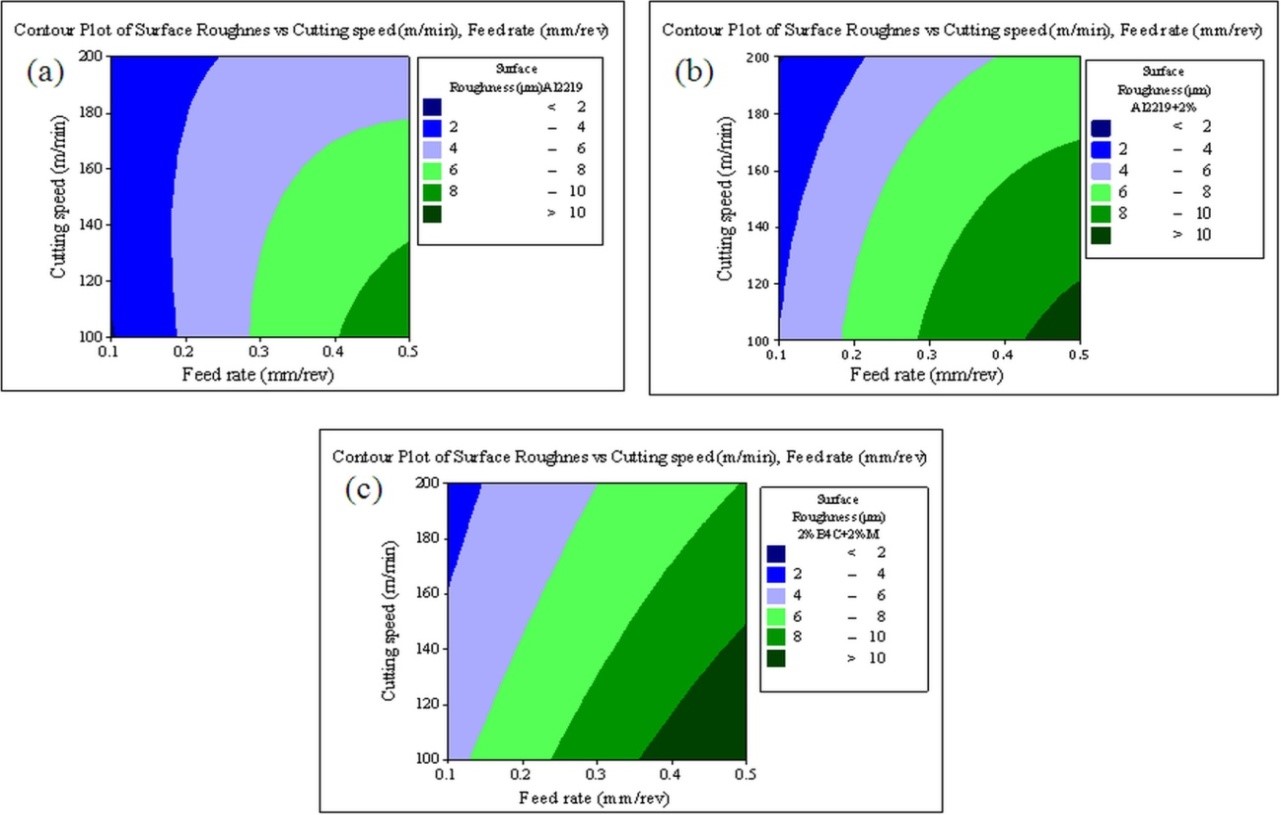
Downloads
References
EY El-Kady, AM Gaafer, HG Ghaith, T Khalil and AA Mostafa. The effect of machining parameters on the cutting forces, tool wear, and machined surface roughness of metal matrix nano composite material. Adv. Mater. 2015; 4, 43-50.
X Teng, D Huo, E Wong, G Meenashisundaram and M Gupt. Micro-machinability of nanoparticle-reinforced Mg-based MMCs: An experimental investigation. Int. J. Adv. Manuf. Technol. 2016; 87, 2165-78.
CRP Rao, MS Bhagyashekar and Narendraviswanath. Effect of machining parameters on the surface roughness while turning particulate composites. Procedia Eng. 2014; 97, 421-31.
A Srinivasan, RM Arunachalam, S Ramesh and JS Senthilkumaar. Machining performance study on metal matrix composites-a response surface methodology approach. Am. J. Appl. Sci. 2012; 9, 478-83.
DSC Kishore, KP Rao and A Mahamani. Investigation of cutting force, surface roughness and flank wear in turning of in-situ Al6061-TiC metal matrix composite. Procedia Mater. Sci. 2014; 6, 1040-50.
M Khakbiz and F Akhlaghi. Synthesis and structural characterization of Al-B4C nano-composite powders by mechanical alloying. J. Alloys Compd. 2009; 479, 334-41.
D Jeyasimman, R Narayanaswamy, R Ponalagusamy, V Anandakrishnan and M Kamaraj. The effect of various reinforcements on dry sliding wear behaviour of AA6061 nano composites. Mater. Des. 2014; 64, 783-93.
S Sivasankaran, PT Harisagar, E Saminathan, S Siddharth and P Sasikumar. Effect of nose radius and graphite addition on turning of AA 7075-ZrB2 in-situ composites. Procedia Eng. 2014; 97, 582-9.
M Aramesh, Y Shaban, M Balazinski, H Attiac, HA Kishaw and S Yacout. Procedia survival life analysis of the cutting tools during turning titanium metal matrix composites (Ti-MMCs). In: Proceedings of the 6th CIRP International Conference on High Performance Cutting, Berkeley, California. 2014, p. 605-9.
S Gopalakannan and T Senthilvelan. Application of response surface method on machining of Al-SiC nano-composites. Measurement 2013; 46, 2705-15.
B Das, S Roy, RN Rai and SC Saha. Studies on effect of cutting parameters on surface roughness of Al-Cu-TiC MMCs: An artificial neural network approach. Procedia Comp. Sci. 2015; 45, 745-52.
SK Saini and SK Pradhan. Optimization of multi-objective response during CNC turning using taguchi-fuzzy application. Procedia Eng. 2014; 97, 141-9.
R Suresh, S Basavarajappa, VN Gaitonde and GL Samuel. Machinability investigations on hardened AISI 4340 steel using coated carbide insert. Int. J. Refract. Met. Hard Mater. 2012; 33, 75-86.
K Palanikuma and R Karthikeyan. Assessment of factors influencing surface roughness on the machining of Al/SiC particulate composites. Mater. Des. 2007; 28, 1584-91.
S Suresha and BK Sridhara. Effect of silicon carbide particulates on wear resistance of graphitic aluminium matrix composites. Mater. Des. 2010; 31, 4470-7.
S Vijayraj, A Arivazhagan, G Prakash and G Prahbu. Optimization of machining parameters of Al-SiC nano composites using DOE. Int. J. Appl. Eng. Res. 2015; 10, 5863-9.
HS Manohar, N Chikkanna and BUM Gowda. Effect of addition of nano clay on machinability of Al/Nano clay metal matrix composites. Int. J. Eng. Res. App. 2012; 2, 1360-70.
JT Lin, D Bhattacharyya and C Lane. Machinability of a silicon carbide reinforced aluminium metal matrix composite. Wear 1995; 181-183, 883-8.
F Schultheissa, S Hagglund, V Bushlya, J Zhou and JE Stahla. Influence of the minimum chip thickness on the obtained surface roughness during turning operations. Procedia CIRP 2014; 13, 67-71.
P Suresh, K Marimuthu, S Ranganathan and T Rajmohan. Optimization of machining parameters in turning of Al-SiC-Gr hybrid metal matrix composites using grey-fuzzy algorithm. Trans. Nonferrous Met. Soc. China 2014; 24, 2805-14.
U Umer, H Kishawy, A Ghandehariun, L Xie and A Al-Ahmari. On modeling tool performance while machining aluminum-based metal matrix composites. Int. J. Adv. Manuf. Technol. 2017; 92, 3519-30.
R Bejjani, M Balazinski, H Attia, P Plamondon and G Lesperance. Chip formation and microstructure evolution in the adiabatic shear band when machining titanium metal matrix composites. Int. J. Mach. Tools Manuf. 2016; 109, 137-46.
D Priyadarshi and RK Sharma. Optimization for turning of Al-6061-SiC-Gr hybrid nano composites using response surface methodologies. Mater. Manuf. Process. 2015; 31, 1342-50.
NGS Kumar, TR Prabhu, GSS Shankar and S Basavarajappa. Dry sliding wear properties of un hybrid and hybrid Al alloy based nano composites. Tribol. Mater. Surf. Interfaces 2016; 10, 138-49.
NGS Kumar, TR Prabhu, RK Mishra, N Eswaraprasad, GSS Shankar and S Basavarajappa. Analysis of dry sliding wear behavior of the nano composites using statistical methods with an emphasis on temperature effects. Measurement 2018; 128, 362-76.
N Muthukrishnan, M Murugan and KP Rao. Machinability issues in turning of Al-SiC (10 %) metal matrix composites. Int. J. Adv. Manuf. Technol. 2008; 39, 211-8.
A Manna and B Bhattacharayya. A study on machinability of Al/SiC-MMC. J. Mater. Process. Technol. 2003; 14, 711-6.
Downloads
Published
How to Cite
Issue
Section
License

This work is licensed under a Creative Commons Attribution-NonCommercial-NoDerivatives 4.0 International License.





