
Health Risk Assessment of Ambient Nitrogen Dioxide Concentrations in Urban and Industrial Area in Rayong Province, Thailand
DOI:
https://doi.org/10.48048/tis.2022.4476Keywords:
Nitrogen dioxide (NO2), Passive sampler, Air pollution, Health risk assessment, Hazard quotient (HQ)Abstract
Nitrogen dioxide (NO2) is a hazardous gas and an air pollutant that is released from a variety of sources, including fossil fuel mining and burning, automobile emissions and other sources. The inhalation of NO2 has been linked to the exact causes of a variety of health issues, including respiratory disorders and a variety of other maladies. The largest source of NO2 exposure is through traffic density emissions. The concentrations of ambient NO2 in Rayong province’s urban, industrial and background areas were measured during rainy, winter and summer seasons. Samples of NO2 were collected with the use of passive samplers during September 2017 to April 2018. The result of the analysis revealed that NO2 concentration of urban area, industrial area and background area were 13.9 - 43.0, 10.4 - 34.0 and 5.8 - 35.2 µg/m3, respectively. It is to be noted that NO2 concentrations in urban and industrial areas were significantly higher than those in background areas (p < 0.05). The dominant source is located nearby high traffic density and industrial establishments. However, the NO2 values obtained from seasonal variations were not significantly different (p > 0.05). A weak correlation was observed between NO2 concentrations and total precipitation (r = −0.237). The low wind speed has no effect on NO2 dispersion. As a result of the geographical and seasonal variation of NO2 concentrations, it was determined that local activities such as traffic density had a much greater impact on NO2 levels than meteorological factors. The hazard quotient (HQ) values from NO2 exposure in Rayong province were less than 1, indicating that the risk was negligible. The inhalation of NO2 by residents who live near the roadside and highway, on the other hand, may endanger their health.
HIGHLIGHTS
- NO2 concentrations in Rayong province related to traffic density and industrial establishments
- The ambient NO2 levels in urban and industrial areas were approximately 1.4 times higher than those in background areas (p < 0.05)
- Residents of Rayong province who live near the roadside and highway road may put their health at risk due to NO2 inhalation
GRAPHICAL ABSTRACT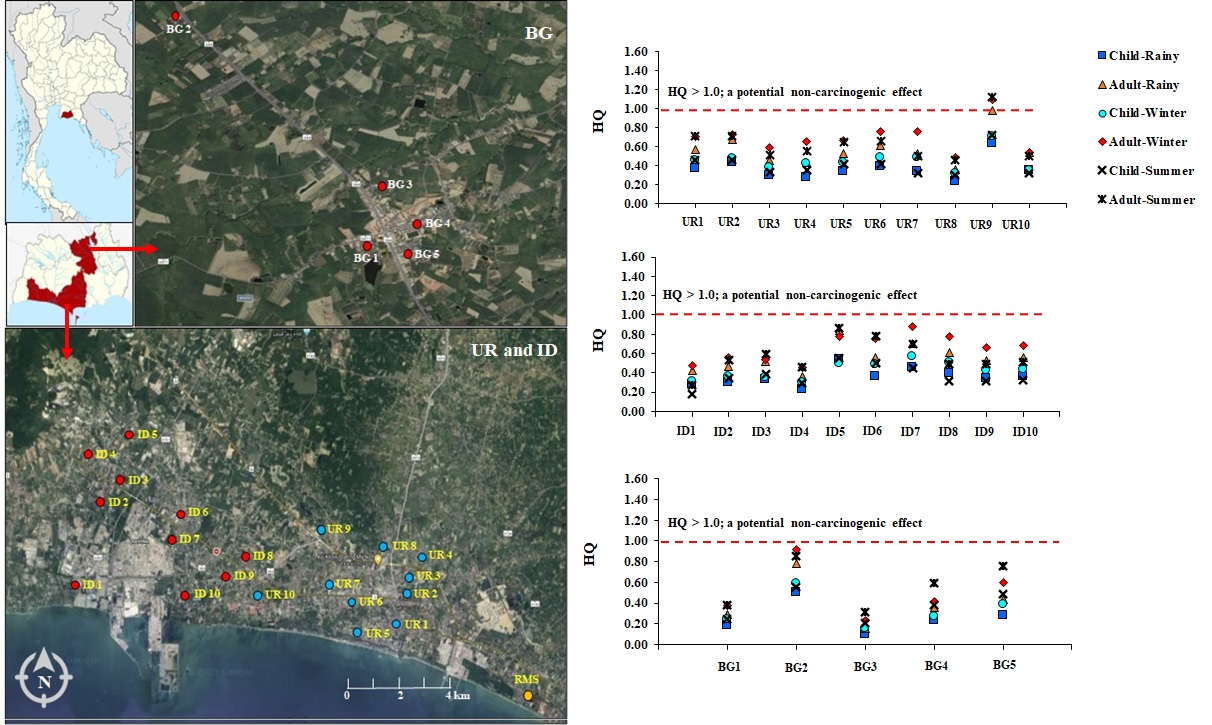
Downloads
References
BH Lee, EC Wood, SC Herndon, BL Lefer, WT Luke, WH Brune, DD Nelson, MS Zahniser and JW Munger. Urban measurements of atmospheric nitrous acid: A caveat on the interpretation of the HONO photostationary state. J. Geophys. Res. Atmos. 2013; 118, 12274-81.
M Masiol, A Hofer, S Squizzato, R Piazza, G Rampazzo and B Pavoni. Carcinogenic and mutagenic risk associated to airborne particle-phase polycyclic aromatic hydrocarbons: A source apportionment. Atmos. Environ. 2012; 60, 375-82.
Y Xie, B Zhao, L Zhang and R Luo. Spatiotemporal variations of PM2.5 and PM10 concentrations between 31 Chinese cities and their relationships with SO2, NO2, CO and O3. Particuology 2015; 20, 141-9.
G Favarato, HR Anderson, R Atkinson, G Fuller, I Mills and H Walton. Traffic-related pollution and asthma prevalence in children. Quantification of associations with nitrogen dioxide. Air Qual. Atmos. Health 2014; 7, 459-66.
F Cibella, G Cuttitta, RD Maggiore, S Ruggieri, S Panunzi, AD Gaetano, S Bucchieri, G Drago, MR Melis, SL Grutta and G Viegi. Effect of indoor nitrogen dioxide on lung function in urban environment. Environ. Res. 2015; 138, 8-16.
JT Varghese and S Ghosh. Trace species and air pollutant transport in green facades: A Vernonia Elaeanifolia case study for a built environment. Front. Heat Mass Tran. 2016; 7, 34.
A Coghlan. Nitrogen oxides in car exhaust kill tens of thousands in UK, Available at: https://www.newscientist.com/article/dn28245-nitrogen-oxide-is-not-so-harmless-and-coulddamage-human-health, accessed September 2020.
J Harkins and JK Goodwine. Oxides of nitrogen in diesel exhaust. J. Air Pollut. Contr. Assoc. 1964; 14, 34-8.
Y Shabbir, MF Khokhar, R Shaiganfar and T Wagner. Spatial variance and assessment of nitrogen dioxide pollution in major cities of Pakixtan along N5-Highway. J. Environ. Sci. 2016; 43, 4-14.
PD Hein, M Hangar, S Fabian and PM Tan. Concentrations of NO2, SO2, and benzene across Hanoi measured by passive diffusion samplers. Atmos. Environ. 2014; 88, 66-73.
SS Ahmad, P Biiker, L Emberson and R Shabbir. Monitoring nitrogen dioxide levels in urban areas in Rawalpindi, Pakistan. Water Air Soil Poll. 2011; 220, 141-50.
Z Bozkurt, G Doğan, D Arslanbaş, B Pekey, H Pekey, Y Dumanoğlu, A Bayram and G Tuncel. Determination of the personal, indoor and outdoor exposure levels of inorganic gaseous pollutants in different microenvironments in an industrial city. Environ. Monit. Assess. 2015; 187, 590.
M Zak, E Melaniuk-Wolny and K Widziewicz. The exposure of pedestrians, driveres and road transport passengers to nitrogen dioxide. Atmos. Pollut. Res. 2017; 8, 781-90.
MS Goldberg, F Labrèche, S Weichenthal, E Lavigne, MF Valois, M Hatzopoulou, KV Ryswyk, M Shekarrizfard, PJ Villeneuve, D Crouse and MÉ Parent. The association between the incidence of postmenopausal breast cancer and concentrations at street-level of nitrogen dioxide and ultrafine particles. Environ. Res. 2017; 158, 7-15.
D Norbäck, JH Hashim, Z Hashim and F Ali. Volatile organic compounds (VOC), formaldehyde and nitrogen dioxide (NO2) in schools in Johor Bahru, Malaysia: Associations with rhinitis, ocular, throat and dermal symptoms, headache and fatigue. Sci. Total Environ. 2017; 592, 153-60.
S Phuangketkeow. Thailand’s Eastern Economic Corridor (EEC): A bold strategic move, Available at: https://www.iseas.edu.sg/support, accessed September 2020.
E Niyomsilp, N Worapongpat and C Bunchapattanasakda. Thailand’s Eastern Economic Corridor (EEC): According to Thailand 4.0 economic policy. J. Leg. Entity Manag. Local Innovat. 2020; 6, 219-27.
S Bootdee, P Chalermrom and S Chantara. Validation and field application of tailor-made nitrogen dioxide passive sampler. Int. J. Environ. Sci. Tech. 2012; 9, 515-26.
AC Olufemi, A Mji and MS Mukhola. Health risks of exposure to air pollutants among students in schools in the vicinities of coal mines. Energ. Explor. Exploit. 2019; 37, 1638-56.
J Sun and T Zhou. Health risk assessment of China’s main air pollutants. BMC Publ. Health 2017; 17, 212.
V Garbero, A Montalto, N Lazovic, P Salizzoni, S Berrone and L Soulhac. Air pollution modeling and its application XXI. In: D Steyn and ST Castelli (Eds.). The impact of the urban air pollution on the human health: A case-study in Turin. Springer, Dordrecht, Netherlands, 2011, p. 729-32.
OM Morakinyo, AS Adebowals, MI Mokgobu and MS Mukhola. Health risk of inhalation exposure to sub-10 µm particulate matter and gaseous pollutants in an urban-industrial area in South Africa: An ecological study. BMJ Open 2017; 7, e013941.
L Khamyingkert and S Thepanondh. Analysis of industrial source concentration to ambient air cocncentration using AERMOD dispersion model. Environmentasia 2016; 9, 28-36.
P Ielpo, C Mangia, GP Marra, V Comite, U Rizza, VF Uricchio and P Fermo. Outdoor spatial distribution and indoor levels of NO2 and SO2 in a high environmental risk site of Southern Italy. Sci. Total Environ. 2019; 648, 787-97.
R Janta, J Kaewrat and C Rattikansukha. Measurement of nitrogen dioxide concentration in traffic area of Nakhon Si Thammarat province and health risk assessment. J. KMUTNB 2020; 30, 481-94.
J Kaewrat and R Janta. Health risk assessment of residents in a tourist city: A case study of Nakhon Si Thammart province. Walailak J. Sci. Tech. 2021; 18, 11510.
SS Ahmad and N Aziz. Spatial and temporal analysis of ground levels ozone and nitrogen dioxide concentration across the twin cities of Pakistan. Environ. Monit. Asses. 2013; 185, 3133-47.
G Ratto and A Nico. Preliminary wind analysis regrarding different speed ranges in the city of La Plata, Argentina. Revista Brasileira de Meteorologia 2012; 27, 281-90.
S Bootdee, S Wongtim, N Kerdtawee, S Phantu and N Chuathong. Spatial and temporal variation of ambient nitrogen dioxide concentrations in Pattaya city, Chon Buri province. J. KMUTNB 2019; 29, 482-94.
S Sillapapiromsuk and R Janta. Monitoring of ambient nitrogen dioxide concentrations in Lampang city by passive sampling. Khon Kaen Univ. Sci. J. 2018; 46, 560-71.
VS Chithra and SM Shiva Nagendra. Impact of outdoor meteorology on indoor PM10, PM2.5 and PM1 concentrations in a naturally ventilated classroom. Urban Clim. 2014; 10, 77-91.
A Gusti. Health risk assessment of inhalation exposure to SO2 and NO2 among traders in a traditional market. Publ. Health Indonesia 2019; 5, 30-5.
J Bangroy, R Janta, J Kaewrat and C Rattikansukha. Nitrogen dioxide concentration and health risk assessment at schools: Case study Tha sala District, Nakhon Si Thammarat province. IOP Conf. Ser. Earth Environ. Sci. 2020; 476, 012134.
U Gehring, AH Wijga, G Hoek, T Bellander, D Berdel, I Brüske, E Fuertes, O Gruzieva, J Heinrich, B Hoffmann, JC Jongste, C Klümper, GH Koppelman, M Korek, U Krämer, D Maier, E Melén, G Pershagen, DS Postma, M Standl, …, B Brunekreef. Exposure to air pollution and development of asthma and rhinoconjunctivitis throughout childhood and adolescence: A population-based birth cohort study. Lancet Respir. Med. 2015; 3, 933-42.
Downloads
Published
How to Cite
Issue
Section
License

This work is licensed under a Creative Commons Attribution-NonCommercial-NoDerivatives 4.0 International License.





