
The Application of Porous Material in the Capillary Barrier System for Residual Soil Slope Stabilization
DOI:
https://doi.org/10.48048/tis.2023.4465Keywords:
Porous concrete, Residual soil, Capillary barrier system, Soil slope, Slope stabilizationAbstract
A drainage system that is used to flow excess rainfall infiltration is an excellent alternative to enhance lateral diversion capacity at the interface of Grade VI and Grade V soil slope layers thus delaying breakthrough occurrences. This study aims to explore the performance of porous transport layer on slope behavior via numerical simulation by GeoStudio SEEP/W. In this study, a 2-dimensional non-homogenous residual soil configuration model, which is composed of Grade VI and Grade V residual soil was constructed. Laboratory tests were conducted on the soil samples collected from the Faculty of Engineering, UTM JB to determine the soil properties as input parameters in numerical modeling. The soil slope model is designed as an infinite residual soil slope according to Jabatan Kerja Raya (JKR) design specification on the cut slope and fill slope with 27 ° inclination respectively. High rainfall intensities were chosen to represent rainfall infiltration in Johor. The slope model was modeled with a porous transport layer at the Grade VI and Grade V layer interfaces. The porous transport layer is introduced as the transport layer and its effectiveness is expected to be similar to the optimum compacted soil mix in the previous study. In addition, porous concrete as a transport layer is introduced and it must meet the adequate porosity and hydraulic conductivity requirements. The suction distribution pattern with depth and time was subsequently observed to identify the volume of infiltrated water and retention time in the transport layer. The porous transport layer is also expected to be efficient in diverting infiltrating water and decreasing the interface's suction distribution between Grade VI and Grade V soil layers.
HIGHLIGHTS
- The water built up within the residual soil slope is one of the common factors of rainfall-induced residual soil slope failure thus porous transport layer introduced
- The detailed laboratory testing and numerical modelling conducted in order to identify the performance of porous transport layer within residual soil slope
- The application of porous transport layer sandwiched between residual soil is effective to decrease the water built up and matric suction thus decrease the risk of slope failure
GRAPHICAL ABSTRACT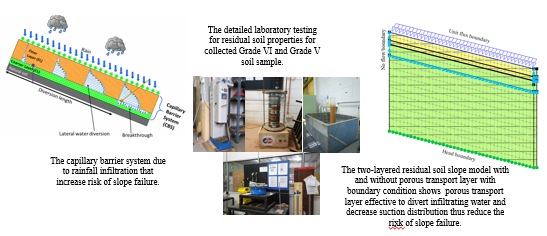
Downloads
References
P Saffari, W Nie, MM Noor, X Zhang and Q Liang. Characterization the geotechnical properties of a Malaysian granitic residual soil grade V. IOP Conf. Ser. Earth Environ. Sci. 2019; 289, 012006.
MF Ishak, MF Zolkepli and M Affendy. Tropical residual soil properties on slopes. Int. J. Eng. Tech. Sci. 2017; 4, 139-47.
SE Cho. Probabilistic stability analysis of rainfall-induced landslides considering spatial variability of permeability. Eng. Geol. 2014; 171, 11-20.
HQ Dou, TC Han, XN Gong, ZY Qiu and ZN Li. Effects of the spatial variability of permeability on rainfall-induced landslides. Eng. Geol. 2015; 192, 92-100.
JH Li, L Du, R Chen and LM Zhang. Numerical investigation of the performance of covers with capillary barrier effects. S. Chin. Comput. Geotech. 2013; 48, 304-15
H Krisdani, H Rahardjo and EC Leong. Behaviour of capillary barrier system constructed using residual soil. In: Proceedings of the Geo-Frontiers Congress, Austin, Texas. 2005.
D Wang, L Li and Z Li. A regularized Lagrangian meshfree method for rainfall infiltration triggered slope failure analysis. Eng. Anal. Bound. Elem. 2014; 42, 51-9.
AS Muntohar and HJ Liao. Rainfall infiltration: infinite slope model for landslides triggering by rainstorm. Nat. Hazards. 2010; 54, 967-84.
LZ Wu, RQ Huang, Q Xu, LM Zhang and HL Li. Analysis of physical testing of rainfall-induced soil slope failures. Environ. Earth Sci. 2015; 73, 8519-31.
TL Tsai and SJ Chiang. Modeling of layered infinite slope failure triggered by rainfall. Environ. Earth Sci. 2013; 68, 1429-34.
GR Zhang, YJ Qian, ZC Wang and B Zhao. Analysis of rainfall infiltration law in unsaturated soil slope. Sci. World J. 2014; 2014, 567250.
GH Yunusa and A Kassim. Laboratory investigation of drainage cell as transport layer in residual soils. Jurnal Teknologi 2016; 78, 6-12.
A Kassim. 2011, Modelling the effect of heterogeneities on suction distribution behaviour in tropical residual soil. Ph. D. Dissertation. Universiti Teknologi Malaysia, Malaysia.
American Concrete Institute. Report on pervious concrete. American Concrete Institute, Michigan, 2010.
DS Patil, AM Khan and TAM Ansari. 2019, Experimental investigation on pervious concrete. Dissertation, Department of Civil Engineering, School of Civil Engineering and Technology, Anjuman-I-Islam’s Kalkesar Technical Campus.
P Chindaprasirt, S Hatanaka, T Chareerat, N Mishima and Y Yuasa. Cement paste characteristics and porous concrete properties. Construct. Build. Mater. 2008; 22, 894-901.
SB Singh, P Munjal and N Thammishetti. Role of water/cement ratio on strength development of cement mortar. J. Build. Eng. 2015; 4, 94-100.
IGB Indrawan, H Rahardjo and EC Leong. Effects of coarse-grained materials on properties of residual soil. Eng. Geol. 2006; 82, 154-64.
DN Singh and SJ Kuriyan. Estimation of unsaturated hydraulic conductivity using soil suction measurements obtained by an insertion tensiometer. Can. Geotech. J. 2003; 40, 476-83.
MV Prodan and Z Arbanas. Weathering influence on properties of siltstones from Istria, Croatia. Adv. Mater. Sci. Eng. 2016; 2016, 1-15.
M Wang, L Kong and M Zang. Effects of sample dimensions and shapes on measuring soil-water characteristic curves using pressure plate. J. Rock Mech. Geotech. Eng. 2015; 7, 463-8.
S Oh, YK Kim and JW Kim. A modified van Genuchten-Mualem model of hydraulic conductivity in Korean residual soils. Water 2015; 7, 5487-502.
YB Yamusa, MA Hezmi, K Ahmad, A Kassim, R Saari, N Alias and ASA Rashid. Soil water characteristic curves for laterite soil at different water contents and methods as lining system. IOP Conf. Ser. Mater. Sci. Eng. 2019; 527, 012002.
M Heidemann, LA Bressani, WYY Gehling, JAA Flores and MS Porto. Influence of structure in the soil-water characteristic curves of two residual soils of granite. E3S Web Conf. 2016; 9, 11002.
H Rahardjo, A Satyanaga, F Harnas, J Wang and E Leong. Capillary barrier system for landfill capping. In: Proceedings of the Coupled Phenomena in Environmental Geotechnics, Torino, Italy. 2013.
PJM Monteiro, AP Kirchheim, S Chae, P Fischer, AA MacDowell, E Schaible and HR Wenk. Characterizing the nano and micro structure of concrete to improve its durability. Cement Concr. Compos. 2009; 31, 577-84.
J Hu, Z Qian, P Liu, D Wang and M Oeser. Investigation on the permeability of porous asphalt concrete based on microstructure analysis. Int. J. Pave. Eng. 2020; 21, 1683-93.
MIM Yusak, RP Jaya, MR Hainin and MH Wan. A review of microstructure properties of porous concrete pavement incorporating nano silica. ARPN J. Eng. Appl. Sci. 2016; 11, 11832-5.
Y Millogo and JC Morel. Microstructural characterization and mechanical properties of cement stabilized adobes. Mater. Struct. 2012; 45, 1311-8.
A Chegenizadeh, M Keramatikerman and H Nikraz. Importance of microstructural analysis in experimental soil stabilization. Global J. Eng. Sci. 2020; 4, 1-4.
MAM Ismail, NH Hamzah, NS Min, MHZ Abidin, SAA Tajudin and A Madun. Analysis of infiltration-suction response in unsaturated residual soil slope in Gelugor, Penang. J. Phys. Conf. Ser. 2018; 995, 012052.
H Rahardjo, V Santoso, E Leong, Y Ng, and C Hua. Performance of horizontal drains in residual soil slope. Soils Found. 2011; 15, 437-47.
TLT Zhan, H Li, GW, YM Chen and DG Fredlund. Physical and numerical study of lateral diversion by three-layer inclined capillary barrier covers under humid climatic conditions. Can. Geotech. J. 2014; 51, 1438-48.
L Zhan, W Jiou, L Kong and Y Chen. Long-term performance of capillary barrier cover with unsaturated drainage layer in humid climate. In: Proceedings of the Geo-Congress, Atlanta, Georgia. 2014, p. 1890-9.

Downloads
Published
How to Cite
Issue
Section
License
Copyright (c) 2022 Walailak University

This work is licensed under a Creative Commons Attribution-NonCommercial-NoDerivatives 4.0 International License.





