
Element Contamination and Probable Ecological Concern in Surface Sediments of the Black Sea’s Iğneada Coasts
DOI:
https://doi.org/10.48048/tis.2022.3974Keywords:
Iğneada, Black Sea, Metal, Sediment quality guidelines, Enrichment factor, Geoaccumulation index, Pollution load indexAbstract
Enrichments of metals in surface sediments from Iğneada shores of the Black Sea were analysed to define the level of contamination in the region. For this purposes, Cd, Hg, Pb, Cu, Cr, Ni, Zn, Mn, Al and Fe levels in surface sediments were studied from 6 stations. Sediment samples were collected using a Van Veen grab. Elemental analyses in sediments were measured by Inductively Coupled Plasma-Mass Spectrometry (ICP-MS). The concentrations of metals varied from 0.031 to 0.091 for Cd; 0.025 to 0.064 for Hg; 3.32 to 7.88 for Pb; 5.75 to 13.42 for Cu; 25.63 to 40.07 for Cr; 14.8 to 28.2 for Ni; 18.29 to 33.21 for Zn; 268 to 377 for Mn; 10,987 to 17,101 for Al; and 11,521 to 20,700 mg·kg₋1 for Fe mg·kg₋1 dry wt. Metal levels were found to be much lower than recommended levels when compared to Sediment Quality Criteria for surface sediments. Enrichment Factors (EF), Geo-Accumulation Index (Igeo) and Pollution Load Index (PLI) were applied to the data for assessing the sediment quality. EF values were nearly between 0.33 and 2.4. Mostly EF for metals were less than 2, may be come from natural weathering processes or crustal substances, indicate no enrichment. However, some results of EF values slightly exceeding 2 indicate moderate enrichment. These rates aren’t thought to be important. Igeo values for all metals were less than 0 at all stations, suggesting that the Iğneada shores was uncontaminated by these studied metals. PLI values ranged from 0.410 in station I to 0.747 in station IV, indicating that Iğneada shores in the Black Sea were less impacted by these metals. PLI value for zone was found as 0.553665002. The Igeo and PLI values also suggest that surface sediments in Iğneada shores of the Black Sea is uncontaminated.
HIGHLIGHTS
- Metal enrichments in surface sediments from the Black Sea coasts of İğneada were studied to determine the level of contamination in the area
- EF values less than or equal to 2 indicate that there is no contamination, and that the concentration is within the natural background prediction range. Only the EF values for Cr and Ni were between 2 and 5, indicating moderate enrichment
- The Igeo analyses revealed that the İğneada shores sediments were unpolluted for all studied metal levels at all stations
- All PLI values in the stations were between 0 and 1, indicating that İğneada shores were less impacted by these metals
GRAPHICAL ABSTRACT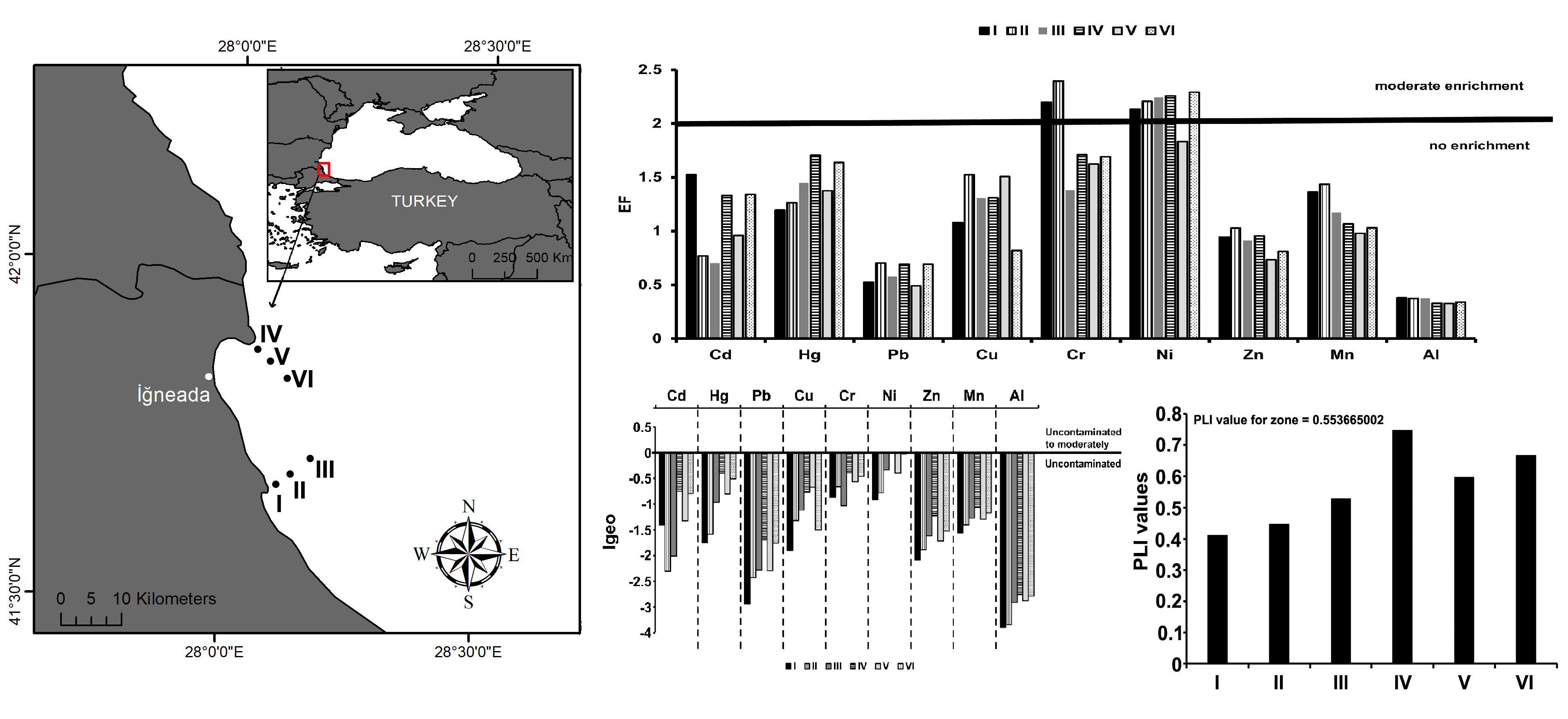
Downloads
References
D Ürkmez, M Sezgin, ME Karaçuha and İ Öksüz. Meiobenthic assemblages from the Southwestern Coast of the Black Sea, Igneada (Turkey). Biologia 2016; 71, 1017-26.
G Kurt-Şahin, M Sezgin, F Ünlüer, B Öztürk, E Cavdar and E Dağlı. Macrozoobenthic community structure of Iğneada region in Turkey (the southwestern Black Sea). Oceanol. Hydrobiol. Stud. 2017; 46, 340-9.
V Velikova, L Boicenco, C Beken-Polat, S Moncheva, L Bat, M Sezgin, T Begun and A Oros. Diagnostic report II: Guiding improvements in the Black Sea monitoring system. European Commission Directorate-General for Environment, Brussels, Belgium, 2013, p. 295.
T Begun, V Velikova, M Muresan, T Zaharia, K Dencheva, M Sezgin and L Bat. Conservation and protection of the Black Sea biodiversity. European Commission Directorate-General for Environment, Brussels, Belgium, 2012, p. 110.
HH Tok, N Öner and E Gönülsüz. The threats and opportunities of the natural resources aimed at ecological agriculture in the Iğneada and its surroundings. Challenges of establishment and management of a trans-border biosphere reserve between Bulgaria and Turkey in Strandzha Mountain. In: Proceedings of the UNESCO-BAS-MOEW workshop, Bourgas, Bulgaria. 2005, p. 15-9.
B Öztürk, B Topaloğlu, A Kıdeys, L Bat, Ç Keskin, M Sezgin, A Amaha Öztürk and AC Yalciner. A proposal for new marine protected areas along the Turkish Black Sea coast. J. Black Sea 2013; 19, 365-79.
A Oros, V Coatu, D Secrieru, D Tiganus, D Vasiliu, H Atabay, C Beken, L Tolun, S Moncheva and L Bat. Results of the assessment of the western Black Sea contamination status in the frame of the MISIS Joint Cruise. Cercetări Mar. 2016; 46, 61-81.
L Bat, A Öztekin, F Şahin, E Arıcı and U Özsandıkçı. An overview of the Black Sea pollution in Turkey. Mediterr. Fish. Aquaculture Res. 2018; 1, 66-86.
L Bat, O Gökkurt, M Sezgin, F Üstün and F Sahin. Evaluation of the Black Sea land based sources of pollution the coastal region of Turkey. Open Mar. Biol. J. 2009; 3, 112-24.
Marine Strategy Framework Directive. Directive 2008/56/EC of the European parliament and of the council of 17 June 2008 establishing a framework for community action in the field of marine environmental policy. Official J. Eur. Union 2008; L164, 19-40.
L Bat and EY Özkan. Heavy metal levels in sediment of the Turkish Black Sea coast. In: Informaiton Management Association (Ed.). Oceanography and coastal informatics: Breakthroughs in research and practice. IGI Global, Hershey, United States, 2019, p. 86-107.
L Bat, EY Özkan and HC Öztekin. The contamination status of trace metals in Sinop coast of the Black Sea, Turkey. Caspian J. Environ. Sci. 2015; 13, 1-10.
KH Wedepohl. The composition of the continental crust. Geochimica et Cosmochimica Acta 1995; 59, 1217-32.
RA Sutherland. Bed sediment-associated trace metals in an urban stream, Oahu, Hawaii. Environ. Geol. 2000; 39, 611-27.
G Müller. Index of geoaccumulation in the sediments of the Rhine River. J. Geol. 1969; 2, 108-18.
Y Ji, Y Feng, J Wu, T Zhu, Z Bai and C Duan. Using geoaccumulation index to study source profiles of soil dust in China. J. Environ. Sci. 2008; 20, 571-8.
M Ahmadov, F Humbatov, S Mammadzada, V Balayev, N Ibadov and Q Ibrahimov. Assessment of heavy metal pollution in coastal sediments of the western Caspian Sea. Environ. Monit. Assess. 2020; 192, 500.
G Müller. Schadstoffe in sedimenten-sedimente als schadstoffe. Mitt Österreichische Geologische Gesellschaft 1986; 79, 107-26.
DL Tomlinson, JG Wilson, CR Harris and DW Jeffrey. Problems in the assessment of heavy metal levels in estuaries and the formation of a pollution. Helgoländer Meeresuntersuchungen 1980; 33, 566-75.
Republic of Turkey Presidential Legislation Information System. Turkish environmental regulations water pollution control regulation, Available at: https://www.mevzuat.gov.tr/mevzuat?MevzuatNo=
&MevzuatTur=7&MevzuatTertip=5, accessed March 2021.
SL Simpson and GE Batley. Sediment quality assessment: A practical guide. 2nd ed. CSIRO Publishing, Canberra, Australia, 2016.
KD Daskalakis and TP O'Connor. Normalization and elemental sediment contamination in the coastal United States. Environ. Sci. Tech. 1995; 29, 470-7.
L Bat, E Arici and A Öztekin. Threats to quality in the coasts of the Black Sea: Heavy metal pollution of seawater, sediment, macro-algae and seagrass. In: PK Shit, PP Adhikary, D Sengupta (Eds.). Spatial modeling and assessment of environmental contaminants. Environmental challenges and solutions. Springer, Switzerland, 2021, p. 289-325.
S Topçuoğlu, Ç Kırbaşoğlu and N Güngör. Heavy metals in organisms and sediments fromTurkish coast of the Black Sea, 1997-1998. Environ. Int. 2002; 27, 521-6.
A Mülayim and H Balkıs. Toxic metal (Pb, Cd, Cr, and Hg) levels in Rapana venosa (Valenciennes, 1846), Eriphia verrucosa (Forskal, 1775), and sediment samples from the Black Sea littoral (Thrace, Turkey). Mar. Pollut. Bull. 2015; 95, 215-22.
F Yücesoy and M Ergin. Heavy-metal geochemistry of surface sediments from the southern Black Sea shelf and upper slope. Chem. Geol. 1992; 99, 265-87.
N Kıratlı and M Ergin. Partitioning of heavy metals in surface Black Sea sediments. Appl. Geochem. 1996; 11, 775-88.
M Ünsal, N Çağatay, Y Bekiroğlu, N Kıratlı, N Alemdağ, M Aktaş and E Sarı. The heavy metal pollution in the Black Sea (in Turkish). Project no: YDEBÇAG-456/G-457/G1998.
S Topçuoğlu. Black Sea ecology. Pollution research in Turkey of the marine environment. Int. Atom. Energ. Agency Bull. 2000; 42, 12-4.
M Ünsal. Lead pollution and its sources along the Turkish coast of the Black Sea. Mediterr. Mar. Sci. 2001; 2, 33-44.
M Ergin, Ş Keskin, O Algan, B Alpar, D Ongan. E Kırcı, E Bayhan and A Temel. Late quaternary geology of the Southwestern Black Sea continental shelf: Sedimentological, shallow seismic stratigraphic, mineralogical and geochemical investigations (in Turkish). Technical report, TUBİTAK Project no:198Y083. 2003, p. 175.
M Ergin. Metal pollution at sea, jeologic and anthropologic heavy metal pollution in the Black Sea, Aegean Sea and Mediterranean Sea sediments. In: KC Güven and B Öztürk (Eds.). Marine pollution. Turkish Marine Research Foundation (TUDAV), Istanbul, Turkey, 2005, p. 161-76.
EY Özkan and B Büyükışık. Geochemical and statistical approach for assessing heavy metal accumulation in the southern Black Sea sediments. Ekoloji 2012; 21, 11-24.
M Sur, HI Sur, R Apak and E Erçağ. The pollution status of bottom surface sediments along the Turkish coast of the Black Sea. Turkish J. Fish. Aquatic Sci. 2012; 12, 453-60.
MS Engin, A Uyanik, S Cay and I Kir. Evaluation of trace metals in sediment, water, and fish (Mugil cephalus) of the central Black Sea coast of Turkey. Hum. Ecol. Risk Assess. 2015; 22, 241- 50.
Downloads
Published
How to Cite
Issue
Section
License

This work is licensed under a Creative Commons Attribution-NonCommercial-NoDerivatives 4.0 International License.





