
Gamma Irradiation Induced High Yield Mutant Genotype Samosir Local Shallot in the Third Generation
DOI:
https://doi.org/10.48048/tis.2022.3681Keywords:
Heritability, Mutant M1V3, Shallot, γ-rays irradiationAbstract
The gamma irradiation can promote the agronomic characters of plant. This study aims to obtain putative mutant genotype of the 3rd generation Samosir local shallot (M1V3), which highly yields. The study used the augmented design in which 8 mutant genotypes of Samosir local shallot from the 2nd generation after gamma (γ)-ray treatment were planted along with untreated. The differences between the irradiation plants and untreated were tested by t-test: Similarity distance and dendrogram were analyzed using the hierarchical cluster. The results showed that almost all the mean values made by all quantitative agronomic character changes in the M1V3 populations were higher than those made in M1V2. The expected high heritability value with a broad coefficient of genetic diversity was found in the character of fresh and dried bulb’s weight resulted from genotype populations treated with γ rays irradiation with doses 3, 4 and 5 Gy. High heritability values were also found in the fresh weight and dry weight of bulb in genotype populations treated with doses 1 and 2 Gy with moderate genetic diversity coefficients. Selection based on the dried bulb’s weight from each mutant genotype population with a selection intensity of 30 % was obtained 39 genotypes that showed the highest selection index. The highest number of genotypes were selected from the application of γ-rays with a dose of 1 to 2 Gy, each of 10 genotypes. Therefore, application at the dose of 1 - 2 Gy in M1V3-generation for Samosir local shallot can still improve the yielding character through breeding to archive shallot in national.
HIGHLIGHTS
- The low doses (1 to 5 Gy) of gamma rays increased the growth and yield of shallots in the third generation
- The dose at 2 Gy of gamma ray resulted in the highest plant length, number of tillers, number of bulbs, fresh- and dry weight of bulbs in mutant M1V3 of Samosir local shallot
- The results found that 38 of 39 shallot mutants had greater characters compared to the control
- The application of 1 - 2 Gy gamma rays on local shallots in the third generation can be used as an effort to increase the yield character
GRAPHICAL ABSTRACT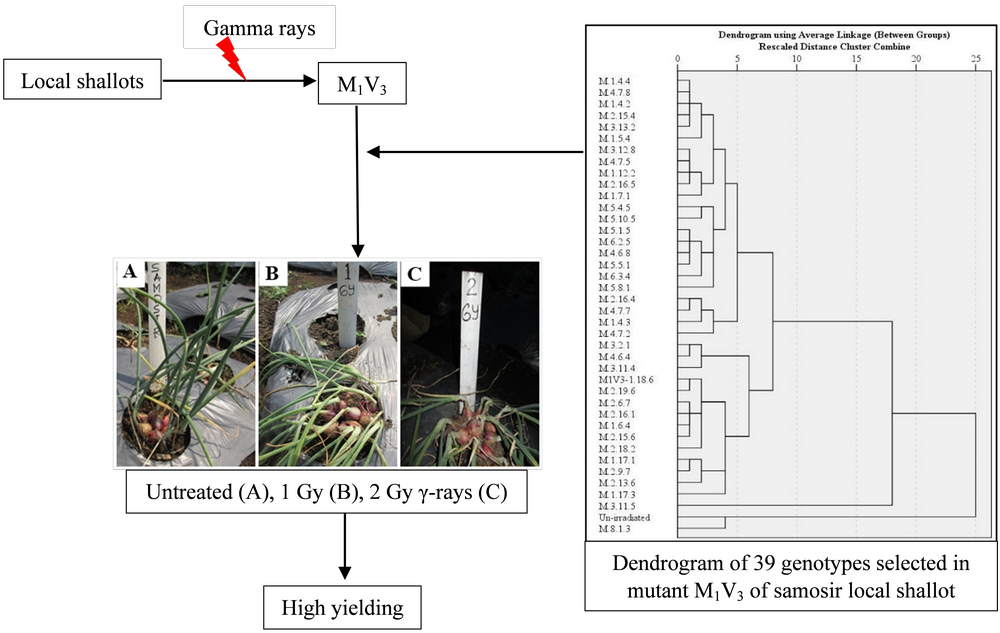
Downloads
References
Statistics of Samosir District. Samosir regency in figures 2018, Available at: https://samosirkab. bps.go.id/publication/2018/08/16/65990ba288f439c515bdb1f5/kabupaten-samosir-dalam-angka-2018.html, accessed 20 January 2020.
Ministry of Agriculture. Last five years data, Available at: https://www.pertanian.go.id/home/?show =page&act=view&id=61, accessed 17 January 2020.
Mugiono, L Harsanti and AK Dewi. The improvement of cisantana rice variety through induced mutation. Sci. J. Appl. Isotopes Radiat. 2009; 5, 194-210.
CP Hiremath, HL Nadaf and CM Keerthi. Induced genetic variability and correlation studies for yield and its component traits in groundnut (Arachis hypogaea L.). Electron. J. Plant Breed. 2011; 2, 135-42.
M Sinuraya, R Rosmayati, H Hasanuddin and DS Hanafiah. Agronomic characteristic, genetic variability and heritability of mutant samosir shallot M1V2 generation irradiated by gamma rays. Bulg. J. Agric. Sci. 2019; 25, 1024-29.
AMV Harten. Mutation breeding: Theory and practical applications. Cambridge University Press, Cambridge, 1998, p. 353.
MA Ali. Effectiveness of selection in the F3 and F5 generations in grain sorghum. Asian J. Crop Sci. 2012; 4, 23-31.
D Roy. Plant breeding: Analysis and exploitation of variation. Alpha Science International Ltd, Oxford, 2000, p. 728.
JR Sharma. Statistical and biometrical techniques in plant breeding. New Age International Publisher, Delhi, India, 2006, p. 432.
RK Singh and BD Chaudhary. Biometrical methods in quantitative genetic analysis. Kalyani Publishers, Delhi, India, 1979, p. 288.
M Sinuraya, Rosmayati, Hasanuddin and DS Hanafiah. Radiosensitivity and the influence of gamma rays irradiation on local samosir shallots. In: Proceedings of the 5th Annual International Conference Syiah Kuala University in conjunction with the 8th International Conference of Chemical Engineering on Science and Applications, Banda Aceh, Indonesia. 2015, p. 228-31.
SG Wi, BY Chung, JS Kim, JH Kim, MH Baek, JW Lee and YS Kim. Effects of gamma irradiation on morphological changes and biological responses in plants. Micron 2007; 38, 553-64.
S Abdullah, NY Kamaruddin and AR Harun. The effect of gamma radiation on plant morphological characteristics of Zingiber officinale Roscoe. Int. J. Adv. Sci. Eng. Inf. Technol. 2018; 8, 2085-91.
JE Gunckel and AH Sparrow. Ionizing radiations: Biochemical, physiological, and morphological aspects of their effects on plants. In: W Ruhland (Ed.). Encyclopedia of plant physiology. Springer, Berlin, Germany, 1967, p. 555-611.
PRR Kumar and SV Ratnam. Mutagenic effectiveness and efficiency in varieties of sunflower (Helianthus annuus L.) by separate and combined treatment with gamma-rays and sodium azide. Afr. J. Biotechnol. 2010; 9, 6517-21.
O Celik, C Atak and Z Suludere. Response of soybean plants to gamma radiation: Biochemical analyses and expression patterns of trichome development. Plant Omics 2014; 7, 382-91.
MS Afrin, MA Kabir and MS Alam. Effect of gamma radiation on the growth, yield and quality of four onion accessions. IOSR J. Agric. Vet. Sci. 2019; 12, 68-78.
Suharsono, M Jusuf and AP Paserang. Analisis ragam, heritabilitas dan pendugaan kemajuan seleksi populasi F2 dari persilangan kedelai kultivar Slamet x Nokonsawon (in Indonesian). J. Tanaman Tropika 2006; 9, 86-93.
Suprapto and NM Kairudin. Genetic variation, heritability, gene action and genetic advance of soybean on ultisol (in Indonesian). Indones. J. Agric. Sci. 2007; 9, 183-90.
M Syukur, S Sujiprihati and R Yuniati. Teknik pemuliaan tanaman (in Indonesian). Penebar Swadaya, Jakarta, Indonedia, 2015.
L Hakim. Genetic variability, heritability and correlation of some agronomic characters in the F2 of varietal crosses of mungbean [Vigna radiata (L.) Wilczek] (in Indonesian). Berita Biologi J. Ilmu-Ilmu Hayati 2010; 10, 23-32.
N Sa’diyah. Genetic variability, heritability, and genetic progress: Stomatal frequency and leaf greenness oF F4 soybean lines. J. Agrotopika 2011; 16, 80-3.
MAJ Parry, PJ Madgwick, C Bayon, K Tearall, A Hernandez-Lopez, M Baudo, M Rakszegi, W Hamada, A Al-Yassin, H Ouabbou, M Labhilili and AL Phillips. Mutation discovery for crop improvement. J. Exp. Bot. 2009; 60, 2817-825.
NF Sianipar, R Purnamaningsih, DL Gumanti, Rosaria and M Vidianty. Analysis of gamma irradiated-third generation mutants of rodent tuber (Typhonium flagelliforme lodd.) based on morphology, RAPD, and GC-MS Markers. Pertanika J. Trop. Agric. Sci. 2017; 40, 185-202.
Downloads
Published
How to Cite
Issue
Section
License

This work is licensed under a Creative Commons Attribution-NonCommercial-NoDerivatives 4.0 International License.





