
The Effects of Surface Roughness of the Stainless-Steel Anode on Electricity Enhancement of Microbial Fuel Cell
DOI:
https://doi.org/10.48048/tis.2022.3680Keywords:
Renewable energy, Microbial fuel cells, Anode, Roughness, Open circuit voltageAbstract
Microorganisms actively catabolize substrate, and bioelectricity is generated. Microbial fuel cells (MFCs) could be utilized as a power generator in small devices. The discovery of species of microorganisms is called Rhodopseudomonas palustris KU-EGAT 13. The experiments have been conducted with the production of electricity from this type of microorganism in a single chamber microbial fuel cell. The study used 4 surface roughness of anode electrode single chamber micro fuel to study the performance of microbial fuel cell effect from the anode. Three stainless steel plates were polished to uniform roughness to the magnitude between 0.05 and 1 µm. After 24 h of experimentation, the rough electrode’s open-circuit voltage (OCV) and power densities were much higher than that produced by the smooth one. Moreover, the smooth surface is higher than the charge-transfer resistance of the rough electrode. The rough surface’s better electrochemical performance is due to denser biofilm grown on the surface, which was observed by scanning electron microscopy (SEM) and figuring out the microbial number in an image using an ImageJ program.
HIGHLIGHTS
- The new discovery of species of microorganisms is called Rhodopseudomonas palustris KU-EGAT 13 which can produce electricity in a single chamber microbial fuel cell
- The performance of MFCs has gotten an effect from the different anode surface roughness.The biomass growth is larger than a rougher anode surface, which contributes to anode’s efficiency
- After observed by SEM, found that when it is in the highest anode surface roughness directed towards the number of microbes stick on the surface
GRAPHICAL ABSTRACT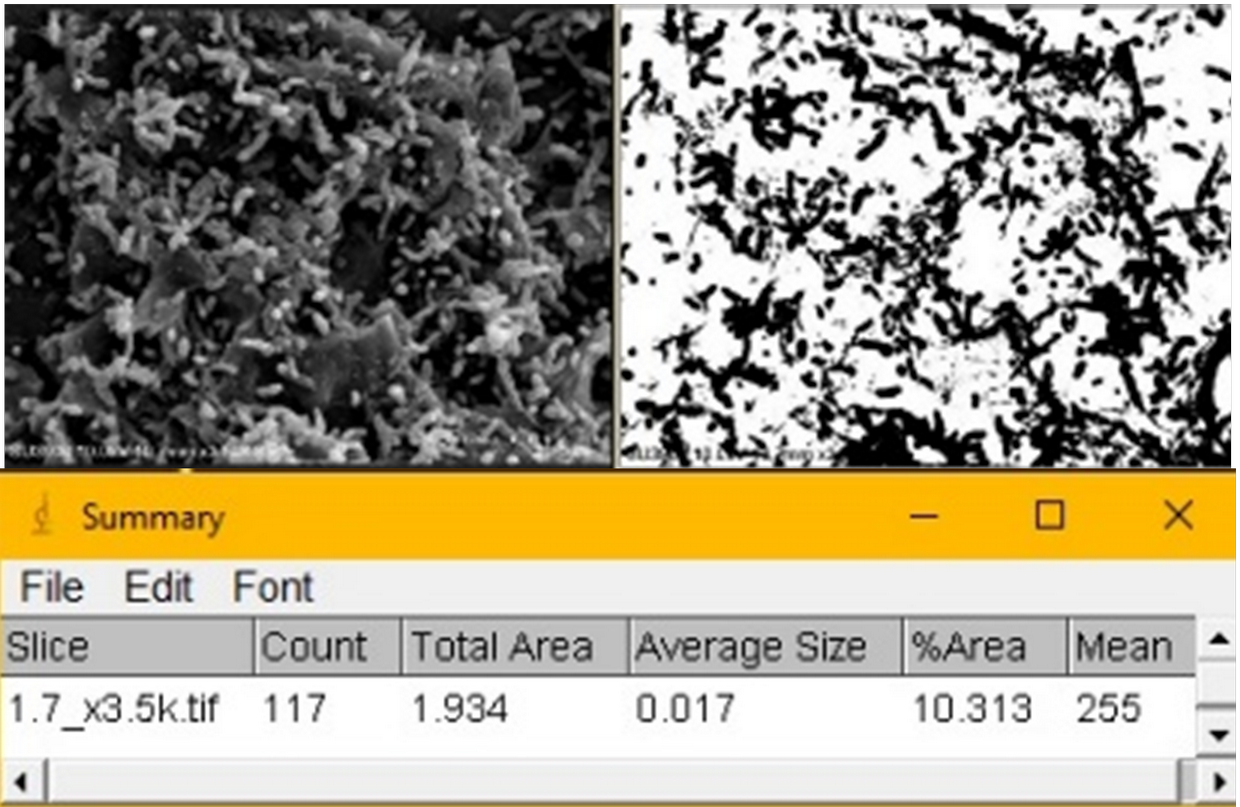
Downloads
References
M Rahimnejad, A Adhami, S Darvari, A Zirepour and SE Oh. Microbial fuel cell as new technology for bioelectricity generation: A review. Alex. Eng. J. 2015; 54, 745-56.
V Chaturvedi and P Verma. Microbial fuel cell: A green approach for the utilization of waste for the generation of bioelectricity. Bioresour. Bioprocess. 2016; 3, 38.
VB Oliveira, M Simoes, LF Melo and AMFR Pinto. Overview on the developments of microbial fuel cells. Biochem. Eng. J. 2013; 73, 53-64.
I Gajda, J Greenman and IA Ieropoulos. Recent advancements in real-world microbial fuel cell applications. Curr. Opin. Electrochem. 2018; 11, 78-83.
P Choudhury, USP Uday, TK Bandyopadhyay, RN Ray and B Bhuniac. Performance improvement of microbial fuel cell (MFC) using suitable electrode and Bioengineered organisms: A review. Bioengineered 2017; 8, 471-87.
SK Kondaveeti, JS Seelam and G Mohanakrishna. Anodic electron transfer mechanism in bioelectrochemical systems. In: D Das (Ed.). Microbial fuel cell. Springer, Cham, Switzerland, 2017, p. 87-100.
G Massaglia and M Quaglio. The role of material selection and microfluidics for optimized energy conversion in microbial fuel cells. In: IH Al-Bahadly (Ed.). Energy conversion: Current technologies and future trends. IntechOpen, London, 2018.
PP Kundu and K Dutta. Progress and recent trends in microbial fuel cells. Elsevier Science, Amsterdam, Netherlands, 2018.
D Banerjee, PM Shivapriya, PK Gautam, K Misra, AK Sahoo and SK Samanta. A review on basic biology of bacterial biofilm infections and their treatments by nanotechnology-based approaches. Proc. Natl. Acad. Sci. India Sect. B: Biol. Sci. 2020; 90, 243-59.
Z Ye, J Hou, MW Ellis and B Behkam. Effect of anode surface roughness on power generation in microbial fuel cells. In: Proceedings of the ASME International Mechanical Engineering Congress and Exposition, Houston, Texas. 2013, p. 1409-14.
D Nicolas. 2012, Power management for microbial fuel cells. Ph.D. Dissertation. Ecole Centrale de
Lyon, Ecully, France.
T Kano, E Suito and N Miki. Effect of microscale surface geometry of electrodes on performance of microbial fuel cells. In: Proceedings of the 15th International Conference on Miniaturized Systems for Chemistry and Life Sciences, Seattle, Washington. 2011, p. 1349-51.
P Champigneux, ML Delia and A Bergel. Impact of electrode micro- and nano-scale topography on the formation and performance of microbial electrodes. Biosens. Bioelectron. 2018; 118, 231-46.
Z Ye, J Hou, MW Ellis and B Behkam. Dependence of electrochemical performance on anode surface roughness in microbial fuel cells. In: Proceedings of the 12th AIChE Annual Meeting, Pittsburgh, Pennsylvania. 2012.
Downloads
Published
How to Cite
Issue
Section
License

This work is licensed under a Creative Commons Attribution-NonCommercial-NoDerivatives 4.0 International License.





