
Effect of the Size of A5N Cylindrical Aluminum Specimens on the Cooling Kinetics
DOI:
https://doi.org/10.48048/tis.2022.3536Keywords:
A5N aluminum, Cooling, Convection, Thermal radiation, Size effect, Temperature dependenceAbstract
The results of the study of “The influence of the size of cylindrical samples of A5N aluminum on the time and the rate of their cooling” are reported. According to experimental data, the temperature dependence of the heat transfer coefficient for pure metals is calculated. It has revealed that the process of cooling of the aluminum and its alloys has a relaxation behavior. It was found that the main mechanisms of natural air cooling are convection heat transfer and radiation. The characteristic cooling time due to radiation is less due to convection. The contribution of thermal radiation is noticeable at high temperatures. It was found that the characteristic times of cooling due to radiation and convection increase with increase in volume to area ratio of the sample.
HIGHLIGHTS
- Cylindrical Al samples were made with dimensions of 2, 2.5, 3, 3.5 and 4 cm, after cleaning aluminum to grade A5N (99.999 %)
- The influence of the dimensions of cylindrical aluminum samples on the time and rate of their spontaneous cooling in air has been studied
- It has been established that the samples are cooled mainly due to convective heat transfer and thermal radiation
- It became known that the cooling time due to convection is longer than the time due to radiation
- It has been found that as the V/S value increases, the cooling time increases
GRAPHICAL ABSTRACT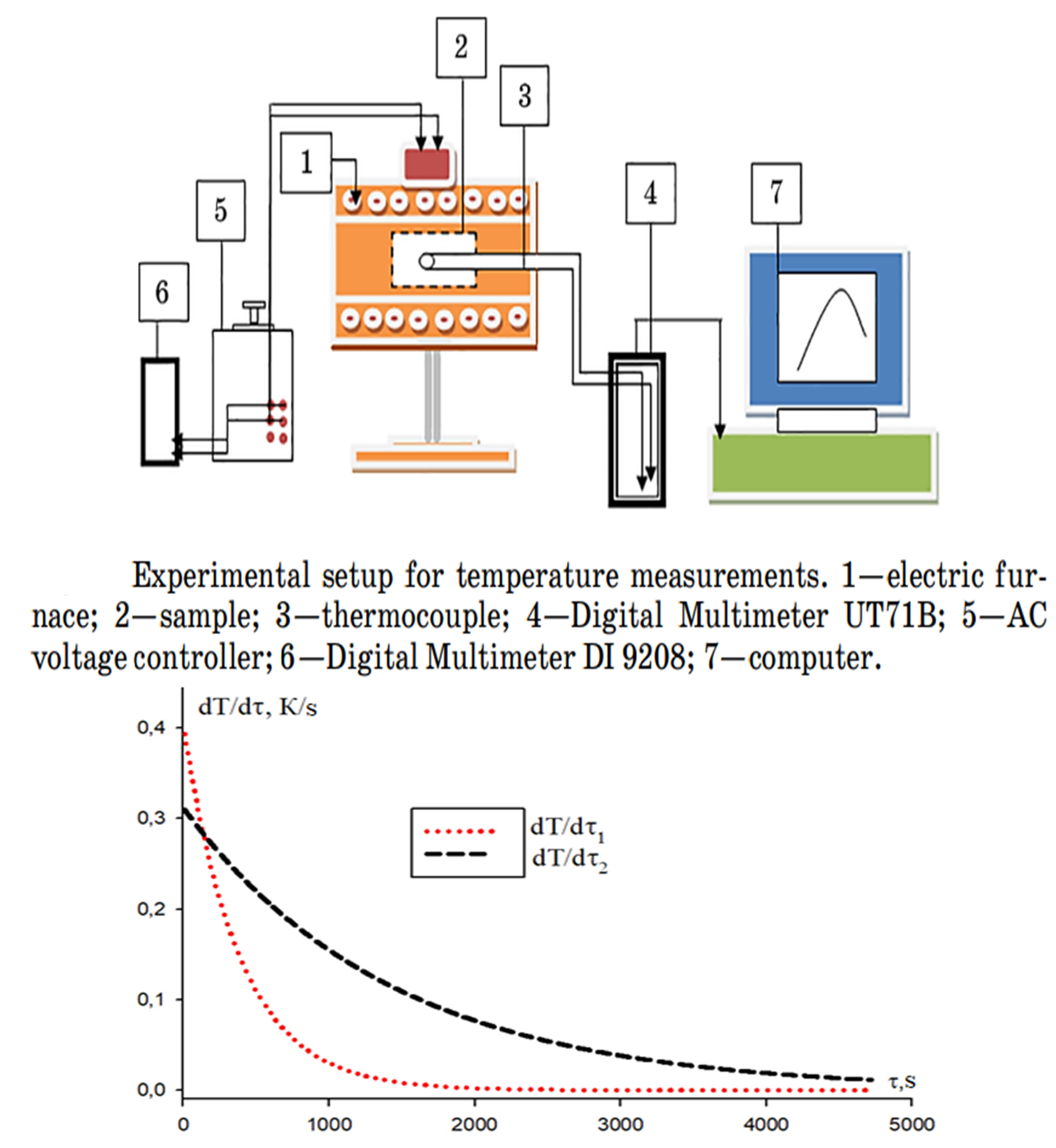
Downloads
References
J Moravec and K Gryc. Forming and heat treatment of modern metallic materials. Metals 2021; 11, 1106.
B Verlinden, J Driver, I Samajdar and R Doherty. Thermo-mechanical processing of metallic materials. Elsevier, Amsterdam, Netherlands, 2007, p. 327-332.
T Trzepieciński. Forming processes of modern metallic materials. Metals 2020; 10, 970.
R Ghanavati and H Naffakh-Moosavy. Additive manufacturing of functionally graded metallic materials: A review of experimental and numerical studies. J. Mater. Res. Tech. 2021; 13, 1628-64.
M Láró, T Gál and A Tóth. The characterization and deterioration of modern metallic threads. Stud. Conservat. 2000; 45, 95-105.
V Shyamu, T Raju, M Sapthagir and A Venkateswarlu. Analysis and evaluation of fractur behaviour of aluminum alloy in various applications. Int. J. Innovat. Eng. Tech. 2015; 5, 132-42.
P Udasi and S Kumbhare. Design and analysis of two wheelers wheel with the replacement of alluminium alloy. Int. J. Recent Tech. Eng. 2014; 3, 1-5.
T Dursun and C Soutis. Recent developments in advanced aircraft aluminum alloys. Mater. Des. 2014; 56, 862-71.
GV Pachurin and VA Vlasov. Structural damageability and durability of metallic materials in terms of the alloy “В95пчT2”. Mod. Sci. Res. Their Practical Appl. 2014; 11410, 345-52.
G Babar, SS Ghadage, VA Pharande, PB Bamankar and PRNikam. Investigation of thermal properties of epoxy composites filled with aluminum nitride (AlN). Int. J. Res. Anal. Rev. 2019; 6, 493-502.
SR Sahoo and SK Sethi. Performance optimization in turning of aluminum 8019 alloy. Int. J. Eng. Manag. Res. 2018; 8, 61-5.
F Nturanabo, L Masu and JB Kirabira. Novel applications of aluminum metal matrix composites. In: KO Cooke (Ed.). Aluminum alloys and composites. IntechOpen, London, 2019.
R Gitter. Aluminum materials for structural engineering–essential properties and selection of materials. Struct. Eng. Int. 2006; 16, 294-300.
Z Duan, C Li, W Ding, Y Zhang, M Yang, T Gao and HM Ali. Milling force model for aviation aluminum alloy: Academic insight and perspective analysis. Chin. J. Mech. Eng. 2021; 34, 21-35.
M Aamir, K Giasin, M Tolouei-Rad and A Vafadar. A review: Drilling performance and hole quality of aluminum alloys for aerospace applications. J. Mater. Res. Tech. 2020; 9, 12484-500.
Z Huda and P Edi. Materials selection in design of structures and engines of supersonic aircrafts: A review. Mater. Des. 2013; 46, 552-60.
J Li and S Wang. Distortion caused by residual stresses in machining aeronautical aluminum alloy parts: Recent advances. Int. J. Adv. Manuf. Tech. 2017; 89, 997-1012.
AK Sharma, R Bhandari, A Aherwar, R Rimašauskienė and C Pinca-Bretotean. A study of advancement in application opportunities of aluminum metal matrix composites. Mater. Today Proc. 2020; 26, 2419-24.
WS Miller, L Zhuang, J Bottema, A Wittebrood, PD Smet, A Haszler and AJ Vieregge. Recent development in aluminum alloys for the automotive industry. Mater. Sci. Eng. A 2000; 280, 37-49.
R Xiao and X Zhang. Problems and issues in laser beam welding of aluminum-lithium alloys. J. Manuf. Process. 2014; 16, 166-75.
SC Altıparmak, VA Yardley, Z Shi and J Lin. Challenges in additive manufacturing of high-strength aluminum alloys and current developments in hybrid additive manufacturing. J. Lightweight Mater. Manuf. 2021; 4, 246-61.
E Ghassemieh. Materials in automotive application, state of the art and prospects. New trends Dev. Automot. Ind. 2011; 20, 365-94.
N Prasanth, M Sharma, RN Yadav and P Jain. Designing of latent heat thermal energy storage systems using metal porous structures for storing solar energy. J. Energ. Storage 2020; 32, 101990.
SW Fu. 2018, Silver aluminum solid-state and eutectic bonding processes and study of intermetallic properties and corrosion for advanced electronics and photonics. Ph. D. Dissertation. University of California, Irvine.
W Zdanowicz and L Zdanowicz. Semiconducting compounds of the AII BV group. Ann. Rev. Mater. Sci. 1975; 5, 301-28.
AH Musfirah and AG Jaharah. Magnesium and aluminum alloys in automotive industry. J. Appl. Sci. Res. 2012; 8, 4865-75.
JS Robinson, RL Cudd and JT Evans. Creep resistant aluminum alloys and their applications. Mater. Sci. Tech. 2003; 19, 143-55.
F Casteels. The aluminium-rich of the aluminum samarium and aluminum-disprosium. J. Less Common Met. 1967; 12, 210-20.
JA Starke and JT Staley. Application of modern aluminum alloys to aircraft. Prog. Aero. Sci. 1996; 32, 131-72.
HZ Wang, DY Leung, MKH Leung and M Ni. A review on hydrogen production using aluminum and aluminum alloys. Renew. Sustain. Energ. Rev. 2019; 13, 845-53.
GS Makarov. Trends in the use of products from aluminum and its alloys in Russia. Non-ferrous Met. 2007; 5, 82-9.
JE Hatch. Aluminum: Properties and physical metallurgy. American Society for Metals, Ohio, 1989.
VS Zolotorevsky and NA Belov. Metal science of cast aluminum alloys (in Russian). MISiS, Moscow, Russia, 2005, p. 370-6.
Z Nizomov and FM Mirzoev. Temperature dependence of heat capacity and thermodynamic functions of aluminum, iron, silicon, zinc, copper, magnesium, manganese and titanium (in Russian). Bull. Tajik Natl. Univ. 2019; 1, 122-8.
BN Gulov, Z Nizomov and FS Tabarov. Thermophysical properties of aluminum of grade A5N and its alloys doped with silicon, copper and rare-earth metals. Metallofizika i Noveishie Tekhnologii 2021; 43, 1553-62.
Z Nizomov, RKH Saidov, JG Sharipov and BN Gulov. Thermophysical properties of Zn5Al, Zn55Al alloys alloyed with rare earth metals (in Russian). Rep. Acad. Sci. Republic Tajikistan 2015; 58, 916-21.
Z Nizomov, ZI Avezov, RH Saidov, FM Mirzoev and MB Akramov. Thermal properties of Zn5Al and Zn55Al alloys with II a group elements. Key Eng. Mater. 2022; 909, 76-84.
Z Nizomov and FM Mirzoev. Thermophysical properties of aluminum of different purity. In: Scientific Research of the SCO Countries: Synergy and Integration - International Conference, Beijing, China. 2019, p. 213-23.
GS Pisarenko. Selected works (in Russian). Naukova dumka, Kyiv, Ukraine, 2010.
GS Pisarenko and VA Strizhalo. Experimental methods in the mechanics of a deformable solid body (in Russian). Naukova dumka, Kyiv, Ukraine, 2018, p. 261-4.
NG Suryaninov, AM Limarenko and GA Oborsky. Experimental methods of research in mechanics (in Russian). Astroprint, Odessa, Ukraine, 2011, p. 548-60.
AA Presnyakov. The role of the scale effect in the development of plastic flow localization. Complex Publishing House, Almaty, Kazakhstan, 2004, p. 264-71.
UK Alsenov and AA Presnyakov. Influence of the scale factor on the development of superplastic flow of aluminum-zinc eutectoid (in Russian). Almaty, Kazakhstan, 1978, p. 211-31.
EA Dzhanbusinov, TV Chernoglazova and NN Mofa. The influence of temperature on the manifestation of the scale effect in plastic materials (in Russian). Collection of scientific papers: Materials Science of Structural Materials of Agricultural Machines. Almaty, Kazakhstan, 1986, p. 62-6.
WG Pfann. Principles of zone-melting. JOM 1952; 4, 747-53.
High purity aluminum 99.9999 % ingots (in Russian), Available at: https://ochv.ru/alyuminiy-osobo-chistyy-99-9999-slitki, accessed March 2022.
Z Nizomov, BN Gulov, RK Saidov and Z Avezov. Measurement of specific heat capacity of solids by cooling method (in Russian). Bull. Natl. Univ. 2010; 3, 136-41.
IT Turakhasanov and Z Nizomov. Influence of the size of cylindrical samples from aluminum grade A0 on the time and rate of cooling (in Russian). Bull. Tech. Coll. Tajik Tech. Univ. Named Acad. M.S. Osimi 2022; 1, 23-8.
IT Turakhasanov. Influence of the size of cylindrical samples from A5 aluminum on the time and rate of cooling (in Russian). Sci. Notes Khujand State Univ. Named Acad. Babajan Gafurov 2022; 1, 107-16.
D Toghraie. Numerical thermal analysis of water’s boiling heat transfer based on a turbulent jet impingement on heated surface. Phys. E Low Dimensional Syst. Nanostruct. 2016; 84, 454-65.
S Rostami, D Toghrai, B Shabani and N Sina. Measurement of the thermal conductivity of MWCNT-CuO/water hybrid nanofluid using artificial neural networks (ANNs). J. Therm. Anal. Calorimetry 2021; 143, 1097-105.
M Tohidi and D Toghraie. The effect of geometrical parameters, roughness and the number of nanoparticles on the self-diffusion coefficient in Couette flow in a nanochannel by using of molecular dynamics simulation. Phys. B Condens. Matter. 2017; 518, 20-32.
S Dabiri, E Khodabandeh, AK Poorfar, R Mashayekhi, D Toghraie and SAA Zade. Parametric investigation of thermal characteristic in trapezoidal cavity receiver for a linear Fresnel solar collector concentrator. Energy 2018; 153, 17-26.
A Moraveji and D Toghraie. Computational fluid dynamics simulation of heat transfer and fluid flow characteristics in a vortex tube by considering the various parameters. Int. J. Heat Mass Tran. 2017; 113, 432-43.
Z Li, P Barnoon, D Toghraie, RB Dehkordi and M Afrand. Mixed convection of non-newtonian nanofluid in an H-shaped cavity with cooler and heater cylinders filled by a porous material: Two phase approach. Adv. Powder Tech. 2019; 30, 2666-85.
Downloads
Published
How to Cite
Issue
Section
License
Copyright (c) 2022 Walailak University

This work is licensed under a Creative Commons Attribution-NonCommercial-NoDerivatives 4.0 International License.





