
Phytochemicals of Citrus Fruits: The in-silico Investigation against Sars-CoV-2 Proteins
DOI:
https://doi.org/10.48048/tis.2023.3508Keywords:
Corona virus, Citrus fruits, Phytochemicals, Molecular docking, Molecular dynamic simulations, ADMEAbstract
The current pandemic Covid-19 brought about by a newly emerged and highly infectious virus named as Sars-CoV-2 as a worldwide danger, has infected more than 600 million people and number of deaths are continuously rising day by day. Till date there are no medications accessible for treatment. All over the world scientists and researchers are involved in the study of this emerged virus and its lifecycle. Structures of proteins in the life cycle of virus has been revealed in RCSB PDB (Research Collaboratory for Structural Bioinformatics Protein Data Bank) by researchers. Citrus fruits are used to treat many distresses of humans. Literature survey shows that it has various activities. Our research work is meant to identify the phytoconstituents which are having phenolic composition and good antiviral and antioxidant properties from citrus fruits against Covid-19 proteins (spike binding domain with ACE2 receptor and spike binding domain with Main protease) and to know its in-silico molecular basis. In this study, about 25 compounds from citrus fruits which is having a good antiviral and antioxidant properties and also phenolic composition were employed for molecular docking analysis, molecular dynamic simulation studies and ADME studies. Based on present study 2 compounds from Citrus fruits acted well against the Covid-19 proteins. The MD simulations were employed to identify Hesperidin and Procyanidin B2 as hit compounds. Further ADME analysis were studied for top 2 compounds, these compounds can be further taken for in-vitro studies to know the effective activity against Covid-19.
HIGHLIGHTS
- Citrus fruit phytochemicals are fascinating core, which shows an excellent anti-viral, anti-inflammatory and antioxidant properties
- The SARS-CoV-2 is newly emerged and highly infectious virus, has infected more than 600 million people and number of deaths are continuously rising day by day
- Molecular docking analysis, Molecular dynamics simulation ADME studies was carried out
- Compound Hesperidin and Procyanidin B2 showed a good inhibitory activity against SARS-CoV-2 proteins
GRAPHICAL ABSTRACT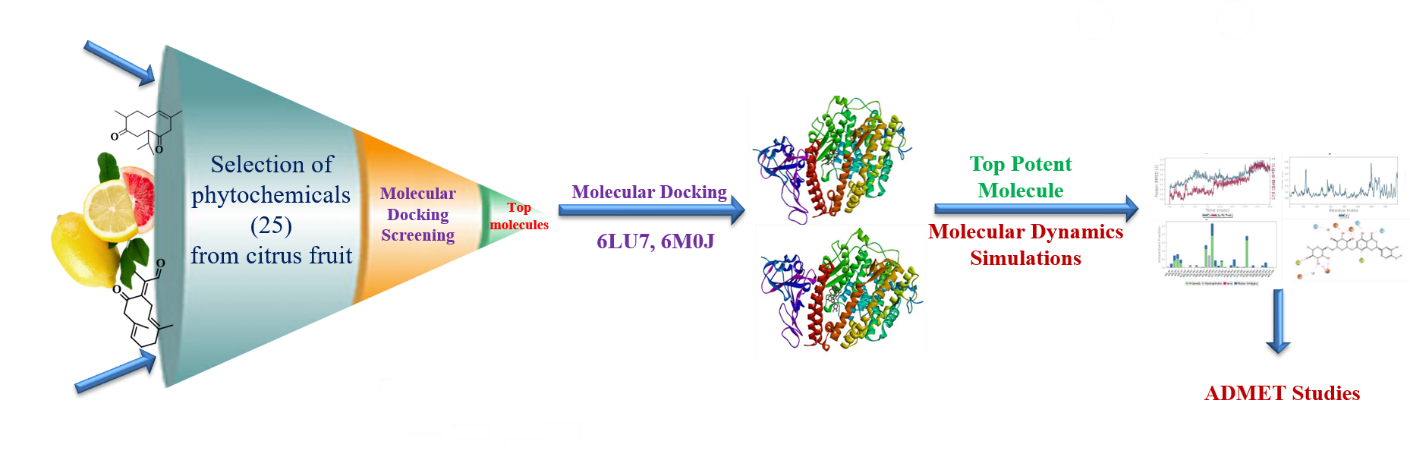
Downloads
References
DE Okwu. Citrus fruits: A rich source of phytochemicals and their roles in human health. Int. J. Chem. Sci. 2008; 6, 451-71.
DE Okwu and IN Emenike. Evaluation of the phytonutrients and vitamin contents of citrus fruits. Int. J. Mol. Med. Adv. Sci. 2006; 2, 1-6.
A Bermejo, MJ Llosá and A Cano. Analysis of bioactive compounds in seven citrus cultivars. Food Sci. Tech. Int. 2011; 17, 55-62.
JMJ Favela-Hernández, O González-Santiago, MA Ramírez-Cabrera, PC Esquivel-Ferriño and MDR Camacho-Corona. Chemistry and pharmacology of Citrus sinensis. Molecules 2016; 21, 247.
A Bovy, E Schijlen and RD Hall. Metabolic engineering of flavonoids in tomato (Solanum lycopersicum): The potential for metabolomics. Metabolomics 2007; 3, 399-412.
MM Jucá, FMS Cysne Filho, JCD Almeida, DDS Mesquita, JRDM Barriga, KCF Dias, TM Barbosa, LC Vasconcelos, LKAM Leal, JE Ribeiro and SMM Vasconcelos. Flavonoids: Biological activities and therapeutic potential. Nat. Prod. Res. 2020; 34, 692-705.
O Benavente-García, J Castillo, FR Marin, A Ortuño and JAD Río. Uses and properties of citrus flavonoids. J. Agr. Food Chem. 1997; 45, 4505-15.
D Barreca, G Gattuso, E Bellocco, A Calderaro, D Trombetta, A Smeriglio, G Laganà, M Daglia, S Meneghini and SM Nabavi. Flavanones: Citrus phytochemical with health-promoting properties. BioFactors 2017; 43, 495-506.
J Manthey, N Guthrie and K Grohmann. Biological properties of citrus flavonoids pertaining to cancer and inflammation. Curr. Med. Chem. 2012; 8, 135-53.
C Zhao, F Wang, Y Lian, H Xiao and J Zheng. Biosynthesis of citrus flavonoids and their health effects. Crit. Rev. Food Sci. Nutr. 2020; 60, 566-83.
Q Chen, D Wang, C Tan, Y Hu, B Sundararajan and Z Zhou. Profiling of flavonoid and antioxidant activity of fruit tissues from 27 Chinese local citrus cultivars. Plants 2020; 9, 196.
S Kawaii, Y Tomono, E Katase, K Ogawa and M Yano. Quantitation of flavonoid constituents in citrus fruits. J. Agr. Food Chem. 1999; 47, 3565-71.
E Tripoli, M La Guardia, S Giammanco, D Di Majo and M Giammanco. Citrus flavonoids: Molecular structure, biological activity and nutritional properties: A review. Food Chem. 2007; 104, 466-79.
Y Nogata, K Sakamoto, H Shiratsuchi, T Ishii, M Yano and H Ohta. Flavonoid composition of fruit tissues of citrus species. Biosci. Biotechnol. Biochem. 2006; 70, 178-92.
S Wang, C Yang H Tu, J Zhou, X Liu, Y Cheng, J Luo, X Deng, H Zhang and J Xu. Characterization and metabolic diversity of flavonoids in citrus species. Sci. Rep. 2017; 7, 10549.
K Kawaguchi, S Kikuchi, R Hasunuma, H Maruyama, T Yoshikawa and Y Kumazawa. A citrus flavonoid hesperidin suppresses infection-induced endotoxin shock in mice. Biol. Pharmaceut. Bull. 2004; 27, 679-83.
S Kaviya, J Santhanalakshmi, B Viswanathan, J Muthumary and K Srinivasan. Biosynthesis of silver nanoparticles using Citrus sinensis peel extract and its antibacterial activity. Spectrochim. Acta Mol. Biomol. Spectros. 2011; 79, 594-8.
N Arooj, N Dar and ZQ Samra. Stable silver nanoparticles synthesis by Citrus sinensis (orange) and assessing activity against food poisoning microbes. Biomed. Environ. Sci. 2014; 10, 815-8.
K Fisher and CA Phillips. The effect of lemon, orange and bergamot essential oils and their components on the survival of Campylobacter jejuni, Escherichia coli O157, Listeria monocytogenes, Bacillus cereus and Staphylococcus aureus in vitro and in food systems. J. Appl. Microbiol. 2006; 101, 1232-40.
RJ Nijveldt, ELSV Nood, DECV Hoorn, PG Boelens, KV Norren and PAMV Leeuwen. Flavonoids: A review of probable mechanisms of action and potential applications. Am. J. Clin. Nutr. 2001; 74, 418-25.
TM LeJeune, HY Tsui, LB Parsons, GE Miller, C Whitted, KE Lynch, RE Ramsauer, JU Patel, JE Wyatt and DS Street. Mechanism of action of two flavone isomers targeting cancer cells with varying cell differentiation status. PLoS One 2015; 10, e0142928.
AC Abreu, A Coqueiro, AR Sultan, N Lemmens, HK Kim, R Verpoorte, WJBV Wamel, M Simões and YH Choi. Looking to nature for a new concept in antimicrobial treatments: Isoflavonoids from Cytisus striatus as antibiotic adjuvants against MRSA. Sci. Rep. 2017; 7, 3777.
J Solnier, L Martin, S Bhakta and F Bucar. Flavonoids as novel efflux pump inhibitors and antimicrobials against both environmental and pathogenic intracellular mycobacterial species. Molecules 2020; 25, 734.
V D’Amelia, R Aversano, P Chiaiese and D Carputo. The antioxidant properties of plant flavonoids: Their exploitation by molecular plant breeding. Phytochem. Rev. 2018; 17, 611-25.
HK Wang, Y Xia, ZY Yang, SLM Natschke and KH Lee. Recent advances in the discovery and development of flavonoids and their analogues as antitumor and anti-HIV agents. Adv. Exp. Med. Biol. 1998; 439, 191-225.
MD Catarino, O Talhi, A Rabahi, AMS Silva and SM Cardoso. The antiinflammatory potential of flavonoids: Mechanistic aspects. Stud. Nat. Prod. Chem. 2016; 48, 65-99.
AN Panche, AD Diwan and SR Chandra. Flavonoids: An overview. J. Nutr. Sci. 2016; 5, e47.
RY Utomo, M Ikawati, DDP Putri, IA Salsabila and E Meiyanto. The chemopreventive potential of diosmin and hesperidin for Covid-19 and its comorbid diseases. Indonesian J. Cancer Chemoprev. 2020; 11, 154-67.
M Muchtaridi, M Fauzi, NKK Ikram, AM Gazzali and HA Wahab. Natural flavonoids as potential angiotensin-converting enzyme 2 inhibitors for Anti-SARS-CoV-2. Molecules 2020; 25, 3980.
AA Alrasheid, MY Babiker and TA Awad. Evaluation of certain medicinal plants compounds as new potential inhibitors of novel corona virus (Covid-19) using molecular docking analysis. In Silico Pharmacol. 2021; 9, 10.
H Tutunchi, F Naeini, A Ostadrahimi, MJ Hosseinzadeh-Attar. Naringenin, a flavanone with antiviral and anti-inflammatory effects: A promising treatment strategy against Covid-19. Phytother. Res. 2020; 34, 3137-47.
N Clementi, C Scagnolari, A D’Amore, F Palombi, E Criscuolo, F Frasca, A Pierangeli, N Mancini, G Antonelli, M Clementi, A Carpaneto and A Filippini. Naringenin is a powerful inhibitor of SARS-CoV-2 infection in vitro. Pharmacol. Res. 2021; 163, 105-255.
PK Agrawal, C Agrawal and G Blunden. Quercetin: Antiviral significance and possible Covid-19 integrative considerations. Nat. Prod. Commun. 2020; 15, 1-10.
A Pawar and A Pal. Molecular and functional resemblance of dexamethasone and quercetin: A paradigm worth exploring in dexamethasone-nonresponsive Covid-19 patients. Phytother. Res. 2020; 34, 3085-8.
S Bastaminejad and S Bakhtiyari. Quercetin and its relative therapeutic potential against Covid-19: A retrospective review and prospective overview. Curr. Mol. Med. 2021; 21, 385-91.
G Derosa, P Maffioli, A D’Angelo and FD Pierro. A role for quercetin in coronavirus disease 2019 (Covid-19). Phytother. Res. 2021; 35, 1230-6.
A Saeedi-Boroujeni and MR Mahmoudian-Sani. Anti-inflammatory potential of Quercetin in Covid-19 treatment. J. Inflamm. 2021; 18, 3.
CH Yeh, JJ Yang, ML Yang, YC Li and YH Kuan. Rutin decreases lipopolysaccharide-induced acute lung injury via inhibition of oxidative stress and the MAPK-NF-κB pathway. Free Radic. Biol. Med. 2014; 69, 249-57.
MMAK Shawan, SK Halder and MA Hasan. Luteolin and abyssinone II as potential inhibitors of SARS-CoV-2: An in silico molecular modeling approach in battling the Covid-19 outbreak. Bull. Natl. Res. Centre 2021; 45, 27.
SA Cherrak, H Merzouk and N Mokhtari-Soulimane. Potential bioactive glycosylated flavonoids as SARS-CoV-2 main protease inhibitors: A molecular docking and simulation studies. PLoS One 2020; 15, e0240653.
G Tatar, M Salmanli, Y Dogru and T Tuzuner. Evaluation of the effects of chlorhexidine and several flavonoids as antiviral purposes on SARS-CoV-2 main protease: Molecular docking, molecular dynamics simulation studies. J. Biomol. Struct. Dynam. 2021; 40, 7656-65.
GH Attia, YS Moemen, M Youns, AM Ibrahim, R Abdou and MAE Raey. Antiviral zinc oxide nanoparticles mediated by hesperidin and in silico comparison study between antiviral phenolics as anti-SARS-CoV-2. Colloid. Surf. B Biointerfac. 2021; 203, 111724.
SS Swain, SR Singh, A Sahoo, T Hussain and S Pati. Anti-HIV-drug and phyto-flavonoid combination against SARS-CoV-2: A molecular docking-simulation base assessment. J. Biomol. Struct. Dynam. 2021; 40, 6463-76.
AS Jain, P Sushma, C Dharmashekar, MS Beelagi, SK Prasad, C Shivamallu, A Prasad, A Syed, N Marraiki and KS Prasad. In silico evaluation of flavonoids as effective antiviral agents on the spike glycoprotein of SARS-CoV-2. Saudi J. Biol. Sci. 2021; 28, 1040-51.
JK Varughese, KLJ Libin, KS Sindhu, AV Rosily and TG Abi. Investigation of the inhibitory activity of some dietary bioactive flavonoids against SARS-CoV-2 using molecular dynamics simulations and MM-PBSA calculations. J. Biomol. Struct. Dynam. 2021; 40, 6755-70.
RY Utomo and E Meiyanto. Revealing the potency of citrus and galangal constituents to halt SARS-CoV-2 infection. Preprints 2020. https://doi.org/10.20944/preprints202003.0214.v1
S Vardhan and SK Sahoo. In silico ADMET and molecular docking study on searching potential inhibitors from limonoids and triterpenoids for Covid-19. Comput. Biol. Med. 2020; 124, 103936.
S Nanjundaswamy, J Jayashankar, RA Renganathan, CS Karthik, L Mallesha, P Mallu and VR Rai. Pyridine coupled pyrazole analogues as lethal weapon against MRSA: An in-vitro and in-silico approach. Microb. Pathog. 2022; 166, 105508.
Ş Adem, V Eyupoglu, I Sarfraz, A Rasul, AF Zahoor, M Ali, M Abdalla, IM Ibrahim and AA Elfiky. Caffeic acid derivatives (CAFDs) as inhibitors of SARS-CoV-2: CAFDs-based functional foods as a potential alternative approach to combat Covid-19. Phytomedicine 2021; 85, 153310.
S Nanjundaswamy, J Jayashankar, MH Chethana, RA Renganathan, CS Karthik, AP Ananda, S Nagashree, P Mallu and VR Rai. Design, synthesis, and in-silico studies of pyrazolylpyridine analogues: A futuristic antibacterial contender against coagulase positive superbug-MRSA. J. Mol. Struct. 2022; 1255, 132400.
K Kavitha, S Sivakumar and B Ramesh. 1, 2, 4 triazolo [1, 5-a] pyrimidin-7-ones as novel SARS-CoV-2 Main protease inhibitors: In silico screening and molecular dynamics simulation of potential Covid-19 drug candidates. Biophys. Chem. 2020; 267, 106478.
N Shankaraiah, KP Siraj, S Nekkanti, V Srinivasulu, P Sharma, KR Senwar, M Sathish, MVPS Vishnuvardhan, S Ramakrishna, C Jadala and N Nagesh. DNA-binding affinity and anticancer activity of β-carboline-chalcone conjugates as potential DNA intercalators: Molecular modelling and synthesis. Bioorgan. Chem. 2015; 59, 130-9.
SN Mohd Amin, MH Md Idris, M Selvaraj, SNM Amin, H Jamari, TL Kek and MZ Salleh. Virtual screening, ADME study, and molecular dynamic simulation of chalcone and flavone derivatives as 5-Lipoxygenase (5-LO) inhibitor. Mol. Simulat. 2020; 46, 487-96.
Z Basharat, M Jahanzaib, A Yasmin and IA Khan. Pan-genomics, drug candidate mining and ADMET profiling of natural product inhibitors screened against Yersinia pseudotuberculosis. Genomics 2021; 113, 238-44.
P Kavaliauskas, B Grybaite, V Mickevicius, R Petraitiene, R Grigaleviciute, R Planciuniene, P Gialanella, A Pockevicius and V Petraitis. Synthesis, ADMET properties, and in vitro antimicrobial and antibiofilm activity of 5-nitro-2-thiophenecarbaldehyde N-((E)-(5-nitrothienyl) methylidene) hydrazone (KTU-286) against Staphylococcus aureus with defined resistance mechanisms. Antibiotics 2020; 9, 612.
P Ninfali, A Antonelli, M Magnani and ES Scarpa. Antiviral properties of flavonoids and delivery strategies. Nutrients 2020; 12, 2534.
W Xi, Y Zhang, Y Sun, Y Shen, X Ye and Z Zhou. Phenolic compositions in the pulps of Chinese wild mandarin pulps (Citrus reticulata Blanco.) and their antioxidant properties. Ind. Crop. Prod. 2014; 52, 466-74.

Downloads
Published
How to Cite
Issue
Section
License
Copyright (c) 2022 Walailak University

This work is licensed under a Creative Commons Attribution-NonCommercial-NoDerivatives 4.0 International License.





