
Computational Study of Charge Density Produced in N2:H2 Plasma Actuator
DOI:
https://doi.org/10.48048/tis.2022.3476Keywords:
Plasma actuator, Space charge density, Surface charge density, COMSOL multiphysicsAbstract
Numerical simulation of charge density produced in plasma actuators is dependent upon the development of models dealing with electrical properties. The main aim of this work is to investigate the characteristics surface charge density and space charge density of DBD plasma actuator. A simple design of surface dielectric barrier discharge plasma actuator is used in the study. The discharge gas was N2:H2 mixture with applied voltage equal to 1.5 kV. A theoretical plasma model is used to establish the charge density details. Results show that surface charge density increased in value and spread in width alone the exposed electrode as the voltage increased and reached to the amplitude value.
HIGHLIGHTS
- In plasma diagnostics studies, charge density is one of the important parameter
- The paper includes simulation to charge density in plasma actuator with two gases which are N2 and H2
- The results very useful to follow up the electric field and flow of gases
GRAPHICAL ABSTRACT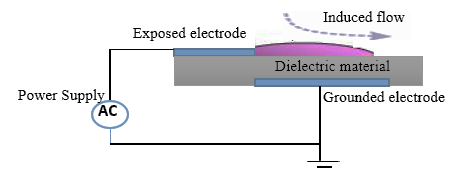
Downloads
References
Z Wu, J Xu, P Chen, K Xie and N Wang. Maximum thrust of single dielectric barrier discharge thruster at low pressure. Am. Inst. Aeronaut. Astronautics J. 2018; 56, 2235-41.
D Greenblatt, D Keisar and D Hasin. Transitioning plasma actuators to flight applications. In: R King (Ed.). Active flow and combustion control. Springer, Cham, Switzerland, 2018, p. 105-18.
G Touchard. Plasma actuators for aeronautics applications - State of art review. Int. J. Plasma Environ. Sci. Tech. 2008; 2, 1-25.
S Sato, H Furukawa, A Komuro, M Takahashi and N Ohnishi. Successively accelerated ionic wind with integrated dielectric-barrier-discharge plasma actuator for low-voltage operation. Sci. Rep. 2019; 9, 5813.
G Zoppini, M Belan, A Zanotti, LD Vinci and G Campanardi. Stall control by plasma actuators: Characterization along the airfoil span. Energies 2020; 13, 1374
R Mestiri, R Hadaji and SB Nasrallah. An experimental study of a plasma actuator in absence of free airflow: Ionic wind velocity profile. AIP Phys. Plasma 2010; 17, 083503.
M Belan and F Messanelli. Compared ionic wind measurements on multi-tip corona and DBD plasma actuators. J. Electrostatics 2015; 76, 278-87.
S Roy. Flow actuation using radio frequency in partially-ionized collisional plasmas. Appl. Phys. Lett. 2005; 86, 101502.
Y Cho and W Shyy. Adaptive flow control of low-reynolds number aerodynamics using dielectric barrier discharge actuator. Progr. Aero. Sci. 2011; 47, 495-521.
KP Singh and S Roy. Force approximation for a plasma actuator operating in atmospheric air. J. Appl. Phys. 2008; 103, 013305.
E Peers, Z Ma and X Haung. A numerical model of plasma effects in flow control. Phys. Lett. A 2010; 374, 1501-4.
R Erfani, T Erfani, SV Utyuzhnikov and K Kontis. Optimisation of multiple encapsulated electrode plasma actuator. Aero. Sci. Tech. 2013; 26, 120-7.
B Jayramann. 2006, Computational modeling of glow discharge-induced fluid dynamics. Ph.D. dissertation. University of Florida, Gainesville FL, United States.
AV Zakharov and EV Rosenfeld. Charge density fluctuations on a dielectric surface exposed to plasma or UV radiation. Plasma 2021; 4, 201-13.
S Zhang, Z Chen, B Zhang and Y Chen. Numerical investigation on the effects of dielectric barrier on a nanosecond pulsed surface dielectric barrier discharge. Molecules 2019; 24, 3933.
P Viegas and A Bourdon. Numerical study of jet-target interaction: Influence of dielectric permittivity on the electric field experienced by the target. Plasma Chem. Plasma Process. 2020; 40, 661-83
COMSOL. Plasma module user’s guide COMSOL, Stockholm, Sweden, 2018.
Downloads
Published
How to Cite
Issue
Section
License

This work is licensed under a Creative Commons Attribution-NonCommercial-NoDerivatives 4.0 International License.





