
Effects of Exogenous Methyl Jasmonate Treatment with Polyethylene Bag Storage on Decay Reduction and Enhanced Total Ascorbic Acid, Total Phenolic, and Antioxidant Activities in ‘Kamphaeng Saen 42’ Mulberry Fruit
DOI:
https://doi.org/10.48048/tis.2022.3069Keywords:
‘Kamphaeng Saen 42’ mulberry fruit, Methyl jasmonate, Polyethylene bag, Decay, AntioxidantAbstract
Mulberry fruit has a short shelf life of only 1 - 2 days under room conditions, make it one of the most fragile and extremely perishable fruits. This study investigated the effects of exogenous methyl jasmonate (MeJA) combined with polyethylene bag (PE) on postharvest decay, total ascorbic acid, total phenolic, anthocyanin, and antioxidant activities in 'Kamphaeng Saen 42’ mulberry fruits. The study was conducted at Postharvest Quality and Storage System Laboratory, Division of AgriScience and Technology (Postharvest Technology), Faculty of Bioresources and Technology, King Mongkut’s University of Technology Thonburi in December 2019. The experiment was laid out in Completely Randomized Design (CRD) with 4 replicates and 2 treatments consisting of 1) untreated with MeJA (control) and 2) fruits treated with 10 mmol L-1 methyl jasmonate (MeJA) combination with polyethylene bag (PE) and maintained at 10 ± 2 °C, 90 ± 2 % relative humidity (RH). The results showed that treating the mulberry fruits with 10 mmol L-1 MeJA before placing them in the PE bag was the most effective method to reduce fruit decay and also resulted in higher levels of total ascorbic acid, total phenols, and antioxidant activities than in the control at the end of storage (55.14 mg/100 g FW, 43.78 mg GAE /g FW and 28.91 mM TE /100 g FW), respectively. However, the treated fruits showed lower anthocyanin content than the control during the first 8 days of storage. These results suggest that the combination of MeJA with PE bag is beneficial in reducing fruit decay and increasing total ascorbic acid, total phenols, and antioxidant activities in 'Kamphaeng Saen 42’ mulberry fruits during storage at 10 ± 2 °C, 90 ± 2 % RH for 10 days.
HIGHLIGHTS
- Mulberry fruit is one of the most fragile and extremely perishable fruits resulting in its has short shelf life
- Exogenous MeJA combined with PE bag were applied to decay reduction and enhanced total ascorbic acid, total phenolic, and antioxidant activities in ‘Kamphaeng Saen 42’ mulberry fruit
- Mulberry fruits treated with 10 µmolL-1 MeJA combined with PE bag were the most effective in reducing fruit decay and increasing total ascorbic acid, total phenols, and antioxidant activities in 'Kamphaeng Saen 42’ mulberry fruits
GRAPHICAL ABSTRACT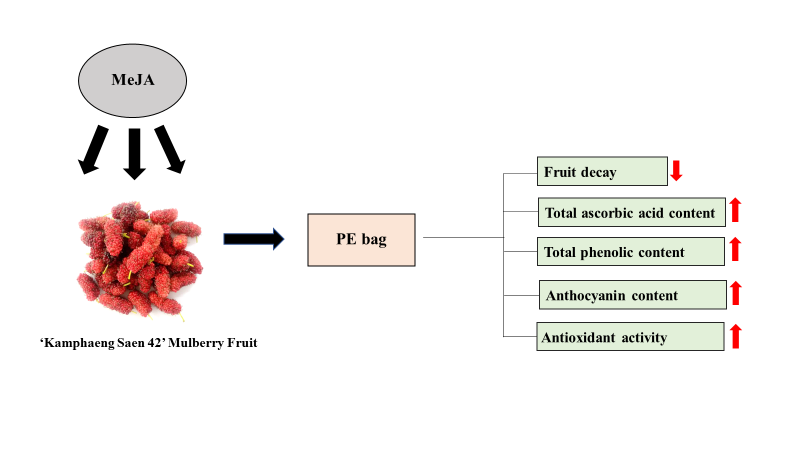
Downloads
References
H Zhang, FW Zheng, L Xiaoqui and L Xinli. Effects of mulberry fruit (Morus alba L.) consumption on health outcomes: A mini-review. Antioxidants 2018; 7, 69.
X Huang, J Li, H Shang and X Meng. Effect of methyl jasmonate on the anthocyanin content and antioxidant activity of blueberries during cold storage. J. Sci. Food Agr. 2015; 95, 337-43.
L Bertini, S Proietti, F Focaracci, B Sabatin and C Carusco. Epigenetic control of dense gene following MeJA-induce priming in rice (O. sativa). J. Plant Physiol. 2018; 228, 166-17.
H Wang, X Kou, C Wu, G Fan and T Li. Methyl jasmonate induces the resistance of postharvest blueberry to gray mold caused by Botrytis cinerea. J. Sci. Food Agr. 2020; 100, 4272-81.
GM Saavedra, E Sanfuentes, PM Figueroa and CR Figueroa. Independent preharvest applications of methyl jasmonate and chitosan elicit differential upregulation of defense-related genes with reduced incidence of gray mold decay during postharvest storage of Fragaria chiloensis fruit. Int. J. Mol. Sci. 2017; 18, 1420.
K Venkatachalam and M Mutita. Effect of methyl jasmonate on physiological and biochemical quality changes of longkong fruit under low temperature storage. Fruits 2015; 70, 69-75.
L Jiang, P Jin, L wang, X Yu, H Wang and Y Zheng. Methyl jasmonate primes defense responses against Botrytis cinerea and reduces disease development in harvested table grapes. Sci. Hortic. 2015; 192, 218-23.
H Liu, F Meng, H Miao, S Chen, T Yin, S Hu and Q Wang. Effects of postharvest methyl jasmonate treatment on main health-promoting components and volatile organic compounds in cherry tomato fruit. Food Chem. 2018; 263, 194-200.
L Moro, NM Aymoto Hassimotto and E Purgatto. Postharvest auxin and methyl jasmonate effect on anthocyanin biosynthesis in red raspberry (Rubus idaeus L.). J. Plant Growth Regul. 2017; 36, 773-82.
H Wang, Y Wu, R Yu, C Wu, G Fan and T Li. Effects of postharvest application of methyl jasmonate on physicochemical characteristics and antioxidant system of the blueberry fruit. Sci. Hort. 2019; 258, 108785.
Y Dong, HH Zhi, J Xu, LH Zhang, MP Liu and W Zong. Effect of methyl jasmonate on reactive oxygen species, antioxidant systems and microstructure of Chinese winter jujube at two major ripening stages during shelf life. J. Hort. Sci. Biotechnol. 2016; 91, 316-23.
P Sangprayoon, S Supapvanich, P Youryon, C Wong-Aree and P Boonyaritthongchai. Efficiency of salicylic acid or methyl jasmonate immersions on internal browning alleviation and physicochemical quality of Queen pineapple cv. “Sawi” fruit during cold storage. J. Food Biochem. 2019; 43, 13059.
Y Li, Y Ishikawa, T Satake, H Kitazawa, X Qiu and S Rungchang. Effect of active modified atmosphere packaging with different initial gas compositions on nutritional compounds of shiitake mushrooms (Lentinus edodes). Postharvest Biol. Tech. 2014; 92, 107-13.
S Kartal, S Aday and C Caner. Use of microperforated films and oxygen scavengers to maintain storage stability of fresh strawberries. Postharvest Biol. Tech. 2012; 71, 32-40.
OJ Caleb, PV Mahajan, FA Al-Said and UM Opera. Modified atmosphere packaging technology of fresh and fresh-cut produce and the microbial consequences: A review. Food Bioproc. Tech. 2013; 6, 303-29.
JH Roe, BM Mary, MJ Oesterling and MD Charlotle. The determination of diketo L-gulonic acid, dehydro-L-ascorbic acid and L-ascorbic acid in the same tissue extract by 2,4-Dinitrophenyl hydrazine method. J. Biol. Chem. 1948; 174, 201-8.
LM Cheung, PC Cheung and VE Ooi. Antioxidant activity and total phenolic of edible mushroom extract. J. Agr. Food Chem. 2003; 81; 249-55.
W Horwitz. Official methods of analysis of AOAC international. 16th ed. AOAC International, Gaithersburg MD, 2000, p. 1401.
W Brand-Williams, ME Cuvelier and C Berset. Use of free radical method to evaluate antioxidant activity. Lebensm. Wiss. Tech. 1995; 28, 25-30.
N Tzortzakis, A Chrysargyris, D Sivakumar and K Loulakakis. Vopour or dipping applications of methyl jasmonate, vinegar and sage oil for pepper fruit sanitation towards grey mold. Postharvest Biol. Tech. 2016; 118, 120-7.
N Selcuk and M Erkan. The effects of modified and palliflex controlled atmosphere storage on postharvest quality and composition of ‘Istanbul’ medlar fruit. Postharvest Biol. Tech. 2015; 99, 9-19.
R Porat, I Kosto and A Daus. Bulk storage of ‘Wonderful’ pomegranate fruit using modified atmosphere bags. Israel J. Plant Sci. 2016; 63, 45-50.
GA Gonzalez-Aguilar, JG Buta and CY Wang. Methyl jasmonate and modified atmosphere packaging (MAP) reduce decay and maintain postharvest quality of papaya ‘Sunrise’. Postharvest Biol. Tech. 2003; 28, 361-70
H Yao and S Tian. Effects of pre-and post-harvest administration of salicylic acid of methyl jasmonate on inducing disease resistance of sweet cherry fruit in storage. Postharvest Biol. Tech. 2005; 35, 253-62.
A Ozturk, K Yildiz, O Burhan and O Karakaya. Maintaining postharvest quality of medlar (Mespilus germanica) fruit using modified atmosphere packaging and methyl jasmonate. LWT Food Sci. Tech. 2019; 111, 117-24.
SY Wang, XC Shi, FQ Liu and P Laborda. Effects of exogenous methyl jasmonate on quality and preservation of postharvest fruits: A review. Food Chem. 2021; 353, 129482.
BA Wolucka, A Goossens and D Inze. Methyl jasmonate stimulates the de no vo biosynthesis of vitamin C in plant cell suspensions. J. Exp. Bot. 2005; 56, 2527-38.
K Wang, P Jin, S Cao, H Shang, Z Yang and Y Zheng. Methyl jasmonate reduces decay and enhances antioxidant capacity in Chinese bayberries. J. Agr. Food Chem. 2009; 57, 5089-815.
O Ozkaya, A Sener, MA Saridas, U Unal, A Valizadeh and O Dundar. Influence of fast cold chain and modified atmosphere packaging storage on postharvest quality of early season-harvested sweet cherries. J. Food Proc. Preserv. 2015; 39, 2119-28.
DO Kim, H Heo, Y kim, H Yang and CY Lee. Sweet and sour cherry phenolics and their protective effects on neuronal cell. J. Agr. Food Chem. 2005; 53, 9921-7.
HE Kong, A Azlan, ST Tang and SM Lim. Anthocyanidins and anthocyanins: Colored pigments as food, pharmaceutical ingredients, and the potential health benefits. Food Nutr. Res. 2017; 61, 1361779.
ME Garcia-Pastor, M Serrano, F Guillen, S Castillo, D Martinez-Romero and D Velero. Methyl jasmonate effects on table grape ripening, vine yield, berry quality and bioactive compound depend on applied concentration. Sci. Hortic. 2019; 247, 380-9.
V Serna-Escolano, JM Valverde, ME Garcia-Pastor, D Valero, S Castillo and F Guillen. Pre-harvest methyl jasmonate treatments increase antioxidant systems in lemon fruit without affecting yield or other fruit quality parameters. J. Sci. Food Agr. 2019; 99, 5035-43.
J Wei, X Wen and L Tang. Effect of methyl jasmonic acid on peach fruit ripening progress. Sci. Hortic. 2017; 220, 206-13.
L Fan, J Shi, J Zho, L Gao, J Lv and Q Wang. Methyl jasmonate delays postharvest ripening and senescence in the non-climacteric eggplant (Solamun melongena L.) fruit. Postharvest Biol. Tech. 2016; 120, 76-83.
S Feng, J Sun, S Sun, Y Wang, C Tian, Q Sun and X Chen. Transcriptional profiles underlying the effects of methyl jasmonate on apple ripening. J. Plant Growth Regul. 2017; 36, 271-80.
PE Zuniga, Y Castaneda, O Arrey-Salas, L Fuentcs, F Aburto and CR Figueroa. Methyl jasmonate applications from flowering to ripe fruit stages of strawberry (Fragaria x ananassa ‘Camarosa’) reinforce the fruit antioxidant response at post-harvest. Front. Plant Sci. 2020; 11, 538.
G Flores and MLRD Castillo. Accumulation of anthocyanin and flavonols in black currants (Ribes nigrum L.) by pre-harvest methyl jasmonate treatments. J. Sci. Food Agr. 2016; 96, 4026-31.
Downloads
Published
How to Cite
Issue
Section
License

This work is licensed under a Creative Commons Attribution-NonCommercial-NoDerivatives 4.0 International License.





