
Experimental Investigation of Tribological Characteristics of Blends of SGME Modified with Copper Oxide Nanoadditivation
DOI:
https://doi.org/10.48048/tis.2022.3047Keywords:
Friction and wear, Four ball tester, Simarouba glauca, Bio dieselAbstract
Biofuels mixed with petro-diesels have become a sine qua non in environmental protection. They have friction and wear mitigation attributes and so enhance power saving and CI-engine life. The present research focuses on exploration of friction and wear features of Simarouba-glauca methyl-ester (SGME) blends in petro-diesel, with and without nanoadditivation employing 4 ball tribometer as per ASTM D 4172. The experiments were carried on B10 (10 %biodiesel in diesel), B20, B30 and diesel B0. Nanoadditivation of copper oxide (CuO) was done in the amounts of 0.20, 0.50, 0.75 and 1 % wt. (weight) with SGME. There was 80 and 49 % reduction in the friction coefficient and minimum wear than that for pure diesel (B0). Wear scars of the balls were characterized by means of scanning electron microscope (SEM). The interfaces exhibited a permutation of abrasion and adhesion mode of wear.
HIGHLIGHTS
- Pioneering study for tribological characteristics of Simarouba glauca biodiesel
- Simarouba glauca biodiesel exhibited superior tribological characteristics
- Simarouba glauca biodiesel proves to be an attractive alternative to other oils
- CuO nanoparticles proved to be highly beneficial showing 80 and 49 % decrease in friction and wear
GRAPHICAL ABSTRACT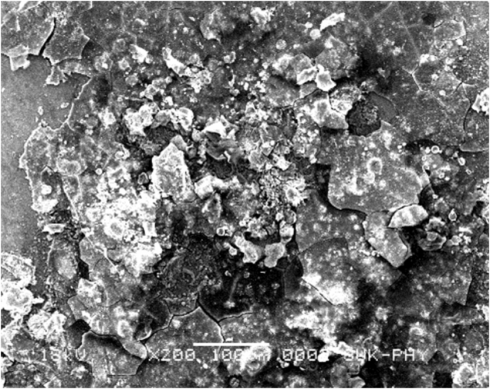
Downloads
References
Ng Jo-Han, NH Kiat and G Suyin. Advances in biodiesel fuel for application in compression ignition engines. Clean Technol. Environ. Policy 2010; 12, 459-93.
Y Xu and Y Peng, X Zheng, KD Dearn, H Xu and X Hu. Synthesis and tribological studies of nanoparticle additives for pyrolysis bio-oil formulated as a diesel fuel. Energy 2015; 83, 80-8.
MA Fazal, ASMA Haseeb and HH Masjuki. Investigation of friction and wear characteristics of palm biodiesel. Energ. Convers. Manage. 2013; 67, 251-6.
M Vasheghani, E Marzbanrad, C Zamani, M Aminy, B Raissi, T Ebadzadeh and H Barzegar-Bafrooei. Effect of Al2O3 phases on the enhancement of thermal conductivity and viscosity of nanofluids in engine oil. Heat Mass Transf. 2011; 47, 1401-5.
CX Gu, GJ Zhu, L Li, XY Tian and GY Zhu. Tribological effects of oxide based nanoparticles in lubricating oils. J. Marine Sci. Appl. 2009; 8, 71-6.
E Ettefaghi, H Ahmadi, A Rashidi, SS Mohtasebi and M Alaei. Experimental evaluation of engine oil properties containing copper oxide nanoparticles as a nano additive. Int. J. Ind. Chem. 2013; 4, 28.
VS Jatti and TP Singh. Copper oxide nano-particles as friction-reduction and anti-wear additives in lubricating oil. J. Mech. Sci. Technol. 2015; 29, 793-8.
Kalyani, V Jaiswal, RB Rastogi and D Kumar. The investigation of different particle size magnesium-doped zinc oxide (Zn0.92Mg0.08O) nanoparticles on the lubrication behaviour of paraffin oil. Appl. Nanosci. 2017; 7, 275-81.
N Talib, R Nasir and EA Rahim. Tribology characteristic of hBN particle as an additive in modified jatropha oil as a sustainable metalworking fluid. In: Proceedings of the Malaysian International Tribology Conference, Penang, Malaysia. 2015, p. 199-200.
W Qiongjie, X Yufu, H Xianguo and Z Xifeng. Experimental study on friction and wear characteristics of bio-oil. Trans. Chin. Soc. Agric. Eng. 2008; 24, 188-92.
S Bhaumik, S Prabhu and KJ Singh. Analysis of tribological behaviour of carbon nanotube based industrial mineral gear oil. Adv. Tribol. 2014; 2014, 341365.
AC Mande, SN Mandlik and SR Nimbalkar. Experimental analysis of tribological properties of lubricating oil using nanoparticle additives. Int. J. Adv. Res. Innov. Ideas Educ. 2016; 2, 637-45.
GC Cristea, A Radulescu, C Georgescu, I Radulescu and L Deleanu. Influence of additive concentration in soybean oil on rheological and tribological behavior. In: Proceedings of the International Conference of Aerospace Sciences, Bucharest, Romania. 2018, p. 35-43.
GC Cristea, C Georgescu, D Dima and L Deleanu. Influence of graphene as additive in soybean oil. IOP Conf. Ser. Mater. Sci. Eng. 2018; 444, 022012.
B Suresha, G Hemanth, A Rakesh and KM Adarsh. Tribological behaviour of pongamia oil as lubricant with and without halloysite nanotubes using four-ball tester. Am. Inst. Phys. Conf. Proc. 2019; 2128, 030011.
VB Borugadda and VV Goud. Biodiesel production from renewable feedstocks: Status and opportunities. Renew. Sust. Energ. Rev. 2012; 16, 4763-84.
PK Devan and NV Mahalakshmi. Utilization of unattended methyl ester of paradise oil as fuel in diesel engine. Fuel 2009; 88, 1828-33.
AA Jungman. 2012, Examining the use of simarouba glauca seed oil as a feedstock for the production of biodiesel using a small scale model developed in India. Master Thesis. Florida International University, Florida, USA.
V Kasturi and MC Navindgi. An experimental analysis of performance, combustion and emission characteristics of simarouba biodiesel and its blends on CI engine. Int. J. Mod. Eng. Res. 2014; 4, 79-86.
HM Mobarak, EN Mohamad, HH Masjuki, MA Kalam, KAHA Mahmud, M Habibullah and AM Ashraful. The prospects of biolubricants as alternatives in automotive applications. Renew. Sust. Energ. Rev. 2014; 33, 34-43.
S Baskar, G Sriram and S Arumugam. Experimental analysis on tribological behavior of nano based bio-lubricants using four ball tribometer. Tribol. Ind. 2015; 37, 449-54.
M Asrul, NWM Zulkifli, HH Masjuki and MA Kalam. Tribological properties and lubricant mechanism of nanoparticle in engine oil. Procedia Eng. 2013; 68, 320-5.
NN Gosvami, J Ma and RW Carpick. An in situ method for simultaneous friction measurements and imaging of interfacial tribochemical film growth in lubricated contacts. Tribol. Lett. 2018; 66, 154.
GE Dieter. Mechanical metallurgy. McGraw-Hill Book Company, London, 2017.
IABS Alves, HM Miranda, LAL Soares and KP Randau. Simaroubaceae family: Botany, chemical composition and biological activities. Braz. J. Pharmacogn. 2014; 24, 481-501.
MS Patil and DK Gaikwad. A critical review on medicinally important oil yielding plant laxmitaru (Simarouba glauca DC.). J. Pharm. Sci. Res. 2011; 3, 1195-213.
Downloads
Published
How to Cite
Issue
Section
License

This work is licensed under a Creative Commons Attribution-NonCommercial-NoDerivatives 4.0 International License.





