
Novel Development of Corrosion Resistant Paint Using Printed Circuit Board from Modern Electronic Wastes
DOI:
https://doi.org/10.48048/tis.2022.2901Keywords:
E-waste generation, Corrosion resistance, Potentiodynamic polarization, Printed circuit board, Discarded electronic appliances, Plain circuit boardAbstract
The growth in the industrial technology and communication sectors has enhanced the usage of electronic gadgets exponentially. Thus, it becomes highly essential to find new solution to utilize or dispose these e-wastes, in order to reduce the e-waste generation. Various reports mentioned that the major component of these e-wastes is their Printed Circuit Boards. Therefore, a new ideology is proposed to use these boards to produce a new coating with good corrosion resistance. At first the boards were separated from the discarded electronic appliances and various electrical elements were separated from these boards. Then the plain circuit boards are pulverized into fine particles and mixed with paint in 3 different proportions ranging from 1:4 to 1:2. The resulting mix was applied over the steel specimen and tested for corrosion resistance. The assessment was done in the aspects of contact angle, weight loss percentage, potentio dynamic polarization technique and electro chemical impedance spectroscopy. From the results it was clear that increase in the addition of printed circuit powder content in the corrosion proof paint coating enhanced the efficiency of the corrosion resistant behaviour 3.5 times than the specimen with uncoated steel specimens. This development of corrosion resistant behaviour of printed circuit powder was attributed from the inertness offered by the presence of silicon dioxides towards the corrosive fluids. Although, the coating of 1:2 proved to be optimum to protect the steel elements from the aggressive corrosion environment, by considering the workability aspects the 1:3 combination was suggested for the innovative development of anti-corrosion paint coating from the e-waste resources.
HIGHLIGHTS
- Life cycles of every electronic wastes end with the hazardous challenging disposals
- Innovative utilizations of these electronic wastes for the corrosion resistant structural applications were detailed
- An anti corrosive coating for steel reinforcement was developed from the waste printed circuit boards
- Coating by printed circuit board powder enhanced 3.5 times more protection from the corrosion
GRAPHICAL ABSTRACT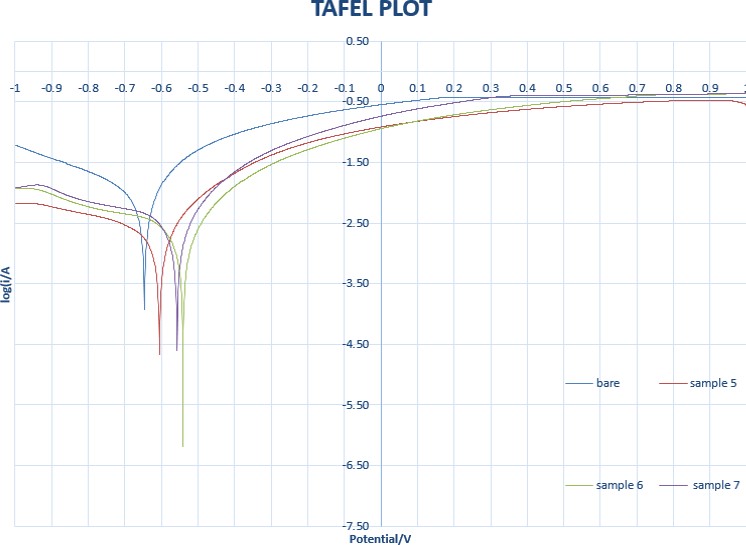
Downloads
References
I Cherukuri, N Sultana and SP Podila. Status of e-waste in India: A review. J. Environ. Sci. Toxicol. Food Tech. 2018; 12, 8-16.
Y Tsunazawa, S Hisatomi, S Murakami and CTokoro. Investigation and evaluation of the detachment of printed circuit boards from waste appliances for effective recycling. Waste Manag. 2018; 78, 474-82.
T Fujita, H Ono, G Dodbiba and K Yamaguchi. Evaluation of a recycling process for printed circuit board by physical separation and heat treatment. Waste Manag. 2014; 34, 1264-73.
A Hubau, A Chagnes, M Minier, S Touzé, S Chapron and AG Guezennec. Recycling-oriented methodology to sample and characterize the metal composition of waste printed circuit boards. Waste Manag. 2019; 91, 62-71.
L Pietrelli, S Ferrobn and M Voccianted. Eco-friendly and cost-effective strategies for metals recovery from printed circuit boards. Renew. Sustain. Energ. Rev. 2019; 112, 317-23.
M Kaya. Waste printed circuit board (WPCB) recovery technology: Disassembly and desoldering approach. Encyclopedia Renew. Sustain. Mater. 2020; 4, 658-76.
U Jadhav and H Hocheng. Hydrometallurgical recovery of metals from largeprinted circuit board pieces. Sci. Rep. 2015; 5, 14574.
H Lu, J Li, J Guo and ZM Xu. Pulverization characteristics and pulverizing of waste printed circuit boards (printed wiring boards) based on resource utilization. J. Shanghai Jiaotong Univ. 2007; 41, 551-6.
A Anthofer, P Kögler, C Friedrich, W Lippmann and A Hurtado. Laser decontamination and decomposition of PCB-containing paint. Optic Laser Tech. 2017; 87, 31-42.
YM Liu, ZQ Wu and DC Yin. Measurement of contact angle under different gravity generated by a longarm centrifuge. Colloid Surface Physicochem. Eng. Aspect 2020; 588, 124381.
AD Usman, AF Victoria, LN Okoro and N Linus. Weight loss corrosion study of some metals in acid medium. J. Adv. Chem. 2015; 11, 3435-40.
RI Holland. Corrosion testing by potentiodynamic polarization in various electrolytes. Dent. Mater. 1992; 8, 241-5.
Y Bao, Y Yan, J Zhang, J Ma, W Zhang and C Liu. Effect of the feeding mode of cross-linker and microcapsule on the corrosion resistance and hydrophobicity of composite coatings. Arabian J. Chem. 2020; 13, 9068-80.
W Tian, F Meng, L Liu, Y Li and F Wang. The failure behaviour of a commercial highly pigmented epoxy coating under marine alternating hydrostatic pressure. Progr. Org. Coating 2015; 82, 101-12.
E Javadia, M Ghaffari, G Bahlakeh and P Taheri. Photocatalytic, corrosion protection and adhesionproperties of acrylic nanocomposite coating containing silane treated nano zinc oxide: A combined experimental and simulation study. Progr. Org. Coating 2019; 135, 496-509.
ZP Mathew, KRC Augustinea, B Joseph and S Johna. Corrosion inhibition of mild steel using poly (2-ethyl-2-oxazoline) in 0.1 M HCl solution author links open overlay panel. Heliyon 2020; 6, 05560.
D Borisova, D Akçakayiran, M Schenderlein, H Möhwald and DG Shchukin. Nanocontainer-based anticorrosive coatings: Effect of the container size on the self-healing performance. Adv. Funct. Mater. 2013; 23, 3799-812.
WA Bizzo, RA Figueiredo and VF de Andrade. Characterization of printed circuit boards for metal and energy recovery after milling and mechanical separation. Materials 2014; 7, 4555-66.
G Priyotomo. A field study of atmospheric corrosion of carbon steel after short exposure in Pelabuhan Ratu, West Java Province, Indonesia. Walailak J. Sci. Tech. 2021, 18, 9667.
Downloads
Published
How to Cite
Issue
Section
License

This work is licensed under a Creative Commons Attribution-NonCommercial-NoDerivatives 4.0 International License.





