
Factors Associated with the Quality of Life in the Elderly with Non-Communicable Diseases in Nakhon Si Thammarat, Thailand
DOI:
https://doi.org/10.48048/tis.2022.2688Keywords:
Quality of life, The elderly, Non-communicable diseases, ThailandAbstract
Medical technology has rapidly developed which increases life expectancy and multiplies the number of an aging population. This trend can be found in many countries, including Thailand. When people live longer, behavior-related illnesses like noncommunicable diseases (NCDs) will be ubiquitous. This point will introduce another burden on global health. NCDs are a cause of death and carry a high cost for extending health in the long-term and decrease the quality of life (QOL) for the elderly. This study was aimed to examine the factors associated with the QOL of the elderly who are having NCDs in Thailand. The sample size was 157 elderly persons aged ≥ 60 years old who lived in Nakhon Si Thammarat, Thailand. The subjects were randomized by the sampling technique. The data were collected using the WHO-QOLBREF questionnaire from 15 May to 10 December 2019. The data were analyzed by descriptive statistics and multiple logistic regression analysis. The total of 157 elderlies with a mean
(± SD) age of 73.76 (± 8.24) years old. The QOL in the elderly with NCDs was qualified at a fair level (63.06 %). The significant factors associating with QOL in the elderly with NCDs were income sufficiency (Odd ratio [OR] = 2.8, 95 %CI: 1.04 to 7.52), self-esteem (OR = 9.75, 95 %CI: 2.74 to 34.70), and social support (OR = 0.12, 95 %CI: 0.03 to 0.43). These results demonstrated that we should be aware of promoting self-esteem, getting social support, and maintaining sufficient income for the elderly. Therefore, it is recommended that the elderly should be encouraged to adapt and plan appropriate behavior and lifestyle in order to improve their quality of life.
HIGHLIGHTS
- The QOL in the elderly with NCDs in Nakhon Si Thammarat, Thailand was qualified at a fair level
- The significant factors associating with QOL in the elderly with NCDs were income sufficiency, self-esteem, and social support
- These results demonstrated that we should be aware of promoting self-esteem, getting social support, and maintaining sufficient income for the elderly
GRAPHICAL ABSTRACT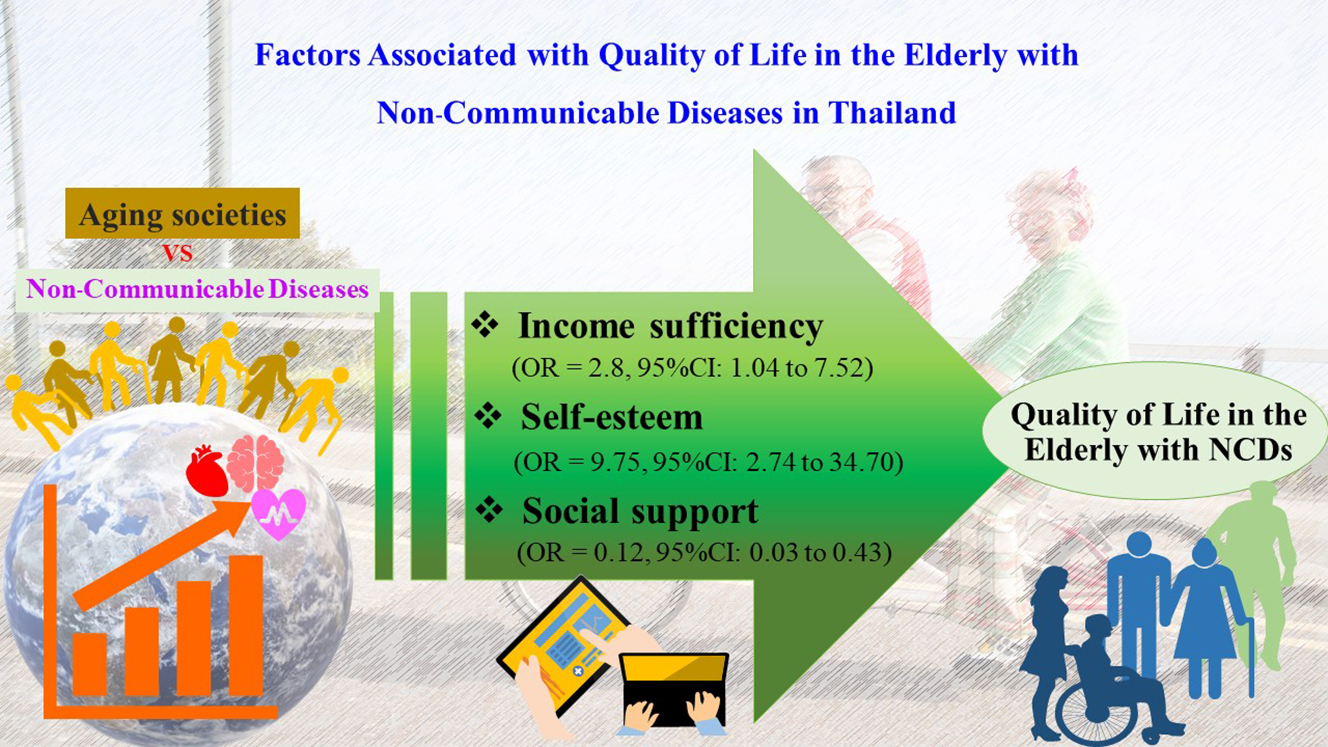
Downloads
References
World Health Organization. US National Institute of Aging. Available at: https://www.who.int/ageing/publications/global_health/en, accessed January 2020.
D Hongthong, R Somrongthong and P Ward. Factors influencing the quality of life (Qol) Among thai older people in a rural area of Thailand. Iran J. Publ. Health 2015; 44, 479-85.
H Kim and K Kim. Health-related quality-of-life and diabetes self-care activity in elderly patients with diabetes in Korea. J. Community Health 2017; 42, 998-1007.
A Boutayeb and S Boutayeb. The burden of non-communicable diseases in developing countries. Int. J. Equity Health 2005; 4, 2.
World Health Organization. Noncommunicable diseases country profiles. World Health Organization, Geneva, Switzerland, 2018.
S Nanthamongkolchai, C Tuntichaivanit, C Munsawaengsub and P Charupoonphol. Factors influencing life happiness among elderly female in Rayong Province, Thailand. J Med. Assoc. Thai. 2009; 92, S8-S12.
A Dans, N Ng, C Varghese, ES Tai, R Firestone and R Bonita. The rise of chronic non-communicable diseases in southeast Asia: Time for action. Lancet 2011; 377, 680-9.
National Statistical Office, Ministry of Information and Communication and Technology. Older persons in Thailand. Available at: http://web.nso.go.th/en/survey/age/older07.htm, accessed December 2019.
R Somrongthon, S Wongchalee, K Yodmai, P Kuhirunyaratn and SMS Sihapark. Quality of life and health status among Thai elderly after economic crisi, Khon Kanen province, Thailand. Eur. J. Sci. Res. 2013; 112, 314-24.
World Health Organization, Regional Office for South-East Asia. Noncommunicable diseases in the South-East Asia Region, 2011: Situation and response. World Health Organization, New Delhi, India, 2012.
Bureau of Non-Communicable Disease. Number and prevalence rate of high blood pressure per 100,000 population (including all diagnoses) 2016 - 2018. Available at: http://www.thaincd.com/2016/mission/documents-detail.php?id=13684&tid=32&gid=1-020, accessed December 2019.
Nakhon Si Thammarat Public Health Office. Population pyramid. (in Thai). Available at: https://nrt.hdc.moph.go.th/hdc/reports/report.php?source=populationpyramid.php&cat_id=ac4eed1bddb23d6130746d62d2538fd0&id=db4e8d42e1234a75bd03d430c31feb2f, accessed December 2019.
World Health Organization. Classification of diabetes mellitus 2019. Available at: https://www.who.int/publications-detail/classification-of-diabetes-mellitus, accessed December 2019.
World Health Organization, Regional Office for the Eastern Mediterranean 2005. Clinical guidelines for the management of hypertension. Available at: https://apps.who.int/iris/handle/10665/119738, accessed December 2019.
WD Wayne. Biostatistics: A foundation of analysis in the health sciences. 6th ed. John Wiley&Sons, New York, 1995, p. 191-2.
The WHOQOL Group. Development of the World Health Organization WHOQOL-BREF quality of life assessment. Psychol. Med. 1998; 28, 551-8.
RF Baumeister. The self in social psychology. Psychology Press, Philadelphia, 1999, p. 225-37.
R Penchansky and JW Thomas. The concept of access: Definition and relationship to consumer satisfaction. Med. Care 1981; 19, 127-40.
AA Alrub, D Hyassat, YS Khader, R Bani-Mustafa, N Younes and K Ajlouni. Factors associated with health-related quality of life among Jordanian patients with diabetic foot ulcer. J. Diabetes Res. 2019; 2019, 4706720.
HV Nguyen, TT Tran, CT Nguyen, TH Tran, BX Tran, CA Latkin, CSH Ho and RCM Ho. Impact of comorbid chronic conditions to quality of life among elderly patients with diabetes mellitus in Vietnam. Int. J. Environ. Res. Publ. Health 2019; 16, 531.
M Baernholdt, I Hinton, G Yan, K Rose and M Mattos. Factors associated with quality of life in older adults in the United States. Qual. Life Res. 2012; 21, 527-34.
MA Bornet, E Rubli Truchard, E Rochat, J Pasquier and S Monod. Factors associated with quality of life in elderly hospitalised patients undergoing post-acute rehabilitation: A cross-sectional analytical study in Switzerland. BMJ Open 2017; 7, e018600.
MS Soósová. Determinants of quality of life in elderly. Cent. Eur. J. Nurs. Midw. 2016; 7, 484-93.
DM Tavares, TG Matias, PC Ferreira, MS Pegorari, JS Nascimento and MM Paiva. Quality of life and self-esteem among the elderly in the community. Ciencia Saude Coletiva 2016; 21, 3557-64.
The WHOQOL Group. The World Health Organization quality of life assessment (WHOQOL): Position paper from the World Health Organization. Soc. Sci. Med. 1995; 41, 1403-9.
LM Byrne-Davis, PD Bennett and GK Wilcock. How are quality of life ratings made? Toward a model of quality of life in people with dementia. Qual. Life Res. 2006; 15, 855-65.
L Clare, RT Woods, SM Nelis, A Martyr, IS Markova, I Roth, CJ Whitaker and RG Morris. Trajectories of quality of life in early-stage dementia: individual variations and predictors of change. Int. J. Geriatr. Psychiatr. 2014; 29, 616-23.
S Marventano, ME Prieto-Flores, B Sanz-Barbero, S Martin-Garcia, G Fernandez-Mayoralas, F Rojo-Perez, P Martinez-Martin, MJ Forjaz and Spanish Research Group on Quality of Life and Ageing. Quality of life in older people with dementia: A multilevel study of individual attributes and residential care center characteristics. Geriatr. Gerontol. Int. 2015; 15, 104-10.
W Moyle, L Venturto, S Griffiths, P Grimbeek, M McAllister, D Oxlade and J Murfield. Factors influencing quality of life for people with dementia: a qualitative perspective. Aging Ment. Health 2011; 15, 970-7.
L Dahlberg and KJ McKee. Correlates of social and emotional loneliness in older people: Evidence from an English community study. Aging Ment. Health 2014; 18, 504-14.
ML Barca, K Engedal, J Laks and G Selbaek. Quality of life among elderly patients with dementia in institutions. Dement Geriatr. Cogn. Disord. 2011; 31, 435-42.
XJ Li, C Suishu, S Hattori, HD Liang, H Gao, CQ Feng and FL Lou. The comparison of dementia patient's quality of life and influencing factors in two cities. J. Clin. Nurs. 2013; 22, 2132-40.
M Mjørud, J Røsvik, AMM Rokstad, M Kirkevold and K Engedal. Variables associated with change in quality of life among persons with dementia in nursing homes: A 10 months follow-up study. PloS One 2014; 9, e115248.
Downloads
Published
How to Cite
Issue
Section
License

This work is licensed under a Creative Commons Attribution-NonCommercial-NoDerivatives 4.0 International License.





