
Spasmolytic Effect of Papaya (Carica papaya L.) Leave Alkaloid on Isolated Rat Myometrial Contraction in vitro
DOI:
https://doi.org/10.48048/tis.2022.2684Keywords:
Carica papaya, Papaya alkaloids, Uterine contraction, Uterine relaxationAbstract
This study aimed to investigate the action of crude alkaloid extract from papaya leaves (PA) on the isolated rat myometrium in vitro. The alkaloids were extracted from papaya leaves using conventional acid-base method. The myometrium strips were taken from female Wistar rats pretreated with diethylstilbestrol (100 mg) for 24 h before the experiment. A preliminary experiment has shown that PA had no effect on myometrial contraction. However, PA (10-6 - 10-3 gm/mL) significantly inhibited myometrium contraction pre-contracted with a depolarizing solution in a concentration-dependent fashion. PA (10-5, 3×10⁻⁵ or 10-4 gm/mL) or verapamil (10-9, 10-8 and 10-7 M) were able to inhibit the myometrial contractile response to CaCl2 (10-5 - 3×10⁻² M) in Ca2+-free solution and cause a rightward shift of log concentration-response curve. PA also significantly inhibited myometrium contraction produced by oxytocin (1 mU/mL), ACh (3×10⁻⁵ M) and PGF2a (10-5 M). Furthermore, propranolol (10-7 M) caused no effect on uterine relaxation induced by PA (10-6 - 10-3 gm/mL), although it inhibited uterine relaxation induced by isoproterenol (10-10 - 10-5 M). These results indicated that PA was a uterine relaxant. Its mechanism of action may be unrelated to stimulation of b2-adrenergic receptors of the uterus. This action may be contributed to mainly the Ca2+ influx, possibly through voltage-operated Ca2+ channel on the plasma membrane, and to a lesser extent by a rise in Ca2+ release from internal storage. However, the action of PA at intracellular sites, downstream of Ca2+ influx such as the contractile machinery of the myometrium, cannot be excluded.
HIGHLIGHTS
- Alkaloid extract from Carica papayaleaves has shown to be a uterine relaxant on isolated rat uterus in vitro
- The alkaloid extract was able to inhibit uterine contraction stimulated by various uterine stimulants such as acetylcholine, oxytocinand prostaglandin F2alpha
- The inhibition on uterine contraction may be due to the inhibition on calcium influx into the uterine muscle cells
GRAPHICAL ABSTRACT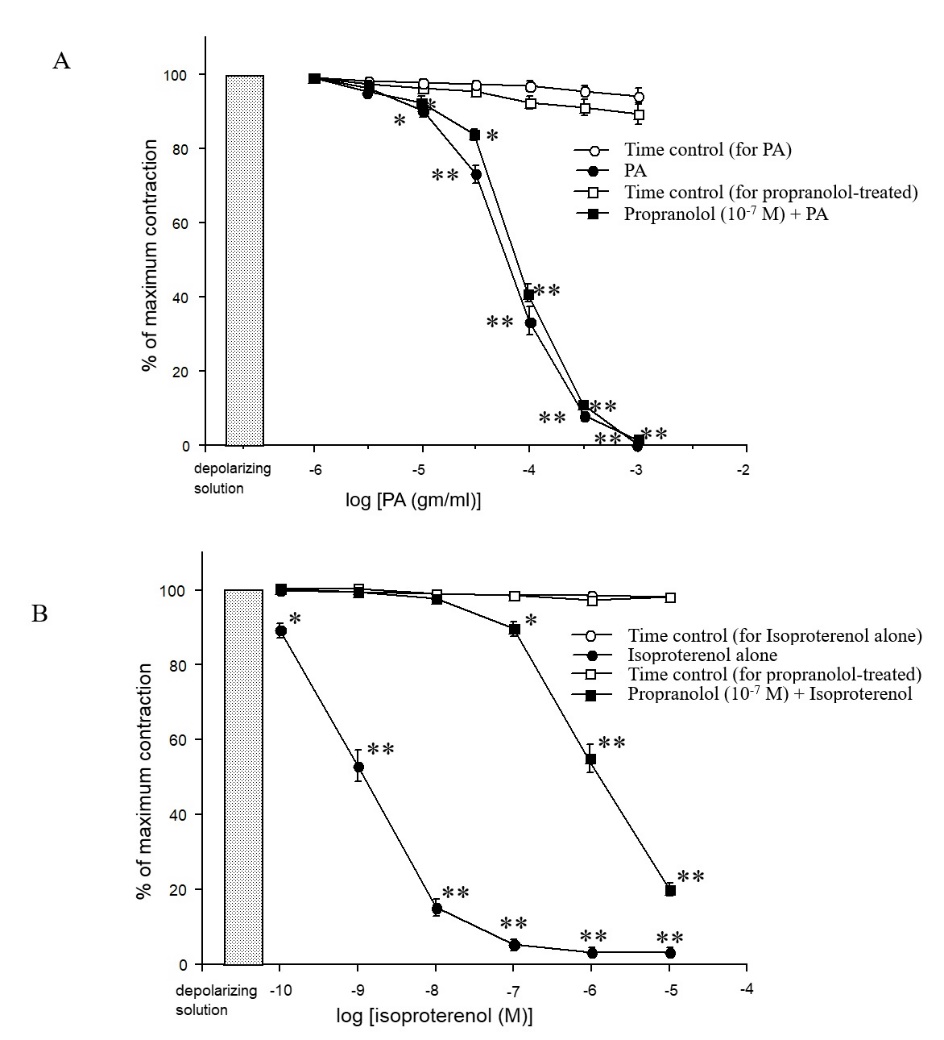
Downloads
References
A Ali, S Devarajan, MI Waly, MM Essa and MS Rahman. Nutritional and medicinal values of papaya (Carica papaya L.). In: MM Essa, A Manickavasagan and E Sukumar (Eds.). Natural products and their active compounds on disease prevention. Nova Science Publishers, New York, 2012, p. 307-24.
A Roshan, NK Verma and A Gupta. A brief study on Carica papaya- A review. Int. J. Cur. Tren. Pharm. Res. 2014; 2, 541-50.
PS Swarkar. A review on: Carica papaya used as herbal medicine in Primary dysmenorrhea. Int. J. Sci. Res. Publ. 2020; 10, 873-80.
SP Singh, S Kumar, SV Mathan, MS Tomar, RK Singh, PK Verma, A Kumar, S Kumar, RP Singh and A Acharya. Therapeutic application of Carica papaya leaf extract in the management of human diseases. Daru J. Pharm. Sci. 2020; 28, 735-44.
SN Abidah, S Hadisaputro, Runjati, ST Hidayat and A Suwondo. Effect of Carica papaya L. leaf on Menstrual pain and prostaglandin level in adolescent with primary dysmenorrhea: A true experiment. Belitung Nurs. J. 2017; 3, 198-204.
EM Burdick. Carpaine: An alkaloid of Carica papaya - its chemistry and pharmacology. Econ. Botany 1971; 25, 363-5.
CA Hurnick, LI Sanders and YC Lin. Effect of carpaine, a papaya alkaloid, on the circulatory function in the rat. Res. Comm. Clin. Path. Pharmacol. 1978; 22, 277-89.
V Zunjar, RP Dash, M Jivrajani, B Trivedi and M Nivsarkar. Antithrombocytopenic activity of carpaine and alkaloidal extract of Carica papaya Linn. leaves in busulfan induced thrombocytopenic Wistar rats. J. Ethnopharmacol. 2016; 181, 20-5.
T Julianti, MD Mieri, S Zimmermann, SN Ebrahimi, M Kaiser, M Neuburger, M Raith, R Brun and M Hamburger. HPLC-based activity profiling for antiplasmodial compounds in the traditional Indonesian medicinal plant Carica papaya L. J. Ethnopharmacol. 2014; 155, 426-34.
GA Cordell. Introduction to alkaloids. John Wiley & Sons, New York, 1981, p. 9-25.
C Perez-Guerrero, MD Herrera and E Marhuenda. Relaxant effect of tetrazepam on rat uterine smooth muscle: role of calcium movement. J. Pharm. Pharmacol. 1996; 48, 1169-73.
S Haldar, S Mohapatra, R Singh and CK Katiyar. Isolation and quantification of bioactive Carpaine from Carica papaya L. and its commercial formulation by HPTLC densitometry. J. Liq. Chromatogr. Relat. Tech. 2020; 43, 11-2.
WJ Elliott and CV Ram. Calcium channel blockers. J. Clin. Hypertens. (Greenwich) 2011; 13, 687-9.
ER Levin, WS Vitek and SR Hammes. Estrogens, progestins, and the female reproductive tract. In: LL Brunton, R Hilal-Dandan and BC Knollmann (Eds.). Goodman & Gilman’s: The pharmacological basis of therapeutics. 13th ed. McGraw-Hill, New York, 2020.
S Wray and C Prendergast. The myometrium: From excitation to contractions and labour. In: H Hashitani and R Lang (Eds.). Smooth muscle spontaneous activity, advances in experimental medicine and biology. Vol 1124. Springer Nature, Singapore, 2019, p. 233-63.
S Arrowsmith and S Wray. Oxytocin: Its mechanism of action and receptor signalling in the myometrium. J. Neuroendocrinol. 2014; 26, 356-69.
CW Gruber and M O’Brien. Uterotonic plants and their bioactive constituents. Planta. Med. 2011; 77, 207-20.
J Brown, K Brandl and J Wess. Muscarinic receptor agonists and antagonists. In: LL Brunton, R Hilal-Dandan and BC Knollmann (Eds.). Goodman & Gilman’s: The pharmacological basis of therapeutics. 13th ed. McGraw-Hill, New York, 2021.
EE Bafor, EK Omogbai and RI Ozolua. In vitro determination of the uterine stimulatory effect of the aqueous leaf extract of Ficus exasperata. J. Ethnopharmacol. 2010; 127, 502-7.
B Jurek and ID Neumann. The oxytocin receptor: From intracellular signaling to behavior. Physiol. Rev. 2018; 98, 1805-908.
TC Westfall, H Macarthur and DP Westfall. Adrenergic agonists and antagonists. In: LL Brunton, R Hilal-Dandan and BC Knollmann (Eds.). Goodman & Gilman’s: The pharmacological basis of therapeutics. 13th ed. McGraw-Hill, New York, 2020.
DK Blumenthal. Pharmacodynamics: Molecular mechanisms of drug action. In: LL Brunton, R Hilal-Dandan and BC Knollmann (Eds.). Goodman & Gilman’s: The pharmacological basis of therapeutics. 13th ed. McGraw-Hill, New York, 2020.
VM Munoz-Perez, E Fernandez-Martinez, H Ponce-Monter and MI Ortiz. Relaxant and anti-inflammatory effect of two thalidomide analogs as PDE-4 inhibitors in pregnant rat uterus. Korean J. Physiol. Pharmacol. 2017; 21, 429-37.
Downloads
Published
How to Cite
Issue
Section
License

This work is licensed under a Creative Commons Attribution-NonCommercial-NoDerivatives 4.0 International License.





