
Performance Evaluation of Physically and Chemically Modified Pumice on Removal of Cu(II) from Aqueous Solution
DOI:
https://doi.org/10.48048/tis.2022.2585Keywords:
Adsorption, Cu, Modification, PumiceAbstract
Modification by physical and chemical treatments was evaluated to increase the adsorption capability of natural pumice in the removal of Cu(II) from aqueous solution. The treatments were heating at temperatures of 300, 450 and 600 ℃ for physical and soaking in acid solutions (HCl, H2SO4 and HNO3) for chemical treatment. The adsorption was performed in the batch system at the optimum condition (5 of pH solution, < 63 µm of adsorbent diameter, 3 g/L of adsorbent dose, 5 mg/L of Cu(II) concentration and 30 min of contact time). The results showed the removal efficiency and Cu(II) uptake increased using modified pumice from 71.19 % and 1.19 mg/g to 84.45 % and 1.41 mg/g. The highest removal efficiency and Cu(II) uptake were obtained from 300℃ of heating temperature and HCl for the acid solution. The application of physical and chemical treatments in modification has the potential to increase the removal efficiency and heavy metal uptake of the natural pumice.
HIGHLIGHTS
- Various methods have been evaluated for the modification of pumice to improve their sorption capacity
- Physical and chemical treatment to pumice may modify the surface areas, pore structures, and chemical functional group on the surface of the pumice
GRAPHICAL ABSTRACT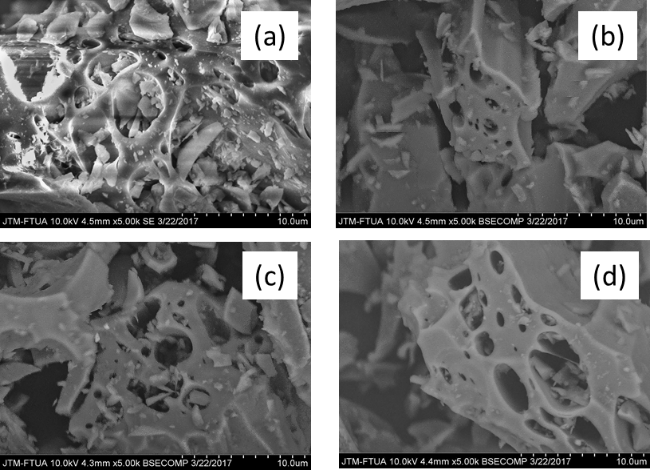
Downloads
References
CA Rozaini, K Jain, CW Oo, KW Tan, LS Tan, A Azraa and KS Tong. Optimization of nickel and copper ions removal by modified mangrove barks. Int. J. Chem. Eng. App. 2010; 1, 84-9.
S Indah, D Helard, MA Herfi and H Hamid. Spatial variation of metals in the Batang Arau River, West Sumatera, Indonesia. Water Environ. Res. 2018; 90, 34-243.
E Demirabs, N Dizge, MT Sulaka and M Kobya. Adsorption kinetics and equilibrium of copper from aqueous solutions using hazelnut shell activated carbon. Chem. Eng. J. 2009; 148, 480-7.
H Tapiero, DM Townsend and KD Tew. Trace elements in human physiology and pathology. Copper. Biomed. Pharmacother. 2003; 57, 386-98.
MM Rao, A Ramesh, GPC Rao and K Seshaiah. Removal of copper and cadmium from aqueous solutions by activated carbon derived from Ceiba pentandra hulls. J. Hazard. Mater. 2006; 129, 123-9.
D Bingöl, M Hercan, S Elevli and E Kılıç. Comparison of the results of response surface methodology and artificial neural network for the biosorption of lead using black cumin. Biores. Tech. 2012; 112, 111-5.
R Gong, M Feng, J Zhao, W Cai and L Liu. Functionalization of sawdust with monosodium glutamate for enhancing its malachite green removal capacity. Biores. Tech. 2009; 100, 975-8.
TS Anirudhan and SS Sreekumari. Adsorptive removal of heavy metal ions from industrial effluents using activated carbon derived from waste coconut buttons. J. Environ. Sci. 2011; 23, 1989-98.
S Indah, D Helard and A Sasmita. Utilization of maize husk (Zea mays L.) as a low-cost adsorbent in the removal of iron from aqueous solution. Water Sci. Tech. 2016; 73, 2929-35.
S Babel and TA Kurniawan. Low-cost adsorbents for heavy metals uptake from contaminated water: A review. J. Hazard. Mater. 2003; 97, 219-43.
JJ Liu, XC Wang and B Fan. Characteristics of PAHs adsorption on inorganic particles and activated sludge in domestic wastewater treatment. Biores. Tech. 2010; 102, 5305-11.
JH Xi, MC He and CY Lin. Adsorption of antimony(III) and antimony(V) on bentonite: Kinetics, thermodynamics and anion. Microchem. J. 2011; 97, 85-91.
A Sari, D Citak and M Tuzen. Equilibrium, thermodynamic and kinetic studies on adsorption of Sb(III) from aqueous solution using low-cost natural diatomite. Chem. Eng. J. 2010; 162, 521-7.
P Chutia, S Kato, T Kojima and S Satokawa. Adsorption of As(V) on surfactant-modified natural zeolites. J. Hazard. Mater. 2009; 162, 204-11.
B Heibati, S Rodriguez-Couto, A Amrane, M Rafatullah, A Hawari and MA Al-Ghouti. Uptake of by pumice and walnut activated carbon: Chemistry and adsorption mechanisms. J. Ind. Eng. Chem. 2014; 20, 2939-47.
T Liu, Y Yang, ZL Wang and Y Sun. Remediation of arsenic(III) from aqueous solutions using improved nanoscale zero-valent iron on pumice. Chem. Eng. J. 2016; 288, 739-44.
H Shayesteh, A Rahbar-Kelishami and R Norouzbeigi. Evaluation of natural and cationic surfactant modified pumice for congo red removal in batch mode: Kinetic, equilibrium, and thermodynamic studies. J. Mol. Liq. 2016; 221, 1-11.
F Akbal. Adsorption of basic dyes from aqueous solution onto pumice powder. J. Colloid Interface Sci. 2005; 286, 455-8.
M Kitis, SS Kaplan, E Karakaya, NO Yigit and G Civelekoglu. Adsorption of natural organic matter from waters by iron coated pumice. Chemosphere 2007; 66, 130-8.
M Heidar, F Moattar, S Nasen, MT Samadi and N Khorasani. Evaluation of aluminum-coated pumice as a potential arsenic (V) adsorbent from water resources. Int. J. Environ. Res. 2011; 5, 447-56.
AH Mahvi and B Heibati. Removal of Reactive Red 120 and Direct Red 81 dyes from aqueous solutions by pumice. Res. J. Chem. Environ. 2012; 16, 62-8.
M Malakootian, A Fatehizadeh and N Yousefi. Evaluating the effectiveness of modified pumice in fluoride removal from water. Asian J. Chem. 2011; 23, 3691-4.
MN Sepehr, A Amrane, KA Karimaian, M Zarrabi and HR Ghaffari. Potential of waste pumice and surface modified pumice for hexavalent chromium removal: Characterization, equilibrium, thermodynamic and kinetic study. J. Taiwan Ins. Chem. Eng. 2014; 45, 635-47.
S Indah, D Helard and A Binuwara. Studies on desorption and regeneration of natural pumice for iron removal from aqueous solution. Water Sci. Tech. 2018; 2017, 509-515.
S Indah, D Helard, T Edwin and R Pratiwi. Utilization of pumice from Sungai Pasak, West Sumatra, Indonesia as low-cost adsorbent in removal of manganese from aqueous solution. AIP Conf. Proc. 2017; 1823, 020072.
GM Walker, L Hansen, JA Hanna and SJ Allen. Kinetics of a reactive dye adsorption onto dolomitic sorbents. Water Res. 2003; 37, 2081-9.
S De Gisi, G Lofrano, M Grassi and M Notarnicola. Characteristics and adsorption capacities of low-cost sorbents for wastewater treatment: A review. Sustain. Mater. Tech. 2016; 9, 10-40.
Z Derakhshan, MA Baghapour, M Ranjbar and M Faramarzian. Adsorption of methylene blue dye from aqueous solutions by modified pumice stone: Kinetics and equilibrium studies. Health Scope 2013; 2, 136-44.
M Ulmanu, E Marañón, Y Fernández, L Castrillón, I Anger and D Dumitriu. Removal of copper and cadmium ions from diluted aqueous solutions by low cost and waste material adsorbents. Water Air Soil Pollut. 2003; 142, 357-73.
RSD Castro, L Caetano, G Ferreira, PM Padilha, MJ Saeki, LF Zara, MAU Martines and GR Castro. Banana peel applied to the solid phase extraction of copper and lead from river water: Preconcentration of metal ions with a fruit waste. Ind. Eng. Chem. Res. 2011; 50, 3446-51.
K Banerjee, ST Ramesh, R Gandhimathi, PV Nidheesh and KS Bharathi. A novel agricultural waste adsorbent, watermelon shell for the removal of copper from aqueous solutions. Iranica J. Energ. Environ. 2012; 3, 143-56.
E Bernard, A Jimoh and J Odigure. Heavy metals removal from industrial wastewater by activated carbon prepared from coconut shell. Res. J. Chem. Sci. 2013; 3, 3-9.
S Halnor, M Farooqui and M Ubale. Removal of copper(II) from aqueous solution and waste water by prosopis juliflora leaf powder by adsorption. Int. J. Appl. Innov. Eng. Manag. 2013; 2, 125-31.
M Gupta, H Gupta and DS Kharat. Adsorption of Cu(II) by low cost adsorbents and the cost analysis. Environ. Tech. Innov. 2018; 10, 91-101.
Downloads
Published
How to Cite
Issue
Section
License

This work is licensed under a Creative Commons Attribution-NonCommercial-NoDerivatives 4.0 International License.





