
New Distributional Records of Lichens for the State of Mizoram, Indo-Burma Region of India
DOI:
https://doi.org/10.48048/tis.2022.2573Keywords:
Documentation, Indo-Burma region, Lichens diversity, Mizoram, New recordsAbstract
The present paper enumerated the occurrence of 30 different species of lichens collected from 2 different study sites situated in 2 districts of Mizoram. It included Crustose (12 sp.), Foliose (16 sp.) and Fruticose (2 sp.) along with 9 species named as Diploschistes scruposus (Schreb.) Norman, Diorygma macgregorii (Vain.) Kalb, Staiger & Elix, Diorygma soozanum (Zahlbr.) M. Nakan. & Kashiw., Malmidea granifera (Ach.) Kalb, Rivas Plata & Lumbsch, Letrouitia vulpina (Tuck.) Hafellner & Bellem., Parmotrema austrosinense (Zahlbr.) Hale, Parmotrema crinitoides J.C. Wei, Parmotrema nilgherrense (Nyl.) Hale, Parmotrema rampoddense (Nyl.) Hale reported as a new record for the 1st time to the state of Mizoram, Northeast India. The finding were correlated with other previous reports on lichens and it provided detailed overview of documentation, distribution and diversity of lichens found in the small state like Mizoram under Indo-Burma region. Therefore, the richness of lichen diversity indicates the conditions of good forest health in Mizoram. The study also submits the need of conservation and exploration in the unexplored areas.
HIGHLIGHTS
- The insight of the lichens diversity of the Mizoram state now provides the open platform for Lichenologist as well as Environmentalist
- The report of few species for the first time from the forest dominated hilly region of Mizoram had shown the richness of lichen distribution and its diversity
- As urbanisations as well as infrastructures developments are taking places in the remote corner of the state, it is very essential to explore the lichens diversities
GRAPHICAL ABSTRACT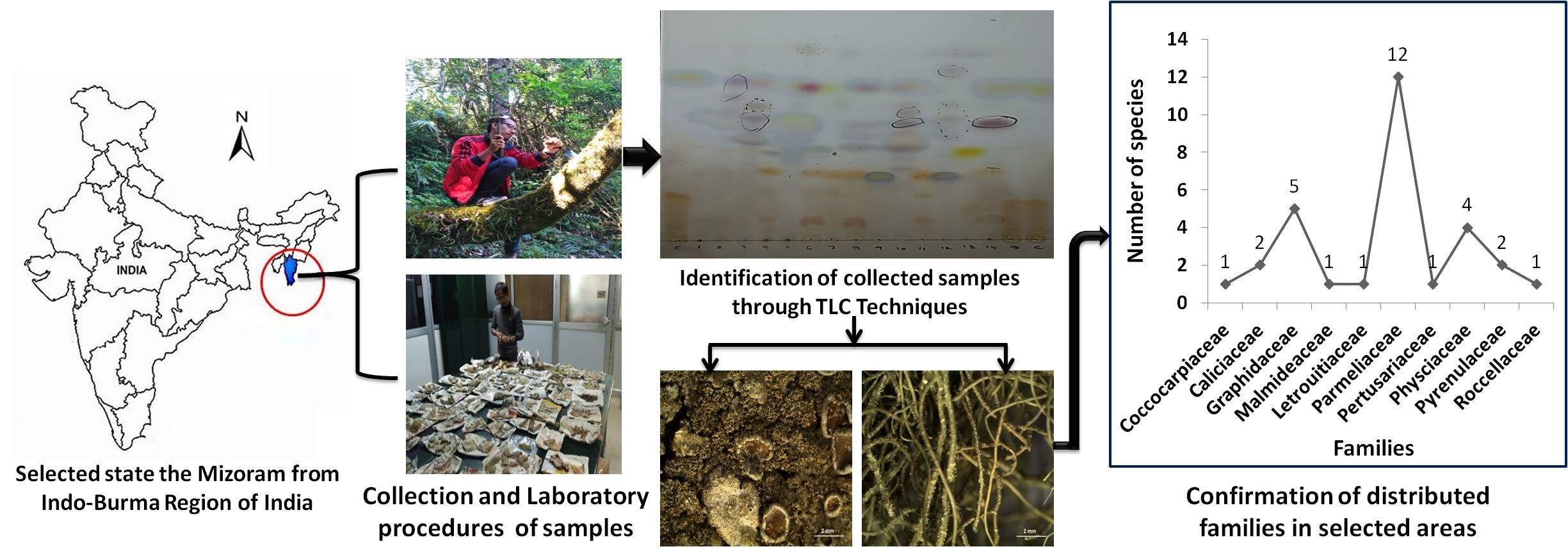
Downloads
References
B Rankovic and M Kosanic. Lichens as a potential source of bioactive secondary metabolites. In: B Rakovic (Ed.). Lichen secondary metabolites. Springer, Cham, Switzerland, 2015, p. 1-26.
NM Thangjam, A Kumar, AC Shukla and DK Upreti. Diversity and distribution of lichens in Murlen National Park of Mizoram, India. Environ. Ecol. 2019; 37, 664-72.
B McCune. Lichen communities as indicators of forest health. Bryologist 2000; 103, 353-6.
R Honegger. Lichen-forming fungi and their photobionts. In: H Deiding (Ed.). Plant relationships. Springer, Berlin, Heidelberg, Germany, 2009, p. 307-33.
DJ Galloway. Biodiversity: A lichenological perspective. Biodivers. Conserv. 1992; 1, 312-23.
A Aptroot. Species diversity in tropical rainforest ascomycetes: Lichenized versus non-lichenized; foliicolous versus corticolous. Abstr. Bot. 1997; 21, 37-44.
R Lucking, BP Hodkinson and SD Leavitt. The 2016 classification of lichenized fungi in the Ascomycota and Basidiomycota - approaching one thousand genera. Bryologist 2017; 119, 361-417.
KP Singh and GP Sinha. Indian lichens: Annotated checklist. Botanical Survey of India, Kolkata, India, 2010.
KP Singh, P Sigh and GP Sinha. Lichen diversity in the Eastern Himalaya biodiversity hotspot region, India. Cryptogam Biodivers. Assess. 2018. DOI: 10.21756/cab.esp9.
A Roy, SK Das, AK Tripathi, NU Singh and HK Barman. Biodiversity in North East India and their conservation. Prog. Agric. 2015; 15, 182-9.
SK Tripathi, A Roy, D Kushwaha, F Lalnunmawia, Lalnundanga, H Lalnundanga, C Lalnunzira and PS Roy. Perspectives of forest biodiversity conservation in Northeast India. J. Biodivers. Biopros. Dev. 2016; 3, 157.
GP Sinha and TAM Ram. Lichen diversity in Sikkim. In: ML Arrawatia and S Tambe (Eds.). Biodiversity of Sikkim: Exploring and conserving a global hotspot. Kwality Stores, Gangtok, Sikkim, India, 2011, p. 13-28.
M Yilmaz, AO Turk, T Tay and M Kivanc. The antimicrobial activity of extracts of the lichen Cladonia foliacea and its (-)-usnic acid, atranorin, and fumarprotocetraric acid constituents. Z. Naturforsch. C 2004; 59, 249-54.
M Kosanic, B Rankovic and T Stanojkovic. Investigation of selected Serbian lichens for antioxidant, antimicrobial and anticancer properties. J. Anim. Plant Sci. 2013; 23, 1628-33.
VP Rajan, S Gunasekaran, S Ramanathan, V Murugaiyah, MW Samsudin and LB Din. Biological activities of four Parmotrema species of Malaysian origin and their chemical constituents. J. Appl. Pharm. Sci. 2016; 6, 36-43.
AR Logesh, M Chinlampianga, AC Shukla and DK Upreti. Studies on lichens of Mizoram, Northeast India. Proc. Natl. Acad. Sci., India, Sect. B Biol. Sci. 2015; 87, 445-57.
GB Pant. State at a glance, Mizoram. ENVIS Centre on Himalayan Ecology, Mizoram, India, 2016, p. 1-135.
HG Champion and SK Seth. A revised survey of the forest types of India. Manager of Publications, Delhi, India, 1968, p. 1-397.
ST Lalzarzovi and Lalnuntluanga. Floristic composition of shrub community of Reiek Forest, Mamit District Mizoram. NeBIO 2013; 4, 55-6.
ST Lalzarzovi and Lalnuntluanga. Plant community structure of tropical semi-evergreen forest of Reiek in Mamit District of Mizoram. Sci. Tech. J. 2018; 5, 58-62.
Mizoram Portal, Available at: https://mizoram.gov.in/page/reiek, accessed April 2020.
H Lalrinawmi, J Zothanzama, BW Held, JMC Vabeikhokhei, Zohmangaiha and RA Blanchette. The gilled mushroom Amanita spissacea (Amanitaceae): A new report for India. J. Threat. Taxa 2018; 10, 12413-7.
Shodhganga, Available at: https://shodhganga.inflibnet.ac.in/bitstream/10603/1207/11/11_chapter %203.pdf, accessed April 2020.
S Nayaka. Methods and techniques in collection, preservation and identification of lichens. In: TS Rana (Ed.). Plant toxonomy and biosystematics: Classical and modern methods. New India Publishing Agency, New Delhi, India, 2014, p. 101-5.
RKS Devi, J Rout, DK Upreti, S Nayaka and A Pinokiyo. New records of lichens from Manipur State, North-eastern India. Mycosphere 2015; 6, 796-813.
BJ Coppins. A key to the microlichens of India, Nepal and Sri Lanka. Lichenologist 1993; 25, 101-4.
P Wolseley. A compendium of the macrolichens from India, Nepal and Sri Lanka. Lichenologist 2008; 40, 267-8.
S Nayaka. 2004, Revisionary studies on lichen genus Lecanora sensulato in India. Ph. D. Thesis. Dr. RML Avadh University Faizabad, Faizabad, India.
PK Divakar and DK Upreti. Parmelioid lichens in India: A revisionary study. Bishen Singh Mahendra Pal Singh, Dehradun, Uttarakhand, India, 2005.
P Shukla, DK Upreti and LM Tewari. Lichen genus Usnea (Parmeliaceae, Ascomycota) in Uttarakhand, India. Curr. Res. Environ. Appl. Mycol. 2014; 4, 188-201.
CF Culberson and HD Kristinsson. A standardized method for the identification of lichen products. J. Chromatogr. 1970; 46, 85-93.
F Schumm. Atlas of images of thin layer chromatograms of lichen substances. Books on Demand, Norderstedt, Germany, 2015, p. 1-6.
R Daimari, N Hazarika, RR Hoque, S Nayaka and DK Upreti. New records of epiphytic lichens from three districts of Assam, India. Indian For. 2014; 140, 807-11.
R Gogoi, S Joseph, S Nayaka and F Yasmin. Additions to the lichen biota of Assam State, India. J. Threat. Taxa 2019; 11, 13765-81.
R Debnath, R Khare, L Gogoi, DK Upreti and J Rout. New additions of macrolichens to the lichen flora of Arunachal Pradesh, India in Eastern Himalaya. Stud. Fungi 2018; 3, 100-14.
P Singh and KP Singh. New distribution records of lichens for the state of Meghalaya, North-East India. Indian J. For. 2016; 39, 245-54.
M Chinlampianga, AR Logesh, U Dubey, AC Shukla and DK Upreti. Preliminary studies on lichen flora of Mizoram, North East India. Sci. Tech. J. 2013; 1, 22-5.
NM Thangjam, A Kumar, KS Kumar, AC Shukla and DK Upreti. Exploration of lichens diversity from Mizoram with addition of Pyrenula dissimulans (Pyrenulaceae) a new record to India. Asian J. Conserv. Biol. 2020; 9, 98-106.
J Rout, P Das and DK Upreti. Epiphytic lichen diversity in a reserve forest in southern Assam, northeast India. Trop. Ecol. 2010; 51, 281-8.
A Pinokiyo, KP Singh and JS Singh. Diversity and distribution of lichens in relation to altitude within a protected biodiversity hot spot, north-east India. Lichenologist 2008; 40, 47-62.
AK Dey, GK Mishra, J Rout and DK Upreti. An enumeration of epiphytic lichens from Hojai sub-division of Nagaon district, Assam, India. Int. J. Adv. Res. Biol. Sci. 2015; 2, 111-5.
R Moberg. The lichen genus Heterodermia (Physciaceae) in South America: A contribution including five new species. Nord. J. Bot. 2011; 29, 129-47.
DK Upreti, R Bajpai and S Nayaka. Lichenology: Current research in India. In: B Bahadur, MV Rajam, L Sahijram and K Krishnamurthy (Eds.). Plant biology and biotechnology. Springer, New Delhi, India, 2015, p. 263-80.
S Gupta, R Khare, O Bajpai, H Rai, DK Upreti, RK Gupta and PK Sharma. Lichen as bioindicator for monitoring environmental status in Western Himalaya, India. Int. J. Environ. 2016; 5, 1-15.
R Bajpai, S Mishra, S Dwivedi and DK Upreti. Change in atmospheric deposition during last half century and its impact on lichen community structure in Eastern Himalaya. Sci. Rep. 2016; 6, 30838.
Downloads
Published
How to Cite
Issue
Section
License

This work is licensed under a Creative Commons Attribution-NonCommercial-NoDerivatives 4.0 International License.





