
Robusta Coffee (Coffeacanephora) Down Regulation TNF-α Expression in Carotid Artery Endothelial Cell of Hyperlipidemia Rat Model
DOI:
https://doi.org/10.48048/tis.2022.2199Keywords:
Robusta coffee (Coffeacanephora), Low Density Lipoprotein (LDL), TNF-α, Hyperlipidemia rat modelAbstract
Hyperlipidemia is a cause of atherosclerosis, that characterized by an abnormal elevation of cholesterol, especially Low Density Lipoprotein (LDL). It leads to foam cell formation, andcorrelated with the increased level of pro-inflammatory cytokine TNF-α.Inflammatory is assumed to be inhibited by natural ingredients which have antiinflammatory effect. One of the natural product which predicted to have antiinflammatory effect is robusta coffee. This research aimedto investigate the effect of robustacoffee on TNF-α expression in hyperlidemiarat model. Fiveteenmale Wistar rats were randomly divided into 3 groups: Control (K), Hyperlipidemia (H), and coffeerobusta(C). Hyperlipidemia induced by feeding the yolks of duck and pork oil. Infraorbital blood was taken for examination of LDL levels andthe rats were sacrified at 29 day after the treatment. Carotid arteries were then processed histologically. Anova and LSD test results showed levels of LDL in the coffee group were significantly different from the hyperlipidemia group (p < 0.05).Immunohistochemical (IHC) analysis was performed using rabbit anti rat TNF- α polyclonal antibody. Lipid deposition in carotid artery observation within Sudan IV staining.Resultshowed robustacoffee induced lower expression of TNF- α and less lipid deposition in subendotelial layer. StrongTNF-αpositive staining seems on hyperlipidemia group. Robusta coffeedown regulationTNF-α expressionin carotid artery ofhyperlipidemia rat model.
HIGHLIGHTS
- Robusta coffee has been shown down regulated TNF-a expression in endothelial cells carotid artery of rats induced by hyperlipidemia
- Robusta coffee has been shown to decrease lipid deposition in the subendothelial layer of rats induced by hyperlipidemia
- This study proves that induction using pork oil and duck egg yolk can increase LDL levels in the blood of experimental animals
GRAPHICAL ABSTRACT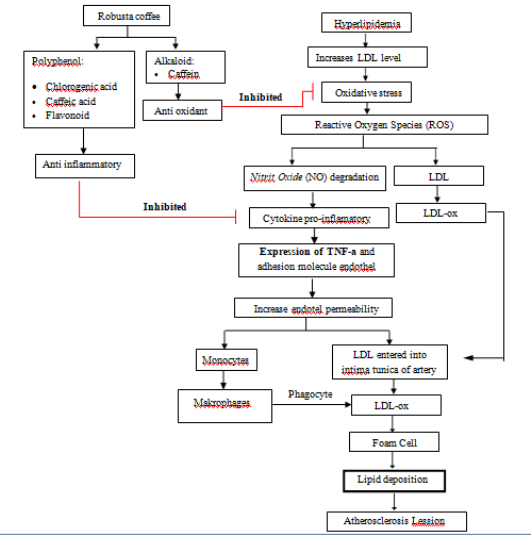
Downloads
References
GH Tomkin and O Daphne. LDL as a cause of atherosclerosis. Open Atherosclerosis Thromb. J. 2012; 5, 13-21.
MK Hamoud. Coronary artery disease. Tufts-New England Medical Center, Boston, Massachusetts, 2008, p. 1-13.
A Kontush and MJ Chapman. HDL: Close to our memories? Arteriosclerosis, Thromb. Vascular Biol. 2008; 28, 1418-20.
S Hall, B Desbrow, SA Dukie, AK Davey, D Arora, C McDermot, MM Schubert, AV Perkins, MJ Kiefel and GD Grant. A review of the bioactivity of coffee, caffeine and key coffee constituents on inflammatory responses linked to depression. Food Res. Int. 2015; 76, 626-36.
YI Yashin, NI Cheurnousova, PA Fedina, DA Levin and SA Mironov. Determination of antioxidants in coffee by an amperometric method. Beer Beverages 2009; 2, 45-7.
A Yashin, Y Yashin, JY Wang and B Nemzer. Antioxidant and antiradical activity of coffee. Antioxidants 2013; 2, 230-45.
Y Zhao, J Wang, O Ballevre, H Luo and W Zhang. Anti-hypertensive effects and mechanisms of chlorogenic acids. Hypertens. Res. 2012; 35, 370-4.
JS Bonita, M Mandarano, D Shuta and J Vinson. Coffee and cardiovascular disease: In vitro, cellular, animal, and human studies. Pharmacol. Res. 2007; 55, 187-98.
N Fatimatuzzahroand RC Prasetya.Efekkopi robustaterhadapprofil lipid darahtikus yang diinduksiseduhandanberatbadan diet tinggilemak. Jurnal Kedokteran Brawijaya 2018; 30, 7-11.
IMS Harsa. Efekpemberian diet tinggilemakterhadapprofillemakdarahtikusputih (Rattusnorvegicus). Jurnal Ilmiah Kedokteran 2014; 3, 21-8.
N Asiah, F Septiyana, U Saptono, L Cemoaka and DA Sari. Identifikasicita rasa sajiantubruk kopi robustapadaberbagaisuhudantingkatkehalusanpenyeduhan. Barometer 2017; 2, 52-6.
S Grioni, C Agnoli, S Sieri, V Pala, F Ricceri, G Masala, C Saieva, S Panico, A Mattiello, P Chiodini, R Tumino, G Frasca, L Lacoviello, AD Curtis, P Vineis and V Krogh. Espresso coffee consumption and risk of coronary heart disease in a large italian cohort. PLoS One 2015; 10, e0126550.
A Umeno, H Masanori, M Kazutoshi, N Yoshihiro and Y Yasuzaku. Antioxidative and antidiabetic effects of natural polyphenols and isoflavones. Molecules 2016; 21,708.
D Echeverri, FR Montes, M Cabrera, A Gal'an and A Prieto. Caffeine’s vascular mechanism of action. Int. J. Vasc. Med. 2010; 2010, 834060.
BA Akinpelu, OA Igbaneghu, AI Awotunde, EO Iwalewaand OO Oyedapo. Antioxidant and antibacterial activities of saponin fractions of Erythropheleumsuaveolens (Guill. and Perri.) stem bark extract. Acad. J. 2014; 9, 826-33.
D Grassi, G Desideri and C Ferri. Flavonoids: Antioxidants againts atherosclerosis. Nutrients 2010; 2, 889-902.
FA Khan, A Maalik and G Murtaza. Inhibitory mechanism against oxidative stress of caffeinacid. J. Food Drug Anal. 2016; 24, 695-702.
B Katochand R Begum. Biochemical basis of the high resistance to oxidative stress in distyosteliumdiscoideum. J.Biosci. 2003; 28, 581-6.
AS Cho, SM Jeon, MJ Kim, J Yeo, K Seo, MS Choi and MK Lee.Chlorogenicacid exhibits anti-obesity property and improves lipidmetabolism in high-fat diet-induced-obese mice.Food Chem. Toxicol.2010; 48, 937-43.
Downloads
Published
How to Cite
Issue
Section
License

This work is licensed under a Creative Commons Attribution-NonCommercial-NoDerivatives 4.0 International License.





