
Production of Hyaluronic Acid from Molasses by Streptococcus thermophilus TISTR 458
DOI:
https://doi.org/10.48048/tis.2022.2192Keywords:
Hyaluronic acid, Streptococcus thermophilus TISTR 458, Glucose, Sugarcane molasses, FermentationAbstract
The purpose of this study was to investigate the capability of Streptococcus thermophilus TISTR 458 on hyaluronic acid (HA) production by using various carbon sources including glucose, sucrose and sugarcane molasses. HA production was determined using a turbidity assay by precipitation with cetyltrimethylammonium bromide (CTAB) and the sugar content was analysed by a sulphuric acid-UV spectrophotometry method. The results showed that S. thermophilus TISTR 458 produced the maximal yield of HA from glucose, sucrose and molasses at approximately 32.80 ± 4.27 (24 h), 79.03 ± 8.36 (24 h) and 213.44 ± 76.79 (12 h) mg/L, respectively, then decreased gradually. Moreover, an elevated level of HA was related to a reduction in the sugar content. It was concluded that S. thermophilus TISTR 458 can produce HA by using glucose, sucrose and molasses. Interestingly, molasses as a cheap agricultural by-product is a promising prospect carbon source for HA production by S. thermophilus TISTR 458.
HIGHLIGHTS
- Searching for alternatives sources such as agro-industrial by-products to produce biomolecules has been an increasing trend nowadays
- Various carbon sources have been used for hyaluronic acid (HA) production by Streptococcus thermophilus TISTR 458, the culture collection in Thailand
- Sugarcane molasses, a cheap agricultural by-product was a promising prospect carbon source for HA production by thermophilus TISTR 458
GRAPHICAL ABSTRACT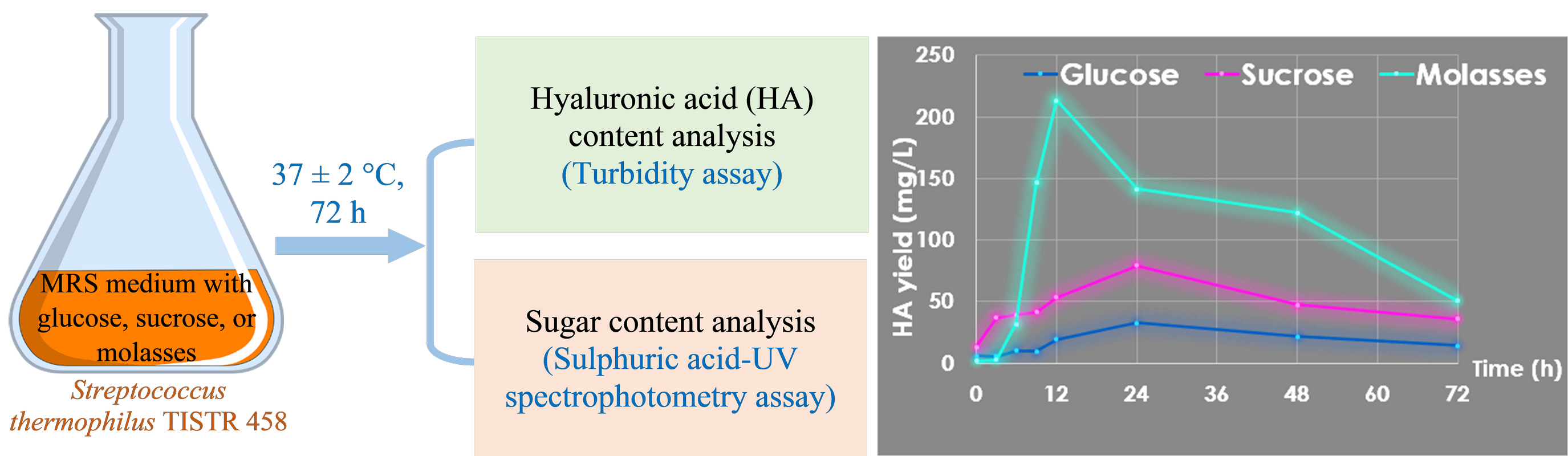
Downloads
References
JH Kim, MJ Moon, DY Kim, SH Heo and YY Jeong. Hyaluronic acid-based nanomaterials for cancer therapy. Polymers (Basel) 2018; 10, 1133.
KJ Reddy and KT Karunakaran. Purification and characterization of hyaluronic acid produced by Streptococcus zooepidemicus strain 3523-7. J. BioSci. Biotech. 2013; 2, 173-9.
CG Boeriu, J Springer, FK Kooy, LAMVD Broek and G Eggink. Production methods for hyaluronan. Int. J. Carbohydr. Chem. 2013; 2013, 624967.
G Kogan, L Soltes, R Stern and P Gemeiner. Hyaluronic acid: A natural biopolymer with a broad range of biomedical and industrial applications. Biotechnol. Lett. 2007; 29, 17-25.
V Rangaswamy and D Jain. An efficient process for production and purification of hyaluronic acid from Streptococcus equi subsp. zooepidemicus. Biotechnol. Lett. 2008; 30, 493-6.
AMB Pires, AC Macedo, SY Eguchi and MHA Santana. Microbial production of hyaluronic acid from agricultural resource derivatives. Bioresour. Technol. 2010; 101, 6506-9.
J Mei, Z Dong, Y Yi, Y Zhang and G Ying. A simple method for the production of low molecular weight hyaluronan by in situ degradation in fermentation broth. e-Polymers 2019; 19, 477-81.
N Izawa, T Hanamizu, R Iizuka, T Sone, H Mizukoshi, K Kimura and K Chiba. Streptococcus thermophilus produces exopolysaccharides including hyaluronic acid. J. Biosci. Bioeng. 2009; 107, 119-23.
PVM Thien and NHK Tu. Hyaluronan production in Streptococcus thermophilus. J. Chem. Pharm. Res. 2016; 8, 491-4.
RG Ferreira, AR Azzoni, MHA Santana and D Petrides. Techno-economic analysis of a hyaluronic acid production process utilizing Streptococcal fermentation. Processes 2021; 9, 241.
E Marcellin, W Chen and LK Nielsen. Microbial hyaluronic acid biosynthesis. In: BHA Rehm (Ed.). Microbial production of biopolymers and polymer precursors: Applications and perspectives. Caister Academic Press, Norfolk, 2009, p. 163-80.
L Liu, J Sun, W Xu, M Wang, G Du and J Chen. Modelling and optimization of microbial hyaluronic acid production by Streptococcus zooepidemicus using radial basis function neural network coupling quantum-behaved particle swarm optimization algorithm. Biotechnol. Prog. 2009; 25, 1819-25.
JM Song, JH Im, JH Kang and DJ Kang. A simple method for hyaluronic acid quantification in culture broth. Carbohydr. Polym. 2009; 78, 633-4.
AA Albalasmeh, AA Berhe and TA Ghezzehei. A new method for rapid determination of carbohydrate and total carbon concentrations using UV spectrophotometry. Carbohydr. Polym. 2013; 97, 253-61.
FE Kendall, M Heidelberger and MH Dawson. A serologically inactive polysaccharide elaborated by mucoid strains of group A hemolytic Streptococcus. J. Biol. Chem. 1937; 118, 61-9.
ACD Macedo and MHA Santana. Hyaluronic acid depolymerization by ascorbate-redox effects on solid state cultivation of Streptococcus zooepidemicus in cashew apple fruit bagasse. World J. Microbiol. Biotechnol. 2012; 28, 2213-9.
MRD Oliveira, RSSFD Silva, JB Buzato and MAPC Celligoi. Study of levan production by Zymomonas mobilis using regional low-cost carbohydrate sources. Biochem. Eng. J. 2007; 37, 177-83.
K Xu and P Xu. Efficient production of l-lactic acid using co-feeding strategy based on cane molasses/glucose carbon sources. Bioresour. Technol. 2014; 153, 23-9.
NC Pan, JA Vignoli, C Baldo, HCB Pereira, RSDFD Silva and MAPC Celligoi. Agro-industrial byproducts for the production of hyaluronic acid by Streptococcus zooepidemicus ATCC 39920. Int. J. Sci. Technol. Res. 2015; 4, 114-8.
IR Amado, JA Vazquez , L Pastrana and JA Teixeira. Microbial production of hyaluronic acid from agro-industrial by-products: Molasses and corn steep liquor. Biochem. Eng. J. 2017; 117, 181-7.
N Pan, HCB Pereira, MLCD Silva, AFD Vasconcelos and MAPC Celligoi. Improvement production of hyaluronic acid by Streptococcus zooepidemicus in sugarcane molasses. Appl. Biochem. Biotechnol. 2017; 182, 276-93.
NC Pan, G Biz, C Baldo and MAPC Celligoi. Factorial design in fermentation medium development for hyaluronic acid production by Streptococcus zooepidemicus. Acta Sci. Technol. 2019; 42, e42729.
Downloads
Published
How to Cite
Issue
Section
License

This work is licensed under a Creative Commons Attribution-NonCommercial-NoDerivatives 4.0 International License.





