
The Structural Complexity of Various Elements of Systems
DOI:
https://doi.org/10.48048/tis.2022.2189Keywords:
Control system, Petri net, Structural complexity, Traffic lights, Various elementsAbstract
This paper is aimed to describe the structural complexity of the traffic light control system. The structural complexity represents an interrelationship indicator between the various elements functions. The traffic light control system has several additional features that are synchronized to the railway doorstop, and the time interval for the green signals is expanded. For determining the method of its structural complexity, the Petri net model is used. Three kinds of traffic lights models are explored, namely standard, Norwegian, and the Norwegian improvement. The study results indicate that the Norwegian traffic lights have the most complex structure when regular implementation. The runner up is the Norwegian improvement. The most ideal is the standard traffic lights. Norwegian improvement is the most ideal when integrated with the railway doorstop and implemented extra green signals time interval. The Norwegian traffic light is the second. The standard traffic lights structural complexity fluctuates. It means that the Norwegian traffic light and its improvement are suitably used. Adding several features improve the structural complexity approaching the ideal system while extra controllers accompany each element.
HIGHLIGHTS
- The Petri net model can represent the structural complexity of a system
- The method that can measure the structural complexity becomes ideal for actual implementation
- The Norwegian traffic lights structural complexities and improvements are ideal for the systems synchronized to the railway and appropriate for systems using the extra green signal time intervals or other additional features
GRAPHICAL ABSTRACT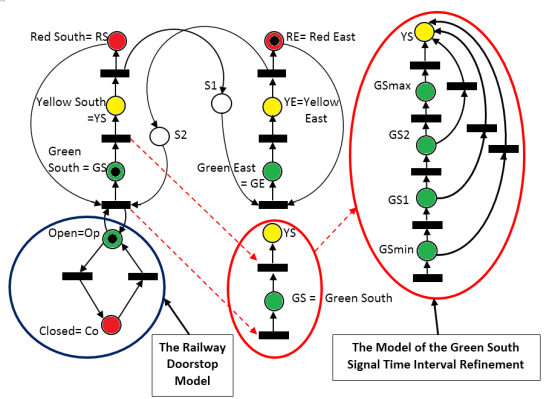
Downloads
References
L Sihombing. The complexity of system. Praxis Framework, 2019
AY Fridman. Planning and coordination in hierarchies of intelligent dynamic systems. Telkomnika 2016; 14, 1408-16.
F Zhou, Y Su and X Fan. Low complexity sparse channel estimation based on compressed sensing. Telkomnika 2016; 14, 538-47.
T Tristono, SD Cahyono, S Sudarno and P Utomo. Model of green extension traffic signal control system using Putri nets. Sendika 2019; 5, 84-92.
CG Cassandras and S Lafortune. Introduction to discrete-event simulation. In: CG Cassandras and S Lafortune (Eds.). Springer, Massachusetts, 2008, p. 591-661.
YS Huang and TH Chung. Modelling and analysis of traffic light control systems using timed colored Petri net. Intechopen, 2010, p. 567-90.
T Murata. Petri net: Properties, analysis, and applications. Proc. IEEE 1989; 77, 541-80.
G Popovicsa and L Monostoria. An approach to determine simulation model complexity. Proc. CIRP 2016; 52, 257-61.
W Maraghy, H Maraghy, T Tomiyama and L Monostori. Complexity in engineering design and manufacturing. CIRP Ann. 2012; 61, 793-814.
FR Hariri and JEW Perkasa. Measurement of e-learning system complexity using function-oriented metrics. Sem Nasional Inovasi Teknologi 2019; 3, 245-50.
M Taiping and Z Peisi. Modeling & performance analysis of manufacturing execution system based on Petri net. Open Cybern. Syst. J. 2015, 9, 1350-7.
H Dong and X Li. Fault diagnosis for substation with redundant protection configuration based on time-sequence fuzzy Petri-net. Telkomnika 2013, 11, 231-40.
I Mukhlash, WN Rumana, D Adzkiya and R Sarno. Business process improvement of production systems using coloured Petri nets. Bull. Electr. Eng. Informat. 2018; 7, 102-12.
D Ouelhadj and S Petrovic. A survey of dynamic scheduling in the manufacturing system. J. Sched. 2009; 12, 417-31.
D Han and Y Tian. Analysis and application of transition systems based on Petri nets and relation matrices to business process management. Math. Probl. Eng. 2020; 2020, 2545413.
MDS Soares. 2010, Architecture-driven integration of modeling languages for the design of software-intensive systems. Master Thesis. Universidade Federal de Uberlândia, Uberlândia, Brazil.
L Yang and Y Xiao-bo. The strategies of optimizing fuzzy Petri nets by using an improved genetic algorithm. Telkomnika 2016; 14, 62-8.
D Hartanti, RN Aziza and PC Siswipraptini. Optimization of smart traffic lights to prevent traffic congestion using fuzzy logic. Telkomnka 2019; 17, 320-7.
F Kurniawan, H Sajati and O Dinaryanto. Adaptive traffic controller based on pre-timed system. Telkomnika 2016; 14, 56-63.
A Zinovyev and E Mirkesde. Data complexity measured by principal graphs. Comput. Math. Appl. 2013, 65, 1471-82.
H Zenil, NA Kiani and J Tegnér. Review of graph and network complexity from an algorithmic information perspective. Entropy 2018; 20, 551.
DL Neel and ME Orrison. The linear complexity of a graph. Electron. J. Combinator. 2006; 13, R9.
RR Basir. Space and time complexity analysis on the growth of heap sort, insertion sort and merge algorithm with java programming. String 2020; 5, 109-18.
WH Lee and CY Chiu. Design and implementation of a smart traffic signal control system for smart city applications. Sensors 2020; 20, 508.
D Adzkiya. 2008, Modeling traffic light using Petri net & its simulation. Master Thesis. Institut Teknologi Sepuluh, Surabaya, Indonesia.
IHCM. Direktorat bina marga direktorat bina jalan kota. IHCM, Jakarta, Indonesia, 1997.
T Tristono, SD Cahyono, Sutomo and P Utomo. Investigate the complexity of the control system of the Norwegian traffic light using Petri net model. J. Phys. Conf. 2019; 1211, 012022.

Downloads
Published
How to Cite
Issue
Section
License

This work is licensed under a Creative Commons Attribution-NonCommercial-NoDerivatives 4.0 International License.





