
A Decision-Making Model of Technological-Focused Government Agency Selection of Technological Start-Up Businesses
DOI:
https://doi.org/10.48048/tis.2022.1749Keywords:
Decision-making, Government agency, Startup business, Selection process, Fuzzy TOPSISAbstract
In developing countries, the government has played an important role in supporting startup businesses in various aspects, primarily through tech-focused government agencies. With a limited budget, the government agencies are critical to select plenty of tech startups for funding, leaving only promising tech startups. Consequently, government agencies inevitably face decision-making problems under uncertain circumstances, like private equity investment situations. Reviewing the relevant decision-making frameworks has identified that a classical multiple criteria decision-making (MCDM) approach is currently used, assuming decision-makers acquire complete information that is not realistic. Moreover, both qualitative and quantitative criteria used in evaluating startup businesses cannot represent the uncertainty which is the fundamental nature of the decision-making circumstance. Thus, this article presents a decision-making framework of tech-focused government agencies for selecting startup businesses based on a fuzzy MCDM of Technique for Order Preference by Similarity to Ideal Solution (TOPSIS). Besides, it identifies selection criteria with mixed research methodologies and determines weights of importance criteria by the Delphi method. Finally, the proposed framework results are fairness, transparency, and eliminating bias in decision-making, including more efficiency when the framework’s ranking orders significantly correspond with actual performances.
HIGHLIGHTS
- Criteria for selecting start-up businesses in technological-focused government agencies
- A decision-making framework of tech-focused government agencies for selecting startup businesses based on a fuzzy MCDM of Technique for Order Preference by Similarity to Ideal Solution (TOPSIS)
- The performance of the decision-making framework in selecting startup businesses to acquire high potential tech startups to drive the national economy
GRAPHICAL ABSTRACT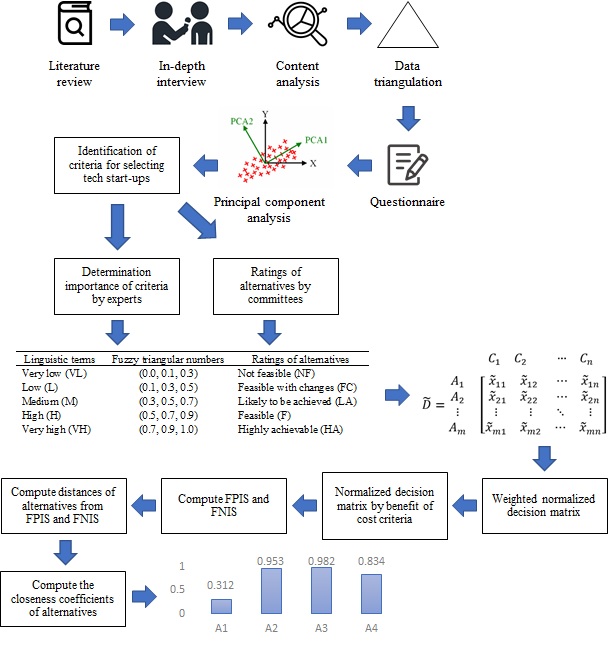
Downloads
References
C Jones and P Pimdee. Innovative ideas: Thailand 4.0 and the fourth industrial revolution. Asian Int. J. Soc. Sci. 2017; 17, 4-35.
P Klaasa, N Thawesaengskulthai and R Vaiyavuth. Factors to support a new tech start-up for business incubation. Asian J. Appl. Sci. 2019; 7, 320-7.
Thailand Tech Startup Ecosystem, Available at: https://techsauce.co, accessed June 2020.
Y Yang and Y Zhao. Modified PROMETHEEII for venture capital investment selection decision-making towards SMEs. J. Interdiscip. Math. 2018; 21, 1017-29.
M Simic. Investment criteria set by venture capitalists. Ekon. Vjesn. 2015; 28, 457-79.
E Afful-Dadzie and A Afful-Dadzie. A decision making model for selecting start-up businesses in a government venture capital scheme. Manag. Decis. 2016; 54, 714-34.
E Afful-Dadzie, ZK Oplatkova and S Nabareseh. Selecting start-up businesses in a public venture capital financing using fuzzy PROMETHEE. Procedia Comput. Sci. 2015; 60, 63-72.
J Kang, SH Gwon, S Kim and K Cho. Determinants of successful technology commercialization: Implication for Korean Government-sponsored SMEs. Asian J. Technol. Innov. 2013; 21, 72-85.
SK Kim, BG Lee, BS Park and KS Oh. The effect of R&D, technology commercialization capabilities and innovation performance. Technol. Econ. Dev. Econ. 2011; 17, 563-78.
CR Ko and JI An. Success factors of student startups in Korea: From employment measures to market success. Asian J. Innov. Policy 2019; 8, 97-121.
T Settajinda. Startup fundraising. 1st ed. Boonsiri Printing, Bangkok, Thailand, 2019.
A Taweesangrungroj, R Ratanabanchuen and S Sinthupinyo. Decision making process of Thai government agent for selection of technological startup companies in pitching of concept ideas. Asian J. Inf. Commun. 2019; 11, 25-38.
X Tian, Z Xu, J Gu and E Herrera-Viedma. How to select a promising enterprise for venture capitalists with prospect theory under intuitionistic fuzzy circumstance? Appl. Soft Comput. 2018; 67, 756-63.
KS Shin and SY Lee. Venture investment decision modeling using analytic hierarchy process. 2000.
G Beim and M Levesque. Selecting projects for venture capital funding: A multiple criteria decision approach. In: Proceedings of the 17th International Conference on Multiple Criteria Decision Making, Whistler, Canada. 2004, p. 1-23.
Z Junjun and H Xiao. Study on the selection of venture capitalists based on fuzzy AHP. In: Proceedings of the 3rd International Conference on Information Management, Innovation Management and Industrial Engineering, Kunming, China. 2010, p. 570-3.
X Zhang. Venture capital investment selection decision-making base on fuzzy theory. Phys. Procedia 2012; 25, 1369-75.
B Aouni, C Colapinto and DL Torre. A fuzzy goal programming model for venture capital investment decision making. Inf. Syst. Oper. Res. 2014; 52, 138-46.
Annual Report 2019, Available at: https://www.nia.or.th, accessed January 2020.
Digital Startup Fund, Available at: https://www.depa.or.th/th/, accessed January 2020.
New Entrepreneur Creation, Available at: http://nec.dip.go.th/, accessed January 2020.
IC MacMillan, L Zemann and P Subbanarasimha. Criteria distinguishing successful from unsuccessful ventures in the venture screening process. J. Bus. Ventur. 1987; 2, 123-37.
R Stuart and PA Abetti. Start-up ventures: Towards the prediction of initial success. J. Bus. Ventur. 1987; 2, 215-30.
M Kakati. Success criteria in high-tech new ventures. Technovation 2003; 23, 447-57.
S Chorev and AR Anderson. Success in Israeli high-tech start-ups; Critical factors and process. Technovation 2006; 26, 162-74.
NMP Bocken. Sustainable venture capital - catalyst for sustainable start-up success? J. Clean. Prod. 2015; 108, 647-58.
A Distanont. Criteria of venture capital for considering investment in start-ups in Thailand. In: Proceedings of the MakeLearn and TIIM International Conference: Integrated Economy and Society; Diversity, Creativity, and Technology, Naples, Italy. 2018, p. 289-94.
K Maair and K Fangjai. The critical factors to success of startup business in Thailand. Payap Univ. J. 2018; 28, 143-58.
RD Hisrich, MP Peters and DA Shepherd. Entrepreneurship. McGraw-Hill Education, New York, 2017.
MS Saric. SMEs perspective on venture capital investment criteria - A study of Croatian SMEs. J. Contemp. Manag. Issues 2017; 22, 117-33.
AL Zacharakis and GD Meyer. The potential of actuarial decision models: Can they improve the venture capital investment decision? J. Bus. Ventur. 2000; 15, 323-46.
PD Leedy, JE Ormrod and LR Johnson. Practical research: Planning and design. Pearson Education, Essex, 2014.
A Lertjanyakul. 2016, Venture capital evaluation criteria on startup in Thailand. Master Thesis. Thammasart University, Bangkok, Thailand.
RK Yin. Case study research and applications: Design and methods. Sage publications, California, 2017.
JS Petty and M Gruber. "In pursuit of the real deal": A longitudinal study of VC decision making. J. Bus. Ventur. 2011; 26, 172-88.
M Dhochak and AK Sharma. Identification and prioritization of factors affecting venture capitalists’ investment decision-making process: An analytical hierarchal process (AHP) approach. J. Small Bus. Enterp. Dev. 2016; 23, 964-83.
R Bro and AK Smilde. Principal component analysis. Anal. Methods 2014; 6, 2812-31.
S Wold, KH Esbensen and P Geladi. Principal component analysis. Chemom. Intell. Lab. Syst. 1987; 2, 37-52.
K Vanichbancha. The statistic for research (in Thai). 10th eds. Samlada Publishing, Bangkok, Thailand, 2016.
C Hwang and K Yoon. Multiple attribute decision making. Springer-verlag, New York, 1981.
R Rostamzadeh, K Ismail and EK Zavadskas. Multi criteria decision making for assisting business angels in investments. Technol. Econ. Dev. Econ. 2014; 20, 696-720.
S Saghafian and SR Hejazi. Multi-criteria group decision making using a modified fuzzy TOPSIS procedure. In: Proceedings of the International Conference on Computational Intelligence for Modelling, Control and Automation and International Conference on Intelligent Agents, Web Technologies and Internet Commerce, Vienna, Austria. 2005, p. 215-21.
B Sodhi and TV Prabhakar. A simplified description of fuzzy TOPSIS. ArXiv 2012. https://arxiv.org/abs/1205.5098
A Suder and C Kahraman. Multicriteria analysis of technological innovation investments using fuzzy sets. Technol. Econ. Dev. Econ. 2016; 22, 235-53.
NB Kore, K Ravi and SB Patil. A simplified description of fuzzy TOPSIS method for multi criteria decision making. Int. Res. J. Eng. Technol. 2017: 4, 2047-50.
J Xu, L Yu and R Gupta. Evaluating the performance of the government venture capital guiding fund using the intuitionistic fuzzy analytic hierarchy process. Sustainability 2020; 12, 6908.
S Opasanon. Multiple criteria decision making for business and logistics management: Theory and application. Thammasart University, Bangkok, Thailand, 2016.
A Kumbhat and Sushil. Ingredients of startup success. In: Proceedings of the 17th Global Conference on Transforming Organizations through Flexible Management, Delhi, India. 2017, p. 1-19.
MA Islam, MA Khan, AZM Obaidullah and MS Alam. Effect of entrepreneur and firm characteristics on the business success of small and medium enterprises (SMEs) in Bangladesh. Int. J. Bus. Manag. 2011, 6, 289-99.
J Hall and CW Hofer. Venture capitalists' decision criteria in new venture evaluation. J. Bus. Ventur. 1993; 8, 25-42.
D Muzyka, S Birley and B Leleux. Trade-offs in the investment decisons of European venture capitalists. J. Bus. Ventur. 1996; 11, 273-87.
T Chotigeat, I Pandey and DJ Kim. Venture capital investment evaluation in emerging markets. Multinatl. Bus. Rev. 1997; 5, 54-62.
I Pandey, J Gupta and R Wickramatilke. Venture capital investment process and evaluation in a developing country: A study of Thailand. J. Appl. Financ. 1995; 1, 90-111.
C Mason and M Stark. What do investors look for in a business plan? A comparison of the investment criteria of bankers, venture capitalists and business angels. Int. Small Bus. J. 2004; 22, 227-48.

Downloads
Published
How to Cite
Issue
Section
License

This work is licensed under a Creative Commons Attribution-NonCommercial-NoDerivatives 4.0 International License.





