
Comparison of Ultimate Capacities of RC Chimney Sections under Wind Loading
DOI:
https://doi.org/10.48048/tis.2022.1722Keywords:
RC chimney section, Ultimate moment, IS: 4998 – 2015, CICIND 2011, ACI 307 – 08Abstract
Diffusion of gaseous and particulate pollutants from tall stacks has formed an important element in the control of air pollution since the industrial revolution began. These tall reinforced concrete chimneys are considered to be cantilever columns subjected to axial load resulted from the self-weight of the shell, linings and other accessories and bending moments which are resulted from the lateral loads like wind forces and earthquake forces.
The recently published IS: 4998 – 2015 adopted a limit state design concept which requires well defined stress-strain relationship for concrete and steel. It has been seen that there are many disparities lies between the stress-strain relationships of constituent materials adopted by IS: 4998 – 2015 and other design standards.
This paper discusses various methods pertaining to the estimation of the ultimate strength of thin-walled hollow circular sections of reinforced concrete chimneys, subjected to wind loading. A comparative study of various methods based on the prevalent codes reveals considerable disparity in the predicted ultimate strength values. These differences have been critically analyzed and results are discussed in this paper in terms of ultimate strength along with the contribution of concrete and steel, ultimate curvature and depth of neutral axis. For the comparison of above-mentioned parameters, design recommendations of IS 4998 – 2015, CICIND 2011, ACI 307 – 08 are used.
HIGHLIGHTS
- The recently published IS: 4998 – 2015 adopted a limit state design concept which requires well defined stress-strain relationship for concrete and steel which differs in terms of strain and stress limits when compared with other well established RC chimney design codes
- Various methods pertaining to the estimation of the ultimate strength of thin-walled hollow circular sections of reinforced concrete chimneys, subjected to wind loading are discussed using a comparative study with different parameters of RC chimney
- For the comparison of above-mentioned parameters, design recommendations of IS 4998 – 2015, CICIND 2011, ACI 307 – 08 are used
- Stress-strain relationship of concrete and steel also discussed with the bases of the same is also discussed in detail for each of the above codes
GRAPHICAL ABSTRACT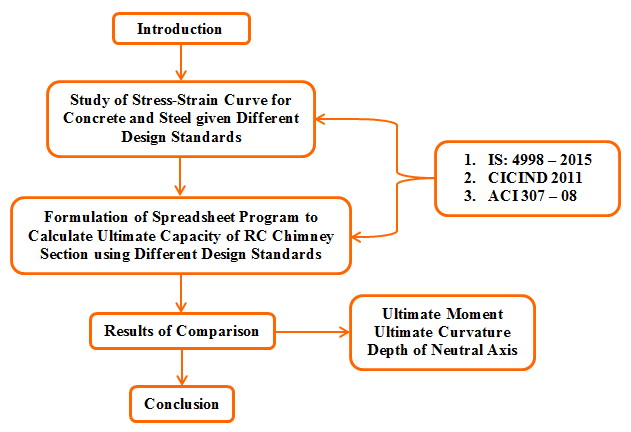
Downloads
References
IS: 4998 – 2015. Indian standard code of practice for design of reinforced concrete chimneys: Design criteria. 3rd eds. Bureau of Indian Standards, New Delhi, India, 2015.
DC Rai, K Kumar and HB Kaushik. Ultimate flexural strength of reinforced concrete circular hollow sections. Indian Concr. J. 2006; 80, 39-45.
IS: 456 – 2000. Indian standard code of practice for plain and reinforced concrete for general building construction. Bureau of Indian Standards, New Delhi, India, 2000.
IS: 11628 – 1985. Criteria for design of RCC staging for overhead water tanks. Bureau of Indian Standards, New Delhi, India, 1985.
IS: 4998 – 1975. Indian standard code of practice for design of reinforced concrete chimneys: part 1: Design criteria. 1st Rev. Bureau of Indian Standards, New Delhi, India, 1975.
KSB Narayan and SC Yaragal. Load-moment interaction envelops for design of tall stacks: A limit state approach. Indian Concr. J. 2007; 81, 21-5.
PS Rao and D Menon. Ultimate strength of tubular RC tower sections under wind loading. Indian Concr. J. 1995; 69, 117-23.
CICIND. Model code for concrete chimneys – part A: the shell. 3rd eds. International Committee for Industrial Construction, Germany, 2011.
ACI 307. Code requirements for reinforced concrete chimneys (ACI 307-08) and commentary. American Concrete Institute, Michigan, 2008.
CICIND. Model code for concrete chimneys – part A: the shell. 2nd eds. Comite International Des Chimness Industrielle, Zurich, Switzerland, 1984.
P Naokowski. The behaviour of the compressed zone of concrete industrial chimney. In: Proceedings of the 4th International Symposium on Industrial Chimneys, The Hauge, Netherlands. 1981.
H Rusch. Researches toward a general flexural theory for structural concrete. J. Am. Concr. Inst. 1960; 57, 1-28.
B Ellingwood, TV Galambos, JC MacGregor and CA Cornell. Development of a probability based load criterion for American national standard A58. National Bureau of Standards, Washington DC, 1980.
ACI Committee 318. Building code requirements for reinforced concrete. American Concrete Institute, Michigan, 2002.
ZAR Morkin and WS Rumman. Ultimate capacity of reinforced concrete members of hollow circular sections subjected on monotonic and cyclic bending. J. Am. Concr. Inst. 1985; 82, 653-6.
C Paulson, JM Rautenberg, SK Graham and D Darwin. Defining yield strength for non-prestressed reinforcing steel. ACI Struct. J. 2016; 113, 169-78.
Gl Schueller and CG Bucher. On the failure mechanisms of reinforced concrete chimneys. CICIND Report. 1997; 13, 6-10.
Downloads
Published
How to Cite
Issue
Section
License

This work is licensed under a Creative Commons Attribution-NonCommercial-NoDerivatives 4.0 International License.





