
The Distribution of Intestinal Amoebae in Wild Long-Tailed Macaques (Macaca fascicularis) in Sabang City, Aceh Province, Indonesia
DOI:
https://doi.org/10.48048/tis.2022.1717Keywords:
Prevalence, Intestinal amoebae, Macaca fascicularis, Aceh Province, IndonesiaAbstract
Amoeba that infects primates can also be found in humans and can be zoonotic. This study aims to identify the distribution of intestinal amoeba in the wild Long-Tailed Macaque (LTM) group located at Cot Murong, Kebun Mangga, and Tugu Zero Kilometer Monument (IZKM) in Sabang City, Aceh Province, Indonesia. A total of 177 stool samples from 59 tails from the three LTM groups were examined microscopically. The results of the examination confirmed seven species of intestinal amoeba, three of which belonged to the genus Entamoeba, namely the Entamoeba histolytica/dispar/moshkovskii complex, Entamoeba coli, Entamoeba pölecki, and four other species from different genera, namely Iodamoeba butschlii, Blastocystis sp., Endolimax nana and Dientamoeba fragilis. The prevalence of intestinal amoeba in wild LTM in Sabang City was 57.6% (102/177). Dientamoeba fragilis was only found in the LTM group of Kebun Mangga. Entamoeba coli dominated the highest prevalence in all LTM groups. The LTM group located around Cot Murong and IZKM had a higher concentration of infection with intestinal amoeba than the Kebun Mangga location. The statistical tests showed a significant difference between the proportions of Iodamoeba butschlii, Endolimax nana and Dientamoeba fragilis, both found in the LTM Cot Murong, Kebun Mangga, or IZKM groups. This study is the first to report amoebic infection prevalence in the wild LTM group in Sabang City, Aceh Province. The pathogenic amoeba that cannot be distinguished microscopically from morphologically identical amoebae needs to be identified molecularly to identify variants and their potential as zoonotic agents.
HIGHLIGHTS
- Intestinal amoeba species found in fecal samples of the wild long-tailed macaques group of Sabang City, Aceh Province, Indonesia, can also be found in human stool samples
- As many as three of the seven identified amoeba species, namely Entamoeba histolytica, Dientamoeba fragilis, and Blastocystis sp. is a pathogen that can cause diarrhea and colitis in humans and non-human primates
- The prevalence of amoeba infection in wild macaques in Sabang City is in the high category and tends to increase the incidence of infection in the macaque group, which has more susceptible individuals, namely infants, children, and females
GRAPHICAL ABSTRACT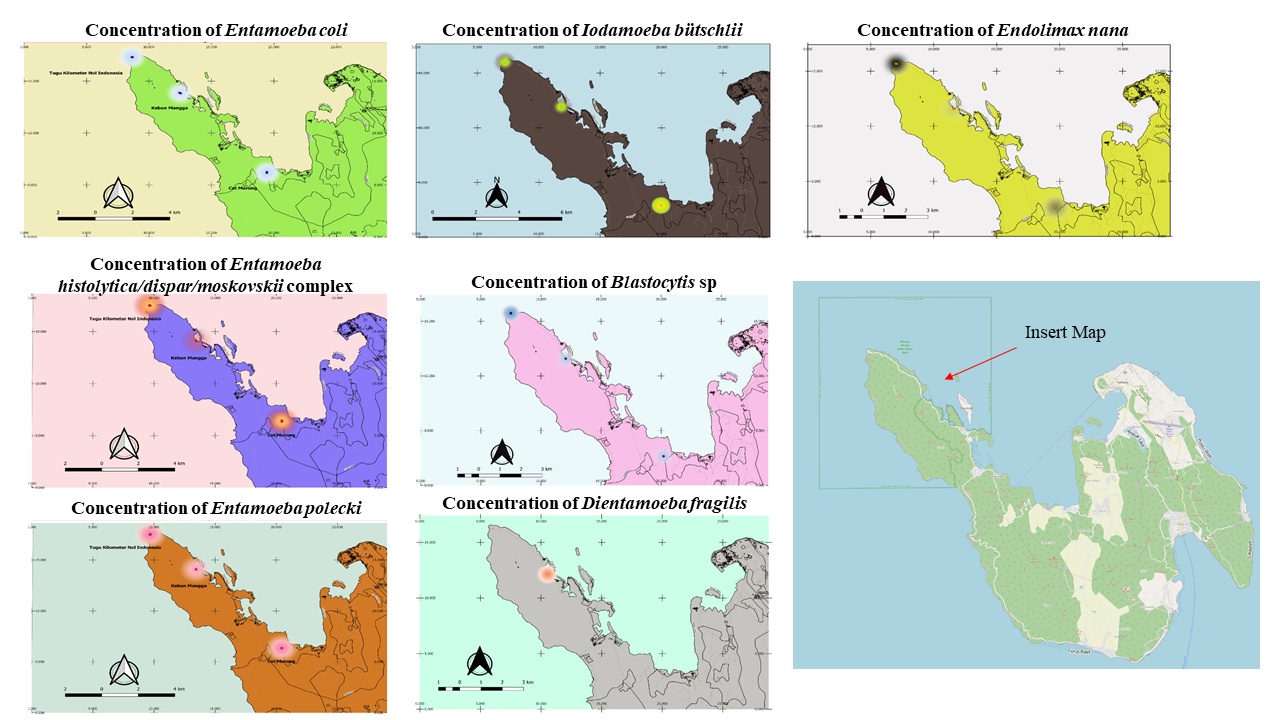
Downloads
References
C Roos, R Boonratana, J Supriatna, J Fellowes, C Groves, S Nash, A Rylands and R Mittermeier. An updated taxonomy and conservation status review of Asian primates. Asian Primates J. 2014; 4, 2-38.
JA Joesoef, D Sajuthi, A Wijaya and MUE Sanam. Endoparasitic diversity in Macaca fascicularis and its zoonotic potential on different weather in Kupang City (in Indonesian). J. Vet. 2018; 19, 451-9.
TL Goldberg, A Gendron-Fitzpatrick, KM Deering, RS Wallace, VL Clyde, M Lauck, GE Rosen, AJ Bennett, EC Greiner and DH O’Connor. Fatal metacestode infection in Bornean orangutan caused by unknown Versteria species. Emerg. Infect. Dis. 2014; 20, 109-13.
N Yoshida, KM Tyler and MS Llewellyn. Invasion mechanisms among emerging food-borne protozoan parasites. Trends Parasit. 2011; 27, 459-66.
B Sebastien. Autophagy in parasitic protists. In: MA Hayat (Ed.). Autophagy: Cancer, other pathologies, inflammation, immunity, infection, and aging. 2nd eds. New Jersey, 2014, p. 185-95.
World Health Organization. Weekly Epidemiological Record, Available at: https://apps.who.Int/iris/handle/10665/230102, accessed July 2019.
C Church, A Neill and AM Schotthoefer. Intestinal infections in humans in the Rocky Mountain Region, United States. J. Parasitol. 2010; 96, 194-6.
LJ Ragazzo, S Zohdy, M Velonabison, J Herrera, PC Wright and TR Gillespie. Entamoeba histolytica infection in wild lemurs associated with proximity to humans. Vet. Parasitol. 2018; 249, 98-101.
A Hussain, EZ Younis, AH Elamami, M Jelodar, T Mishra and G Shivaramaiah. Prevalence of intestinal parasitic infestation among expatriate workers. Cureus 2019; 11, e4894.
GH Volpato, EV Lopes, LB Mendonca, R Bocon, MV Bisheimer, PP Serafini and AD Luiz. The use of the point count method for bird survey in the Atlantic forest. Zoologia 2009; 26, 74-8.
AJ Showler and AK Boggild. Entamoeba histolytica. Can. Med. Assoc. J. 2013; 185, 1064.
AK Santosh. Microbiological stool examination: Overview. J. Clin. Diagn. Res. 2012; 6, 503-9.
Thermo Fisher Scientific. Remel Wheatley Trichrome Stain [manual procedure], Available at: https://www.thermofisher.com/search/results?query=%20Wheatley%20Trichrome%20Stain&persona=DocSupport, accessed October 2019.
CK Lang. Long-tailed macaque (Macaca fascicularis), Available at: http://pin.primate.wisc.edu/factsheets/entry/long-tailed_macaque, accessed September 2019.
AK Simon, GA Hollander and A Mcmichael. Evolution of the immune system in humans from infancy to old age. Proc. Biol. Sci. 2015; 282, 20143085.
E Rahmi, M Hanafiah, A Sutriana, M Hambal and F Wajidi. The Incidence of gastrointestinal parasite in wild long tail macaque in wildlife reserve park, Weh Island, Sabang (in Indonesian). J. Indones. Anim. Sci. 2010; 13, 289-91.
AAWK Putra, IN Wandia and IM Dwinata. Prevalence and identification of gastrointestinal protozoa in longtail macaque in Nusa Penida Island (in Indonesian). Bul. Vet. Udayana 2020; 12, 80-9.
S Ghosh, J Padalia and S Moonah. Tissue destruction caused by Entamoeba histolytica parasite: Cell death, inflammation, invasion, and the gut microbiome. Curr. Clin. Microbiol. Rep. 2019; 6, 51-7.
N Nagata, D Marriott, J Harkness, JT Ellis and D Stark. Current treatment options for Dientamoeba fragilis infections. Int. J. Parasitol. Drugs Drug Resist. 2012; 2, 204-15.
T Ji, HX Cao, R Wu, LL Cui, GM Su, C Niu, N Zhang, SK Wang and DH Zhou. Prevalence and genetic identification of three Entamoeba species in pigs in Southeastern China. BioMed Res. Int. 2019; 2019, 2824017.
P Nowak, K Mastalska and J Loster. Entamoeba histolytica - pathogenic protozoan of the large intestine in humans. J. Clin. Microbiol. Biochem. Technol. 2015; 1, 10-7.
NM Soares, HC Azevedo, FTP Pacheco, JN De Souza, RP Del-Rei, MCA Teixeira, and FLN Santos. A cross-sectional study of Entamoeba histolytica/dispar/moshkovskii complex in Salvador, Bahia, Brazil. BioMed Res. Int. 2019; 2019, 7523670.
V Khanna, K Tilak, S Rasheed and C Mukhopadhyay. Identification and preservation of intestinal parasites using methylene blue-glycerol mount: A new approach to stool microscopy. J. Parasitol. Res. 2014; 2014, 672018.
CA Chapman, DD Bowman, RR Ghai, JF Gogarten, TL Goldberg, JM Rothman, D Twinomugisha and C Walsh. Protozoan parasites in group-living primates: Testing the biological island hypothesis. Am. J. Primatol. 2012; 74, 510-7.
X Zhang, KA Kadir, LF Quintanilla-Zarinan, J Villano, P Houghton, H Du, B Singh and DG Smith. Distribution and prevalence of malaria parasites among long-tailed macaques (Macaca fascicularis) in regional populations across Southeast Asia. Malar. J. 2016; 15, 450.
T Day, AL Graham and AF Read. Evolution of parasite virulence when host responses cause disease. Proc. Biol. Sci. 2007; 274, 2685-92.
M Muller, M Mentel, JJ Hellemond, K Henze, C Woehle, SB Gould, RY Yu, M Giezen, AGM Tielens and WF Martin. Biochemistry and evolution of anaerobic energy metabolism in eukaryotes. Microbiol. Mol. Biol. Rev. 2012; 76, 444-95.
R Subahar and L Sutanto. Ascaris lumbricoides eggs and human-intestinal protozoan cysts found in river water of Angke river, Jakarta. Makara Kes. 2008; 12, 83-5.
GT El-Sherbini and MR Gneidy. Cockroaches and flies in mechanical transmission of medical important parasites in Khaldyia Village, El-Fayoum, Governorate, Egypt. J. Egypt. Soc. Parasitol. 2012; 42, 165-74.
M Feng, B Yang, L Yang, Y Fu, Y Zhuang, L Liang, Q Xu, X Cheng and H Tachibana. High prevalence of Entamoeba infections in captive long-tailed macaques in China. Parasitol. Res. 2021; 4, 1093-97.
R Issa. Non-pathogenic protozoa (review article). Int. J. Pharm. Pharm. Sci. 2014; 3, 30-40.
S Kumar, P Sundararaj, HN Kumara, A Pal, K Santhosh and S Vinoth. Prevalence of gastrointestinal parasites in bonnet macaque and possible consequences of their unmanaged relocations. PLoS One 2018; 11, 1-23.
Downloads
Published
How to Cite
Issue
Section
License

This work is licensed under a Creative Commons Attribution-NonCommercial-NoDerivatives 4.0 International License.





