
Synthesis, Characterization and Photocatalytic Performance of Poly-3-Thenoic Acid/Cu-TiO2 Nanohybrid for Efficient Visible Light Assisted Degradation of Bismarck Brown R
DOI:
https://doi.org/10.48048/tis.2022.1715Keywords:
Nanohybrid, Bismarck Brown R, Azo dye, Photocatalytic degradation, Modified sol-gel methodAbstract
The present work reported on the synthesis and characterization of Poly-3-Thenoic acid/Cu-TiO2 nanohybrid (PCuT) for the photocatalytic degradation of organic azo dye pollutant from wastewater. The as-synthesized nanohybrid by an in-situ modified sol-gel method including chemical oxidative polymerization was characterized by X-ray diffraction (XRD), Fourier transform infrared (FT-IR) spectroscopy, UV-visible diffuse reflectance spectroscopy (UV-vis.DRS), scanning electron microscopy with energy-dispersive X-ray spectroscopy (SEM-EDX), transmission electron microscopy (TEM) and Brunauer-Emmet-Teller (BET) surface area analysis. The characterization results revealed the formation of small aggregates of polymer contained high crystalline anatase TiO2 nanoparticles (XRD) with narrowed bandgap energy (UV-vis.DRS), decreased particle size (TEM) with smooth surface morphology (SEM) and large surface area (BET). All the constituent elements of the polymer and Cu-TiO2 were found in the PCuT nanohybrid material (EDX) and their chemical interaction studied by FT-IR confirmed the stability of the nanohybrid. The photocatalytic activity of the nanohybrid was tested by the degradation of Bismarck Brown R dye under visible light irradiation. To enhance the photocatalytic efficiency, effects of various catalyst/dye reaction parameters such as polymer content, solution pH, catalyst dosage, and initial dye concentration were studied and optimized.
HIGHLIGHTS
- Poly-3-Thenoic acid/Cu-TiO2 nanohybrid material was successfully synthesized by in situ modified sol-gel process
- Poly-3-Thenoic acid has enhanced the visible light absorption capacity of anatase TiO2 in nanohybrids
- Electron-hole recombination in TiO2 was effectively inhibited by Cu doping
- Bismark Brown R, an organic pollutant was successfully degraded in 75 min of visible light irradiation
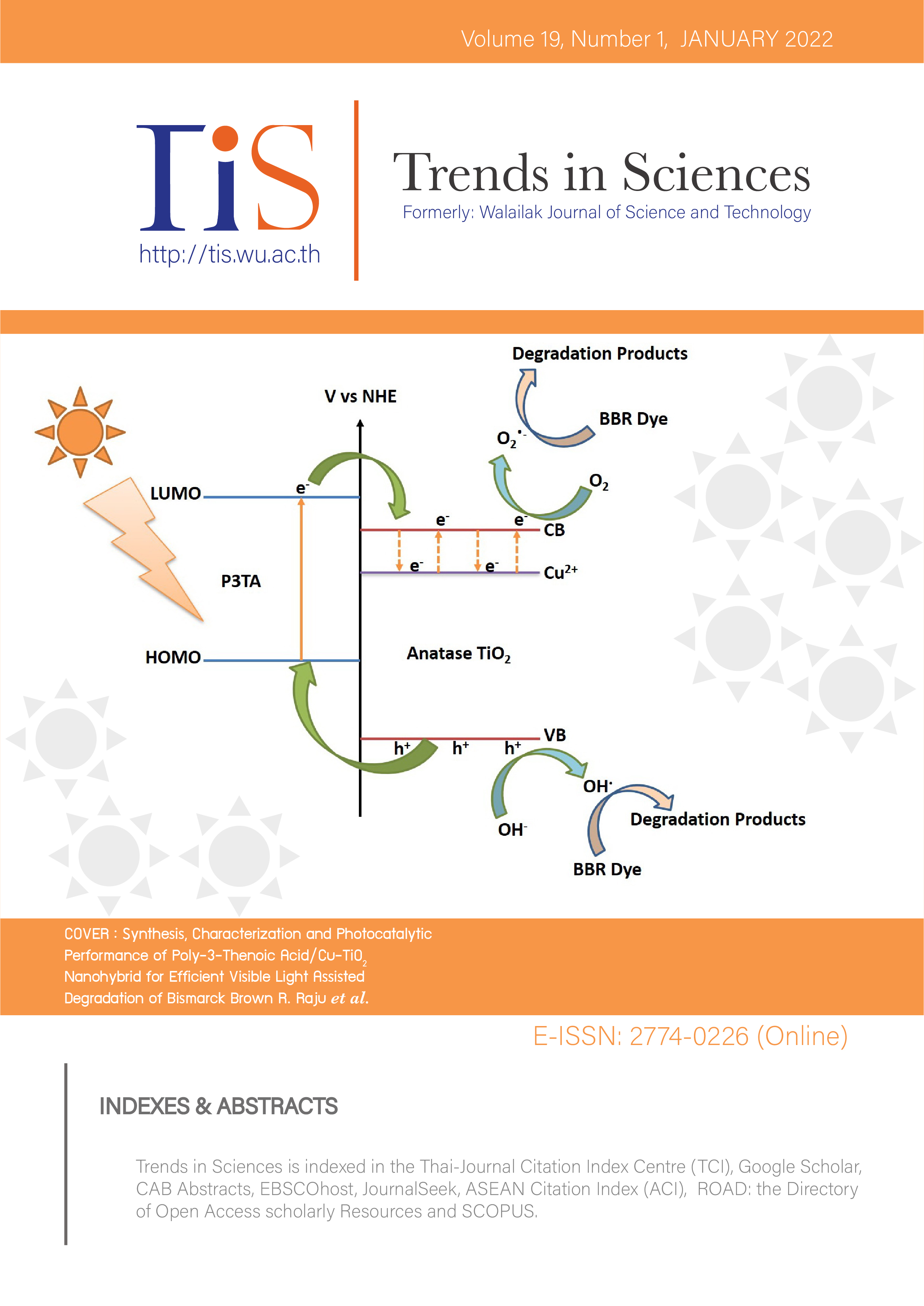
GRAPHICAL ABSTRACT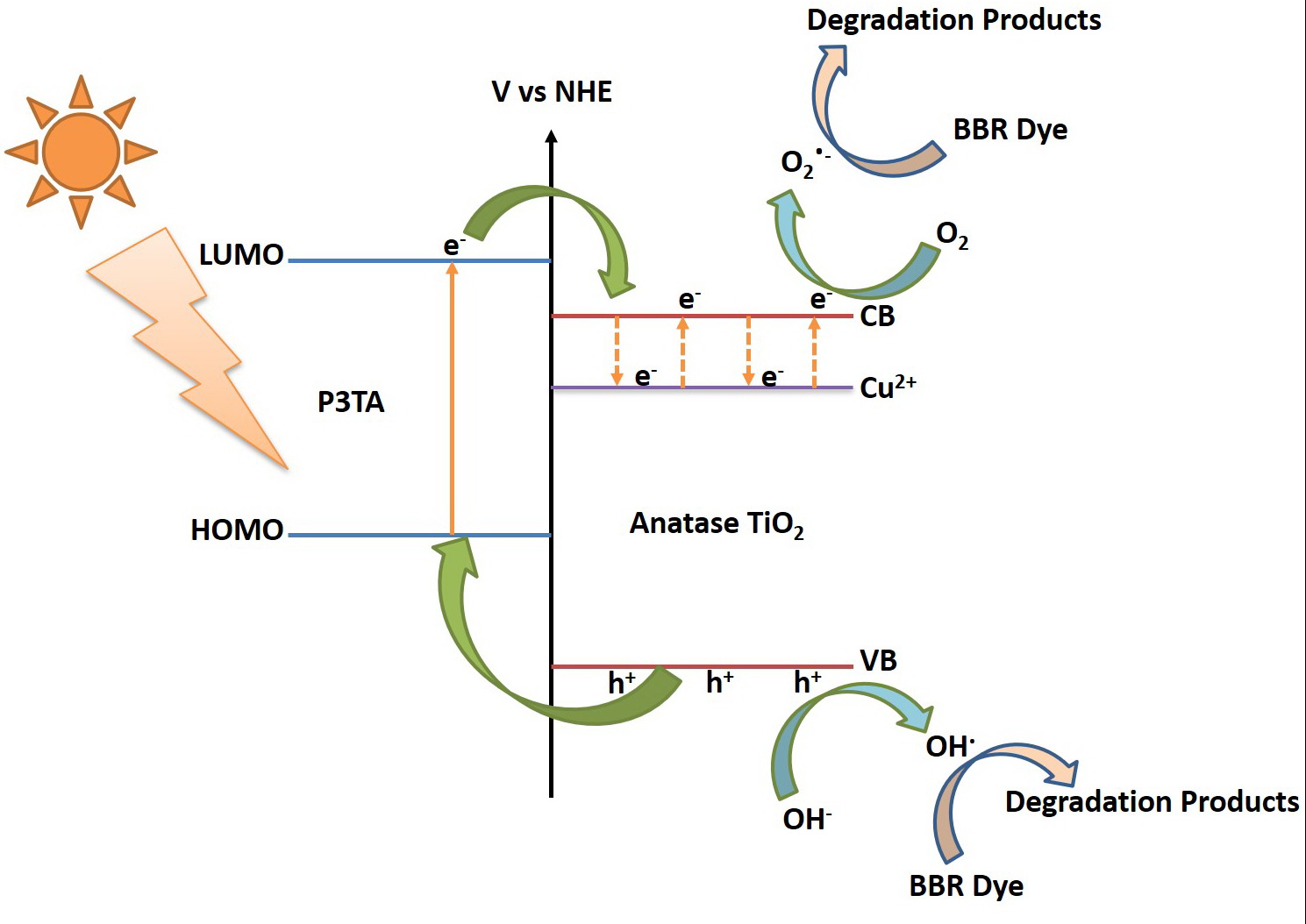
Downloads
References
A Jraba, Z Anna and E Elaloui. Effects of Sr2+, Fe3+ and Al3+ doping on the properties of TiO2 prepared using the sol-gel method. C.R. Chim. 2019; 22, 648-58.
W Zhang, N Luo, S Huang, NL Wu and M Wei. Sulfur-Doped Anatase TiO2 as an Anode for High-Performance Sodium-Ion Batteries. ACS Appl. Energy Mater. 2019; 2, 3791-7.
TH Kim, GM Go, HB Cho, Y Song, CG Lee and YH Choa. A novel synthetic method for N doped TiO2 nanoparticles through plasma-assisted electrolysis and photocatalytic activity in the visible region. Front. Chem. 2019; 6, 458.
KVD Lakshmi, TS Rao, JS Padmaja, IM Raju, SA Alim, and P Kalyani. Visible light driven mesoporous Mn and S co-doped TiO2 nano material: Characterization and applications in photocatalytic degradation of indigo carmine dye and antibacterial activity. Environ. Nanotechnol. Monit. Manage. 2018; 10, 494-504.
KVD Lakshmi, TS Rao, JS Padmaja, IM Raju and MR Kumar. Structure, photocatalytic and antibacterial activity study of Mesoporous Ni and S co-doped TiO2 nano material under visible light irradiation. Chin. J. Chem. Eng. 2019; 27, 1630-41.
SA Alim, TS Rao, IM Raju, MR Kumar and KVD Lakshmi. Fabrication of visible light driven nano structured Copper, Boron codoped TiO2 for photocatalytic removal of Lissamine Green B. J. Saudi Chem. Soc. 2019; 23, 92-103.
RK Mulpuri, SR Tirukkovalluri, MR Imandi, SA Alim and VDL Kapuganti. Zinc and boron co-doped nanotitania with enhanced photocatalytic degradation of acid red 6A under visible light irradiation. Sustainable Environ. Res. 2019; 29, 29.
G Sanzone, M Zimbone, G Cacciato, F Ruffino, R Carles, V Privitera and MG Grimaldi. Ag/TiO2 nanocomposite for visible light-driven photocatalysis. Superlattices Microstruct. 2018; 123, 394-402.
M Dahl, Y Liu and Y Yin. Composite Titanium Dioxide Nanomaterials. Chem. Rev. 2014; 114, 9853-89.
JS Padmaja, TS Rao, KVD Lakshmi, IM Raju. Fabrication of hetero-structured mesoporours TiO2-SrTiO3 nanocomposite in presence of Gemini surfactant: Characterization and application in catalytic degradation of Acid Orange. J. Environ. Chem. Eng. 2018; 6, 6457-67.
BS Mohan, K Ravi, RB Anjaneyulu, GS Sree and K Basavaiah. Fe2O3/RGO nanocomposite photocatalyst: Effective degradation of 4-Nitrophenol. Phys. B: Condens. Matter. 2019; 553, 190-4.
MA Ramazanov, FV Hajiyeva and AM Maharramov. Structure and properties of PP/TiO2 based polymer nanocomposites. Integr. Ferroelectr. 2018; 192, 103-12.
H Feng, H Xu, H Feng, Y Gao and X Jin. The sol-gel synthesis and photocatalytic activity of Gd-SiO2-TiO2 photocatalyst. Chem. Phys. Lett. 2019; 733, 136676.
BS Mohan, K Basavaiah. Fabrication of multifunctional TANI/Cu2O/Ag nanocomposite for environmental abatement. Sci. Rep. 2020; 10, 14080.
N Turkten, Z Cinar, A Tomruk and M Bekbolet. Copper-doped TiO2 photocatalysts: Applications to drinking water by humic matter degradation. Environ. Sci. Pollut. Res. 2019; 26, 36096-106.
MR Chandra, TS Rao, HS Kim, SVN Pammi, N Prabhakarrao and IM Raju. Hybrid copper doped titania/polythiophene nanorods as efficient visible light-driven photocatalyst for degradation of organic pollutants. J. Asian Ceram. Soc. 2019; 5, 436-43.
IM Raju, TS Rao, KVD Lakshmi, MR Chandra, JS Padmaja and G Divya. Poly-3-Thenoic acid sensitized, copper doped anatase/brookite TiO2 nanohybrids for enhanced photocatalytic degradation of an organophosphorus pesticide. J. Environ. Chem. Eng. 2019; 7, 103211.
N Paradee and A Sirivat. Synthesis of poly(3,4-ethylenedioxythiophene) nanoparticles via chemical oxidation polymerization. Polym. Int. 2014; 63, 106-13.
Y Zhu and Y Dan. Photocatalytic activity of poly(3-hexylthiophene)/titanium dioxide composites for degrading methyl orange. Sol. Enegy. Mater. Sol. Cells. 2010; 94, 1658-64.
B Fatima, SI Siddiqui, R Ahmed and SA Chaudhry. Green synthesis of f-CdWO4 for photocatalytic degradation and adsorptive removal of Bismarck Brown R dye from water. Water Resour. Ind. 2019; 22, 100119.
MW Girolami and RW Rousseau. Effects of Bismarck Brown R on the growth rates of large and small potassium alum crystals. J. Cryst. Growth. 1985; 71, 220-4.
JM Vazquez, E Martinez, J Roca, P Coy and S Ruiz. Use of triple stain technique for simultaneous assessment of vitality and acrosomal status in boar spermatozoa. Theriogenology. 1992; 38, 843-52.
J Mittal, V Thakur and A Mittal. Batch removal of hazardous azo dye Bismark Brown R using waste material hen feather. Ecolog. Eng. 2013; 60, 249-53.
GM Sole and JK Chipman. The mutagenic potency of Chrysoidines and Bismark Brown dyes. Carcinogenesis. 1986; 7, 1921-3.
BS Mohan, GP Naidu, M Ravichandra, SJ Rani, RB Anjaneyulu and CV Ramana. Flower like SnO2-Fe2O3-rGO ternary composite as highly efficient visible light induced photocatalyst for the degradation of organic pollutants from contaminated water. J. Mater. Res. Technol. 2020; 9, 12461-72.
M Khairy and W Zakaria. Effect of metal-doping of TiO2 nanoparticles on their photocatalytic activities toward removal of organic dyes. Egypt. J. Pet. 2014; 23, 419-26.
H Diker, C Varlikli, K Mizrak and A Dana. Characterizations and photocatalytic activity comparisons of N-doped nc-TiO2 depending on synthetic conditions and structural differences of amine sources. Energy. 2011; 36, 1243-54.
N Ghobadi. Band gap determination using absorption spectrum fitting procedure. Int. Nano Lett. 2013; 3, 2.
Y Nishi and M Inagaki. Gas adsorption/desorption isotherm for pore structure characterization. In: M Inagaki and F Kang (Eds). 1st ed. Materials science and engineering of carbon: Characterization. Elsevier Inc., UK, 2016, p. 227-47.
S Lin, Q Rongliang, M Yueqi, Z Dongdong, W Hui and X Ya. Photodegradation of phenol in a polymer-modified TiO2 semiconductor particulate system under the irradiation of visible light. Catal. Commun. 2007; 8, 429-33.
W Desong, Z Jie, L Qingzhi, L Xueyan, D Yandong and A Jing. Characterization and photocatalytic activity of poly(3-hexylthiophene)-modified TiO2 for degradation of methyl orange under visible light. J. Hazard. Mater. 2009; 169, 546-50.
W Desong, W Yanhong, L Xueyan, L Qingzhi, A Jing and Y Jianxia. Sunlight photocatalytic activity of polypyrrole-TiO2 nanocomposites prepared by ‘in situ’ method. Catal. Commun. 2008; 9, 1162-6.
W Fang, M Shixiong, H Yuqi and F Lei. Visible-light-induced photocatalytic degradation of methylene blue with polyaniline-sensitized TiO2 composite photocatalysts. Superlattices Microstruct. 2010; 48, 170-80.
Downloads
Published
How to Cite
Issue
Section
License

This work is licensed under a Creative Commons Attribution-NonCommercial-NoDerivatives 4.0 International License.





