
Evaluating Reproductive Impairment Induced by Phthalates: A Systematic Preclinical Meta-Analysis of Wistar Rat Models with A Qualitative Assessment of Human Regulatory Frameworks
DOI:
https://doi.org/10.48048/tis.2026.14717Keywords:
Phthalate esters, Endocrine disruption, Reproductive impairment, Preclinical meta-analysis, Wistar rat model, Hazard identification, Interspecies extrapolation, Benchmark dose modelingAbstract
Phthalates represent a pervasive class of endocrine-disrupting chemicals found throughout the biosphere. While the Wistar rat is the widely used animal model for assessing phthalate-related reproductive toxicity, a cohesive synthesis of these preclinical data to inform hazard identification is notably absent. This study aimed to systematically meta-analyze the reproductive impacts of phthalates in Wistar rats, qualitatively correlate these findings with current regulatory safety thresholds as a means of identifying research gaps, and assess their consistency with human epidemiological observations. Adhering to Preferred Reporting Items for Systematic Reviews and Meta-Analyses (PRISMA) protocols, we conducted an exhaustive search of PubMed, Web of Science, Scopus, and TOXLINE for primary research published between 2000 and 2025. Statistical analysis utilized random-effects models to calculate standardized mean differences (SMDs), while study rigor was evaluated using the SYRCLE Risk of Bias tool and the Grading of Recommendations Assessment, Development and Evaluation (GRADE) approach. Out of 1,847 initial records, 82 studies met the inclusion criteria. Our analysis revealed that perinatal exposure to di-(2-ethylhexyl) phthalate (DEHP) and dibutyl phthalate (DBP) resulted in a statistically significant reduction in anogenital distance among male offspring (SMD: −1.24; 95% CI: −1.58 to −0.90; moderate certainty). Furthermore, sperm motility exhibited a sharp decline (SMD: −0.98; 95% CI: −1.24 to −0.72; high certainty) within just twenty-one days of exposure. Histopathological assessments consistently identified Leydig cell abnormalities, seminiferous tubule degradation, and elevated oxidative stress markers. Notably, qualitative benchmarking of these findings against U.S. Environmental Protection Agency (EPA) reference doses indicated that adverse reproductive outcomes occurred at exposure levels that appear lower than existing regulatory benchmarks when compared directly, though formal interspecies extrapolation (allometric scaling, toxicokinetic differences, and uncertainty factors) is required before drawing definitive conclusions about human risk. Molecular docking simulations corroborated these outcomes, demonstrating clear DEHP-androgen receptor binding, thereby supporting a potential mechanism of anti-androgenic activity. These findings illuminate critical areas for further investigation in regulatory science. We propose that integrating systematic preclinical synthesis into modern risk assessment frameworks is essential to improving the accuracy and protective capacity of public health policies regarding phthalate exposure, while acknowledging that animal-to-human extrapolation remains a significant challenge. Registration: PROSPERO (CRD420261358797).
HIGHLIGHTS
- A systematic synthesis of 82 Wistar-rat studies identified reproducible phthalate-related reproductive effects.
- Perinatal exposure was associated with reduced anogenital distance and increased nipple retention in male offspring.
- Phthalate exposure was associated with reduced sperm motility, sperm count, testis weight, and reproductive success.
- Oxidative stress, Leydig-cell dysfunction, and androgen-receptor interactions provide convergent mechanistic evidence.
- Qualitative comparison with regulatory benchmarks highlights the need for formal interspecies extrapolation in risk assessment.
GRAPHICAL ABSTRACT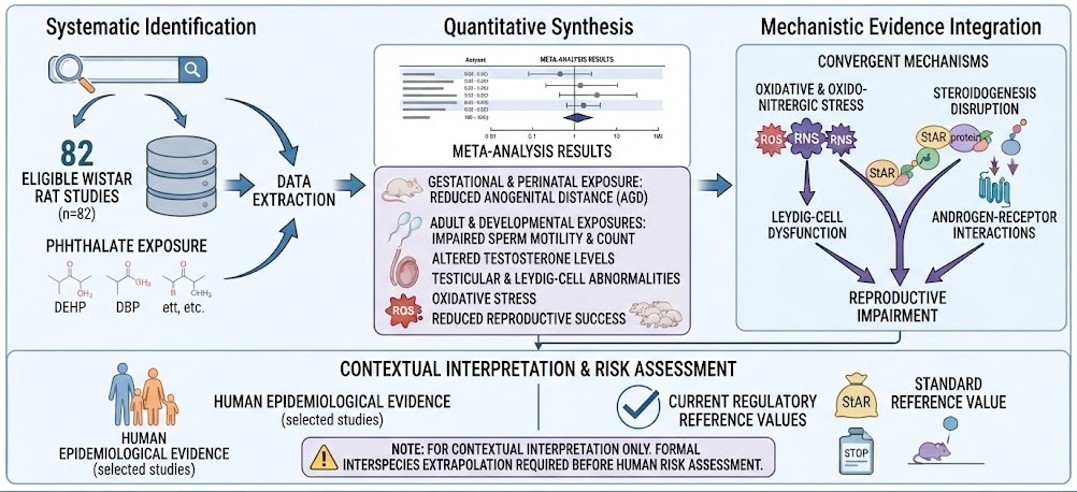
Downloads
References
R Hauser and AM Calafat. Phthalates and human health. Occupational and Environmental Medicine 2005; 62(11), 806-818.
JM Braun, S Sathyanarayana and R Hauser. Phthalate exposure and children’s health. Current Opinion in Pediatrics 2013; 25(2), 247-254.
EFSA Panel on Food Contact Materials, Enzymes and Processing Aids (CEP), V Silano, JM Barat Baviera, C Bolognesi, A Chesson, PS Cocconcelli, R Crebelli, DM Gott, K Grob, E Lampi, A Mortensen, G Rivière, IL Steffensen, C Tlustos, H Van Loveren, L Vernis, H Zorn, JP Cravedi, C Fortes, MF Tavares Poças, …, L Castle. Update of the risk assessment of di-butylphthalate (DBP), butyl-benzyl-phthalate (BBP), bis(2-ethylhexyl)phthalate (DEHP), di-isononylphthalate (DINP) and di-isodecylphthalate (DIDP) for use in food contact materials. EFSA Journal 2019; 17(12), e05838.
S Dutta, B Gorain, H Choudhury, S Roychoudhury and P Sengupta. Environmental and occupational exposure of metals and female reproductive health. Environmental Science and Pollution Research 2022; 29(41), 62067-62092.
S Hyman, J Acevedo, C Giannarelli and L Trasande. Phthalate exposure from plastics and cardiovascular disease: Global estimates of attributable mortality and years life lost. EBioMedicine 2025; 117, 105730.
JS Fisher. Environmental anti-androgens and male reproductive health: Focus on phthalates and testicular dysgenesis syndrome. Reproduction 2004; 127(3), 305-315.
PMD Foster. Disruption of reproductive development in male rat offspring following in utero exposure to phthalate esters. International Journal of Andrology 2006; 29(1), 140-147.
EG Radke, JM Braun, JD Meeker and GS Cooper. Phthalate exposure and male reproductive outcomes: A systematic review of the human epidemiological evidence. Environment International 2018; 121(P1), 764-793.
CG Bornehag, F Carlstedt, BAG Jönsson, CH Lindh, TK Jensen, A Bodin, C Giwercman, A Zheng, S Svanes and SH Swan. Prenatal phthalate exposures and anogenital distance in Swedish boys. Environmental Health Perspectives 2015; 123(1), 101-107.
SH Swan, KM Main, F Liu, SL Stewart, RL Kruse, AM Calafat, CS Mao, JB Redmon, CL Ternand, S Sullivan and S Teague. Decrease in anogenital distance among male infants with prenatal phthalate exposure. Environmental Health Perspectives 2005; 113(8), 1056-1061.
SH Swan, S Sathyanarayana, ES Barrett, S Janssen, F Liu, RH Nguyen and JB Redmon. First trimester phthalate exposure and anogenital distance in newborns. Human Reproduction 2015; 30(4), 963-972.
LE Gray Jr, J Ostby, J Furr, M Price, DN Veeramachaneni and L Parks. Perinatal exposure to the phthalates DEHP, BBP, and DINP, but not DEP, DMP, or DOTP, alters sexual differentiation of the male rat. Toxicological Sciences 2000; 58(2), 350-365.
KL Howdeshell, VS Wilson, J Furr, CR Lambright, CV Rider, CR Blystone, AK Hotchkiss and LE Gray Jr. A mixture of five phthalate esters inhibits fetal testicular testosterone production in the Sprague-Dawley rat in a cumulative, dose-additive manner. Toxicological Sciences 2008; 105(1), 153-165.
AJ Martino-Andrade and I Chahoud. Reproductive toxicity of phthalate esters. Molecular Nutrition & Food Research 2010; 54(1), 148-157.
JL Lyche, AC Gutleb, Å Bergman, GS Eriksen, AJ Murk, E Ropstad, M Saunders and JU Skaare. Reproductive and developmental toxicity of phthalates. Journal of Toxicology and Environmental Health, Part B 2009; 12(4), 225-249.
PR Hannon and JA Flaws. The effects of phthalates on the ovary. Frontiers in Endocrinology 2015; 6, 8.
EG Radke, BS Glenn, JM Braun and GS Cooper. Phthalate exposure and female reproductive and developmental outcomes: A systematic review of the human epidemiological evidence. Environment International 2019; 130, 104580.
CG Basso, AT de Araújo-Ramos and AJ Martino-Andrade. Exposure to phthalates and female reproductive health: A literature review. Reproductive Toxicology 2022; 109, 61-79.
S Sedha, H Lee, S Singh, S Kumar, S Jain, A Ahmad, YA Bin Jardan, S Sonwal, S Shukla, J Simal-Gandara, J Xiao, YS Huh, YK Han and VK Bajpai. Reproductive toxic potential of phthalate compounds - State of art review. Pharmacological Research 2021; 167, 105536.
M Mariana, J Feiteiro, I Verde and E Cairrao. The effects of phthalates in the cardiovascular and reproductive systems: A review. Environment International 2016; 94, 758-776.
L Caporossi and M Marino. Phthalate exposure: From quantification to risk assessment. Toxics 2022; 10(6), 330.
MA Kamrin. Phthalate risks, phthalate regulation, and public health: A review. Journal of Toxicology and Environmental Health, Part B 2009; 12(2), 157-174.
SS Rowdhwal and J Chen. Toxic effects of di-2-ethylhexyl phthalate: An overview. BioMed Research International 2018; 2018, 1750368.
S Dutta, DK Haggerty, DA Rappolee and DM Ruden. Phthalate exposure and long-term epigenomic consequences: A review. Frontiers in Genetics 2020; 11, 405.
GX Hu, QQ Lian, RS Ge, DO Hardy and XK Li. Phthalate-induced testicular dysgenesis syndrome: Leydig cell influence. Trends in Endocrinology and Metabolism 2009; 20(3), 139-145.
S Takeuchi, M Iida, S Kobayashi, K Jin, T Matsuda and H Kojima. Differential effects of phthalate esters on transcriptional activities via human estrogen receptors alpha and beta, and androgen receptor. Toxicology 2005; 210(2-3), 223-233.
WH Chang, SS Li, MH Wu, HA Pan and CC Lee. Phthalates might interfere with testicular function by reducing testosterone and insulin-like factor 3 levels. Human Reproduction 2015; 30(11), 2658-2670.
H Wang, H He, Y Wei, X Gao, T Zhang and J Zhai. Do phthalates and their metabolites cause poor semen quality? A systematic review and meta-analysis of epidemiological studies on risk of decline in sperm quality. Environmental Science and Pollution Research 2023; 30(12), 34214-34228.
AC Gore, VA Chappell, SE Fenton, JA Flaws, A Nadal, GS Prins, J Toppari and RT Zoeller. EDC-2: The Endocrine Society’s second scientific statement on endocrine-disrupting chemicals. Endocrine Reviews 2015; 36(6), E1-E150.
LR Rhomberg and JE Goodman. Low-dose effects and nonmonotonic dose-responses of endocrine disrupting chemicals: Has the case been made? Regulatory Toxicology and Pharmacology 2012; 64(1), 130-133.
CR Hooijmans, MM Rovers, RBM de Vries, M Leenaars, M Ritskes-Hoitinga and MW Langendam. SYRCLE’s risk of bias tool for animal studies. BMC Medical Research Methodology 2014; 14, 43.
V Emojevwe, AO Naiho, EK Nwangwa, MO Oyovwi, K Anachuna, E Agbanifo-Chijiokwu and TME Daubry. Duration-dependent effects of high dose of phthalate exposure on semen quality in adult male rats. JBRA Assisted Reproduction 2022; 26(1), 53-61.
V Emojevwe, EK Nwangwa, AO Naiho, MO Oyovwi, O Igiehon, E Ogunwole, MS Makinde-Taylor, OA Ayotomide, AO Akinola, PT Edesiri, BO Oghenetega and SI Ovuakporaye. Therapeutic efficacy of N-acetylcysteine and zinc sulphate against di-(2-ethylhexyl) phthalate-induced testicular oxido-nitrergic stress in male Wistar rat. Andrologia 2022; 54(9), e14508.
V Emojevwe, EK Nwangwa, AO Naiho, MO Oyovwi and B Ben-Azu. Toxicological outcome of phthalate exposure on male fertility: Ameliorative impacts of the co-administration of N-acetylcysteine and zinc sulfate in rats. Middle East Fertility Society Journal 2022; 27, 5.
VO Emojevwe, MO Oyovwi, KE Adewole, PE Ohwin, AO Akinola, AO Naiho, EK Nwangwa, V Omo-Idonije, M Lade-Ige and B Ben-Azu. N-acetylcysteine and zinc sulphate abate di-2-ethylhexyl phthalate-mediated reproductive dysfunction in rats: Focus on oxidative and sex hormone receptors mechanisms. Asian Pacific Journal of Reproduction 2024; 13(5), 228-240.
VR Kay, C Chambers and WG Foster. Reproductive and developmental effects of phthalate diesters in females. Critical Reviews in Toxicology 2013; 43(3), 200-219.
RH McKee, JH Butala, RM David and G Gans. NTP Center for the Evaluation of Risks to Human Reproduction reports on phthalates: Addressing the data gaps. Reproductive Toxicology 2004; 18(6), 759-760.
SD Gangolli. Testicular effects of phthalate esters. Environmental Health Perspectives 1982; 45, 77-84.
BT Akingbemi, RT Youker, CM Sottas, R Ge, E Katz, GR Klinefelter, BR Zirkin and MP Hardy. Modulation of rat Leydig cell steroidogenic function by di(2-ethylhexyl)phthalate. Biology of Reproduction 2001; 65(4), 1252-1260.
PR Hannon, KE Brannick, W Wang, RK Gupta and JA Flaws. Di(2-ethylhexyl) phthalate inhibits antral follicle growth, induces atresia, and inhibits steroid hormone production in cultured mouse antral follicles. Toxicology and Applied Pharmacology 2015; 284(1), 42-53.
W Wang, ZR Craig, MS Basavarajappa, RK Gupta and JA Flaws. Di(2-ethylhexyl) phthalate inhibits growth of mouse ovarian antral follicles through an oxidative stress pathway. Toxicology and Applied Pharmacology 2012; 258(2), 288-295.
PR Hannon, J Peretz and JA Flaws. Daily exposure to di(2-ethylhexyl) phthalate alters estrous cyclicity and accelerates primordial follicle recruitment potentially via dysregulation of the phosphatidylinositol 3-kinase signaling pathway in adult mice. Biology of Reproduction 2014; 90(6), 136.
JW Crissman, DG Goodman, PK Hildebrandt, RR Maronpot, DA Prater and JH Riley. Best practice guideline: Toxicologic histopathology. Toxicologic Pathology 2004; 32(1), 126-131.
TT Schug, A Janesick, B Blumberg and JJ Heindel. Endocrine disrupting chemicals and disease susceptibility. Journal of Steroid Biochemistry and Molecular Biology 2011; 127(3-5), 204-215.
LN Vandenberg, T Colborn, TB Hayes, JJ Heindel, DRJ Jr, DH Lee, T Shioda, AM Soto, FS vom Saal, WV Welshons, RT Zoeller and JP Myers. Hormones and endocrine-disrupting chemicals: Low-dose effects and nonmonotonic dose responses. Endocrine Reviews 2012; 33(3), 378-455.
F Lagarde, C Beausoleil, SM Belcher, LP Belzunces, C Emond, M Guerbet and C Rousselle. Non-monotonic dose-response relationships and endocrine disruptors: A qualitative method of assessment. Environmental Health 2015; 14, 13.
RJ Aitken, TB Smith, MS Jobling, MA Baker and GN de Iuliis. Oxidative stress and male reproductive health. Asian Journal of Andrology 2014; 16(1), 31-38.
E Barati, H Nikzad and M Karimian. Oxidative stress and male infertility: Current knowledge of pathophysiology and role of antioxidant therapy in disease management. Cellular and Molecular Life Sciences 2020; 77(1), 93-113.
L Zhang, H Li, M Gao, T Zhang, Z Wu, Z Wang and T Chong. Genistein attenuates di-(2-ethylhexyl) phthalate-induced testicular injuries via activation of Nrf2/HO-1 following prepubertal exposure. International Journal of Molecular Medicine 2018; 41(3), 1437-1446.
U.S. Environmental Protection Agency. Integrated Risk Information System (IRIS): Di(2-ethylhexyl)phthalate (DEHP) reference dose for oral exposure, Available at: https://iris.epa.gov/ ChemicalLanding/%26substance_nmbr%3D14, accessed May 2026.
TK Jensen, H Frederiksen, HB Kyhl, TH Lassen, SH Swan, CG Bornehag, NE Skakkebaek, KM Main, DV Lind, S Husby and AM Andersson. Prenatal exposure to phthalates and anogenital distance in male infants from a low-exposed Danish cohort (2010-2012). Environmental Health Perspectives 2016; 124(7), 1107-1113.
KN Cajachagua-Torres, NB Salvi, E Seok, Y Wang, M Liu, K Kannan, LG Kahn, L Trasande and A Ghassabian. Prenatal phthalate exposure and anogenital distance in infants at 12 months. Environment International 2025; 199, 109472.
CL Schwartz, S Christiansen, AM Vinggaard, M Axelstad, U Hass and T Svingen. Anogenital distance as a toxicological or clinical marker for fetal androgen action and risk for reproductive disorders. Archives of Toxicology 2019; 93(2), 253-272.
KK Ferguson, TF McElrath, YH Chen, B Mukherjee and JD Meeker. Urinary phthalate metabolites and biomarkers of oxidative stress in pregnant women: A repeated measures analysis. Environmental Health Perspectives 2015; 123(3), 210-216.
JD Meeker, AM Calafat and R Hauser. Urinary phthalate metabolites and their association with reproductive hormones in men. Epidemiology 2009; 20(4), 487-493.
PD Louis, PD Sundaram, PD Sweeney, PD Schisterman and PD Kannan. Urinary bisphenol A, phthalates, and couple fecundity: The Longitudinal Investigation of Fertility and the Environment (LIFE) study. Fertility and Sterility 2014; 101(5), 1359-1366.
J Jurewicz, M Radwan, W Sobala, D Ligocka, P Radwan, M Bochenek and W Hanke. Association between urinary levels of phthalate metabolites and sperm quality parameters. International Journal of Occupational Medicine and Environmental Health 2014; 27(3), 387-399.
National Toxicology Program. NTP-CERHR monograph on the potential human reproductive and developmental effects of Di(2-ethylhexyl) phthalate (DEHP). National Toxicology Program, North Carolina, 2006.
SW Thurston, J Mendiola, AR Bellamy, H Levine, C Wang, A Sparks, JB Redmon, EZ Drobnis and SH Swan. Phthalate exposure and semen quality in fertile US men. Andrology 2016; 4(4), 632-638.
SM Duty, MJ Silva, DB Barr, JW Brock, L Ryan, Z Chen, RF Herrick, DC Christiani and R Hauser. Phthalate exposure and human semen parameters. Epidemiology 2003; 14(3), 269-277.
UN Joensen, H Frederiksen, MB Jensen, MP Lauritsen, IA Olesen, TH Lassen, AM Andersson and NE Skakkebaek. Phthalate exposure is associated with reduced semen quality in young Danish men. Environment International 2012; 47, 105-112.
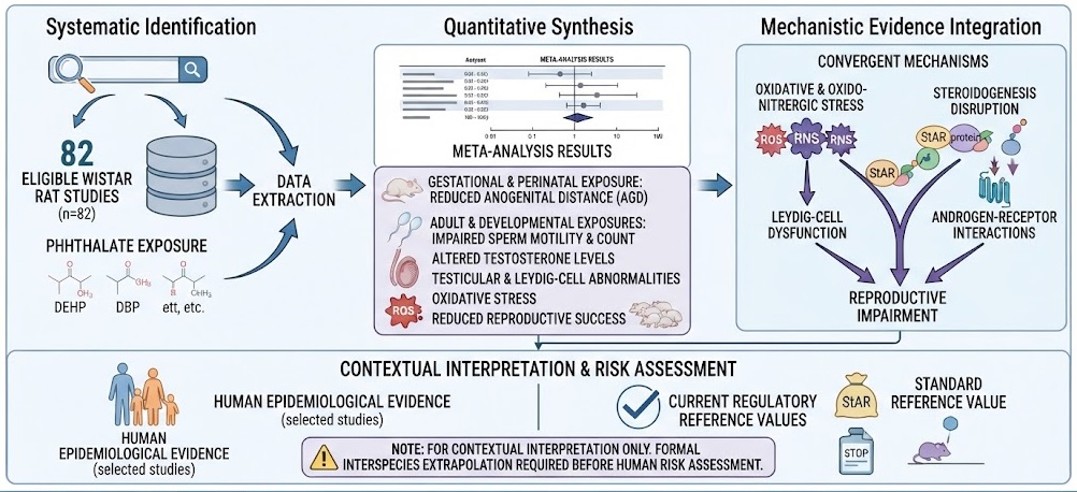
Downloads
Published
How to Cite
Issue
Section
License
Copyright (c) 2026 Walailak University

This work is licensed under a Creative Commons Attribution-NonCommercial-NoDerivatives 4.0 International License.





