
Pangasius micronemus Oil: Extraction Method Comparison, Fatty Acid Profile, and Biological Evaluation in A549 and Huh-7 Cancer
DOI:
https://doi.org/10.48048/tis.2026.14577Keywords:
Pangasius micronemus, Fish oil, Mechanical pressing, Soxhlet extraction, Fatty acid composition, Physicochemical properties, A549 cells, Huh-7 cellsAbstract
Pangasius micronemus oil (PMO) has attracted attention as a potential source of bioactive lipids with nutraceutical value; however, its quality and biological activity are highly dependent on the extraction method. This study aimed to characterize the physicochemical properties and fatty acid composition of PMO obtained by mechanical pressing and Soxhlet extraction, and to evaluate its anticancer potential through integrated in vitro and in silico approaches. Physicochemical properties were evaluated according to Association of Official Analytical Chemists (AOAC) official methods and fatty acid profiles were determined by gas chromatography with flame ionization detection (GC–FID). Cytotoxic activity was evaluated via 3-(4,5-dimethylthiazol-2-yl)-2,5-diphenyltetrazolium bromide (MTT) assay on A549 (non-small cell lung cancer, NSCLC) and Huh-7 (hepatocellular carcinoma) cell lines. Molecular docking and network pharmacology analyses were subsequently performed to explore potential mechanisms of action against NSCLC-related targets. Soxhlet extraction yielded higher oil content (29.57%) than mechanical pressing (25.79%) (p < 0.05); however, pressed oil demonstrated good physicochemical quality, with lower acid value (6.07 mg KOH/g), lower peroxide value (2.33 meq O₂/kg), higher saponification value (188 mg KOH/g), and higher iodine value (74.22 g I₂/100 g). Fatty acid profiles were highly similar between extraction methods, with unsaturated fatty acids accounting for 63.60% - 64.64% of total fatty acids. Oleic acid was the predominant fatty acid (43.57% - 44.11%), followed by palmitic acid (29.14% - 29.22%) and linoleic acid (15.21% - 15.55%). Biological evaluation demonstrated weak cytotoxic activity against A549 cells, with an estimated IC₅₀ value of 4,520 ± 3,190 μg/mL, and no significant inhibitory effect against Huh-7 cells across the tested concentration range. Molecular docking revealed that docosahexaenoic acid (DHA) displayed the strongest binding affinities toward epidermal growth factor receptor (EGFR), mammalian target of rapamycin (mTOR), and matrix metalloproteinase-9 (MMP-9), while network pharmacology identified multiple cancer-related targets and pathways associated with lipid metabolism and cell proliferation. These findings indicate that mechanical pressing yielded oil with favorable physicochemical characteristics, while PMO demonstrated limited direct anticancer activity under the conditions tested.
HIGHLIGHTS
- Integrated evaluation of extraction methods, lipid composition, and biological activity of Pangasius micronemus
- Mechanical pressing produced oil with more favorable physicochemical quality parameters despite lower extraction yield.
- Unsaturated fatty acids accounted for more than 63% of total fatty acids in both oils.
- Pangasius micronemus oil showed limited antiproliferative activity against human lung cancer cells and no significant effect against liver cancer cells.
- Molecular docking and network pharmacology suggested EGFR, mTOR, and MMP-9 as potential molecular targets.
GRAPHICAL ABSTRACT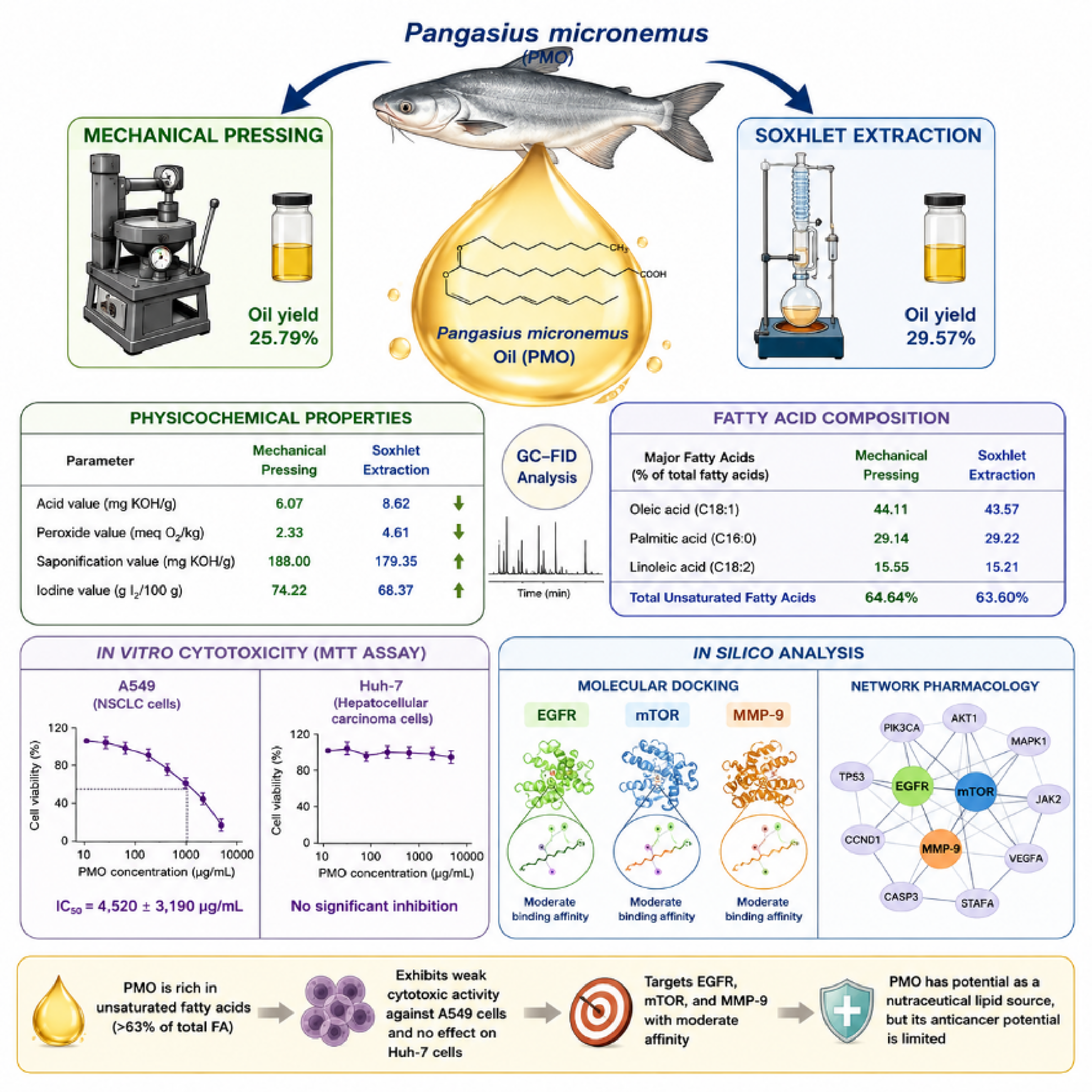
Downloads
References
AG Jayathilake, RB Luwor, K Nurgali and XQ Su. Molecular mechanisms associated with the inhibitory role of long chain n-3 PUFA in colorectal cancer. Integrative Cancer Therapies 2024. https://doi.org/10.1177/15347354241243024
R Ashraf, CDC Buchanan, LM Hillyer, E Ogloblina, GA Wood, RP Bazinet, S Subedi, AM Edwards, YI Kim, WJ Muller, JM Monk, LE Robinson and DWL Ma. Lifelong n-3 PUFA consumption reduces HER2+ mammary tumour growth and alters immune markers compared to safflower- or corn oil-based sources of n-6 PUFA. Nutrients 2026; 18(4), 606.
J de Freitas Rodrigues, HK Philippsen, MF Dolabela, CY Nagamachi and JC Pieczarka. The potential of DHA as cancer therapy strategies: A narrative review of in vitro cytotoxicity trials. Nutrients 2023; 15(8), 2006.
Y Yin, C Sui, F Meng, P Ma and Y Jiang. The omega-3 polyunsaturated fatty acid docosahexaenoic acid inhibits proliferation and progression of non-small cell lung cancer cells through the reactive oxygen species-mediated inactivation of the PI3K/Akt pathway. Lipids in Health and Disease 2017; 16(1), 87.
RB Hashim, EF Jamil, FH Zulkipli and JM Daud. Fatty acid compositions of silver catfish, Pangasius sp. farmed in several rivers of Pahang, Malaysia. Journal of Oleo Science 2015; 64(2), 205-209.
AR Putri, A Rohman and S Riyanto. Authentication of patin (Pangasius micronemus) fish oil adulterated with palm oil using FTIR spectroscopy combined with chemometrics. International Journal of Applied Pharmaceutics 2019; 11(3), 195-199.
AR Putri, A Rohman and S Riyanto. Comparative study of fatty acid profiles in patin (Pangasius micronemus) and gabus (Channa striata) fish oil and its authentication using FTIR spectroscopy combined with chemometrics. International Journal of Applied Pharmaceutics 2019; 11(6), 55-60.
D D’Eliseo and F Velotti. Omega-3 fatty acids and cancer cell cytotoxicity: Implications for multi-targeted cancer therapy. Journal of Clinical Medicine 2016; 5(2), 15.
H Sung, J Ferlay, RL Siegel, M Laversanne, I Soerjomataram, A Jemal and F Bray. Global cancer statistics 2020: GLOBOCAN estimates of incidence and mortality worldwide for 36 cancers in 185 countries. CA: A Cancer Journal for Clinicians 2021; 71(3), 209-249.
A Zhang, K Miao, H Sun and CX Deng. Tumor heterogeneity reshapes the tumor microenvironment to influence drug resistance. International Journal of Biological Sciences 2022; 18(7), 3019-3033.
ZF Lim and PC Ma. Emerging insights of tumor heterogeneity and drug resistance mechanisms in lung cancer targeted therapy. Journal of Hematology and Oncology 2019; 12(1), 134.
N Rahman, S Hashem, S Akther and JS Jothi. Impact of various extraction methods on fatty acid profile, physicochemical properties, and nutritional quality index of Pangus fish oil. Food Science and Nutrition 2023; 11(8), 4688-4699.
E Kalkan, HK Cavdar and M Maskan. Health impacts and innovative extraction methods of fish oil: A review. European Journal of Lipid Science and Technology 2025; 127(2), e202400171.
J Chen and H Liu. Nutritional indices for assessing fatty acids: A mini-review. International Journal of Molecular Sciences 2020; 21(16), 5695.
D Lv, R Wang, M Chen, Y Li and C Cao. Fish intake, dietary polyunsaturated fatty acids, and lung cancer: Systematic review and dose-response meta-analysis of 1.7 million men and women. Nutrition and Cancer 2022; 74(6), 1976-1985.
E Patterson, R Wall, GF Fitzgerald, RP Ross and C Stanton. Health implications of high dietary omega-6 polyunsaturated fatty acids. Journal of Nutrition and Metabolism 2012; 2012, 539426.
A Swaidan, F Grasso, F Falco, F Turrini and R Boggia. Advances in fish oil extraction and enrichment: A comprehensive review of conventional and green technologies for high-quality omega-3-rich oil production. Sustainable Food Technology 2026. https://doi.org/10.1039/D5FB00888C
KR Pawar and PK Nema. Apricot kernel characterization, oil extraction, and its utilization: A review. Food Science and Biotechnology 2023; 32(3), 249-263.
Z Shahzadi, Z Yousaf, I Anjum, M Bilal, H Yasin, A Aftab, A Booker, R Ullah and A Bari. Network pharmacology and molecular docking: Combined computational approaches to explore the antihypertensive potential of Fabaceae species. Bioresources and Bioprocessing 2024; 11(1), 53.
SS Hassanein, AL Abdel-Mawgood and SA Ibrahim. EGFR-dependent extracellular matrix protein interactions might light a candle in cell behavior of non-small cell lung cancer. Frontiers in Oncology 2021; 11, 766659.
AOAC International. AOAC official method 940.28: Fatty acids (free) in crude and refined oils. Oxford University Press, New York, 2023.
AOAC International. Official methods of analysis. 18th ed. AOAC International, Gaithersburg, United States, 2005.
Y Lima-Pereira, EMO de Souza, DS dos Reis, IGC Barcellos-Silva, KSL Miki, VF Veiga-Júnior and BE Teixeira-Costa. Current perspectives on the extraction, isolation, and identification of fats and fatty acids using conventional and green methods. Separations 2025; 12(6), 160.
DN Hagbe, FFD Dongmo, ARF Mba, FHN Ngamga, BS Noutsa, LL Lienou, RME Etame and I Gouado. Comparative study of extraction methods for nutritional and safety assessment of fish oils from Heterotis niloticus co-products. Applied Food Research 2025; 5(1), 100783.
A Akhmedov, N Erkaeva and O Rakhmonkulova. New technology for primary purification of sunflower and soybean oils. E3S Web of Conferences 2023; 401, 04034.
S Wang, J Wang, G Dong, X Chen, S Lei and Q Bai. Effect of different extraction methods on quality characteristics of rapeseed and flaxseed oils. Journal of Food Quality 2022; 2022, 8296212.
Y Elouafy, A El Yadini, H El Moudden, H Harhar, MM Alshahrani, AA Al Awadh, KW Goh, LC Ming, A Bouyahya and M Tabyaoui. Influence of the extraction method on the quality and chemical composition of walnut (Juglans regia L.) oil. Molecules 2022; 27(22), 7681.
CODEX Alimentarius. Standard for fish oils CXS 329-2017. FAO/WHO Codex Alimentarius Commission, Rome, Italy, 2024.
T Dedebas. Oxidative stability of poppy seed oils: Kinetic and thermodynamic analyses under accelerated conditions. Journal of Food Measurement and Characterization 2024; 18(3), 1969-1979.
M Ivanova, A Hanganu, R Dumitriu, M Tociu, G Ivanov, C Stavarache, L Popescu, A Ghendov-Mosanu, R Sturza, C Deleanu and NA Chira. Saponification value of fats and oils as determined from (_^1)"H-NMR" data: The case of dairy fats. Foods 2022; 11(10), 1466.
AA Ayeloja, WA Jimoh and TV Oyewole. Nutritional quality of fish oil extracted from selected marine fish species. Food and Humanity 2024; 2, 100212.
MM Roman-Lara, KJ Chong, RM Bill and AD Goddard. A miniaturized iodine value assay for quantifying the unsaturated fatty acid content of lipids, lipid mixtures, and biological membranes. Lipids 2025; 60(4), 201-210.
United States Pharmacopeia. US Pharmacopeia. United States Pharmacopeial Convention, Rockville, United States, 2026.
PW Harlina, AY Nasution, I Musfiroh, M Muchtaridi, F Geng, T Yuliana and VP Yarlina. A sustainable source of freshwater fish oil: Nutritional and functional insights through lipidomics and metabolomics. LWT 2026; 241, 119046.
AR Putri, W Setyaningsih, MP Lovillo, CAC Fernández, A Rohman, S Riyanto and YP Jang. Ultrasound-assisted extraction of patin fish oil: optimization using response surface methodology–Box Behnken design. Indonesian Journal of Chemistry 2025; 25(5), 1462-1474.
SS Borges, SEM Miranda, VHS Marinho, ALB de Barros, S Yoshioka, LIS Hage-Melim, ACJ Silva, IM Ferreira and AEMFMO Oliveira. Evaluation of the cytotoxic activity of nanostructured lipid carrier systems for fatty acid amides and silk fibroins in breast cancer cell lines. Molecules 2025; 30(16), 3337.
CJ Briscoe, MR Stiles and DS Hage. System suitability in bioanalytical LC/MS/MS. Journal of Pharmaceutical and Biomedical Analysis 2007; 44(2), 484-491.
ML Nordin, A Abdul Kadir, ZA Zakaria, R Abdullah and MNH Abdullah. In vitro investigation of cytotoxic and antioxidative activities of Ardisia crispa against breast cancer cell lines, MCF-7 and MDA-MB-231. BMC Complementary and Alternative Medicine 2018; 18(1), 87.
E Kaviani, F Hajibabaie, N Abedpoor and K Safavi. Synergic effects and possible mechanism of omega-6 fatty acids (ω-6) on immune system, inflammation, and cancer. Molecular Nutrition and Food Research 2025; 69(12), e70092.
PC Hsu, DM Jablons, CT Yang and L You. Epidermal growth factor receptor (EGFR) pathway, yes-associated protein (YAP) and the regulation of programmed death-ligand 1 (PD-L1) in non-small cell lung cancer (NSCLC). International Journal of Molecular Sciences 2019; 20(15), 3821.
RA Saxton and DM Sabatini. mTOR signaling in growth, metabolism, and disease. Cell 2017; 168(6), 960-976.
M Wolosowicz, S Prokopiuk and TW Kaminski. Matrix metalloproteinase-9 (MMP-9) as a therapeutic target: Insights into molecular pathways and clinical applications. Pharmaceutics 2025; 17(11), 1425.
C Kousparou, M Fyrilla, A Stephanou and I Patrikios. DHA/EPA (omega-3) and LA/GLA (omega-6) as bioactive molecules in neurodegenerative diseases. International Journal of Molecular Sciences 2023; 24(13), 10717.
D Tocher, M Betancor, M Sprague, RE Olsen and JA Napier. Omega-3 long-chain polyunsaturated fatty acids, EPA and DHA: Bridging the gap between supply and demand. Nutrients 2019; 11(1), 89.
Z Ma, A Ajibade and X Zou. Docking strategies for predicting protein-ligand interactions and their application to structure-based drug design. Communications in Information and Systems 2024; 24(3), 199-230.
Y Chen, Y Sun, Y Ding, Y Ding, S Liu, X Zhou, H Wu, J Xiao and B Lu. Recent progress in fish oil-based emulsions by various food-grade stabilizers: Fabrication strategy, interfacial stability mechanism and potential application. Critical Reviews in Food Science and Nutrition 2024; 64(6), 1677-1700.
YZ Shen, YS Ding, Q Gu and KC Chou. Identifying the hub proteins from complicated membrane protein network systems. Medicinal Chemistry 2010; 6(3), 165-173.
K Vandereyken, J Van Leene, B De Coninck and BPA Cammue. Hub protein controversy: Taking a closer look at plant stress response hubs. Frontiers in Plant Science 2018; 9, 694.
Y Yao, Q Zhang, Z Li and H Zhang. MDM2: Current research status and prospects of tumor treatment. Cancer Cell International 2024; 24(1), 170.
T Rajasegaran, CW How, A Saud, A Ali and JCW Lim. Targeting inflammation in non-small cell lung cancer through drug repurposing. Pharmaceuticals 2023; 16(3), 451.
N Bhattacharyya, S Gupta, S Sharma, A Soni, SA Bagabir, M Bhattacharyya, A Mukherjee, AH Almalki, MF Alkhanani, S Haque, AK Ray and MZ Malik. CDK1 and HSP90AA1 appear as the novel regulatory genes in non-small cell lung cancer: a bioinformatics approach. Journal of Personalized Medicine 2022; 12(3), 393.
S Chattopadhyay, SS Sarkar, S Saproo, S Yadav, D Antil, B Das and S Naidu. Apoptosis-targeted gene therapy for non-small cell lung cancer using chitosan-poly-lactic-co-glycolic acid-based nano-delivery system and CASP8 and miRs 29A-B1 and 34A. Frontiers in Bioengineering and Biotechnology 2023; 11, 1188652.
S Liu, J Liu, Y Wang, F Deng and Z Deng. Oxidative stress: Signaling pathways, biological functions, and disease. MedComm 2025; 6(7), e70268.
EN Mendoza, MR Ciriolo and F Ciccarone. Hypoxia-induced reactive oxygen species: Their role in cancer resistance and emerging therapies to overcome it. Antioxidants 2025; 14(1), 94.
K Tahayneh, M Idkedek and FA Akar. NSCLC: Current evidence on its pathogenesis, integrated treatment, and future perspectives. Journal of Clinical Medicine 2025; 14(3), 1025.
LM Mustachio, A Chelariu-Raicu, L Szekvolgyi and J Roszik. Targeting KRAS in cancer: Promising therapeutic strategies. Cancers 2021; 13(6), 1204.
R Lin and J Lin. Blocking of CDC25B suppresses sarcoma progression via arresting cell cycle. Translational Cancer Research 2025; 14(6), 3438-3451.
I Pellarin, A Dall’Acqua, A Favero, I Segatto, V Rossi, N Crestan, J Karimbayli, B Belletti and G Baldassarre. Cyclin-dependent protein kinases and cell cycle regulation in biology and disease. Signal Transduction and Targeted Therapy 2025; 10(1), 11.
X Yuan and D Xu. Telomerase reverse transcriptase (TERT) in action: Cross-talking with epigenetics. International Journal of Molecular Sciences 2019; 20(13), 3338.
F Chen, M Xiao, S Hu and M Wang. Keap1-Nrf2 pathway: A key mechanism in the occurrence and development of cancer. Frontiers in Oncology 2024; 14, 1381467.
TKH Lim, F Skoulidis, KM Kerr, MJ Ahn, JR Kapp, FA Soares and Y Yatabe. KRAS G12C in advanced NSCLC: Prevalence, co-mutations, and testing. Lung Cancer 2023; 184, 107293.
I Müller, E Strozyk, S Schindler, S Beissert, HZ Oo, T Sauter, P Lucarelli, S Raeth, A Hausser, NA Nakouzi, L Fazli, ME Gleave, H Liu, HU Simon, H Walczak, DR Green, J Bartek, M Daugaard and D Kulms. TRAIL-R2 promoting melanoma progression by inducing membrane ruffling and cell migration is regulated by interaction with TRAF2. Cell Death & Disease 2024; 15(1), 82.
A Zafar, MJ Khan and A Naeem. MDM2 - An indispensable player in tumorigenesis. Molecular Biology Reports 2023; 50(8), 6871-6883.
KT Skinner, AM Palkar and AL Hong. Genetics of ABCB1 in cancer. Cancers 2023; 15(17), 4236.
K Jin, C Qian, J Lin and B Liu. Cyclooxygenase-2-prostaglandin E2 pathway: A key player in tumor-associated immune cells. Frontiers in Oncology 2023; 13, 1099811.
Downloads
Published
How to Cite
Issue
Section
License
Copyright (c) 2026 Walailak University

This work is licensed under a Creative Commons Attribution-NonCommercial-NoDerivatives 4.0 International License.