Evaluation of ASHB-5 and ASHB-6 Complexes as Novel Anti-Inflammatory Candidates Using Carrageenan-Induced Paw Edema and Molecular Docking Approaches
DOI:
https://doi.org/10.48048/tis.2027.14543Keywords:
ASHB complexes, COX-2, NF-kB, ASHB complexes, Anti-inflammatory activity, Carrageenan-induced paw edema, Anti-exudative activity, Molecular docking, COX-2, NF-kBAbstract
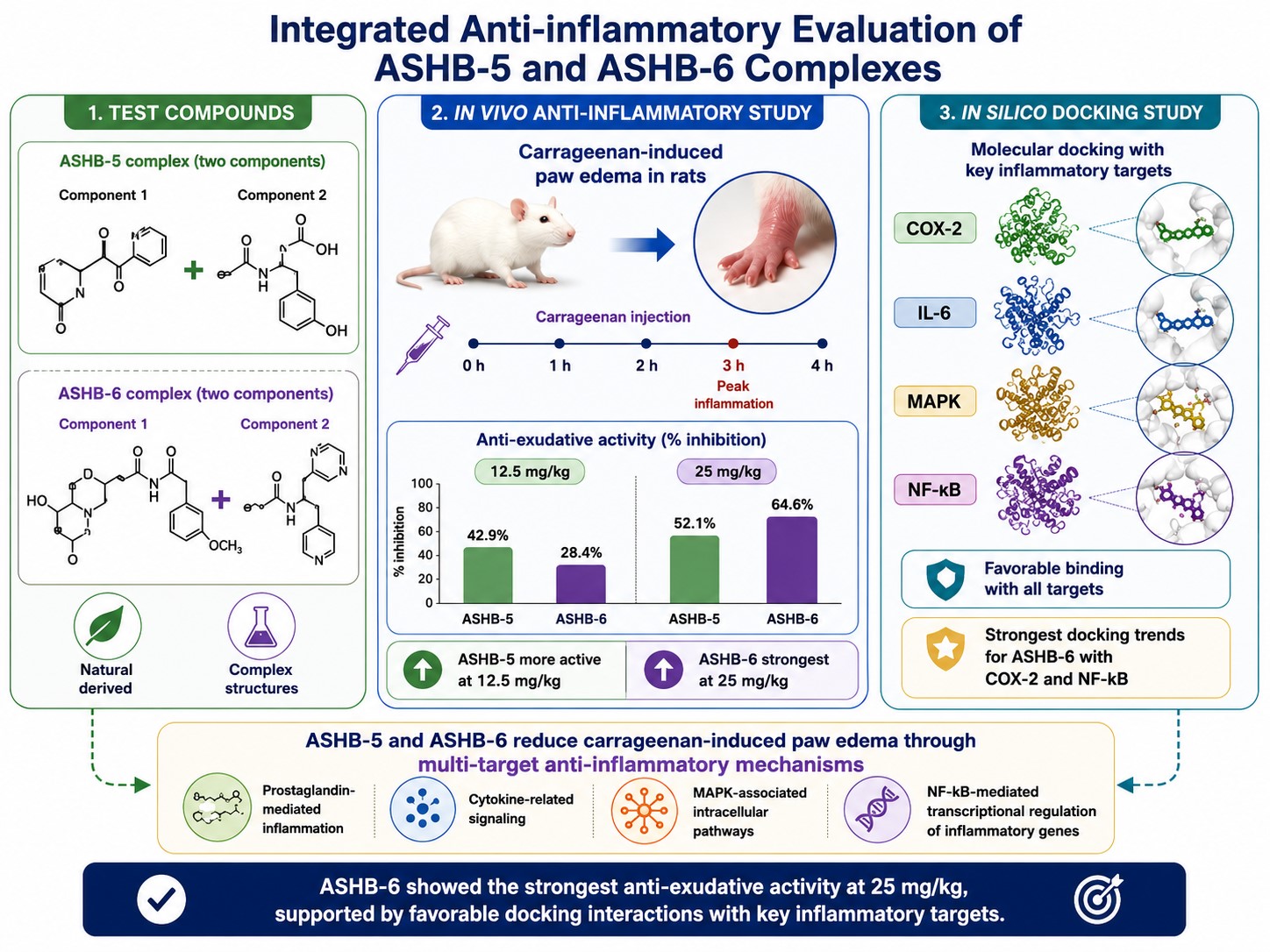
Inflammation is a complex biological response regulated by multiple mediators, enzymes, cytokines, and intracellular signaling pathways. The present study aimed to evaluate the anti-inflammatory potential of ASHB-5 and ASHB-6 complexes using an integrated in vivo and in silico approach. The anti-exudative activity of the complexes was investigated in rats using the carrageenan-induced paw edema model. ASHB-5 and ASHB-6 were administered orally at doses of 12.5 and 25 mg/kg, and paw edema development was monitored after carrageenan injection. Molecular docking analysis was performed against key inflammation-related targets, including cyclooxygenase-2 (COX-2), interleukin-6 (IL-6), mitogen-activated protein kinase (MAPK), and nuclear factor-kappa B (NF-kB), to explore possible molecular mechanisms underlying the observed effects. In vivo results showed that both ASHB-5 and ASHB-6 reduced carrageenan-induced paw edema in a dose-dependent manner. At 12.5 mg/kg, ASHB-5 demonstrated stronger anti-exudative activity than ASHB-6, with inhibition values of 42.9 ± 5.1% and 28.4 ± 3.7%, respectively. At 25 mg/kg, ASHB-6 produced the most pronounced effect, reaching 64.6 ± 4.8% inhibition, whereas ASHB-5 showed 52.1 ± 4.6% activity. These findings indicate that ASHB-5 was more effective at the lower dose, while ASHB-6 exhibited greater activity at the higher dose. Docking analysis revealed favorable predicted interactions of both complexes with COX-2, IL-6, MAPK, and NF-kB. Particularly strong binding profiles were observed for COX-2 and NF-kB, especially for ASHB-6, which showed the strongest predicted interaction with NF-kB. Overall, the combined in vivo and in silico findings suggest that ASHB-5 and ASHB-6 may exert anti-inflammatory effects through multi-target mechanisms involving prostaglandin-mediated inflammation, cytokine-related signaling, MAPK-associated intracellular pathways, and NF-kB-mediated transcriptional regulation. These results support further pharmacological investigation of ASHB-5 and ASHB-6 as potential multi-target anti-inflammatory candidates.
HIGHLIGHTS
- ASHB-5 and ASHB-6 reduced carrageenan-induced paw edema in rats.
- Both complexes showed dose-dependent anti-exudative activity.
- ASHB-5 was more active at 12.5 mg/kg, while ASHB-6 was strongest at 25 mg/kg.
- ASHB-6 produced the highest inhibition of edema formation, reaching 64.6 ± 4.8%.
- Molecular docking showed favorable interactions with COX-2, IL-6, MAPK, and NF-κB.
- ASHB-6 demonstrated particularly strong predicted binding with COX-2 and NF-κB.
- Integrated in vivo and in silico findings suggest multi-target anti-inflammatory mechanisms.
GRAPHICAL ABSTRACT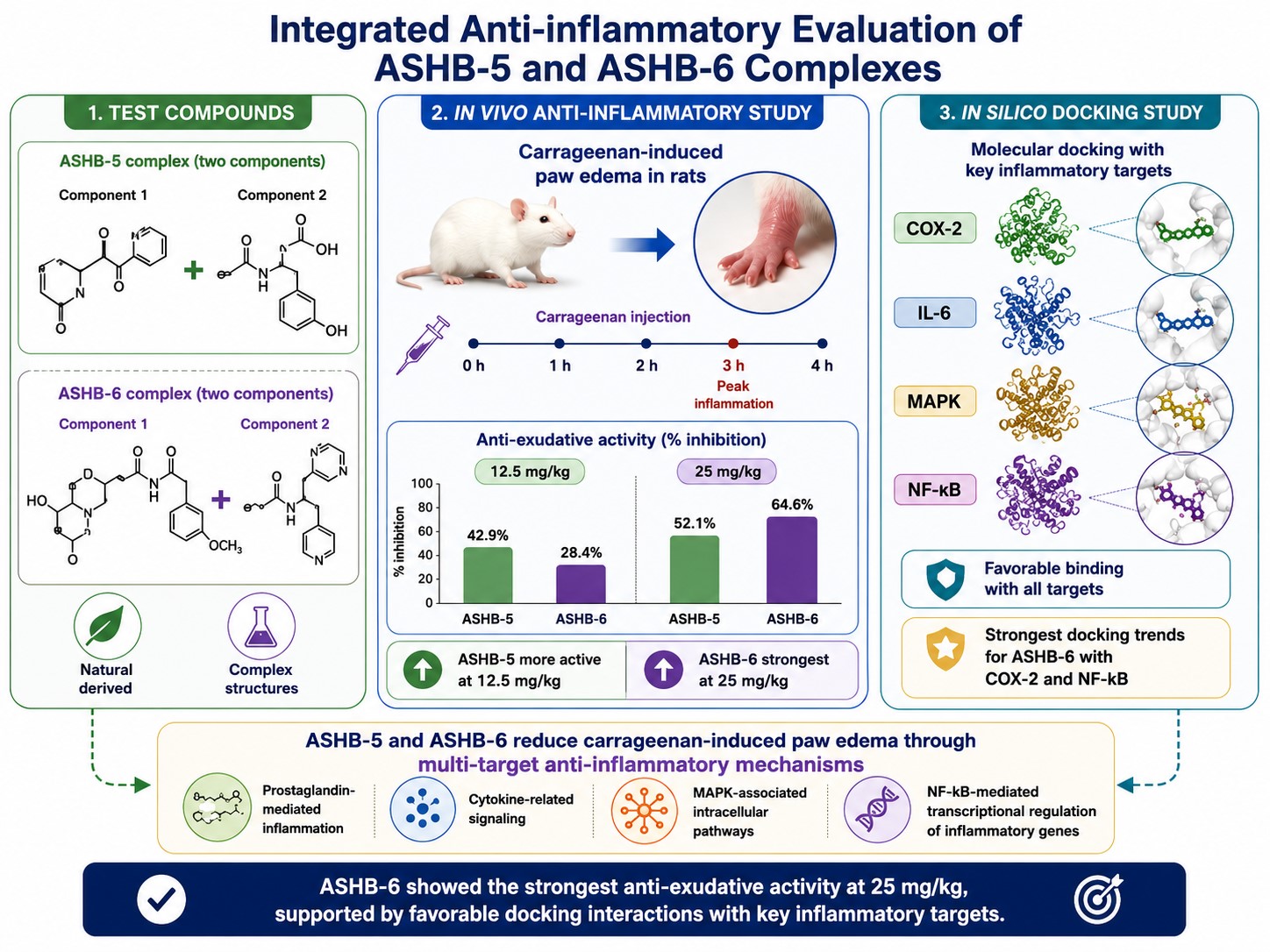
Downloads
References
MS Bakieva, SR Rustamova, TO Rakhmonov, NN Sharipova and KS Mukhitdinova. Hypotensive effect of the alkaloid benzoylheteratisine on the functional activity of rat aortic smooth muscle cells. Academic Research Journal 2022; 1(2), 24-30.
W Li, LN Tu, L Hsieh, JR Smith, YT Yeh, A Sinyagin, EGB Evans, M Ghassemian, A Timms, K Charette, D Mauchley, M McMullan, L Bohuta, C Greene, MC Regier, JCD Alamo, R Savan and V Nigam. A shear stress-responsive pathway in monocytes drives cardiopulmonary bypass-induced inflammation via spectrin/RAF1/store-operated calcium entry. Cell Reports 2026; 45(2), 116903.
HMH Martinez, E Barragan, KO Marichev, D Chávez-Flores and A Bugarin. Phthalimides as anti-inflammatory agents. Future Medicinal Chemistry 2025; 17(1), 125-142.
MT Labro. Antibiotics as anti-inflammatory agents. Current Opinion in Investigational Drugs 2002; 3(1), 61-68.
SS Adams and R Cobb. Non-steroidal anti-inflammatory drugs. Progress in Medicinal Chemistry 1967; 5, 59-138.
DR Royall and RF Palmer. INFLAMMATION's cognitive impact revealed by a novel “Line of Identity” approach. PLoS One 2024; 19(3), e0295386.
T Li, R Guo, Q Zong and G Ling. Application of molecular docking in elaborating molecular mechanisms and interactions of supramolecular cyclodextrin. Carbohydrate Polymers 2022; 276, 118644.
X Liu, F Zhu, XH Ma, Z Shi, SY Yang, YQ Wei and YZ Chen. Predicting targeted polypharmacology for drug repositioning and multi-target drug discovery. Current Medicinal Chemistry 2013; 20(13), 1646-1661.
Z Fang, H Ran, Y Zhang, C Chen, P Lin, X Zhang and M Wu. AlphaFold 3: An unprecedented opportunity for fundamental research and drug development. Precision Clinical Medicine 2025; 8(3), pbaf015.
LG Ferreira, RN Dos Santos, G Oliva and AD Andricopulo. Molecular docking and structure-based drug design strategies. Molecules 2015; 20(7), 13384-13421.
B Kaur and P Singh. Inflammation: Biochemistry, cellular targets, anti-inflammatory agents and challenges with special emphasis on cyclooxygenase-2. Bioorganic Chemistry 2022; 121, 105663.
MDS Maia, GCS Rodrigues, ABS Cavalcanti, L Scotti and MT Scotti. Consensus analyses in molecular docking studies applied to medicinal chemistry. Mini-Reviews in Medicinal Chemistry 2020; 20(14), 1322-1340.
MD Ferrer, C Busquets-Cortés, X Capó, S Tejada, JA Tur, A Pons and A Sureda. Cyclooxygenase-2 inhibitors as a therapeutic target in inflammatory diseases. Current Medicinal Chemistry 2019; 26(18), 3225-3241.
M Vasarri and D Degl’innocenti. Exploring marine-derived antioxidant and anti-inflammatory agents: Findings from recent studies. Marine Drugs 2025; 23(6), 240.
H Wood. Anti-inflammatory drugs could cause chronic pain. Nature Reviews Neurology 2022; 18(7), 382.
Redaktsiia. Clinical guidelines “Rational use of nonsteroidal anti-inflammatory drugs (NSAIDs) in clinical practice”. Part I. Zhurnal Nevrologii i Psikhiatrii imeni S.S. Korsakova 2015; 115(4), 70-82.
DV Tudor, I Bâldea, M Lupu, T Kacso, E Kutasi, A Hopârtean, R Stretea and AG Filip. COX-2 as a potential biomarker and therapeutic target in melanoma. Cancer Biology & Medicine 2020; 17(1), 20-31.
YJ Guo, WW Pan, SB Liu, ZF Shen, Y Xu and LL Hu. ERK/MAPK signalling pathway and tumorigenesis. Experimental and Therapeutic Medicine 2020; 19(3), 1997-2007.
EO Gubernatorova, EA Gorshkova, AI Polinova and MS Drutskaya. IL-6: Relevance for immunopathology of SARS-CoV-2. Cytokine & Growth Factor Reviews 2020; 53, 13-24.
NA El-Shitany and BG Eid. Icariin modulates carrageenan-induced acute inflammation through HO-1/Nrf2 and NF-kB signaling pathways. Biomedicine & Pharmacotherapy 2019; 120, 109567.
Downloads
Published
How to Cite
Issue
Section
License
Copyright (c) 2026 Walailak University

This work is licensed under a Creative Commons Attribution-NonCommercial-NoDerivatives 4.0 International License.