Protective Effects of Probiotic-Derived Supernatants Against Oxidative Stress and Inflammation in UVB-Exposed Human Keratinocyte Cells
DOI:
https://doi.org/10.48048/tis.2027.14359Keywords:
Probiotics, Keratinocyte, Antioxidant, Anti-inflammatory, Ultraviolet-B-protectionAbstract
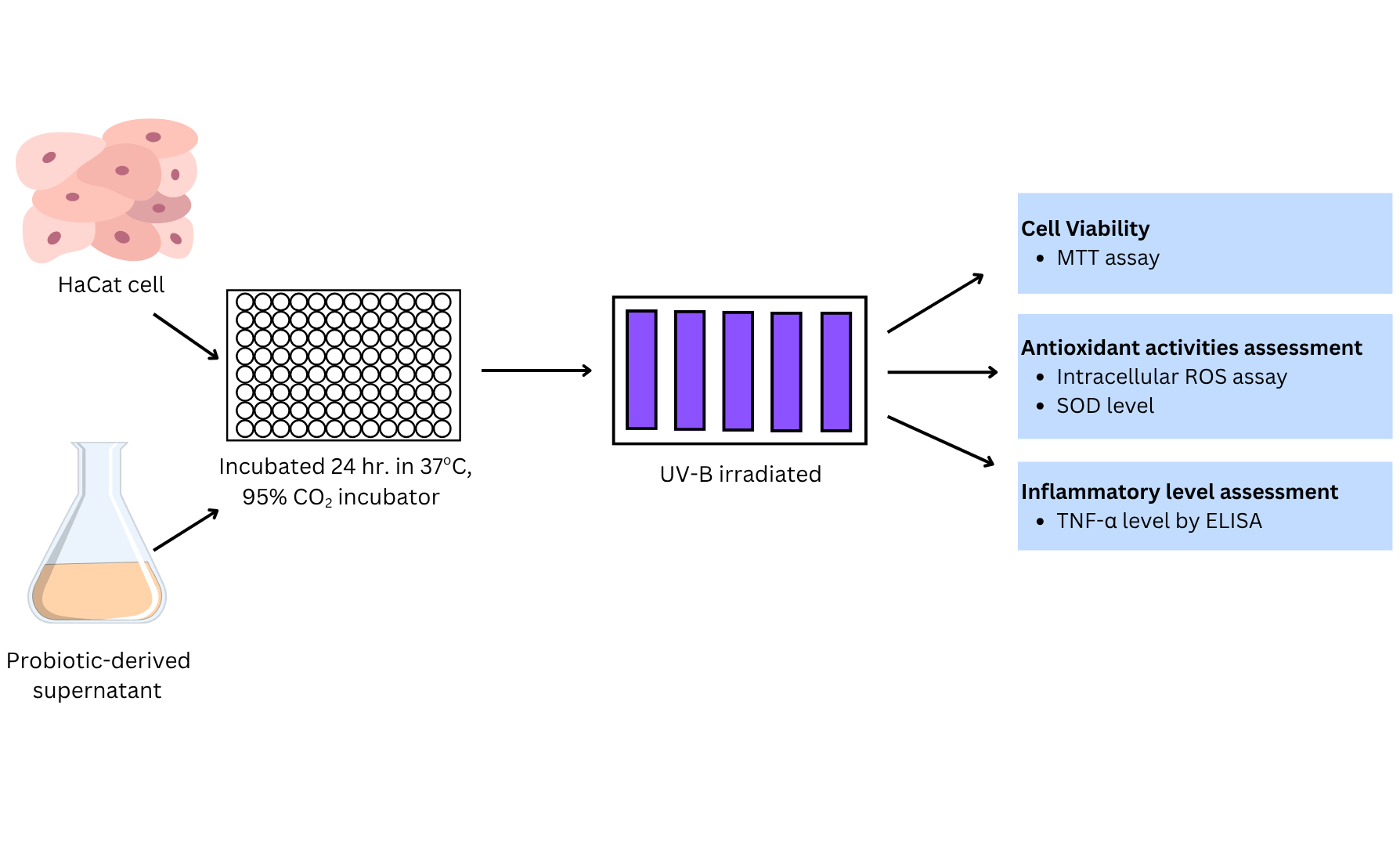
Probiotics have been reported to reduce reactive oxygen species (ROS) and inflammation, demonstrating antioxidant and anti-inflammatory properties; however, evidence regarding the photoprotective effects of supernatants derived from Thai probiotic strains on human keratinocytes remains limited. This study aimed to evaluate the antioxidant, anti-inflammatory, and UVB-protective effects of probiotic-derived supernatant from eight Thai probiotic strains - Lactobacillus gasseri TM01, L. rhamnosus TM14, L. reuteri TF314, L. reuteri TF7, L. salivarius MSMC105-3, L. paracasei MSMC39-1, Bifidobacterium animalis MSMC83, and B. animalis TA1 - on UVB-irradiated human keratinocyte (HaCaT) cells. Cells were pretreated with lyophilized probiotic-derived supernatants (0.25 and 0.5 mg/mL) reconstituted in deionized water prior to irradiation with 20 mJ/cm² UVB. Antioxidant activity was assessed by measuring intracellular ROS levels using a fluorometric assay and superoxide dismutase (SOD) activity using a commercial assay kit, while anti-inflammatory effects were determined by quantifying tumor necrosis factor-alpha (TNF-α) levels using ELISA. Pretreatment with probiotic-derived supernatants attenuated UVB-induced photodamage, as evidenced by a reduction in intracellular ROS levels, increased SOD activity (up to 0.288 ± 0.025 U/mL with L. paracasei MSMC39-1 at 0.5 mg/mL, vs. 0.056 ± 0.025 U/mL in UVB-control group), and decreased TNF-α levels (as low as 7.000 ± 0.413 pg/mL with L. paracasei MSMC39-1, vs. 15.727 ± 1.081 pg/mL in UVB-control group). These findings suggest that Thai probiotic-derived supernatants can mitigate oxidative stress and inflammatory responses in UVB-irradiated keratinocytes, indicating their potential role in photoprotection. In conclusion, these postbiotic preparations demonstrate antioxidant and anti-inflammatory effects that may support the development of UV-protective skincare formulations; however, further mechanistic and in vivo studies are required to validate their translational relevance.
HIGHLIGHTS
- Ultraviolet B (UVB) radiation can cause oxidative stress and inflammation in skin cells, leading to skin damage and premature aging.
- Probiotics can produce bioactive metabolites with potential antioxidant and anti-inflammatory properties that may benefit skin health.
- Supernatants derived from Thai probiotic strains were evaluated for their protective effects on Human keratinocyte cell lines (HaCaT).
- Probiotic-derived supernatants reduced intracellular oxidative stress and inflammatory responses in skin cells.
GRAPHICAL ABSTRACT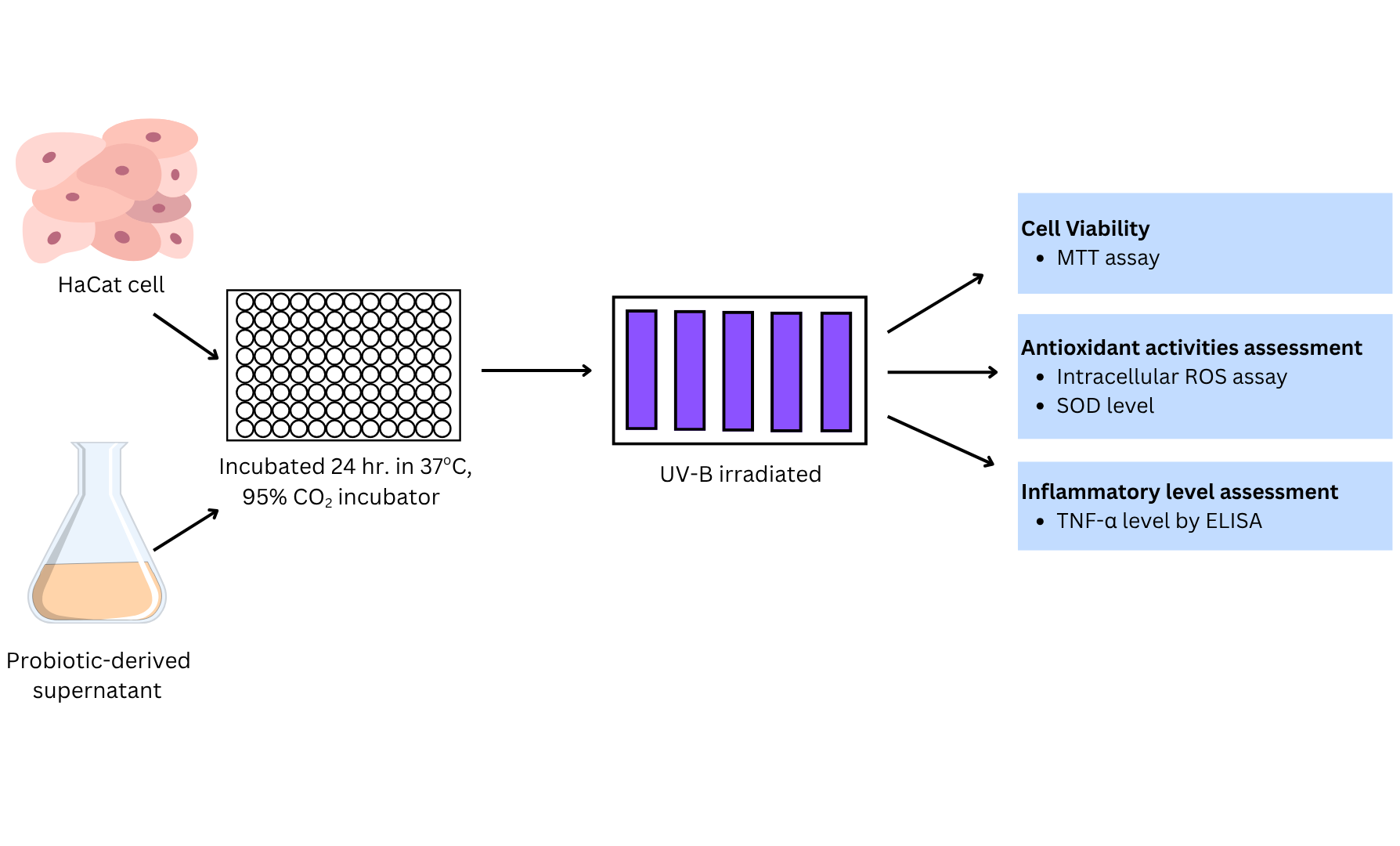
Downloads
References
G Brar, A Dhaliwal, AS Brar, M Sreedevi, Y Ahmadi and M Irfan. A comprehensive review of the role of UV radiation in photoaging processes between different types of skin. Cureus 2025; 17(3), e81109.
M Scollan and C Lauren. Photodermatoses: What’s new. Current Opinion in Pediatrics 2022; 34(4), 374-380.
KJ Gromkowska-Kępka, A Puścion-Jakubik, R Markiewicz-Żukowska and K Socha. The impact of ultraviolet radiation on skin photoaging - review of in vitro studies. Journal of Cosmetic Dermatology 2021; 20(11), 3427-3431.
Y Teng, Y Huang, X Danfeng, X Tao and Y Fan. The role of probiotics in skin photoaging and related mechanisms: A review. Clinical, Cosmetic and Investigational Dermatology 2022; 15, 2455-2464.
MJ Calvo, C Navarro, P Durán, NJ Galan-Freyle, LAP Hernández, LC Pacheco-Londoño, D Castelanich, V Bermúdez and M Chacin. Antioxidants in photoaging: From molecular insights to clinical applications. International Journal of Molecular Sciences 2024; 25(4), 2403.
MMANR Ranjha, B Shafique, M Batool, PŁ Kowalczewski, Q Shehzad, M Usman, MF Manzoor, SM Zahra, S Yaqub and RMA Aadil. Nutritional and health potential of probiotics: A review. Applied Sciences 2021; 11(23), 11204.
K Farahmandi, S Sulaimany and K Kalhor. Twenty years review of probiotic meta-analyses articles: Effects on disease prevention and treatment. medRxiv 2021. https://doi.org/10.1101/2021.08.23.21262411
H Sales-Campos, SC Soares and CJF Oliveira. An introduction of the role of probiotics in human infections and autoimmune diseases. Critical Reviews in Microbiology 2019; 45(4), 413-432.
S Sathikulpakdee, S Kanokrungsee, P Vitheejongjaroen, N Kamanamool, M Udompataikul and M Taweechotipatr. Efficacy of probiotic-derived lotion from Lactobacillus paracasei MSMC 39-1 in mild to moderate acne vulgaris, randomized controlled trial. Journal of Cosmetic Dermatology 2022; 21(10), 5092-5097.
S Salminen, MC Collado, A Endo, C Hill, S Lebeer, EMM Quigley, ME Sanders, R Shamir, JR Swann, H Szajewska and G Vinderola. The International Scientific Association of Probiotics and Prebiotics (ISAPP) consensus statement on the definition and scope of postbiotics. Nature Reviews Gastroenterology & Hepatology 2021; 18(9), 649-667.
N Kango and S Nath. Prebiotics, probiotics and postbiotics: The changing paradigm of functional foods. Journal of Dietary Supplements 2024; 21(5), 709-735.
CV De Almeida, E Antiga and M Lulli. Oral and topical probiotics and postbiotics in skincare and dermatological therapy: A concise review. Microorganisms 2023; 11(6), 1420.
JH Kim, WJ Lee, KY Choi, SH Yoo, SP Pack and NS Oh. Exopolysaccharide from Lacticaseibacillus rhamnosus IR06 as a potential postbiotics attenuates photoaging through regulation of MAPK and NF-κB signaling. Free Radical Biology and Medicine 2025; 241, 843-856.
BN Abdul Hakim, NJ Xuan and SN Oslan. A comprehensive review of bioactive compounds from lactic acid bacteria: Potential functions as functional food in dietetics and the food industry. Foods 2023; 12(15), 2850.
A Stec, M Sikora, M Maciejewska, K Paralusz-Stec, M Michalska, E Sikorska and L Rudnicka. Bacterial metabolites: A link between gut microbiota and dermatological diseases. International Journal of Molecular Sciences 2023; 24(4), 3494.
Y Su, Y Zhang, H Fu, F Yao, P Liu, Q Mo, D Wang, D Zhao, C Wang and M Li. Physicochemical and anti-UVB-induced skin inflammatory properties of Lacticaseibacillus paracasei subsp. paracasei SS-01 strain exopolysaccharide. Fermentation 2022; 8(5), 198.
N Puttarat, B Ladda, A Kasorn, S Tanasupawat and M Taweechotipatr. Cholesterol-lowering activity and functional characterization of lactic acid bacteria isolated from traditional Thai foods for their potential used as probiotics. Songklanakarin Journal of Science and Technology 2021; 43(5), 1283-1291.
C Chantarangkul, P Phuengmaung, A Leelahavanichkul, P Piewngam, M Otto and M Taweechotipatr. Lipid-lowering and antioxidant properties of probiotic Bifidobacterium animalis MSMC83 in rats on a high-fat diet. Beneficial Microbes 2024; 16(2), 237-252.
P Vitheejongjaroen, P Kanthawang, F Loison, Y Jaisin, U Pachekrepapol and M Taweechotipatr. Antioxidant activity of Bifidobacterium animalis MSMC83 and its application in set-style probiotic yoghurt. Food Bioscience 2021; 43, 101259.
S Banjonjit, M Taweechotipatr and S Rungsiyanont. Effect of probiotic Lactobacillus paracasei on tumor necrosis factor-alpha level in gingival crevicular fluid of patients undergoing impacted third molar removal. Journal of Oral Science 2022; 64(3), 185-189.
TT Yang and CE Lan. Photocarcinogenesis of the skin: Current status and future trends. Kaohsiung Journal of Medical Sciences 2025; 41(4), e12946.
W Zhu, H Ren, Y Liu, Z Li, X Luo, H Meng and Y Dong. Key targets and pathways in skin photoaging: A comprehensive review. Journal of Dermatologic Science and Cosmetic Technology 2025; 2(3), 100101.
A Guéniche, J Benyacoub, S Blum, L Breton and I Castiel. Probiotics and skin health. In: R Watson and S Zibadi (Eds.). Bioactive dietary factors and plant extracts in dermatology nutrition and health. Humana Press, New Jersey, United States, 2013, p. 49-58.
Y Ishii, S Sugimoto, N Izawa, T Sone, K Chiba and K Miyazaki. Oral administration of Bifidobacterium breve attenuates UV-induced barrier perturbation and oxidative stress in hairless mice skin. Archives of Dermatological Research 2014; 306(5), 467-473.
AR Im, B Lee, DJ Kang and S Chae. Protective effects of tyndallized Lactobacillus acidophilus IDCC 3302 against UVB induced photodamage to epidermal keratinocytes cells. International Journal of Molecular Medicine 2019; 43(6), 2499-2506.
S Şirin. Lactic acid bacteria-derived exopolysaccharides mitigate the oxidative response via the NRF2-KEAP1 pathway in PC12 cells. Current Issues in Molecular Biology 2023; 45(10), 8071-8090.
L Shao, J Huang, Y Li, L Ma, Y Niu, W Jiang, C Yuan, T Bai and S Yang. Antioxidant activities of the cell-free supernatant of a potential probiotic Cutibacterium acnes strain CCSM0331, isolated from a healthy skin. Journal of Cosmetic Dermatology 2025; 24(3), e70105.
S Peng, G Guo, S Wu and Z Duan. Isolation, characterization and anti-UVB irradiation activity of an extracellular polysaccharide produced by Lacticaseibacillus rhamnosus VHPriobi O17. Heliyon 2022; 8(10), e11125.
K Wang, M Niu, D Yao, J Zhao, Y Wu, B Lu and X Zheng. Physicochemical characteristics and in vitro and in vivo antioxidant activity of a cell-bound exopolysaccharide produced by Lactobacillus fermentum S1. International Journal of Biological Macromolecules 2019; 139, 252-261.
B Karaca, M Yilmaz and UK Gursoy. Targeting Nrf2 with probiotics and postbiotics in the treatment of periodontitis. Biomolecules 2022; 12(5), 729.
Downloads
Published
How to Cite
Issue
Section
License
Copyright (c) 2026 Walailak University

This work is licensed under a Creative Commons Attribution-NonCommercial-NoDerivatives 4.0 International License.