Purple Sweet Potato (Ipomoea batatas L.) Mitigates Overtraining-Induced Physiological Stress and Inflammation
DOI:
https://doi.org/10.48048/tis.2027.14249Keywords:
Oxidative stress, Cytokines, Antioxidant capacity, Exercise fatigue, Animal modelAbstract
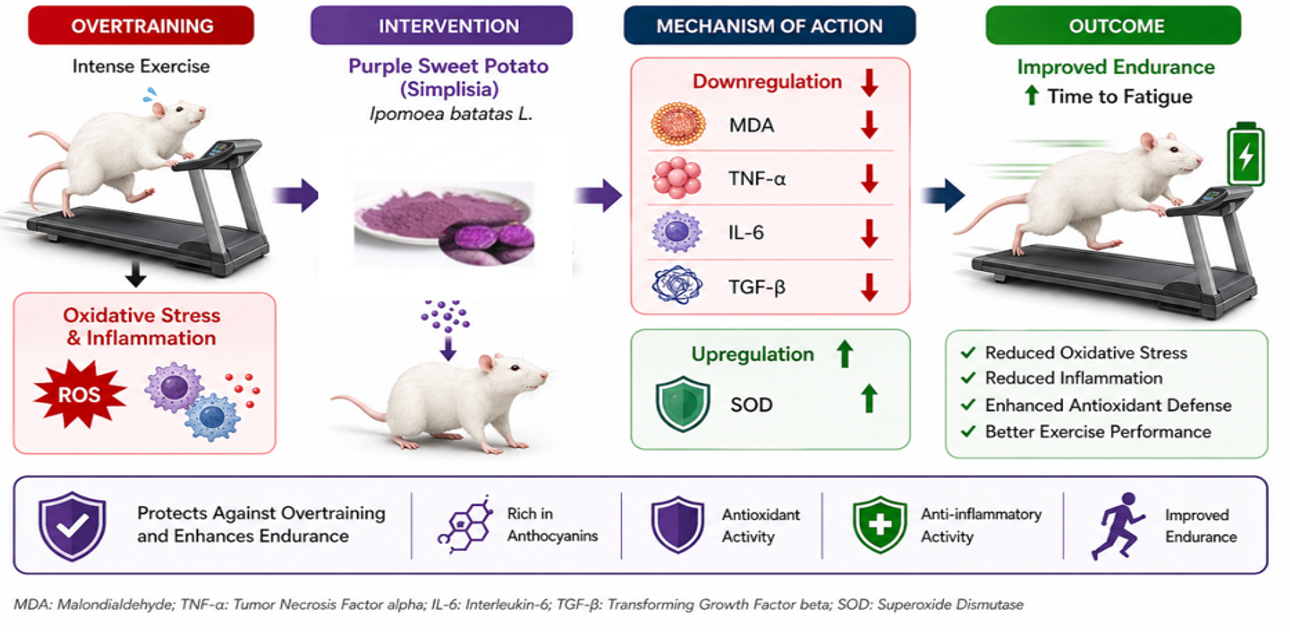
Repeated high-intensity physical exercise induces overtraining by generating excess reactive oxygen species (ROS) and activating systemic inflammatory pathways, leading to oxidative damage and impaired physical endurance. In this state, malondialdehyde (MDA) and proinflammatory cytokines such as interleukin-6 (IL-6), tumor necrosis factor alpha (TNF-α), and transforming growth factor beta (TGF-β) are elevated, while endogenous antioxidant defenses including superoxide dismutase (SOD) are suppressed. This study aimed to investigate the mechanisms underlying purple sweet potato (Ipomoea batatas L.) modulation of oxidative stress, inflammatory signaling, and fatigue resistance in an overtrained Wistar rat model. Using a true experimental, randomized controlled pre-test–post-test design conducted with ethical approval from the Research Ethics Committee of the Faculty of Medicine, Universitas Sebelas Maret (No. 14/UN27.06.11/KEP/EC/2025) and in accordance with ARRIVE 2.0 guidelines, 36 male Wistar rats (150 - 250 g) were assigned into 6 groups (n = 6): Normal control, negative control (overtraining only), positive control (vitamin C 1.6 mg/200 g/day), and three treatment groups receiving purple sweet potato at 100, 200, and 300 mg/kg body weight/day. After a 7-day acclimatization period, overtraining was induced on a treadmill (20 m/min, 30 min, 10° incline) for 5 weeks. Plasma levels of MDA, SOD, IL-6, TNF-α, and TGF-β were measured by enzyme-linked immunosorbent assay (ELISA), and fatigue time was assessed by a treadmill exhaustion test. Data were analyzed using paired-samples t-test and one-way ANOVA with Tukey’s post hoc test (p < 0.05). Purple sweet potato administration dose-dependently reduced MDA levels from 6.07 ± 0.24 to 3.02 ± 0.19 nmol/mL, IL-6 from 81.33 ± 5.27 to 61.66 ± 4.32 pg/mL, TNF-α from 14.30 ± 0.51 to 6.85 ± 0.29 pg/mL, and TGF-β from 13.29 ± 0.46 to 8.07 ± 0.38 pg/mL, while increasing SOD activity from 44.12 ± 3.83 to 71.32 ± 2.75 U/mL at the highest dose (300 mg/kg body weight). Fatigue time increased significantly from 32.14 ± 1.76 min (100 mg/kg body weight) to 45.19 ± 1.64 min (300 mg/kg body weight), approaching normal control values (48.89 ± 1.20 min). All changes were statistically significant (p < 0.05) and showed a clear dose-dependent trend. Mechanistically, purple sweet potato likely attenuates exercise-induced oxidative stress through the action of its bioactive anthocyanins and polyphenols, which scavenge ROS, enhance SOD-mediated dismutation of superoxide radicals, and upregulate endogenous antioxidant defenses. Concurrently, these compounds appear to suppress proinflammatory cytokine production by modulating key inflammatory pathways, including NF-κB and related cytokine signaling, thereby reducing systemic inflammation and protecting muscle and metabolic tissues. In conclusion, purple sweet potato supplementation mitigates oxidative stress and inflammation-related damage while improving antioxidant capacity and endurance in an overtrained rat model, supporting its potential as a natural, mechanism-based intervention for overtraining-related fatigue and inflammation.
HIGHLIGHTS
- Overtraining significantly increased oxidative stress and inflammatory biomarkers in Wistar rats.
- Purple sweet potato supplementation reduced MDA, TNF-α, IL-6, and TGF-β levels in a dose-dependent manner.
- Antioxidant defense was enhanced, as indicated by increased SOD activity following intervention.
- Anthocyanin-rich purple sweet potato modulates oxidative stress and inflammation via the ROS–NF-κB–Nrf2 pathway.
- Purple sweet potato shows potential as a natural intervention to improve resistance to overtraining-induced fatigue.
GRAPHICAL ABSTRACT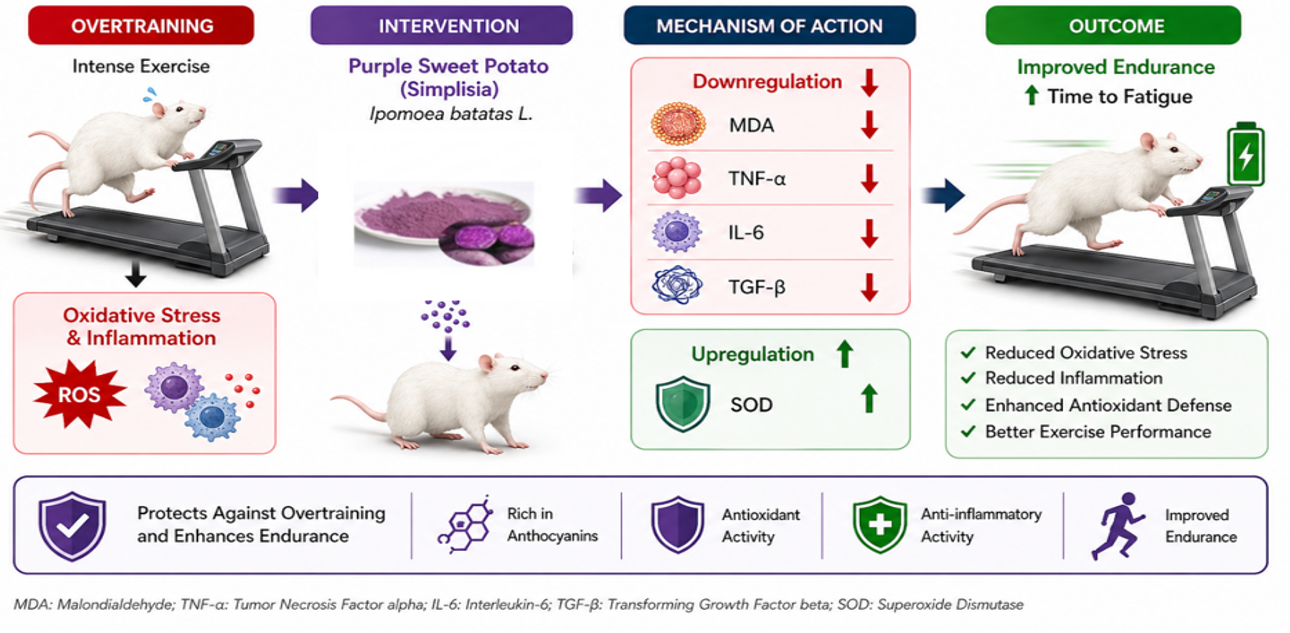
Downloads
References
R Meeusen, M Duclos, C Foster, A Fry, M Gleeson, D Nieman, J Raglin, G Rietjens, J Steinacker and A Urhausen. Prevention, diagnosis, and treatment of the overtraining syndrome: Joint consensus statement of the European College of Sport Science and the American College of Sports Medicine. Medicine & Science in Sports & Exercise 2023; 45(1), 186-205.
C Grandou, L Wallace, FM Impellizzeri, NG Allen and AJ Coutts. Overtraining in resistance exercise: An exploratory systematic review and methodological appraisal of the literature. Sports Medicine 2020; 50(4), 815-828.
A Nicolò, C Massaroni and L Passfield. Respiratory frequency during exercise: The neglected physiological measure. Frontiers in Physiology 2017; 8, 922.
DC Nieman and LM Wentz. The compelling link between physical activity and the body’s defense system. Journal of Sport and Health Science 2019; 8(3), 201-217.
SK Powers and MJ Jackson. Exercise-induced oxidative stress: Cellular mechanisms and impact on muscle force production. Physiological Reviews 2008; 88(4), 1243-1276.
B Halliwell and JMC Gutteridge. Free radicals in biology and medicine. Oxford University Press, London, 2015.
T Liu, L Zhang, D Joo and SC Sun. NF-κB signaling in inflammation. Signal Transduction and Targeted Therapy 2017; 2(1), 17023.
T Lawrence. The nuclear factor NF-κB pathway in inflammation. Cold Spring Harbor Perspectives in Biology 2009; 1(6), a001651.
J Scheiman, JM Luber, TA Chavkin, T MacDonald, A Tung, LD Pham, MC Wibowo, RC Wurth, S Punthambaker, BT Tierney, Z Yang, MW Hattab, J Avila-Pacheco, CB Clish, S Lessard, GM Church and AD Kostic. Meta-omics analysis of elite athletes identifies a performance-enhancing microbe that functions via lactate metabolism. Nature Medicine 2019; 25(7), 1104-1109.
VD Truong, N Deighton, RT Thompson, RF McFeeters, LO Dean, KV Pecota and GC Yencho. Characterization of anthocyanins and anthocyanidins in purple-fleshed sweetpotatoes by HPLC-DAD/ESI-MS/MS. Journal of Agricultural and Food Chemistry 2010; 58(1), 404-410.
HE Khoo, A Azlan, ST Tang and SM Lim. Anthocyanidins and anthocyanins: Colored pigments as food, pharmaceutical ingredients, and the potential health benefits. Food & Nutrition Research 2017; 61(1), 1361779.
A Syetiawinanda, M Doewes, B Purwanto, S Soetrisno, A Kristiyanto and EP Pamungkasari. The effects of overtraining protocol on markers of oxidative stress and inflammation. Physical Therapy Journal of Indonesia 2025; 6(2), 145-148.
R Zhao, R Wu, J Jin, K Ning, Z Wang, X Yi, L Kapilevich and J Liu. Signaling pathways regulated by natural active ingredients in the fight against exercise fatigue - A review. Frontiers in Pharmacology 2023; 14, 1269878.
AA Fallah, E Sarmast and T Jafari. Effect of dietary anthocyanins on biomarkers of oxidative stress and antioxidative capacity: A systematic review and meta-analysis of randomized controlled trials. Journal of Functional Foods 2020; 68, 103912.
X Ma, Z Jin, Z Rao and L Zheng. Health benefits of anthocyanins against age-related diseases. Frontiers in Nutrition 2025; 12, 1618072.
Y Lu, HD Wiltshire, JS Baker and Q Wang. Effects of high intensity exercise on oxidative stress and antioxidant status in untrained humans: A systematic review. Biology 2021; 10(12), 1272.
N Mohammadi, M Farrell, L O’Sullivan, A Langan, M Franchin, L Azevedo and D Granato. Effectiveness of anthocyanin-containing foods and nutraceuticals in mitigating oxidative stress, inflammation, and cardiovascular health-related biomarkers: A systematic review of animal and human interventions. Food & Function 2024; 15(7), 3274-3299.
M Godyla-Jabłoński, E Raczkowska, A Jodkowska, AZ Kucharska, T Sozański and M Bronkowska. Effects of anthocyanins on components of metabolic syndrome - A review. Nutrients 2024; 16(8), 1103.
R Jan, S Asif, S Asaf, Lubna, Z Khan and KM Kim. Unveiling the protective role of anthocyanin in rice: Insights into drought-induced oxidative stress and metabolic regulation. Frontiers in Plant Science 2024; 15, 1397817.
Y Liu, X Wang, NS Podio, X Wang, S Xu, S Jiang, X Wei, Y Han, Y Cai, X Chen, F Jin, X Li and ES Gong. Research progress on the regulation of oxidative stress by phenolics: The role of gut microbiota and Nrf2 signaling pathway. Journal of the Science of Food and Agriculture 2024; 104(4), 1861-1873.
D Wang, T Wang, Z Li, Y Guo and D Granato. Green tea polyphenols upregulate the Nrf2 signaling pathway and suppress oxidative stress and inflammation markers in D-galactose-induced liver aging in mice. Frontiers in Nutrition 2022; 9, 836112.
Q Meng and CH Su. The impact of physical exercise on oxidative and nitrosative stress: Balancing the benefits and risks. Antioxidants 2024; 13(5), 573.
SK Powers, R Lategan-Potgieter and E Goldstein. Exercise-induced Nrf2 activation increases antioxidant defenses in skeletal muscles. Free Radical Biology and Medicine 2024; 224, 470-478.
Y Xie, Y Gu, Z Li, L Zhang and Y Hei. Effects of exercise on different antioxidant enzymes and related indicators: A systematic review and meta-analysis of randomized controlled trials. Scientific Reports 2025; 15(1), 12518.
S Khotimah, M Doewes, R Reviono, B Wasita, B Purwanto, S Soetrisno, EP Pamungkasari and P Dirgahayu. Modulation of oxidative stress markers and inflammatory mediators in alveolar damage induced by anaerobic exercise. International Journal on Advanced Science, Engineering and Information Technology 2025; 15(1), 267-274.
A Gęgotek and E Skrzydlewska. Antioxidative and anti-inflammatory activity of ascorbic acid. Antioxidants 2022; 11(10), 1993.
J Verschueren, B Tassignon, KD Pauw, M Proost, A Teugels, J Van Cutsem, B Roelands, E Verhagen and R Meeusen. Does acute fatigue negatively affect intrinsic risk factors of the lower extremity injury risk profile? A systematic and critical review. Sports Medicine 2020; 50(4), 767-784.
Y Chung, YT Hsiao and WC Huang. Physiological and psychological effects of treadmill overtraining implementation. Biology 2021; 10(6), 515.
ÉDF dos Santos, YNV Sabino, EN Montenegro, CA Faria, TC de Almeida, J Gameiro and JC Machado. Antitumor, anti-inflammatory, and antioxidant activities of anthocyanins from food and isolated sources: Methodological insights and interactions with the intestinal microbiota. Journal of Functional Foods 2025; 134, 107026.
A Speciale, MS Molonia, C Muscarà, M Cristani, FL Salamone, A Saija and F Cimino. An overview on the cellular mechanisms of anthocyanins in maintaining intestinal integrity and function. Fitoterapia 2024; 175, 105953.
X Zhu, X Lin, P Zhang, Y Liu, W Ling and H Guo. Upregulated NLRP3 inflammasome activation is attenuated by anthocyanins in patients with nonalcoholic fatty liver disease: A case-control and an intervention study. Clinical and Research in Hepatology and Gastroenterology 2022; 46(4), 101843.
D Cai, Y Li, D Sun, Y Zhang, W Bai and X Li. Anthocyanin-mediated epigenetic modifications: A new perspective in health promoting and disease prevention. Journal of Advanced Research 2025; 85, 1099-1117.
V Chrysikopoulou, A Rampaouni, T Adamantidi, D Pantazi, A Ofrydopoulou and A Tsoupras. Beneficial synergistic roles of flavonoids and vitamin C against inflammatory complications, cancer, and cardiovascular diseases: A comprehensive review. Applied Sciences 2026; 16(4), 1838.
Z Zhao, Y Zhu and D Wan. Exercise and tissue fibrosis: Recent advances in therapeutic potential and molecular mechanisms. Frontiers in Endocrinology 2026; 16, 1557797.
A Ismaeel, JS Kim, JS Kirk, RS Smith, WT Bohannon and P Koutakis. Role of transforming growth factor-β in skeletal muscle fibrosis: A review. International Journal of Molecular Sciences 2019; 20(10), 2446.
Z Deng, T Fan, C Xiao, H Tian, Y Zheng, C Li and J He. TGF-β signaling in health, disease and therapeutics. Signal Transduction and Targeted Therapy 2024; 9(1), 61.
P Bharathy and PV Thanikachalam. Pharmacological relevance of anthocyanin derivative: A review. Pharmacological Research - Modern Chinese Medicine 2025; 14, 100565.
T Kowalczyk, M Muskała, A Merecz-Sadowska, J Sikora, L Picot and P Sitarek. Anti-inflammatory and anticancer effects of anthocyanins in in vitro and in vivo studies. Antioxidants 2024; 13(9), 1143.
AJ Cheng, B Jude and JT Lanner. Intramuscular mechanisms of overtraining. Redox Biology 2020; 35, 101480.
Z Ma, B Du, J Li, Y Yang and F Zhu. An insight into anti-inflammatory activities and inflammation related diseases of anthocyanins: A review of both in vivo and in vitro investigations. International Journal of Molecular Sciences 2021; 22(20), 11076.
N Vargas-Mendoza, M Angeles-Valencia, Á Morales-González, EO Madrigal-Santillán, M Morales-Martínez, E Madrigal-Bujaidar, I Álvarez-González, J Gutiérrez-Salinas, C Esquivel-Chirino and JA Morales-González. Oxidative stress, mitochondrial function and adaptation to exercise: New perspectives in nutrition. Life 2021; 11(11), 1269.
G Cao, J Zuo, B Wu and Y Wu. Polyphenol supplementation boosts aerobic endurance in athletes: A systematic review. Frontiers in Physiology 2024; 15, 1369174.
J Chen, J Ding, C Han, Q Liu, L Wang, W Ma, Z Liang and Y Li. Effects of different antioxidants on exercise-induced oxidative stress and muscle damage in athletes: A systematic review and meta-analysis. BMC Sports Science, Medicine and Rehabilitation 2025; 17(1), 328.
F Wang, X Wang, Y Liu and Z Zhang. Effects of exercise‐induced ROS on the pathophysiological functions of skeletal muscle. Oxidative Medicine and Cellular Longevity 2021; 2021, 3846122.
SK Powers, R Deminice, M Ozdemir, T Yoshihara, MP Bomkamp and H Hyatt. Exercise-induced oxidative stress: Friend or foe? Journal of Sport and Health Science 2020; 9(5), 415-425.
C Zhu, X Ding, M Chen, J Feng, J Zou and L Zhang. Exercise-mediated skeletal muscle-derived IL-6 regulates bone metabolism: A new perspective on muscle-bone crosstalk. Biomolecules 2025; 15(6), 893.
W Lin, H Song, J Shen, J Wang, Y Yang, Y Yang, J Cao, L Xue, F Zhao, T Xiao and R Lin. Functional role of skeletal muscle-derived interleukin-6 and its effects on lipid metabolism. Frontiers in Physiology 2023; 14, 1110926.
D Nash, MG Hughes, L Butcher, R Aicheler, P Smith, T Cullen and R Webb. IL‐6 signaling in acute exercise and chronic training: Potential consequences for health and athletic performance. Scandinavian Journal of Medicine & Science in Sports 2023; 33(1), 4-19.
Y Tamura, J Ishizaka, S Yokoyama, A Ochi, K Kishishita, R Nakajima, M Sakai, Y Zeng, A Okugawa, R Higuchi, T Fujisato, K Mizutani and T Nakamura. TNF-α-induced contractile dysfunction in three-dimensional engineered muscle. Journal of Bioscience and Bioengineering 2026; 141(4), 300-307.
FS Gallardo, M Cruz-Soca, A Bock-Pereda, J Faundez-Contreras, C Gutiérrez-Rojas, A Gandin, V Torresan, JC Casar, A Ravasio and E Brandan. Role of TGF-β/SMAD/YAP/TAZ signaling in skeletal muscle fibrosis. American Journal of Physiology - Cell Physiology 2025; 328(3), C1015-C1028.
X Fang, Y Yin, H Lun, S Su and S Zhu. Assessment of the effects of transforming growth factor beta1 (TGF-β1)-Smad2/3 on fibrosis in rat myofascial trigger points using point shear wave elastography. PeerJ 2023; 11, e16588.
D Liu, Y Ji, K Wang, Y Guo, H Wang, H Zhang, L Li, H Li, SW Cui and H Wang. Purple sweet potato anthocyanin extract regulates redox state related to gut microbiota homeostasis in obese mice. Journal of Food Science 2022; 87(5), 2133-2146.
S Wu, X Liao, Z Zhu, R Huang, M Chen, A Huang, J Zhang, Q Wu, J Wang and Y Ding. Antioxidant and anti-inflammation effects of dietary phytochemicals: The Nrf2/NF-κB signalling pathway and upstream factors of Nrf2. Phytochemistry 2022; 204, 113429.
Downloads
Published
How to Cite
Issue
Section
License
Copyright (c) 2026 Walailak University

This work is licensed under a Creative Commons Attribution-NonCommercial-NoDerivatives 4.0 International License.