
Novel Insights into Anti-proliferative Activity of Nepenthes mirabilis and Its Constituents on HeLa Cervical Cancer Cells
DOI:
https://doi.org/10.48048/tis.2027.14202Keywords:
Anticancer, Carnivorous plants, Cervical cancer cell, Nepenthes mirabilis, NepenthoneAbstract
Nepenthes mirabilis, a carnivorous plant species predominantly distributed across tropical regions, has long been utilized in ethnomedicine to treat various ailments. However, mechanistic evidence regarding its anticancer activity, particularly against cervical cancer cells, remains limited. This study sought to evaluate the anti-proliferative effects of N. mirabilis methanol extract and its isolated constituent against HeLa cervical cancer cells. The methanol extract showed cytotoxicity against HeLa cells (IC50, 59.33 µg/mL) and a lesser effect on HEK293 cells, resulting in a selectivity index of 3.82. Additionally, the extract impaired clonogenic survival and cell migration, correlating with intracellular ROS accumulation and decreased mRNA expression of Akt and Bcl-2. Bioactivity-guided isolation identified 4 constituents, namely nepenthone C, gallic acid, quercetin, and daucosterol, whereas gallic acid and daucosterol were first reported in this species. Among them, nepenthone C showed the greatest selectivity toward HeLa cells compared with HEK293 cells (IC50, 43.54 µM; SI, 6.44). Mechanistically, nepenthone C induced apoptosis, as evidenced by increased Annexin V-positive apoptotic cell populations, enhanced cleaved caspase-3 activation, reduced Bcl-2 expression, and an elevated Bax/Bcl-2 ratio. The partial rescue effect observed with N-acetyl-L-cysteine (NAC) further suggests that ROS accumulation contributes to nepenthone C-mediated apoptosis, at least partially upstream. Taken together, these findings identify nepenthone C as the major bioactive ingredient responsible for the anti-proliferative activity of N. mirabilis and provide initial mechanistic evidence that this natural napthoquinone scaffold promotes ROS-associated mitochondrial apoptosis. This study illustrates that nepenthone C should be considered as a promising candidate for further research into its potential as an anti-cervical cancer agent.
HIGHLIGHTS
- This study provides the first mechanistic evidence linking the anti-proliferative activity of Nepenthes mirabilis against HeLa cervical cancer cells to a defined bioactive constituent.
- Bioactivity-guided isolation identified nepenthone C as the most active isolated compound from mirabilis in the HeLa cell model.
- Nepenthone C exhibited selectivity toward HeLa cells compared with HEK293 cells and induced apoptosis, at least in part, through ROS-associated mitochondrial signaling.
- Mechanistic validation was supported by ROS assessment, NAC partial rescue, Annexin V/PI flow cytometry, and apoptosis-related protein analysis.
- These findings position nepenthone C as a promising natural naphthoquinone scaffold for further mechanistic validation and investigation of its anti-cervical cancer activity.
GRAPHICAL ABSTRACT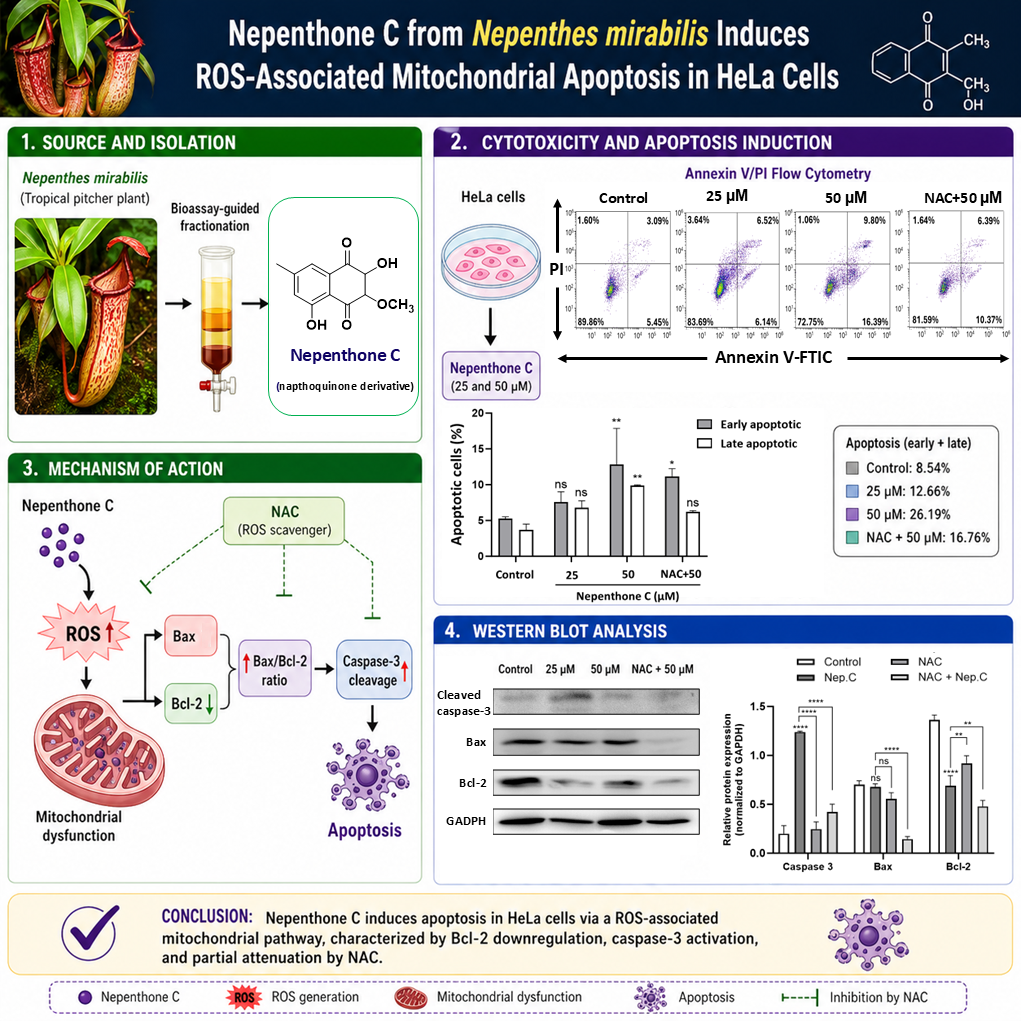
Downloads
References
NP Thao, BTT Luyen, JE Koo, S Kim, YS Koh, NV Thanh, NX Cuong, PV Kiem, CV Minh and YH Kim. In vitro anti-inflammatory components isolated from the carnivorous plant Nepenthes mirabilis (Lour.) Rafarin. Pharmaceutical Biology 2016; 54(4), 588-594.
A Mithöfer. Carnivorous plants and their biotic interactions. Journal of Plant Interactions 2022; 17(1), 333-343.
MAF Rosli, KA Azizan and HH Goh. Antioxidant activity of pitcher extracts from 3 Nepenthes species. Sains Malaysiana 2018; 47(12), 3069-3075.
MAF Rosli, A Mediani, KA Azizan, SN Baharum and HH Goh. UPLC-TOF-MS/MS-based metabolomics analysis reveals species-specific metabolite compositions in pitchers of Nepenthes ampullaria, Nepenthes rafflesiana, and their hybrid Nepenthes × hookeriana. Frontiers in Plant Science 2021; 12, 655004.
NV Quy, LV Cuong, NV Hop, PT Ha and NH Hai. Interspecific association of dominant tree species in an evergreen broadleaved forest in Phu Quoc National Park, Vietnam. Journal of Forestry Science and Technology 2023; 8(2), 87-96.
DT Nguyen. Exploring the diversity of leaf beetles (Coleoptera:Chrysomelidae) on the islands of Vietnam: A survey of Phu Quoc Island, South of Vietnam. International Journal of Tropical Insect Science 2022; 42(5), 3525-3539.
KM Lai, YH Huang, Y Lien and CY Huang. Bioactive potential of Nepenthes miranda flower extracts: Antidiabetic, anti-skin aging, cytotoxic, and dihydroorotase-inhibitory activities. Plants 2025; 14(16), 2579.
NV Thanh, NP Thao, PTT Huong, SH Lee, HD Jang, NX Cuong, PV Kiem, YH Kim and CV Minh. Naphthoquinone and flavonoid constituents from the carnivorous plant Nepenthes mirabilis and their anti-osteoporotic and antioxidant activities. Phytochemistry Letters 2015; 11, 254-259.
A Bhattacharya, AK Verma, S Rao, SG Momin, P Radhakrishnanand and P Sarkar. Unlocking the phytochemicals in unopened pitcher fluids of Nepenthes khasiana–a GC-MS study. Intelligent Pharmacy 2024; 2(2), 284-290.
TT Hong, VT Khang, NT Tuan and TQC Nguyen. Bioactivity-guided identification of constituents responsible for the anti-oxidative stress effects of Nepenthes mirabilis. Records of Natural Products 2026; 20(5), e26043785.
NQC Thanh, TG Tue, TTD Huynh, VN Thanh, NH Khiem, VT Khang and TT Hong. Study on investigation of the anti-cancer activity of Nepenthes mirabilis extract on various human cancer cell line. Can Tho University Journal of Science 2025; 61(3), 99-107.
SW Kamau, M Jepkorir, G Kipkoech, IJL Lagu, W Kanda, S Kibunja, R Letoluo, S Barmasai, A Wanyoko, V Ruttoh, J Kuria, PG Mwitari, MP Ngugi and SN Nijeru. Antiproliferative activity of Grewia villosa ethyl acetate extract on cervical cancer HeLa cell line: Mechanistic insights through network pharmacology and functional assays approach. PLoS One 2025; 20(9), e0331649.
WH Talib, I Alsalahat, S Daoud, RF Abutayeh and AI Mahmod. Plant-derived natural products in cancer research: Extraction, mechanism of action, and drug formulation. Molecules 2020; 25(22), 5319.
OO Olaleye, DH Kim and KA Spriggs. Antiproliferative activities of some selected Nigerian medicinal plants against breast, liver, and cervical cancer cells. BMC Complementary Medicine and Therapies 2024; 24(1), 1-15.
E Bahar and H Yoon. Modeling and predicting the cell migration properties from scratch wound healing assay on cisplatin-resistant ovarian cancer cell lines using artificial neural network. Healthcare 2021; 9(7), 911.
TQC Nguyen, TT Hong, VT Khang, YH Thi Nhu, DT Pham, DH Giao, TTT Tu and K Kamei. Anti-inflammatory constituents isolated from Launaea sarmentosa against infection by LPS-stimulated macrophages. Records of Natural Products 2024; 18(6), 663-673.
TQC Nguyen, YDH Nguyen, TD Binh, TLA Pham, K Kanaori, K Kamei, DTX Trang and TT Nguyen. Anti-inflammatory effects of Lasia spinosa leaf extract in lipopolysaccharide-induced RAW 264.7 macrophages. International Journal of Molecular Sciences 2020; 21(10), 1-18.
G Prinsloo and N Nogemane. The effects of season and water availability on chemical composition, secondary metabolites and biological activity in plants. Phytochemistry Reviews 2018; 17(4), 889-902.
MR Luna-Samano, C Martínez-Peralta, AG Trejo-Loyo and RE Alcalá. Ecological interactions of carnivorous plants: Beyond the relationship with their prey. Arthropod-Plant Interactions 2024; 18(2), 193-204.
GE Villalpando-Rodriguez and SB Gibson. Reactive oxygen species (ROS) regulates different types of cell death by acting as a rheostat. Oxidative Medicine and Cellular Longevity 2021; 2021, 9912436.
A Ray, S Jena, B Dash, A Sahoo, B Kar, J Patnaik, PC Panda, S Nayak and N Mahapatra. Hedychium coronarium extract arrests cell cycle progression, induces apoptosis, and impairs migration and invasion in HeLa cervical cancer cells. Cancer Management and Research 2019; 11, 483-500.
S Guo, NI Burcus, M Scott, Y Jing and I Semenov. The role of reactive oxygen species in the immunity induced by nano-pulse stimulation. Scientific Reports 2021; 11(1), 1-13.
L Wang, Y Xu, X Zhao, X Zhu, X He, A Sun and G Zhuang. Antagonistic effects of N-acetylcysteine on lead-induced apoptosis and oxidative stress in chicken embryo fibroblast cells. Heliyon 2023; 9(11), e21847.
X Lin, Y Fang, X Mi, J Fu, S Chen, M Wu and N Jin. Asiatic acid inhibits cervical cancer cell proliferation and migration via PI3K/AKT/mTOR signaling pathway. Heliyon 2024; 10(13), e34047.
G Ma, Q Dong, F Li, Z Jin, J Pi, W Wu and J Li. Network pharmacology and in vivo evidence of the pharmacological mechanism of geniposide in the treatment of atherosclerosis. BMC Complementary Medicine and Therapies 2024; 24(1), 53.
IJL Lagu, DW Nyamai and SN Njeru. Phytochemical analysis, in-vitro and in-silico study of antiproliferative activity of ethyl acetate fraction of Launaea cornuta (Hochst. ex Oliv. & Hiern) C. Jeffrey against human cervical cancer cell line. Frontiers in Pharmacology 2024; 15, 1399885.
G Leisching, B Loos, M Botha and AM Engelbrecht. Bcl-2 confers survival in cisplatin treated cervical cancer cells: Circumventing cisplatin dose-dependent toxicity and resistance. Journal of Translational Medicine 2015; 13(1), 328.
F Alharbi, E Almanifi and M Ashrafuzzaman. Targeting BCL-2 family proteins using BH3 mimetic drugs for cancer therapy: A systematic review of randomized clinical trials. Medicine in Drug Discovery 2024; 24, 100199.
IM Adebisi, BC Gomo, A Usman, CJ Ugwah-Oguejiofor, AM Ramadan, TR Giaze, A Hamidu, JY Oyaniyi, M Umar, T Oduola, A Samaila and I Malami. Evaluation of anti-cervical cancer potential of Caralluma dalzielii: An in vitro approach. Pharmacological Research - Natural Products 2025; 9, 100420.
M Kostić, M Ivanov, T Markovic, SS Babić, L Barros, R Calhelha, M Sokovic and A Ciric. An in vitro study of the Origanum minutiflorum O. Schwarz & P. H. Davis and Coriandrum sativum L. essential oils as chronic tonsillitis therapeutics: Antibacterial, antibiofilm, antioxidant, and cytotoxic activities. Journal of Essential Oil Research 2022; 34(6), 533-543.
BR You, HJ Moon, YH Han and WH Park. Gallic acid inhibits the growth of HeLa cervical cancer cells via apoptosis and/or necrosis. Food and Chemical Toxicology 2010; 48(5), 1334-1340.
H Abdullah, I Ismail, R Suppian and NM Zakaria. Natural gallic acid and methyl gallate induces apoptosis in HeLa cells through regulation of intrinsic and extrinsic protein expression. International Journal of Molecular Sciences 2023; 24(10), 8495.
U Sarı, F Zaman, İ Özdemir, Ş Öztürk and MC Tuncer. Galic acid induces HeLa cell lines apoptosis via the P53/Bax signaling pathway. Biomedicines 2024; 12(11), 2632.
WH Park. Gallic acid induces HeLa cell death via increasing GSH depletion rather than ROS levels. Oncology Reports 2017; 37(2), 1277-1283.
BR You, SZ Kim, SH Kim and WH Park. Gallic acid-induced lung cancer cell death is accompanied by ROS increase and glutathione depletion. Molecular and Cellular Biochemistry 2011; 357(1-2), 295-303.
MM Quradha, R Khan, A Adhikari, A Rauf, U Rashid, S Bawazeer, YS Al-Awthan, O Bahattab and MS Mubarak. Isolation, biological evaluation, and molecular docking studies of compounds from Sophora mollis (Royle) Graham ex Baker. ACS Omega 2021; 6(24), 15911-15919.
AF Clemente-Soto, E Salas-Vidal, C Milan-Pacheco, JN Sánchez-Carranza, O Peralta-Zaragoza and L González-Maya. Quercetin induces G2 phase arrest and apoptosis with the activation of p53 in an E6 expression-independent manner in HPV-positive human cervical cancer-derived cells. Molecular Medicine Reports 2019; 19(3), 2097-2106.
K Herni, A Subarnas, A Diantini and Y Iskandar. Cytotoxicity of quercetin and quercetin-3-O-rhamnoside of Etlingera elatior (Jack) R.M.Sm. leaves against HeLa cervical cancer cells. Journal of Applied Pharmaceutical Science 2021; 11(5), 085-090.
RV Priyadarsini, RS Murugan, S Maitreyi, K Ramalingam, D Karunagaran and S Nagini. The flavonoid quercetin induces cell cycle arrest and mitochondria-mediated apoptosis in human cervical cancer (HeLa) cells through p53 induction and NF-κB inhibition. European Journal of Pharmacology 2010; 649(1-3), 84-91.
T Xiang, Y Fang and SX Wang. Quercetin suppresses HeLa cells by blocking PI3K/Akt pathway. Journal of Huazhong University of Science and Technology 2014; 34(5), 740-744.
Y Huang, G Li, C Hong, X Zheng, H Yu and Y Zhang. Potential of steroidal alkaloids in cancer: Perspective insight into structure-activity relationships. Frontiers in Oncology 2021; 11, 733369.
MM Rahman, MR Islam, S Akash, S Shohag, L Ahmed, FA Supti, A Rauf, ASM Aljohani, WA Abdulmonem, AA Khalil, R Sharma and M Thiruvengadam. Naphthoquinones and derivatives as potential anticancer agents: An updated review. Chemico-Biological Interactions 2022; 368, 110198.
TG Son, S Camandola, TV Arumugam, RG Cutler, RS Telljohann, MR Mughal, TA Moore, W Luo, QS Yu, DA Johnson, JA Johnson, NH Greig and MP Mattson. Plumbagin, a novel Nrf2/ARE activator, protects against cerebral ischemia. Journal of Neurochemistry 2010; 112(5), 1316-1326.
YB Ji, ZY Qu and X Zou. Juglone-induced apoptosis in human gastric cancer SGC-7901 cells via the mitochondrial pathway. Experimental and Toxicologic Pathology 2011; 63(1-2), 69-78.
CE Pereyra, RF Dantas, SB Ferreira, LP Gomes and FP Silva. The diverse mechanisms and anticancer potential of naphthoquinones. Cancer Cell International 2019; 19(1), 207.
G Navarro-Tovar, S Vega-Rodríguez, E Leyva, S Loredo-Carrillo, D de Loera and LI López-López. The relevance and insights on 1,4-naphthoquinones as antimicrobial and antitumoral molecules: A systematic review. Pharmaceuticals 2023; 16(4), 496.
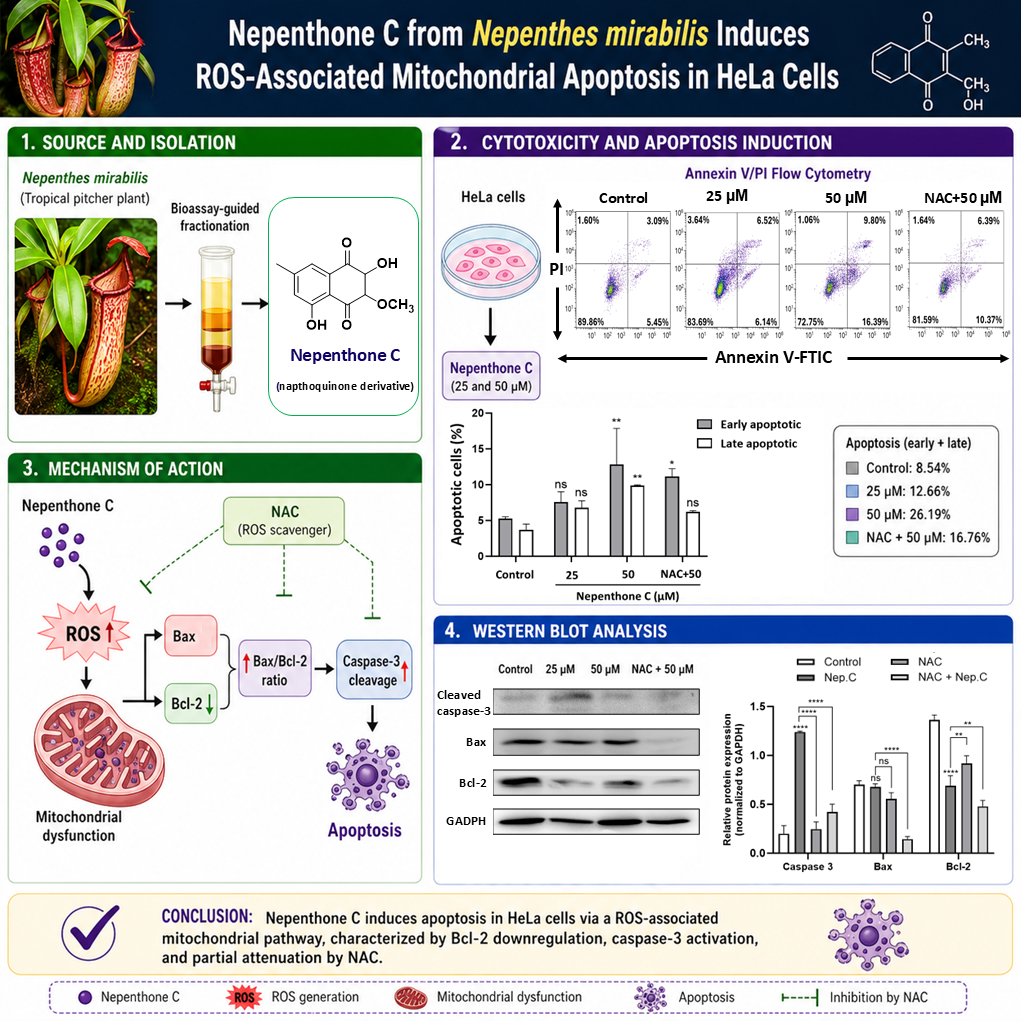
Downloads
Published
How to Cite
Issue
Section
License
Copyright (c) 2026 Walailak University

This work is licensed under a Creative Commons Attribution-NonCommercial-NoDerivatives 4.0 International License.