Antihypercholesterolemic Activity of Flavonoid Compounds from Sea Apple Leaves (Syzygium grande L.) through HMG-CoA Reductase Inhibition
DOI:
https://doi.org/10.48048/tis.2027.14200Keywords:
HMGCR, Inhibitor, Antihypercholesterolemia, Syzygium grande, Luteolin, Rutin, Myricetin, HMGCR, Inhibitor, Antihypercholesterolemia, Syzygium grande, Luteolin, Rutin, MyricetinAbstract
Hypercholesterolemia is a lipid disorder in which total cholesterol levels in the body exceed 200 mg/dL. This condition can lead to atherosclerosis and cardiovascular diseases. A common drug to treat this condition is statin, but it is associated with adverse side effects such as nausea, muscle pain, and abnormal liver function. Thus, alternative medicine using natural products from plants was needed as they have been recognized as medicinal agents, due to their safety and effectiveness. This study aims to examine the potency of a coastal plant, Syzygium grande L., to lower cholesterol levels by inhibiting HMG-CoA (3-hydroxyl-3-methylglutaryl coenzyme A) reductase (HMGCR) activity. The methanol extract of S. grande leaves (SGLM) was assessed for HMGCR inhibition activity in vitro. The extracts significantly reduced HMGCR activity. The presence of SGLM as inhibitor gave a strong inhibitory effect (0.1105 Units/mgP at 200 mg/mL) towards HMGCR enzyme activity (0.1933 Units/mgP at 200 mg/mL, p < 0.05). Interestingly, the HMGCR inhibitory effect of SGLM extracts was not significantly different (p > 0.05) compared to atorvastatin drug, indicating that the S. grande L. could be an alternative antihypercholesterolemia agent via the same mechanism as atorvastatin. Additionally, S. grande leaves were isolated to get the bioactive compounds. Molecular docking studies were carried out to understand the interaction between isolated compounds: myricetin, rutin, and luteolin, to HMGCR. The molecular docking analysis showed strong binding affinities between the HMGCR enzyme and luteolin, rutin, and myricetin with values of −9.0, −9.6, and −8.5 kcal/mol, respectively, which suggest a strong compound-protein interaction that might contribute in inhibiting HMGCR enzyme activity. These compounds also bind to a similar catalytic site of HMGCR enzyme for atorvastatin. These findings suggest that extracts from S. grande can potentially lower cholesterol production by inhibiting HMGCR, hence highlighting their usefulness as natural agents for managing cholesterol levels.
HIGHLIGHTS
- Syzygium grande leaves as an alternative HMG-CoA reductase inhibitor.
- Flavonoid compounds (luteolin, rutin, and myricetin) were successfully isolated from grande leaves.
- Luteolin, rutin, and myricetin had strong binding affinities with HMG-CoA reductase (HMGCR), suggesting a strong compound-protein interaction that might alter HMGCR activity.
GRAPHICAL ABSTRACT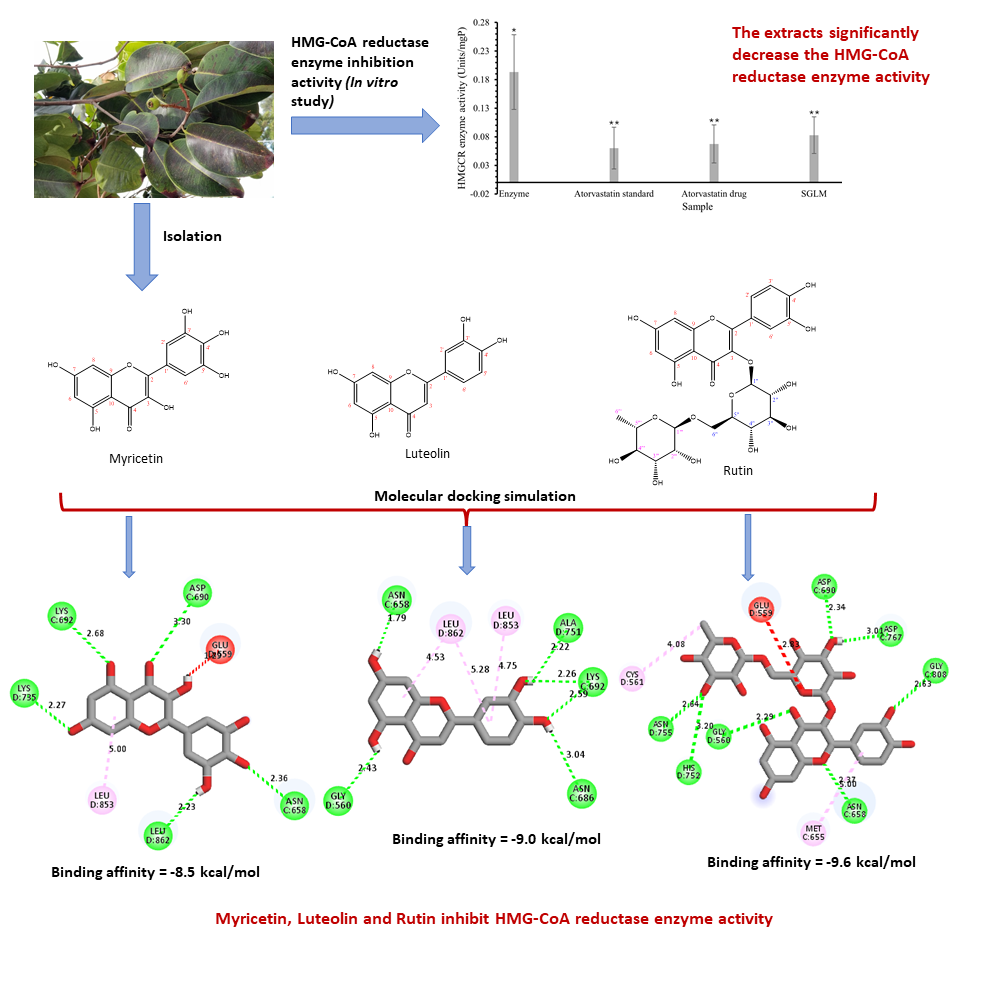
Downloads
References
Institute for Quality and Efficiency in Health Care. High cholesterol: Overview. National Library of Medicine, Maryland, United States, 2017.
M Spacek, D Zemanek, M Hutyra, M Sluka and M Taborsky. Vulnerable atherosclerotic plaque - a review of current concepts and advanced imaging. Biomedical Papers 2018; 162(1), 10-17.
JK Aronson. HMG coenzyme-A reductase inhibitors. In: JK Aronson (Ed.). Meyler’s side effects of drugs (16th). Elsevier, Amsterdam, Netherlands, 2016, p. 763-780.
SY Jiang, H Li, JJ Tang, J Wang, J Luo, B Liu, JK Wang, XJ Shi, HW Cui, J Tang, F Yang, W Qi, WW Qiu and BL Song. Discovery of a potent HMG-CoA reductase degrader that eliminates statin-induced reductase accumulation and lowers cholesterol. Nature Communications 2018; 9(1), 5138.
I Pangestika, E Oksal, TST Muhammad, H Amir, DF Syamsumir, MEA Wahid and Y Andriani. Inhibitory effects of tangeretin and trans-ethyl caffeate on the HMG-CoA reductase activity: Potential agents for reducing cholesterol levels. Saudi Journal Bioogical Science 2020; 27(8), 1947-1960
H Zeng and Z Liu. Atorvastatin induces hepatotoxicity in diabetic rats via oxidative stress, inflammation, and anti-apoptotic pathway. Medical Science Monitor 2019; 25, 6165-6173.
CM Uritu, CT Mihai, GD Stanciu, G Dodi, TA Stratulat, A Luca, MML Constantin, R Stefanescu, V Bild, S Melnic and BI Tamba. Medicinal plants of the family lamiaceae in pain therapy: A review. Pain Research and Management 2018; 2018(1), 7801543.
A Shang, R Gan, X Xu, Q Mao, P Zhang and HBL Li. Effects and mechanisms of edible and medicinal plants on obesity : an updated review. Critical Reviews in Food Science and Nutrition 2020; 61(12), 2061-2077.
JA Burt and A Bartholomew. Towards more sustainable coastal development in the Arabian Gulf: Opportunities for ecological engineering in an urbanized seascape. Marine Pollution Bulletin 2019; 142, 93-102.
R Govaerts. World checklist of myrtaceae. Kew Publishing, London, 2008.
KB Abdusalam, LS Yee, A Mediani, MT Akhtar, N Buzgaia, Y Rukayadi, IS Ismail and K Shaari. 1h nmr-based metabolomics profiling of Syzygium grande and Oenanthe javanica and relationship between their metabolite compositions and antimicrobial activity against Bacillus species. Records of Natural Products 2022; 16(2), 128-143.
R Sarvesan, P Eganathan, J Saranya and P Sujanapal. Chemical composition and antimicrobial activity of leaf essential oil of Syzygium grande (Wight) Walp. Journal of Essential Oil-Bearing Plants 2015; 18(3), 642-646.
S Jothiramshekar, P Eganathan and S Puthiyapurayil. Antioxidant activity of the leaf essential oil of Syzygium calophyllifolium, Syzygium makul, Syzygium grande and Eugenia cotinifolia ssp. codyensis. Journal of Biologically Active Products from Nature 2014; 4(1), 12-18.
W hanifah, Y Andriani, AM Zin, D Ryandini, FAA Majid, B Subhan and TST Muhammad. Selected coastal plants as potential treatment for pneumonia disease: Determination of their phytochemicals and antibacterial activity against some pneumonia bacteria. Oriental Journal of Chemistry 2023; 39(6), 1479-1494.
SV Kumar, JD Kingsley, S Dharani, N Narayanan and SM Thejan. Floristic analysis of medicinal plants from the Sholas of Nilgiris, Tamil Nadu, India. Journal of Drug Delivery and Therapeutics 2022; 12(6), 16-21.
WY Lim, EWC Chan, CW Phan and CW Wong. Tyrosinase inhibiting extracts from coastal plants as potential additives in skin whitening formulations. Current Journal of Applied Science and Technology 2021; 21(3), 481-494.
MN Samy, S Sugimoto, K Matsunami, H Otsuka and MS Kamel. One new flavonoid xyloside and one new natural triterpene rhamnoside from the leaves of Syzygium grande. Phytochemistry Letters 2014; 10(1), 86-90.
M Koren-Gluzer, M Rosenblat and T Hayek. Paraoxonase 2 induces a phenotypic switch in macrophage polarization favoring an M2 anti-inflammatory state. International Journal of Endocrinology 2015; 2015(1), 915243.
LM Hulten, C Ullstrom, A Krettek, DV Reyk, SL Marklund, C Dahlgren and O Wiklund. Human macrophages limit oxidation products in low density lipoprotein. Lipids in Health and Disease 2005; 4(6), 6.
J DeFuria, G Bennett, KJ Strissel, JW Perfield II, PE Milbury, AS Greenberg and MS Obin. Dietary blueberry attenuates whole-body insulin resistance in high fat-fed mice by reducing adipocyte death and its inflammatory sequelae. The Journal of Nutrition 2009; 139(8), 1510-1516.
Y Andriani, W Hanifah, AH Kholieqoh, FAA Majid, H Hermansyah, H Amir and TST Muhammad. Antibacterial activity of hexane and methanol fractions of some selected plants against Klebsiela pneumoniae. Journal of Advanced Pharmaceutical Technology & Research 2023; 14(3), 220-225.
S Tang, R Chen, M Lin, Q Lin, Y Zhu, J Ding, H Hu, M Ling and J Wu. Accelerating AutoDock Vina with GPUs. Molecules 2022; 27(9), 3041.
O Trott and AJ Olson. AutoDock Vina: Improving the speed and accuracy of docking with a new scoring function, efficient optimization, and multithreading. Journal of Computational Chemistry 2010; 31(2), 455-461.
BL Jejurikar and SH Rohane. Drug designing in discovery studio. Asian Journal of Research in Chemistry 2021; 14(2), 135-138.
S Akash, A Kumer, MM Rahman, TB Emran, R Sharma, RK Singla, FA Alhumayadhi, MU Khandaker, MN Park, AM Idris, P Wilairatana and B Kim. Development of new bioactive molecules to treat breast and lung cancer with natural myricetin and its derivatives: A computational and SAR approach. Frontiers in Cellular and Infection Microbiology 2022; 12, 952297.
X Cao, B He, F Liu, Y Zhang, L Xing, N Zhang, Y Zhou, C Gong and W Xue. Design, synthesis and bioactivity of myricetin derivatives for control of fungal disease and tobacco mosaic virus disease. RSC Advances 2023; 13(10), 6459-6465.
J Qian, J Zhang, Y Chen, C Dai, J Fan and H Guo. Hypoglycemic activity and mechanisms of myricetin. Natural Product Research 2022; 36(23), 6177-6180.
S Caporali, AD Stefano, C Calabrese, A Giovannelli, M Pieri, I Savini, M Tesauro, S Bernardini, M Minieri and A Terrinoni. Anti-inflammatory and active biological properties of the plant-derived bioactive compounds luteolin and luteolin 7-glucoside. Nutrients 2022; 14(6), 1155.
FM Djeujo, V Stablum, E Pangrazzi, E Ragazzi and G Froldi. Luteolin and vernodalol as bioactive compounds of leaf and root Vernonia amygdalina extracts: Effects on α-glucosidase, glycation, ROS, cell viability, and in silico ADMET parameters. Pharmaceutics 2023; 15(5), 1541.
BM Popović, D Uka, O Alioui, RZ Pavlović and Y Benguerba. Experimental and COSMO-RS theoretical exploration of rutin formulations in natural deep eutectic solvents: Solubility, stability, antioxidant activity, and bioaccessibility. Journal of Molecular Liquids 2022; 359, 119266.
YH Yeh, CT Kuo, GJ Chang, YH Chen, YJ Lai, ML Cheng and WJ Chen. Rosuvastatin suppresses atrial tachycardia-induced cellular remodeling via Akt/Nrf2/heme oxygenase-1 pathway. Journal of Molecular and Cellular Cardiology 2015; 82, 84-92.
A Mansouri, Z Reiner, M Ruscica, ET Reiner, S Radbakhsh, MB Ekta and A Sahebkar. Antioxidant effects of statins by modulating Nrf2 and Nrf2/HO-1 signaling in different diseases. Journal of Clinical Medicine 2022; 11(5), 1313.
AH Kholieqoh, MNI Kassim, TST Muhammad, K Anam, YY Sung, H Amir, HN Praja and Y Andriani. SNEDDS to improve the bioactivities of Pandanus tectorius leaves: Optimization, antioxidant, and anticancer activities via apoptosis induction in human cervical cancer cell line. Journal of Applied Pharmaceutical Science 2024; 14(10), 175-189.
M Batty, MR Bennett and E Yu. The role of oxidative stress in atherosclerosis. Cells 2022; 11(23), 3843.
A Popolo, G Autore, A Pinto and S Marzocco. Oxidative stress in patients with cardiovascular disease and chronic renal failure. Free Radical Research 2013; 47(5), 346-356.
F Ito, Y Sono and T Ito. Measurement and clinical significance of lipid peroxidation as a biomarker of oxidative stress: Oxidative stress in diabetes, atherosclerosis, and chronic inflammation. Antioxidants 2019; 8(3), 72.
J Bore, MJ Chapman, RM Krauss, CJ Packard, JF Bentzon, CJ Binder, MJ Daeman, LL Demer, RA Hegele, SJ Nicholls, BG Nordestgaard, GF Watts, E Bruckert, S Fazio, BA Ference, A Graham, JD Horton, U Landmesser, U Laufs, …, HN Ginsberg. Low-density lipoproteins cause atherosclerotic cardiovascular disease: Pathophysiological, genetic, and therapeutic insights: A consensus statement from the European Atherosclerosis Society Consensus Panel. European Heart Journal 2020; 41(24), 2313-2330.
P Riyad, A Purohit, K Sen, A Panwar and H Ram. HMG-CoA reductase inhibition mediated hypocholesterolemic potential of myricetin and quercetin: In-silico and in-vivo studies. CYTA - Journal of Food 2023; 21(1), 115-125.
A Alaofi, E Farokhi, VD Prasasty, A Anbanandam, K Kuczera and TG Siahaan. Probing the interaction between cHAVc3 peptide and the EC1 domain of E-cadherin using NMR and molecular dynamics simulations. Journal of Biomolecular Structure & Dynamics 2017; 35(1), 92-104.
R Huo, Wuhanqimuge, M Zhang, M Sun and Y Miao. Molecular dynamics modeling of different conformations of beta-glucan, molecular docking with dectin-1, and the effects on macrophages. International Journal of Biological Macromolecules 2025; 293, 139382.
S Boulton, R Selvaratnam, R Ahmed, K Van, X Cheng and G Melacini. Mechanisms of specific versus nonspecific interactions of aggregation-prone inhibitors and attenuators. Journal of Medicinal Chemistry 2019; 62(10), 5063-5079.
J Xiao. Dietary flavonoid aglycones and their glycosides: Which show better biological significance? Critical Reviews in Food Science and Nutrition 2019; 57(9), 1874-1905.
BE Haines, O Wiest and CV Stauffacher. The increasingly complex mechanism of HMG-CoA reductase. Accounts of Chemical Research 2013; 46(11), 2416-2426.
ES Istvan and J Deisenhofer. Structural mechanism for statin inhibition of HMG-CoA reductase. Science 2001; 292(5519), 1160-1164.
L NR, AR Nair, S Senthilpandian and V Ravi. Hypolipidemic action of Rutin on Triton WR-1339 induced hyperlipidemia in rats. Journal of Pre-Clinical and Clinical Research 2021; 15(2), 200-208.
HS Park, K Lee, SH Kim, MJ Hong, NJ Jeong and MS Kim. Luteolin improves hypercholesterolemia and glucose intolerance through LXRα-dependent pathway in diet-induced obese mice. Journal of Food Biochemistry 2020; 44(9), e13358.
LRDZ Neto, JTM Filho, BJ Neves, RLBR Maidana, ACR Guimaraes, N Furnham, CH Andrade and FP Silva. In silico strategies to support fragment-to-lead optimization in drug discovery. Frontiers in Chemistry 2020; 8, 93.
CA Lipinski, F Lombardo, BW Dominy and PJ Feeney. Experimental and computational approaches to estimate solubility and permeability in drug discovery and development settings. Advanced Drug Delivery Reviews 2001; 46(1-3), 3-26.
L Hu, Y Luo, J Yang and C Cheng. Botanical flavonoids: Efficacy, absorption, metabolism and advanced pharmaceutical technology for improving bioavailability. Molecules 2025; 30(5), 1184.
D Tungmunnithum, A Thongboonyou, A Pholboon and A Yangsabai. Flavonoids and other phenolic compounds from medicinal plants for pharmaceutical and medical aspects: An overview. Medicines 2018; 5(3), 93.
JX Wang, ZF Lin, XY Zheng, JL Zhou, JJ Huang and YJ Lu. Engineering galactoside acetyltransferase for enhanced hesperetin-7-O-glucoside bioavailability. Applied Microbiology and Biotechnology 2026; 110(1), 2.
H Lv, B An, Q Yu, Y Cao, Y Liu and S Li. The hepatoprotective effect of myricetin against lipopolysaccharide and D-galactosamine-induced fulminant hepatitis. International Journal of Biological Macromolecules 2020; 155, 1092-1104.
WS Hashim, YS Yasin, AH Jumaa, MI Al-Zuhairi and AH Abdulkareem. Physiological scrutiny to appraise a flavonol versus statins. Biomedical and Pharmacology Journal 2023; 16(1), 289-293.
Y Gong, D Teng, Y Wang, Y Gu, Z Wu, W Li, Y Tang and G Liu. In silico prediction of potential drug-induced nephrotoxicity with machine learning methods. Journal of Applied Toxicology 2022; 42(10), 1639-1650.
ZU Din, SU Farooq, M Shahid, O Alghamdi, N Al-Hamoudi, F Vohra and T Abduljabbar. The flavonoid 6-hydroxyflavone prevention of cisplatin-induced nephrotoxicity. Histology and Histopathology 2020; 35(10), 1197-1209.
Downloads
Published
How to Cite
Issue
Section
License
Copyright (c) 2026 Walailak University

This work is licensed under a Creative Commons Attribution-NonCommercial-NoDerivatives 4.0 International License.