
Exploring the Role of Cav1.2 VGCCs and PDGF-BB/PDGFRβ Signaling in Diabetes-Associated Wound Healing Impairment
DOI:
https://doi.org/10.48048/tis.2026.14195Keywords:
Collagen, Diabetic foot ulcer, ERK1/2, PDGFR, PDGF-BB, VGCCs, Wound healingAbstract
Diabetic foot ulcers (DFUs) are a significant complication of diabetes with high recurrence and prolonged healing. To promote the healing of DFUs, relevant molecular signaling pathways must be modulated. Therefore, this study examines the role of Cav1.2 voltage-gated calcium channel (VGCC)-mediated platelet-derived growth factor (PDGF)-BB/platelet-derived growth factor receptor (PDGFR) β-extracellular signal-regulated kinase (ERK)1/2 signaling in impaired wound healing in diabetes. Immunohistochemistry was used to evaluate Cav1.2 VGCC, PDGFRβ, and collagen I; enzyme-linked immunosorbent assay (ELISA) was used to quantify PDGF-BB, ERK1/2, and α-smooth muscle actin (SMA); and hematoxylin and eosin staining was used to assess re-epithelialization. Twelve Wistar rats were allocated to normal and diabetic groups, with diabetes induced by streptozotocin (STZ) and nicotinamide (NA) administration. Four full-thickness skin wounds were generated on the dorsum of each rat using a punch biopsy. Wounds were treated every 2 days for a total of 6 days with standard treatments. Skin samples were collected 7 days after the initial injury. There was no correlation between Cav1.2 VGCCs and PDGFRβ (r = ‒0.5885, p = 0.233), as well as between PDGFRβ and ERK1/2 (r = 0.3879, p = 0.447). In contrast, a significant correlation was observed between PDGF-BB and α-SMA (r = 0.8644, p = 0.026). Furthermore, Cav1.2 VGCC expression, PDGF-BB levels, and ERK1/2 levels did not differ significantly (p > 0.05). However, PDGFRβ expression, level of α-SMA, collagen I expression, and re-epithelialization were significantly reduced in diabetic wound rats compared with those in normal rats (p < 0.05). Altogether, the findings support the involvement of PDGF-BB/PDGFRβ signaling in impaired diabetic wound healing. In contrast, no significant association was detected between Cav1.2 VGCCs and disrupted wound healing in diabetic rats. These findings underscore the need for further investigation to clarify the functions of these pathways and to identify potential therapeutic interventions.
HIGHLIGHTS
- PDGF-BB/PDGFRβ signaling critically modulates diabetic wound healing impairment.
- 2 VGCCs do not significantly contribute to diabetes-induced disruption in wound healing.
- Diabetic rat wounds showed reduced PDGFRβ, α‑SMA, collagen I, and re‑epithelialization.
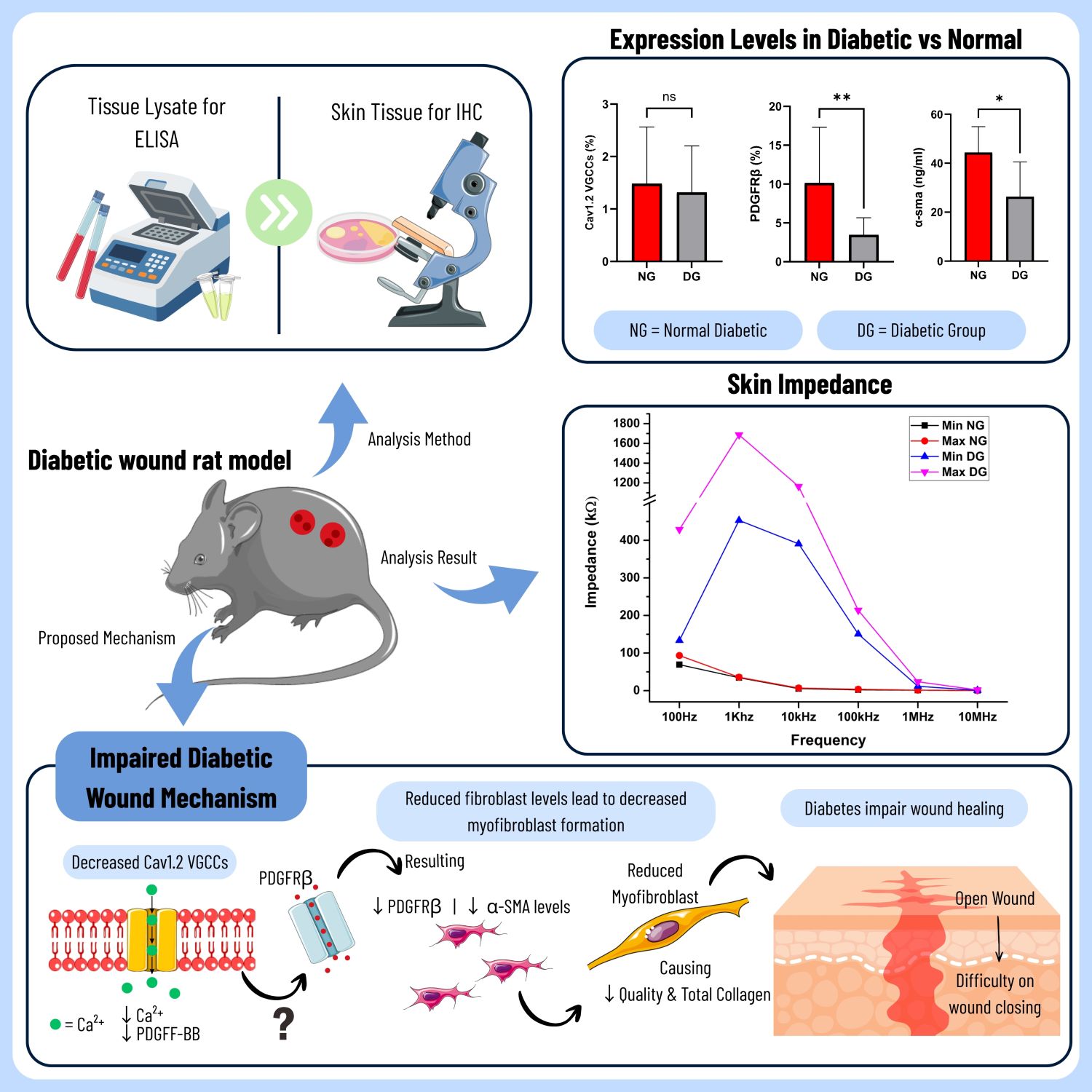
GRAPHICAL ABSTRACT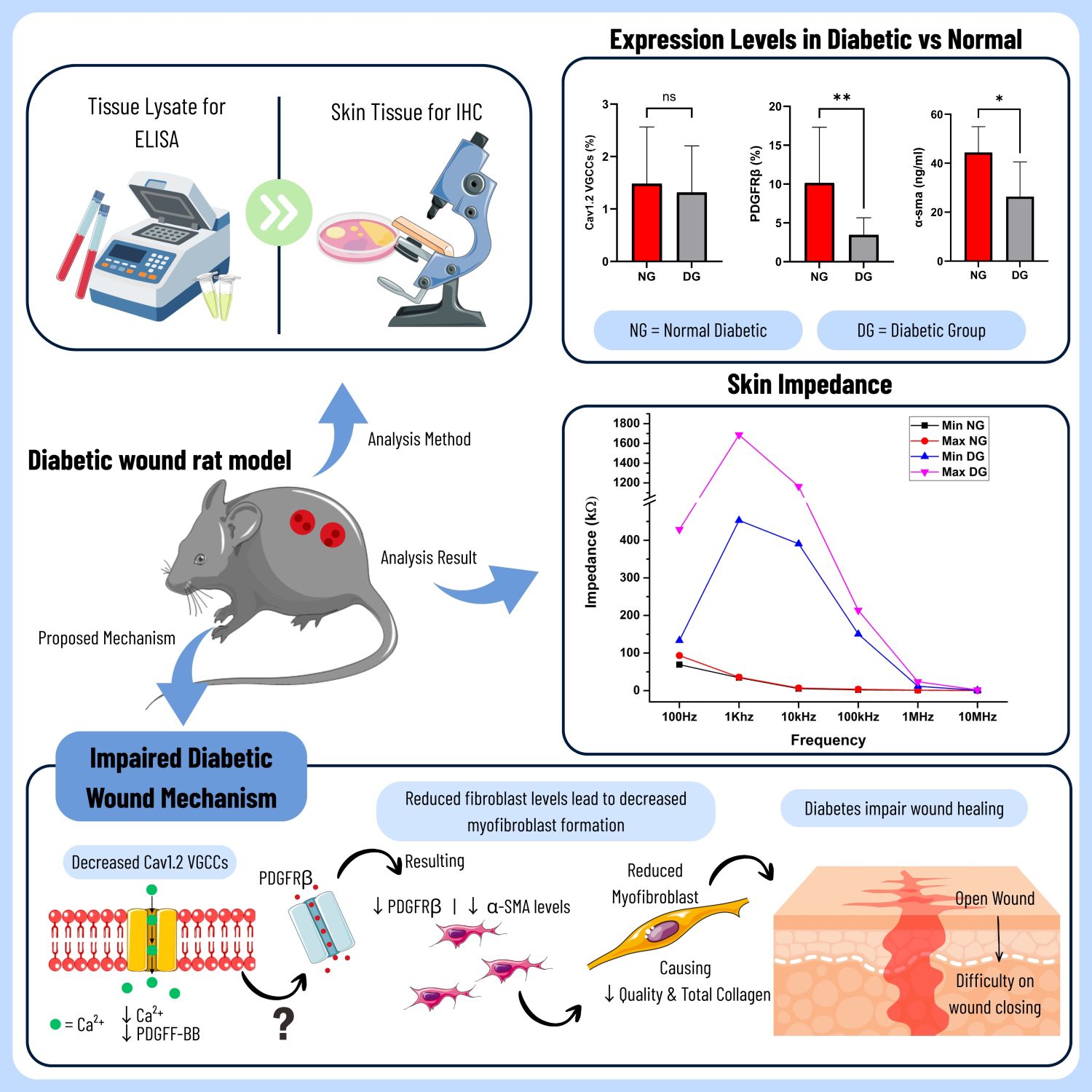
Downloads
References
LFS Gushiken, FP Beserra, JK Bastos, CJ Jackson and CH Pellizzon. Cutaneous wound healing: An update from physiopathology to current therapies. Life 2021; 11(7), 665.
NC Schaper, JJ van Netten, J Apelqvist, SA Bus, RJ Hinchliffe and BA Lipsky. Practical Guidelines on the prevention and management of diabetic foot disease (IWGDF 2019 update). Diabetes/Metabolism Research and Reviews 2020; 36(1), 3266.
FWA Waibel, I Uçkay, L Soldevila-Boixader, C Sydler and K Gariani. Current knowledge of morbidities and direct costs related to diabetic foot disorders: A literature review. Front Endocrinol 2024; 14, 1323315.
M Aminuddin, Sukarni, Haryanto, S Jais, A Yamada, K Mukai and M Oe. Effectiveness of online education on thermography-based diabetic foot ulcer prevention for wound care specialists: A single-group quasi-experimental study. Diabetology International 2025; 16, 356-364.
SY Zheng, XX Wan, PA Kambey, Y Luo, XM Hu, YF Liu, JQ Shan, YW Chen and K Xiong. Therapeutic role of growth factors in treating diabetic wound. World Journal of Diabetes 2023; 14(4), 364-395.
AVA Mariadoss, AS Sivakumar, CH Lee and SJ Kim. Diabetes mellitus and diabetic foot ulcer: Etiology, biochemical and molecular based treatment strategies via gene and nanotherapy. Biomedicine and Pharmacotherapy 2022; 151, 113134.
M Patrick, WNWM Zohdi, SA Muid and Effat Omar. Alpha(α)-mangostin (Xanthone of Garcinia mangostana L.): Augmenting macrophages activity for an effective diabetic wound healing. Trends in Sciences 2024; 21(10), 8254.
AD denDekker and KA Gallagher. Dysregulated inflammation in diabetic wounds. Elsevier, Netherlands, 2020, p. 81-95.
P Porel, M Kaur, V Sharma and KR Aran. Understanding molecular mechanism of diabetic wound healing: Addressing recent advancements in therapeutic managements. Journal of Diabetes & Metabolic Disorders 2025; 24, 76.
Y Dong, M Wang, Q Wang, X Cao, P Chen and Z Gong. Single‐cell RNA‐seq in diabetic foot ulcer wound healing. Wound Repair and Regeneration 2024; 32(6), 880-889.
K Huang, B Mi, Y Xiong, Z Fu, W Zhou, W Liu, G Liu and G Dai. Angiogenesis during diabetic wound repair: From mechanism to therapy opportunity. Burns Trauma 2025; 13, 052.
C Aditya, SPN Bukke, K Anitha, P Meeraraje, N Goruntla, TM Yadesa and H Onohuean. A comprehensive review on diabetic foot ulcer addressing vascular insufficiency, impaired immune response, and delayed wound healing mechanisms. Frontiers in Pharmacology 2025; 16, 1622055.
H Elajaili, BD Lyttle, CV Lewis, JR Bardill, N Dee, S Seal, ES Nozik, KW Liechty and C Zgheib. Increased ROS and persistent pro-inflammatory responses in a diabetic wound healing model (db/db): Implications for delayed wound healing. International Journal of Molecular Sciences 2025; 26(10), 4884.
R Wan, JP Weissman, K Grundman, L Lang, DJ Grybowski and RD Galiano. Diabetic wound healing: The impact of diabetes on myofibroblast activity and its potential therapeutic treatments. Wound Repair and Regeneration 2021; 29(4), 573-581.
JP Yadav, DK Patel, A Verma and P Pathak. Revolutionizing diabetic wound healing: Targeted therapeutic strategies based on growth factors. Obesity Medicine 2024; 47, 100535.
X Zhou, D Yu, X Sun, W Huang, Y Xu, C Li and Y Zhang. Hypoxia-inducible Factor-1α in diabetic foot ulcers: Plain but not simple. Gene Expression 2023; 22(4), 306-320.
G Du, J Chen, X Zhu and Z Zhu. Bioinformatics analysis identifies TGF-β signaling pathway-associated molecular subtypes and gene signature in diabetic foot. IScience 2024; 27(3), 109094.
H Deng, B Li, Q Shen, C Zhang, L Kuang, R Chen, SY Wang, ZQ Ma and G Li. Mechanisms of diabetic foot ulceration: A review. Journal of Diabetes 2023; 15(4), 299-312.
M Wang, Y Sun, L Li, P Wu, O Dkw and H Shi. Calcium channels: Noteworthy regulators and therapeutic targets in dermatological diseases. Frontiers in Pharmacology 2021; 12, 702264.
L Liu, Y Zhou, P Liao, TW Soong and Z Hu. Degradation of voltage-gated calcium channels: Mechanisms and applications in neurological and cardiovascular diseases. Cell Communication and Signaling 2025; 23, 337.
GS Pitt, M Matsui and C Cao. Voltage-gated calcium channels in nonexcitable tissues. Annual Review of Physiology 2021; 83, 183-203.
A Grigore, A Vatasescu-Balcan, S Stoleru, A Zugravu, E Poenaru, M Engi, OA Coman and I Fulga. Experimental research on the influence of ion channels on the healing of skin wounds in rats. Processes 2024; 12(1), 109.
M Ouyang, B Zhou, C Li and L Deng. Characterization of PDGF-induced subcellular calcium regulation through calcium channels in airway smooth muscle cells by FRET Biosensors. Biosensors 2024; 14(4), 179.
J Irma, AS Kartasasmita, A Kartiwa, I Irfani, SA Rizki and S Onasis. From growth factors to structure: PDGF and TGF‐β in granulation tissue formation. A literature review. Journal of Cellular and Molecular Medicine 2025; 29(11), 70374.
G Toogood, R Evans, L Zhang, R Patel, S Meng, VK Boda, W Li and J Xu. TRPC3 inhibition induces myofibroblast differentiation in diabetic dermal fibroblasts. Frontiers in Physiology 2025; 16, 1577118.
Y Zhang, R Wang, Y Li, W Zhu, Y Liu, Z Zhang, X Qi, H Chen, Q Zhou and L Xie. Hyperglycemia-reduced platelet-derived growth Factor–BB expression impairs corneal wound healing in diabetic mice. Investigative Ophthalmology & Visual Science 2025; 66(11), 61.
H Luo, Y Wang, Y Su, D Liu, H Xiao, M Wu, Y Zhao and F Xue. Paracrine effects of adipose-derived stem cells in cutaneous wound healing in streptozotocin-induced diabetic rats. Journal of Wound Care 2022; 31(3), 29-38.
Y Wang, G Han, B Guo and J Huang. Hyaluronan oligosaccharides promote diabetic wound healing by increasing angiogenesis. Pharmacological Reports 2016; 68(6), 1126-1132.
A Kaul, WD Short, SG Keswani and X Wang. Immunologic roles of hyaluronan in dermal wound healing. Biomolecules 2021; 11(8), 1234.
M Alissa, SA Alghamdi and AS Binshaya. Hyaluronic acid-based three dimensional scaffold in combination with hyperbaric oxygen therapy promote diabetic wound healing. Tissue and Cell 2026; 98, 103136.
F Song, Y Kong, C Shao, Y Cheng, J Lu, Y Tao, J Du and H Wang. Chitosan-based multifunctional flexible hemostatic bio-hydrogel. Acta Biomaterialia 2021; 136, 170-183.
H Hameed, SM Ahmad, MA Khan, MU Nabi, R Shehzad, I Majeed and MN Alvi. Chitosan as a multifunctional polymer in drug delivery systems for diabetic wound management. Polymer Bulletin 2025; 82, 5241-5274.
Y Song, N Han, Z Guo, H Li, M Guo, M Dou, J Ye, Z Peng, X Lu, M Li, X Wang, J Bai and S Du. Baicalein-modified chitosan nanofiber membranes with antioxidant and antibacterial activities for chronic wound healing. International Journal of Biological Macromolecules 2024; 279(2), 134902.
HP Nagaiah, MB Samsudeen, AR Augustus and KP Shunmugiah. In vitro evaluation of silver-zinc oxide-eugenol nanocomposite for enhanced antimicrobial and wound healing applications in diabetic conditions. Discover Nano 2025; 20, 14.
RY Sun, XB Wei, ZY Song, JJ Luo, JY Ye, YN Zhang, LF Zhu, J Gao, H Zhang, H Zhu, X Wang and K Xu. Zinc‐containing bioactive glass programs macrophage polarization through extracellular traps regulation for enhanced diabetic wound healing. Advanced Healthcare Materials 2026; 15, 05663.
A Sergeev, D Mokhov, A Sergeev and AM Morozov. New opportunities of electroimpedansometry to control the wound process. Medical News of the North Caucasus 2020; 15(4), 512-514.
A Kekonen and J Viik. Monitoring wound healing. Elsevier, Netherlands, 2021, p. 221-270.
A Liao, MC Lin, LC Ritz, SL Swisher, D Ni and K Mann. Impedance sensing device for monitoring ulcer healing in human patients. The Annual International Conference of the IEEE Engineering in Medicine and Biology Society 2015; 2015, 5130-5133.
I Fajarwati, DD Solihin, T Wresdiyati and I Batubara. Self-Recovery in diabetic sprague dawley rats induced by intraperitoneal alloxan and streptozotocin. Heliyon 2023; 9(5), 15533.
RA Crowe and W Yue. Semi-quantitative determination of protein expression using immunohistochemistry staining and analysis: An integrated protocol. Bio-Protocol journal 2019; 9(24), 3465.
DK Meyerholz and AP Beck. Principles and approaches for reproducible scoring of tissue stains in research. Laboratory Investigation 2018; 98, 844-855.
A Vergnol, M Traoré, F Pietri-Rouxel and S Falcone. New insights in CaVβ subunits: Role in the regulation of gene expression and cellular homeostasis. Frontiers in Cell and Developmental Biology 2022; 10, 880441.
M Wang, D Yang, L Li, P Wu, Y Sun, X Zhang, C Ji, W Xu, H Qian and H Shi. A dual role of mesenchymal stem cell derived small extracellular vesicles on TRPC6 protein and mitochondria to promote diabetic wound healing. ACS Nano 2024; 18(6), 4871-4885.
G Bonsignore, S Martinotti and E Ranzato. Wound Repair and Ca2+ Signalling Interplay: The Role of Ca2+ Channels in Skin. Cells 2024; 13(6), 491.
L Wu, W Lian and L Zhao. Calcium signaling in cancer progression and therapy. The FEBS Journal 2021; 288, 6187-6205.
K Mai, E Maverakis, J Li and M Zhao. Maintaining and restoring gradients of ions in the epidermis: The role of ion and water channels in acute cutaneous wound healing. Advances in Wound Care 2023; 12(12), 696-709.
TS Erçakalli, G Coskun, D Saker, L Sencar, G Gönlüşen and S Polat. Effects of apigenin on mesangial GATA3 expression and PDGFR-β/NF-κB signaling pathway in experimental diabetic nephropathy model. European Journal of Pharmacology 2025; 1007, 178252.
H Suzuki, I Usui, I Kato, T Oya, Y Kanatani, Y Yamazaki, S Fujisaka, S Senda, Y Ishii, M Urakaze, A Mahmood, S Takasawa, H Okamoto, M Kobayashi, K Tobe and M Sasahara. Deletion of platelet-derived growth factor receptor-β improves diabetic nephropathy in Ca2+/calmodulin-dependent protein kinase IIα (Thr286Asp) transgenic mice. Diabetologia 2011; 54, 2953-2962.
Z Cao, Y Liu, Y Wang and P Leng. Research progress on the role of PDGF/PDGFR in type 2 diabetes. Biomedicine & Pharmacotherapy 2023; 164, 114983.
JW Park, SR Hwang and IS Yoon. Advanced growth factor delivery systems in wound management and skin regeneration. Molecules 2017; 22(8), 1259.
S Das, M Majid and AB Baker. Syndecan-4 enhances PDGF-BB activity in diabetic wound healing. Acta Biomaterialia 2016; 42, 56-65.
JMD Legrand and MM Martino. Growth factor and cytokine delivery systems for wound healing. Cold Spring Harbor Perspectives in Biology 2022; 14, 041234.
H Li, X Fu, L Zhang, Q Huang, Z Wu and T Sun. Research of PDGF-BB gel on the wound healing of diabetic rats and its pharmacodynamics. Journal of Surgical Research 2008; 145(1), 41-48.
X Yang, P Zhan, X Wang, Q Zhang, Y Zhang, H Fan, R Li and M Zhang. Polydopamine-assisted PDGF-BB immobilization on PLGA fibrous substrate enhances wound healing via regulating anti-inflammatory and cytokine secretion. PLoS One 2020; 15(9), 0239366.
S Gökşen, B Balabanlı and Ş Coşkun-Cevher. Application of platelet derived growth factor-BB and diabetic wound healing: The relationship with oxidative events. Free Radical Research 2017; 51(5), 498-505.
H Strang, A Kaul, U Parikh, L Masri, S Saravanan, H Li, Q Miao and S Balaji. Role of cytokines and chemokines in wound healing. Elsevier, Netherlands, 2020, p. 197-235.
A Kita, Y Saito, N Miura, M Miyajima, S Yamamoto, T Sato, T Yotsuyanagi, M Fujimiya and TS Chikenji. Altered regulation of mesenchymal cell senescence in adipose tissue promotes pathological changes associated with diabetic wound healing. Communications Biology 2022; 5, 310.
MB Zaidi, F Khan, F Jameel, I Khan, SG Musharraf and A Salim. Temporal and differential proteomic profile of molecular mediators associated with chronic and acute wound healing. Cell Biochemistry and Function 2024; 42(2), 3946.
A Martin-Vega and MH Cobb. Navigating the ERK1/2 MAPK cascade. Biomolecules 2023; 13(10), 1555.
Z Naito, E Takashi, G Xu, T Ishiwata, K Teduka, M Yokoyama, N Yamada, Y Sugisaki and G Asano. Different influences of hyperglycemic duration on phosphorylated extracellular signal-regulated kinase 1/2 in rat heart. Experimental and Molecular Pathology 2003; 74(1), 23-32.
X Wen, L Jiao and H Tan. MAPK/ERK pathway as a central regulator in vertebrate organ regeneration. International Journal of Molecular Sciences 2022; 23(3), 1464.
Z Zhang, Z Li, Y Wang, Q Wang, M Yao, L Zhao, J Shi, F Guan and S Ma. PDGF-BB/SA/Dex injectable hydrogels accelerate BMSC-mediated functional full thickness skin wound repair by promoting angiogenesis. Journal of Materials Chemistry B 2021; 9(31), 6176-6189.
M Heleven, MD Molina, V Jaenen, K Bijnens, F Cebrià and K Smeets. Redox-modulated ERK dynamics support wound-dependent tissue formation during early planarian regeneration. IScience 2026; 29(5), 115640.
A Ram, D Murphy, N DeCuzzi, M Patankar, J Hu, M Pargett and JG Albeck. A guide to ERK dynamics, part 2: Downstream decoding. Biochemical Journal 2023; 480(23), 1909-1928.
H Shankaran and HS Wiley. Oscillatory dynamics of the extracellular signal-regulated kinase pathway. Current Opinion in Genetics & Development 2010; 20, 650-655.
TH Kim, HY Cho and SM Lee. High-voltage pulsed current stimulation enhances wound healing in diabetic rats by restoring the expression of collagen, α-Smooth muscle actin, and TGF-β. The Tohoku Journal of Experimental Medicine 2014; 234(1), 1-6.
Y Huang and TR Kyriakides. The role of extracellular matrix in the pathophysiology of diabetic wounds. Matrix Biology Plus 2020; 6-7, 100037.
I Jahan, J Pandya, R Munshi and S Sen. Glycocalyx disruption enhances motility, proliferation and collagen synthesis in diabetic fibroblasts. Biochimica et Biophysica Acta (BBA) - Molecular Cell Research 2021; 1868(4), 118955.
Y Li, Y Lu, Y Zhao, N Zhang, Y Zhang and Y Fu. Deciphering the wound-healing potential of collagen peptides and the molecular mechanisms: A review. Journal of Agricultural and Food Chemistry 2024; 72(47), 26007-26026.
B Yang, S Alimperti, MV Gonzalez, T Dentchev, M Kim, J Suh, PM Titchenell, KI Ko, J Seykora, M Benakanakere and DT Graves. Reepithelialization of diabetic skin and mucosal wounds is rescued by treatment with epigenetic inhibitors. Diabetes 2024; 73(1), 120-134.
P Rousselle, M Montmasson and C Garnier. Extracellular matrix contribution to skin wound re-epithelialization. Matrix Biology 2019; 75-76, 12-26.
SF Spampinato, GI Caruso, RD Pasquale, MA Sortino and S Merlo. The treatment of impaired wound healing in diabetes: Looking among old drugs. Pharmaceuticals 2020; 13(4), 60.
C Obiajulu, D Nguyen, KHN Bui, T Tran, A Vu, C Ngo, IA Slowinski, K Miyazawa and K Slowinska. Kv1.3 ion channels mediate electrical stimulation-induced collagen expression in human dermal fibroblasts. Cosmetics 2025; 12(3), 86.
L Gao, LAC Blair, GD Salinas, LA Needleman and J Marshall. Insulin-like growth Factor-1 modulation of CaV1.3 calcium channels depends on Ca2+ release from IP3-Sensitive stores and calcium/calmodulin kinase II phosphorylation of the α1 subunit EF hand. Journal of Neuroscience 2006; 26(23), 6259-6268.
R Lobmann, T Pap, A Ambrosch, K Waldmann, W König and H Lehnert. Differential effects of PDGF-BB on matrix metalloproteases and cytokine release in fibroblasts of Type 2 diabetic patients and normal controls in vitro. Journal of Diabetes and its Complications 2006; 20(2), 105-112.
S Pandey, T Anshu, KC Maharana and S Sinha. Molecular insights into diabetic wound healing: Focus on Wnt/β-catenin and MAPK/ERK signaling pathways. Cytokine 2025; 191, 156957.
S Patel, S Srivastava, MR Singh and D Singh. Mechanistic insight into diabetic wounds: Pathogenesis, molecular targets and treatment strategies to pace wound healing. Biomedicine and Pharmacotherapy 2019; 112, 108615.
DK Kamat, D Bagul and PM Patil. Blood glucose measurement using bioimpedance technique. Advances in Electronics 2014; 2014, 406257.
BG Pedro, JAG Sanchez and P Bertemes-Filho. Sensitivity approach for blood glucose impedance data using the geselowitz theorem. Sensing and Bio-Sensing Research 2024; 46, 100698.
D Wulandari, CS Widodo and E Retnaningtyas. Identification of electrical impedance correlation using interdigital transducer (IDT) electrode and blood glucose by giving variations of sugar concentration to male mice. Journal of Physics: Conference Series 2021; 1796, 012049.
Y Cui, Y An, T Jin, F Zhang and P He. Real-time monitoring of skin wound healing on nano-grooves topography using electric cell-substrate impedance sensing (ECIS). Sensors and Actuators B: Chemical 2017; 250, 461-468.
L Kiesewetter, L Littau, H Walles, AR Boccaccini and F Groeber-Becker. Reepithelialization in focus: Non-invasive monitoring of epidermal wound healing in vitro. Biosensors and Bioelectronics 2019; 142, 111555.
M Antoszewska, K Połomska, P Spychalski, A Kekonen, J Viik and W Barańska-Rybak. Bioimpedance measurement for monitoring chronic wounds: A systematic review. International Wound Journal 2025; 22(6), 70707.
N Arabsalmani, A Ghouchani, SJ Ashtiani and M Zamani. Exploring Bio-Impedance sensing for intelligent wearable devices. Bioengineering 2025; 12(5), 521.
Downloads
Published
How to Cite
Issue
Section
License
Copyright (c) 2026 Walailak University

This work is licensed under a Creative Commons Attribution-NonCommercial-NoDerivatives 4.0 International License.