Hepatoprotective and Anti-Inflammatory Effects of the As-Capsipol Complex: An Integrated In Vivo and In Silico Study
DOI:
https://doi.org/10.48048/tis.2026.14186Keywords:
As-Capsipol, Hepatoprotective activity, Molecular docking, MAPK, NF-kB, TNF-α, Paracetamol-Induced hepatitisAbstract
This study investigated the hepatoprotective, anti-inflammatory, and safety properties of the As-Capsipol complex using combined in vivo and in silico approaches. Acute liver injury was induced in rats by administration of a toxic dose of paracetamol, resulting in significant hepatocellular damage, as evidenced by increased alanine aminotransferase (ALT) and aspartate aminotransferase (AST) levels and decreased blood urea concentration. Treatment with As-Capsipol at 150 mg/kg for 14 days improved these biochemical parameters, including reduction of transaminase activity and partial restoration of urea levels, suggesting recovery of liver function. Anti-inflammatory activity was evaluated using a carrageenan-induced paw edema model. As-Capsipol exhibited dose-dependent anti-exudative effects, with the highest activity observed at 150 mg/kg, indicating attenuation of acute inflammatory responses. Acute toxicity testing in mice showed no mortality or persistent adverse effects at a dose of 2,000 mg/kg, suggesting low acute toxicity under the tested conditions. To investigate potential mechanisms, molecular docking studies were conducted against key inflammation-related targets, including MAPK, NF-kB, and TNF-α. The selected amino acids demonstrated binding energies ranging from −5.0 to −8.1 kcal/mol. The binding affinity pattern followed the order: Tryptophan > tyrosine ≈ phenylalanine > arginine > glutamic acid, indicating stronger interactions for aromatic amino acids. These interactions were stabilized by hydrogen bonding and hydrophobic contacts within protein active sites. The findings indicate that As-Capsipol may support liver function and modulate inflammatory processes under experimental conditions. Further studies are required to confirm these effects and clarify the underlying mechanisms.
HIGHLIGHTS
- As-Capsipol complex exhibited significant hepatoprotective activity in a paracetamol-induced hepatitis model in rats.
- Treatment restored liver function markers (ALT, AST, and urea) close to physiological levels.
- No adverse effects on renal function were observed, confirming the safety profile of the compound.
- Molecular docking revealed strong binding affinities toward key inflammatory targets (MAPK, NF-kB, TNF-α).
- Binding strength followed the order: Tryptophan > tyrosine > phenylalanine > arginine > glutamic acid.
- Results suggest a multi-target mechanism involving anti-inflammatory and cytoprotective pathways.
GRAPHICAL ABSTRACT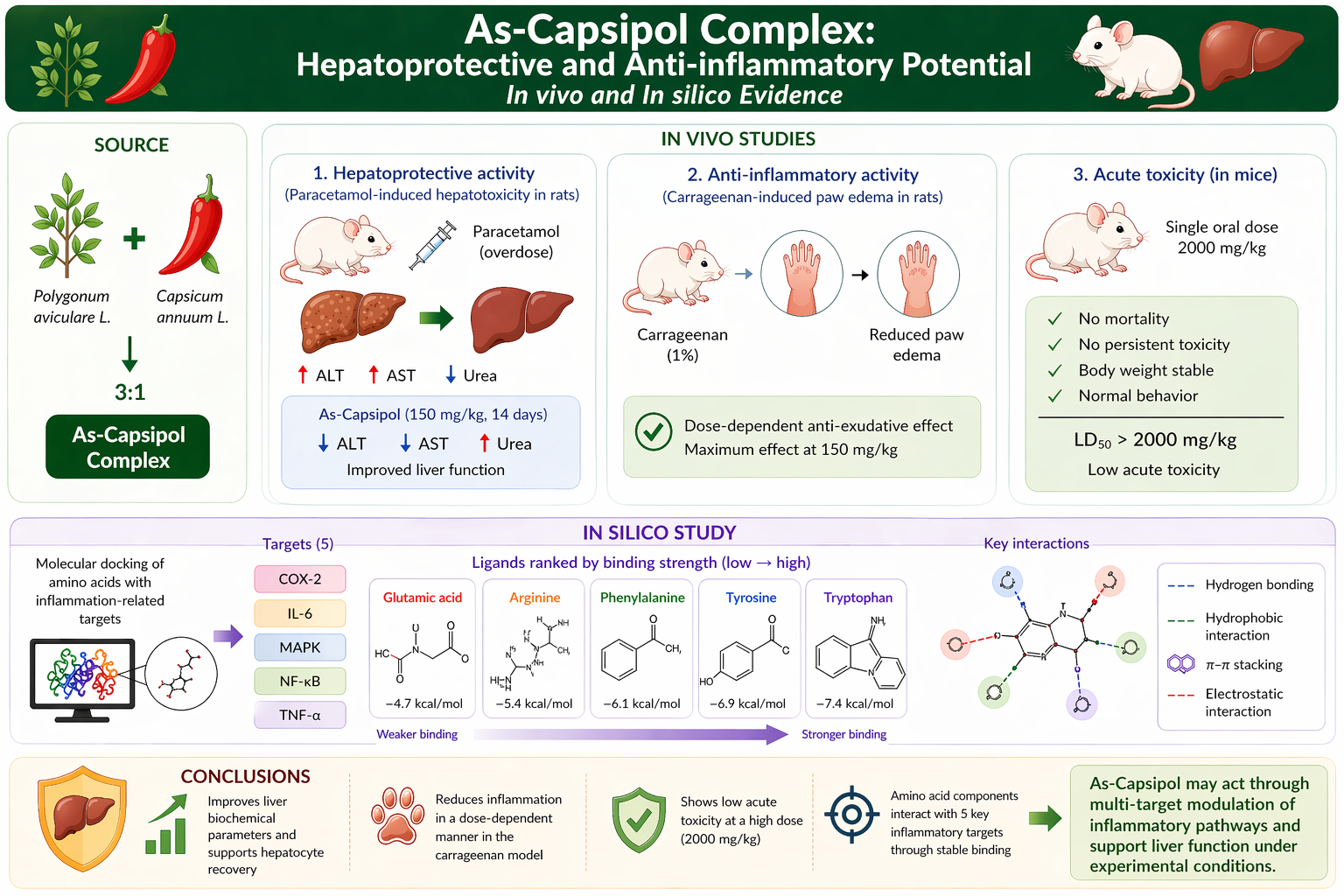
Downloads
References
SA Ali, NH Sharief and YS Mohamed. Hepatoprotective activity of some medicinal plants in Sudan. Evidence-Based Complementary and Alternative Medicine 2019; 2019, 2196315.
P Liu, W Chen, D Wu, Z Zhang, W Li and Y Yang. The preparation, modification and hepatoprotective activity of chitooligosaccharides: A review. International Journal of Biological Macromolecules 2024; 277, 134489.
DS Mandlik and AG Namdeo. Pharmacological evaluation of Ashwagandha highlighting its healthcare claims, safety, and toxicity aspects. Journal of Dietary Supplements 2021; 18(2), 183-226.
J Deng, Y Cong, X Han, W Wei, Y Lu, T Liu, W Zhao, B Lin, Y Luo and X Zhang. A liver-on-a-chip for hepatoprotective activity assessment. Biomicrofluidics 2020; 14(6), 064107.
S He, Y Yi, D Hou, X Fu, J Zhang, X Ru, J Xie and J Wang. Identification of hepatoprotective traditional Chinese medicines based on the structure–activity relationship, molecular network, and machine learning techniques. Frontiers in Pharmacology 2022; 13, 969979.
DH Lee, JS Park, LY S, J Han, DK Lee, SW Kwon, DH Han, YH Lee and SH Bae. SQSTM1/p62 activates NFE2L2/NRF2 via ULK1-mediated autophagic KEAP1 degradation and protects mouse liver from lipotoxicity. Autophagy 2020; 16(11), 1949-1973.
QD Le, HD Vu, VM Nguyen, GJ Choi, LTP Hoa, DT Dung, PV Kiem, NX Nhiem, QD De, QC Nguyen, DT Nghiem and DN Quang. Desmodinosides A-E: New flavonoid C-glycosides from Desmodium heterocarpon var. strigosum with hepatoprotective and antifungal activity. Fitoterapia 2023; 169, 105609.
BD Hiraganahalli, VC Chinampudur, S Dethe, D Mundkinajeddu, MK Pandre, J Balachandran and A Agarwal. Hepatoprotective and antioxidant activity of standardized herbal extracts. Pharmacognosy Magazine 2012; 8(30), 116-123.
C Zhao, J Fan, Y Liu, W Guo, H Cao, J Xiao, Y Wang and Liu B. Hepatoprotective activity of Ganoderma lucidum triterpenoids in alcohol-induced liver injury in mice, an iTRAQ-based proteomic analysis. Food Chemistry 2019; 271, 148-156.
M Iranshahy, M Iranshahi, SR Abtahi and G Karimi. The role of nuclear factor erythroid 2-related factor 2 in hepatoprotective activity of natural products: A review. Food and Chemical Toxicology 2018; 120, 261-276.
T Lan, Y Yu, J Zhang, H Li, Q Weng, S Jiang, S Tian, T Xu, S Hu, G Yang, Y Zhang, W Wang, L Wang, Q Zhu, X Rong and J Guo. Cordycepin ameliorates nonalcoholic steatohepatitis by activation of the AMP-activated protein kinase signaling pathway. Hepatology 2021; 74(2), 686-703.
Putz P, Klinger M, Male C, Pabinger I. Lower physical activity and altered body composition in patients with haemophilia compared with healthy controls. Haemophilia. 2021 Mar;27(2):e260-e266. doi: 10.1111/hae.14259. Epub 2021 Feb 12. PMID: 33578451; PMCID: PMC8048548
.A Hermenean, T Mariasiu, I Navarro-González, J Vegara-Meseguer, E Miuțescu, S Chakraborty and H Pérez-Sánchez. Hepatoprotective activity of chrysin is mediated through TNF-α in chemically-induced acute liver damage: An in vivo study and molecular modeling. Experimental and Therapeutic Medicine 2017; 13(5), 1671-1680.
Hoffman RP. Sympathetic mechanisms of hypoglycemic counterregulation. Curr Diabetes Rev. 2007 Aug;3(3):185-93. doi: 10.2174/157339907781368995. PMID: 18220670.V Kaur, M Kumar, P Kaur, S Kaur, AP Singh and S Kaur. Hepatoprotective activity of Butea monosperma bark against thioacetamide-induced liver injury in rats. Biomedicine & Pharmacotherapy 2017; 89, 332-341.
K Lahon and S Das. Hepatoprotective activity of Ocimum sanctum alcoholic leaf extract against paracetamol-induced liver damage in Albino rats. Pharmacognosy Research 2011; 3(1), 13-18.
P Niziński, A Krajewska, T Oniszczuk, B Polak and A Oniszczuk. Hepatoprotective effect of kaempferol - A review. Molecules 2025; 30(9), 1913.
HS Park, E Jo, JH Han, SH Jung, DH Lee, I Park, KS Heo, M Na and CS Myung. Hepatoprotective effects of an Acer tegmentosum Maxim extract through antioxidant activity and the regulation of autophagy. Journal of Ethnopharmacology 2019; 239, 111912.
Z Meena, MA Rahman, P Bagga and M Mujahid. Hepatoprotective activity of Tamarindus indica Linn stem bark ethanolic extract against hepatic damage induced by co-administration of antitubercular drugs isoniazid and rifampicin in Sprague Dawley rats. Journal of Basic and Clinical Physiology and Pharmacology 2018; 30(1), 131-137.
NT Selvam, V Venkatakrishnan, R Dhamodharan, S Murugesan and SD Kumar. Hepatoprotective activity of methanolic extract of Syzygium jambos (Linn.) leaf against paracetamol intoxicated Wistar albino rats. Ayu 2013; 34(3), 305-308.
R Domitrović and I Potočnjak. A comprehensive overview of hepatoprotective natural compounds: mechanism of action and clinical perspectives. Archives of Toxicology 2016; 90(1), 39-79.
DZ Xia, PH Zhang, Y Fu, WF Yu and MT Ju. Hepatoprotective activity of puerarin against carbon tetrachloride-induced injuries in rats: A randomized controlled trial. Food and Chemical Toxicology 2013; 59, 90-95.
AR Rao, R Sarada, MD Shylaja and GA Ravishankar. Evaluation of hepatoprotective and antioxidant activity of astaxanthin and astaxanthin esters from microalga - Haematococcus pluvialis. Journal of Food Science and Technology 2015; 52(1), 6703-6710.
X Su, L Li, H Sun, Z Zhang, C Li, F Li, H Wang, B Li, R Chen and J Kang. Eight new glycosides with hepatoprotective activity isolated from the aerial parts of Morinda parvifolia. Bioorganic Chemistry 2019; 87, 867-875.
HA Mohammed, HM Eldeeb, RA Khan, MS Al-Omar, SAA Mohammed, MSM Sajid, MSA Aly, AM Ahmad, AAH Abdellatif, SY Eid and MZ El-Readi. Sage, Salvia officinalis L., constituents, hepatoprotective activity, and cytotoxicity evaluations of the essential oils obtained from fresh and differently timed dried herbs: A comparative Analysis. Molecules 2021; 26(19), 5757.
L Pinzi and G Rastelli. Molecular docking: Shifting paradigms in drug discovery. International Journal of Molecular Sciences 2019; 20(18), 4331.
LG Ferreira, RN Dos Santos, G Oliva and AD Andricopulo. Molecular docking and structure-based drug design strategies. Molecules 2015; 20(7), 13384-13421.
A Bisht, D Tewari, S Kumar and S Chandra. Network pharmacology, molecular docking, and molecular dynamics simulation to elucidate the mechanism of anti-aging action of Tinospora cordifolia. Molecular Diversity 2024; 28(3), 1743-1763.
K Crampon, A Giorkallos, M Deldossi, S Baud and LA Steffenel. Machine-learning methods for ligand-protein molecular docking. Drug Discovery Today 2022; 27(1), 151-164.
F Stanzione, I Giangreco and JC Cole. Use of molecular docking computational tools in drug discovery. Progress in Medicinal Chemistry 2021; 60, 273-343.
T Li, R Guo, Q Zong and G Ling. Application of molecular docking in elaborating molecular mechanisms and interactions of supramolecular cyclodextrin. Carbohydrate Polymers 2022; 276, 118644.
Y Hou, Y Bai, C Lu, Q Wang, Z Wang, J Gao and H Xu. Applying molecular docking to pesticides. Pest Management Science 2023; 79(11), 4140-4152.
LHS Santos, RS Ferreira and ER Caffarena. Integrating Molecular Docking and Molecular Dynamics Simulations. Methods in Molecular Biology 2019; 2053, 13-34.
J Wang, Y Bai, X Guan, Y Lao and Z Dong. Network pharmacology and molecular docking study on the mechanism of chronic prostatitis treatment using Xiaochaihutang. Asian Journal of Surgery 2023; 46(11), 4798-4800.
S Baghaki, CE Yalcin, HS Baghaki, SY Aydin, B Daghan and E Yavuz. COX-2 inhibition in the treatment of COVID-19: Review of literature to propose repositioning of celecoxib for randomized controlled studies. International Journal of Infectious Diseases 2020; 101, 29-32.
M Lyndin, O Kravtsova, K Sikora, Y Lyndina, Y Kuzenko, WA Awuah, T Abdul-Rahman, N Hyriavenko, V Sikora and A Romaniuk. COX-2 effects on endometrial carcinomas progression. Pathology - Research and Practice 2022; 238, 154082.
D Barrett. IL-6 blockade in cytokine storm syndromes. Advances in Experimental Medicine and Biology 2024; 1448, 565-572.
T Tanaka, M Narazaki, K Masuda and T Kishimoto. Regulation of IL-6 in immunity and diseases. Advances in Experimental Medicine and Biology 2016; 941, 79-88.
YJ Guo, WW Pan, SB Liu, ZF Shen, Y Xu and LL Hu. ERK/MAPK signalling pathway and tumorigenesis. Experimental and Therapeutic Medicine 2020; 19(3), 1997-2007.
L Kalvaitis, G Gedvilaite-Vaicechauskiene, L Kriauciuniene and R Liutkeviciene. TNF-alfa gene polymorphism associations with multiple sclerosis. Journal of Clinical Medicine 2024; 13(13), 3693.
S Kochbati, F Boussema, MB Miled, S Ktari, L Daoud, SB Rhouma, GB Amor, O Chérif and L Rokbani. Les modulateurs du TNFalpha dans le traitement de la polyarthrite rhumatoide. Tunisie Medicale 2004; 82(10), 893-904.
Downloads
Published
How to Cite
Issue
Section
License
Copyright (c) 2026 Walailak University

This work is licensed under a Creative Commons Attribution-NonCommercial-NoDerivatives 4.0 International License.