
Aqueous Edible Flower Extracts as Functional Agents: Synergistic Chemosensitization of Clitoria ternatea and Multifunctional Bioactivity of Nelumbo nucifera
DOI:
https://doi.org/10.48048/tis.2027.14162Keywords:
Butterfly pea, Lotus, -Glucosidase, Colorectal cancer, 5-FluorouracilAbstract
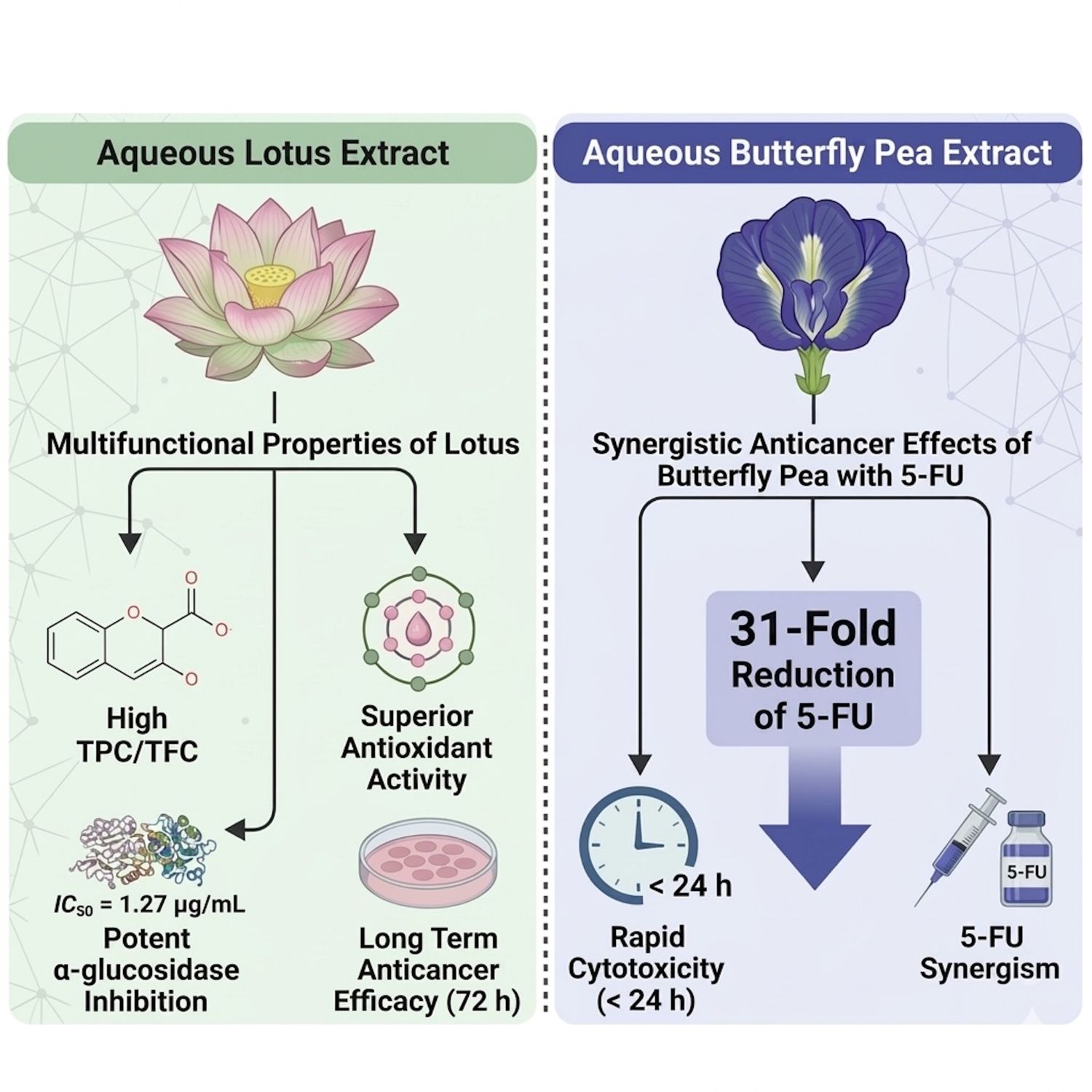
Edible flowers are increasingly recognized as rich sources of bioactive compounds; however, research on their aqueous extracts, particularly regarding therapeutic synergy, remains limited. This study aimed to evaluate the phytochemical profiles, antioxidant capacities, antidiabetic potential, and cytotoxic effects of aqueous extracts from 4 Thai edible flowers: Clitoria ternatea L. (butterfly pea), Nelumbo nucifera Gaertn. (lotus), and 2 cultivars of Ixora sp. (pink and red ixora). Total phenolic (TPC) and flavonoid (TFC) contents were determined, alongside DPPH, ABTS, and GC-MS profiling. Antidiabetic potential was assessed via α-glucosidase inhibition. Furthermore, cytotoxicity against HT-29 colorectal cancer cells was evaluated over 24 - 72 h, and synergistic interactions with 5-fluorouracil (5-FU) were quantified using the Combination Index (CI). Results revealed that lotus extract possessed the highest TPC and TFC, correlating with its superior antioxidant activity and potent α-glucosidase inhibition. Lotus extract also showed the highest long-term cytotoxicity against HT-29 cells at 72 h. Conversely, butterfly pea extract showed lower initial bioactivity but demonstrated a remarkably rapid onset of cytotoxicity and a significant synergism with 5-FU, effectively achieving a substantial 31-fold dose reduction of the chemotherapeutic drug. Interestingly, lotus extract exhibited antagonism when combined with 5-FU, suggesting mechanistic divergence in drug-extract interactions. GC-MS profiling revealed that acetic acid and DDMP predominated in the butterfly pea extract, whereas tyrosol and DDMP were the major components in the lotus extract. These findings highlight lotus as a promising agent for oxidative stress and glycemic control, while introducing butterfly pea as a potential chemosensitizing adjuvant to enhance 5-FU efficacy for colorectal cancer therapy. Collectively, this study supports the utilization of Thai edible flowers as prospective functional ingredients and multitarget nutraceuticals.
HIGHLIGHTS
- Aqueous lotus extract shows potent a-glucosidase inhibition.
- Aqueous lotus extract demonstrates superior long-term cytotoxic efficacy against HT-29
- Aqueous butterfly pea extract exhibits a rapid cytotoxic effects onset within 24 h of treatment.
- Aqueous butterfly pea extract synergizes with 5-FU, achieving a 31-fold reduction in the chemotherapeutic dose against HT-29 cells.
GRAPHICAL ABSTRACT
Downloads
References
P Kandylis. Phytochemicals and antioxidant properties of edible flowers. Applied Sciences 2022; 12(19), 9937.
G Janarny, KDPP Gunathilake and KKDS Ranaweera. Nutraceutical potential of dietary phytochemicals in edible flowers-A review. Journal of Food Biochemistry 2021; 45(3), e13642.
S Fakhri, M Tomas and E Capanoglu. Antioxidant and anticancer potentials of edible flowers: Where do we stand? Critical Reviews in Food Science and Nutrition 2022; 62(18), 5005-5028.
L Rivas-García, MD Navarro-Hortal and JM Romero-Márquez. Edible flowers as a health promoter: An evidence-based review. Trends in Food Science & Technology 2021; 117, 46-59.
E Matyjaszczyk and M Śmiechowska. Edible flowers. Benefits and risks pertaining to their consumption. Trends in Food Science and Technology 2019; 91, 100-110.
P Kumari and MN Adarsh. Flowers: A new source of nutraceuticals and various approaches to increase nutraceutical compounds in flowers. Ecology, Environment and Conservation 2016; 22(1), 441-445.
P Kumari, Ujala and B Bhargava. Phytochemicals from edible flowers: Opening a new arena for healthy lifestyle. Journal of Functional Foods 2021; 78, 104375.
LY Prakruthi, H Krishnan, L Banupriya and S Kumar. Unlocking the nutraceutical promise of edible flowers: An AI-driven approach to comprehensive chemical profiling. Trends in Food Science & Technology 2026; 167, 105449.
C Altomare, R Macrì, M Serra and V Mollace. The potential of nutraceutical supplementation in counteracting cancer development and progression: A pathophysiological perspective. Nutrients 2025; 17(14), 2354.
N Zhang, Y Ren and Y Xu. From laboratory to clinic: Opportunities and challenges of functional food active ingredients in cancer therapy. Frontiers in Nutrition 2025; 12, 1627949.
S Ashrafpour and M Ashrafpour. The double-edged sword of nutraceuticals: Comprehensive review of protective agents and their hidden risks. Frontiers in Nutrition 2025; 12, 1524627.
G Derosa, A D’Angelo, F Angelini and P Maffioli. Nutraceuticals and supplements in management of prediabetes and diabetes. Nutrients 2025; 17(1), 14.
A Lewandowska, G Rudzki, T Lewandowski, A Stryjkowska-Gora and S Rudzki. Risk factors for the diagnosis of colorectal cancer. Cancer Control 2022; 22, 1-15.
A Ibrahim, S Siswandono and BPE Wardojo. Potential anticancer activities of chloroform subfraction from Peronema leaf on colon cancer HT-29 cells in vitro. Journal of Applied Pharmaceutical Science 2021; 11(12), 082-089.
E Fernando-Macías, MT Fernández-García, E García-Pérez, A Cresswell, J Soria-Valles, M Soria-Valles, S Astudillo, F López-Otín and M Alejandro-García. A new aggressive xenograft model of human colon cancer using cancer-associated fibroblasts. PeerJ 2020; 8, e9045.
PDC Gamboa-Flores, N Castillo-Cálix, S Quiroz-Gómez and J Carbonell-Santana. Therapeutic potential of curcumin in colorectal cancer: A systematic review. Nutrición Hospitalaria 2025; 42, 5920.
E Khatoon, K Banik, C Harsha and A Sailo. Phytochemicals in cancer cell chemosensitization: Current knowledge and future perspectives. Seminars in Cancer Biology 2022; 80, 227-239.
BS Vinod, TT Maliekal and RJ Anto. Phytochemicals as chemosensitizers: From molecular mechanism to clinical significance. Antioxidants & Redox Signaling 2013; 18(10), 1307-1348.
O Porfyris, P Detopoulou, T Adamantidi and C Tsiamis. Phytochemicals as chemo-preventive and therapeutic agents against bladder cancer: A comprehensive review. Diseases 2025; 13, 103.
SJ Monica, D Jemima, EL Daniel and V Kumar. Phytochemicals as anticancer agents: Investigating molecular pathways from preclinical research to clinical relevance. Current Research in Nutrition and Food Science Journal 2025; 13, 09.
K Ashraf, NF Adlin, AN Basri and S Jamil. The traditional uses, phytochemistry, and pharmacological effects of Clitoria ternatea: A review. Indian Journal of Pharmaceutical Education and Research 2024; 58(1), 1-14.
M Skrajda-Brdak, G Dąbrowski and I Konopka. Edible flowers, a source of valuable phytonutrients and their pro-healthy effects – A review. Trends in Food Science & Technology 2020; 103, 179-191.
AR Abubakar and M Haque. Preparation of medicinal plants: Basic extraction and fractionation procedures for experimental purposes. Journal of Pharmacy and Bioallied Sciences 2020; 12(1), 1-10.
QW Zhang, LG Lin and WC Ye. Techniques for extraction and isolation of natural products: A comprehensive review. Chinese Medicine 2018; 13, 20.
VL Singleton, R Orthofer and RM Lamuela-Raventós. Analysis of total phenols and other oxidation substrates and antioxidants by means of folin-ciocalteu reagent. Methods in Enzymology 1999; 299, 152-178.
K Wolfe, X Wu and RH Liu. Antioxidant activity of apple peels. Journal of Agricultural and Food Chemistry 2003; 51(3), 609-614.
W Brand-Williams, ME Cuvelier and C Berset. Use of a free radical method to evaluate antioxidant activity. LWT - Food Science and Technology 1995; 28(1), 25-30.
R Re, N Pellegrini, A Proteggente, A Pannala, M Yang and C Rice-Evans. Antioxidant activity applying an improved ABTS radical cation decolorization assay. Free Radical Biology and Medicine 1999; 26(9-10), 1231-1237.
YM Kim, YK Jeong, MH Wang, WY Paik, NH Rhee, MS Han and HJ Lee. Inhibitory effect of pine extract on α-glucosidase activity and postprandial hyperglycemia. Nutrition 2005; 21(6), 756-761.
WH Talib. Consumption of garlic and lemon aqueous extracts combination reduces tumor burden by angiogenesis inhibition, apoptosis induction, and immune system modulation. Nutrition 2017; 43-44, 127-135.
TC Chou and P Talalay. Quantitative analysis of dose-effect relationships: The combined effects of multiple drugs or enzyme inhibitors. Advances in Enzyme Regulation 1984; 22, 27-55.
C Ngoitaku, P Kwannate and K Riangwong. Total phenolic content and antioxidant activities of edible flower tea products from Thailand. International Food Research Journal 2016; 23(1), 111-117.
O Kaisoon, S Siriamornpun and N Weerapreeyakul. Phenolic compounds and antioxidant activities of edible flowers from Thailand. Journal of Functional Foods 2011; 3(2), 88-99.
D Tungmunnithum, S Drouet and C Hano. Phytochemical diversity and antioxidant potential of natural populations of Nelumbo nucifera Gaertn. throughout the floristic regions in Thailand. Molecules 2022; 27(3), 681.
T Pokhrel, D Shrestha, K Dhakal and BK Shrestha. Comparative analysis of the antioxidant and antidiabetic potential of Nelumbo nucifera Gaertn. and Nymphaea lotus L. var. pubescens (Willd.). Journal of Chemistry 2022; 2022, 4258124.
J Lucianus, L Darsono, W Widowati and I Afifah. Anti-diabetes mellitus potential of butterfly pea flower (Clitoria ternatea L.) extract based on antioxidant and inhibition of α-amylase and α-glucosidase activities. Medicinal Plants - International Journal of Phytomedicines and Related Industries 2024; 16(1), 40.
S Adisakwattana, T Ruengsamran, P Kampa and S Sompong. In vitro inhibitory effects of plant-based foods and their combinations on intestinal α-glucosidase and pancreatic α-amylase. BMC Complementary and Alternative Medicine 2012; 12, 110.
NT Ngan. Comparative evaluation of phenolic content, antioxidant, anti-inflammatory, and antidiabetic properties of Clitoria ternatea flowers and leaves from Vietnam. Malaysian Journal of Analytical Sciences 2025; 29(1), 1-12.
TT Mai, NN Thu, PG Tien and NK Chuyen. Alpha-glucosidase inhibitory and antioxidant activities of Vietnamese edible plants and their relationships with polyphenol contents. Journal of Nutritional Science and Vitaminology 2007; 53(3), 267-276.
C Proença, M Freitas, D Ribeiro, SM Tomé, EF Oliveira, MF Ribeiro, AM Silva, PA Fernandes, HS Ramos and JL Costa. α-Glucosidase inhibition by flavonoids: An in vitro and in silico structure-activity relationship study. Journal of Enzyme Inhibition and Medicinal Chemistry 2017; 32(1), 1088-1095.
MN Sarian, QU Ahmed, SZ Mat So’Ad, AM Alhassan, S Murugesu, V Perumal, SN Mohamad, A Khatib and J Latip. Antioxidant and antidiabetic effects of flavonoids: A structure-activity relationship-based study. BioMed Research International 2017; 2017, 8386065.
F Giacco and M Brownlee. Oxidative stress and diabetic complications. Circulation Research 2010; 107(9), 1058-1070.
GD Neda, MS Rabeta and MT Ong. Chemical composition and anti-proliferative properties of flowers of Clitoria ternatea. International Food Research Journal 2013; 20(3), 1229-1234.
SM ALshamrani, FA Safhi, MA Mobasher, M Alam, MS Al-Zahrani and AA Al-Karmalawy. Antiproliferative effect of Clitoria ternatea ethanolic extract against colorectal, breast, and medullary thyroid cancer cell lines. Separations 2022; 9(11), 331.
S Rahayu, Muhtadi and P Indrayudha. Apoptosis induction activity and inhibition of MCF-7 cell proliferation in active isolate of butterfly pea flower (Clitoria ternatea L.). Trends in Sciences 2023; 20(8), 5518.
P Arjun, PSS Sivan, SM Priya and S Ganesan. Phytochemical analysis and anticancer activity of Nelumbo nucifera floral receptacle extracts in MCF-7 cell line. Journal of Academia and Industrial Research 2015; 4(2), 52-56.
AS Binshay, FM Aldakheel and GS Aloraini. Lotus root extract: An investigation of its antioxidant and anticancer properties for potential application in functional foods. International Journal of Advanced and Applied Sciences 2024; 11(6), 57-62.
G Britina, D Ezhilarasan and K Shree Harini. Nelumbo nucifera leaf extract induces cytotoxicity in osteosarcoma Saos-2 cells. Cureus 2023; 15(10), e47609.
VJ Mallela, M Rudrapal, DSNBK Prasanth, SR Alotaibi, AA Alqarni and J Pasupuleti. Lotus seed (Nelumbinis semen) extract: Anticancer potential and chemoprofiling by in vitro, in silico and GC-MS studies. Frontiers in Chemistry 2024; 12, 1505272.
GK Oguis, EK Gilding, MA Jackson and DJ Craik. Butterfly pea (Clitoria ternatea), a cyclotide-bearing plant with applications in agriculture and medicine. Frontiers in Plant Science 2019; 10, 645.
MB Lijon, NS Meghla, E Jahedi, MA Rahman and I Hossain. Phytochemistry and pharmacological activities of Clitoria ternatea. International Journal of Natural and Social Sciences 2017; 4(1), 01-10.
S Zhang, KZ Xiao, J Jin, J Hong, JH Xu and K Hu. Chemosensitizing activities of cyclotides from Clitoria ternatea in paclitaxel-resistant lung cancer cells. Oncology Letters 2013; 5(1), 343-347.
A Satari, SA Amini, E Raeisi, M Lemoigne, S Deamici, S Abbasi and M Abbasi. Synergetic impact of combined 5-fluorouracil and rutin on apoptosis in PC3 cancer cells through the modulation of P53 gene expression. Advanced Pharmaceutical Bulletin 2019; 9(3), 470-478.
M González-Vallinas, M González-Castejón, A Rodríguez-Casado and G Ramírez de Molina. Dietary phytochemicals in cancer prevention and therapy: A complementary approach with promising perspectives. Nutrition Reviews 2013; 71(9), 585-599.
EJ Ladas, JS Jacobson, DD Kennedy, P Teel and AB Kelly. Antioxidants and cancer therapy: A systematic review. Journal of Clinical Oncology 2004; 22(8), 1492-1505.
KS Chun and SH Joo. Modulation of reactive oxygen species to overcome 5-fluorouracil resistance. Biomolecules & Therapeutics 2022; 30(4), 312-321.
C Pfab, A Abgaryan, B Danzer, F Mourtada, W Ali, A Gessner and N El-Najjar. Ceftazidime and cefepime antagonize 5-fluorouracil’s effect in colon cancer cells. BMC Cancer 2022; 22, 11.
Y Ge, Y Wu, A Aihaiti, C Yu, M Wu and S Qin. The metabolic pathways of yeast and acetic acid bacteria during fruit vinegar fermentation and their influence on flavor development. Microorganisms 2025; 13(3), 477.
T Sakamoto, Z Li, A Nishida, G Tomii, S Sakamoto, S Iida and T Adachi. Identification of major antioxidant compounds from the edible mushroom Basidiomycetes-X (Echigoshirayukidake). Frontiers in Bioscience - Elite 2022; 14(2), 10.
Z Chen, Q Liu, Z Zhao, S Li and Y Sun. Effect of hydroxyl on antioxidant properties of 2,3-dihydro-3,5-dihydroxy-6-methyl-4H-pyran-4-one to scavenge free radicals. RSC Advances 2021; 11(61), 38556-38564.
JO Ban, IG Hwang, TM Kim, MS Lee, KH Jeong, JH Roh, SY Ryu, EJ Jeong, MY Hong, NM Yoon and HS Ro. Anti-proliferate and pro-apoptotic effects of 2,3-dihydro-3,5-dihydroxy-6-methyl-4H-pyranone through inactivation of NF-kB in human colon cancer cells. Archives of Pharmacal Research 2007; 30(11), 1455-1463.
K Rana, J Behdokht and H Morvarid. Anti-cancer effects of tyrosol on breast cancer cell line- exploring the action mechanisms. Journal of Human Genetics and Genomics 2023; 7(1), 369.
L Sun, C Luo and J Liu. Hydroxytyrosol induces apoptosis in human colon cancer cells through ROS generation. Food & Function 2014; 5(8), 1909-1914.
A Kumar, B Singh, K Paul and SK Yadav. Hydroxytyrosol in cancer research: recent and historical insights on discoveries and mechanisms of action. Future Journal of Pharmaceutical Sciences 2024; 10, 70.
AK Marković, J Torić, M Barbarić and C Jakobušić Brala. Hydroxytyrosol, tyrosol and derivatives and their potential effects on human health. Molecules 2019; 24(10), 2001.
J Huang, G He, L Wu, M Wu and S Qin. The edible lotus (Nelumbo nucifera Gaertn.) and its byproducts as valuable source of natural antioxidants: A review of phytochemicals, health benefits, safety and food applications. Future Foods 2025; 11, 100603.
C Liu, J Liu, G Liu, X Zhang and Y Wang. Anthocyanins and flavonoids derived from Clitoria ternatea L. flower inhibit bladder cancer growth via suppressing fatty acid synthesis mediated by SREBP1 pathway. Acta Biochimica et Biophysica Sinica 2025; 57(5), 770-781.
GC Vidana Gamage, YY Lim and WS Choo. Anthocyanins from Clitoria ternatea flower: Biosynthesis, extraction, stability, antioxidant activity, and applications. Frontiers in Plant Science 2021; 12, 792303.
R Chowdhury, MS Bhuia, MS Al Hasan and M Islam. Anticancer potential of phytochemicals derived from mangrove plants: Comprehensive mechanistic insights. Food Science & Nutrition 2024; 12(10), 6845-6862.
NA Baeshen, YQ Almulaiky, M Afifi and AH Al-Saeed. GC-MS analysis of bioactive compounds extracted from plant Rhazya stricta using various solvents. Plants 2023; 12(4), 960.
A Bouslimani, LM Sanchez, N Garg and PC Dorrestein. Mass spectrometry of natural products: Current, emerging and future technologies. Natural Product Reports 2014; 31(6), 718-729.
PA Corsetto, I Colombo, J Kopecka, C Riganti and AM Rizzo. omega-3 long chain polyunsaturated fatty acids as sensitizing agents and multidrug resistance revertants in cancer therapy. International Journal of Molecular Sciences 2017; 18(12), 2770.
M Jóźwiak, A Filipowska, F Fiorino and M Struga. Anticancer activities of fatty acids and their heterocyclic derivatives. European Journal of Pharmacology 2020; 871, 172937.
D D’Eliseo and F Velotti. Omega-3 fatty acids and cancer cell cytotoxicity: Implications for multi-targeted cancer therapy. Journal of Clinical Medicine 2016; 5(2), 15.
P Otero, P Garcia-Oliveira, M Carpena, M Barral-Martinez, F Chamorro, J Echave, P Garcia-Perez, H Cao, J Xiao, J Simal-Gandara and MA Prieto. Applications of by-products from the olive oil processing: Revalorization strategies based on target molecules and green extraction technologies. Trends in Food Science & Technology 2021; 116, 1084-1104.
AV Thakur, S Ambwani, TK Ambwani and H Punetha. Evaluation of phytochemicals in the leaf extract of Clitoria ternatea Willd. through GC-MS analysis. Tropical Plant Research 2018; 5(2), 200-206.
A Das, G Shanmuga Priya, S Soundariya and S Santhi. Antibacterial and in vitro anticancer study of methanol extracts of Clitoria ternatea leaves. Journal of Natural Remedies 2020; 20(1), 96-102.
VJ Mallela, M Rudrapal, DSNBK Prasanth, SR Alotaibi, AA Alqarni and J Pasupuleti. Lotus seed (Nelumbinis semen) extract: Anticancer potential and chemoprofiling by in vitro, in silico and GC-MS studies. Frontiers in Chemistry 2024; 12, 1505272.
M Al-Nuri, IM Abu-Reidah, AA Alhajeh, S Al-Afghani and S Jodeh. GC–MS-based metabolites profiling, in vitro antioxidant, anticancer, and antimicrobial properties of different solvent extracts from the botanical parts of Micromeria fruticosa (Lamiaceae). Processes 2022; 10(5), 1016.
NB Cech and K Yu. Mass spectrometry for natural products research: Challenges, pitfalls, and opportunities. LCGC North America 2013; 31(11), 938-947.
Downloads
Published
How to Cite
Issue
Section
License
Copyright (c) 2026 Walailak University

This work is licensed under a Creative Commons Attribution-NonCommercial-NoDerivatives 4.0 International License.