
In-situ Transformation of MoS2 and Waste Eggshells into CaMoO4-based Composite: Synergistic Mechanisms for Organic and Inorganic Pollutant Remediation
DOI:
https://doi.org/10.48048/tis.2026.14120Keywords:
Photocatalysis, Photoreduction, Adsorption, CaCO3, MoS2, CaMoO4, Heavy metal, Dye, TextileAbstract
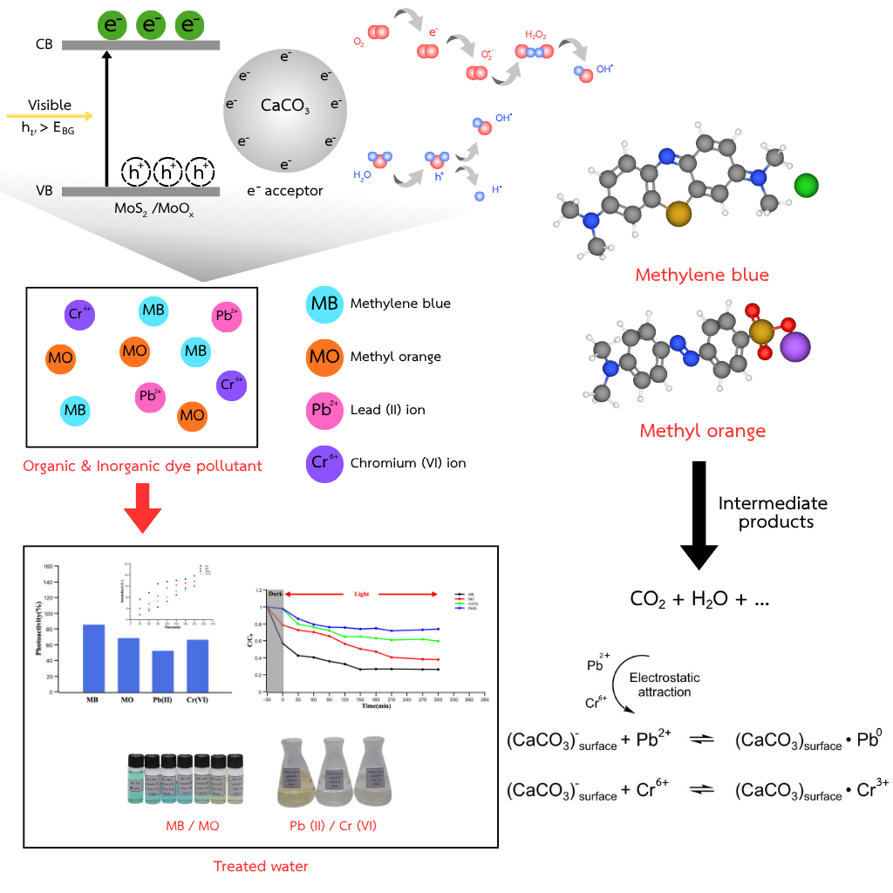
In this work, a CaMoO4-based composite was synthesized via the in-situ transformation of MoS2 and eggshell-derived CaCO3 precursors. CaMoO4-based composite-based composite was formed in-situ during microwave-assisted hydrothermal treatment through direct phase transformation of the precursor mixture. The phase transformation was confirmed by XRD analysis, showing the conversion into a crystalline scheelite CaMoO4-based composite structure, while SEM and TEM observations revealed a porous, cauliflower-like morphology composed of integrated nanosheets. The in-situ transformation was further validated by FT-IR and BET analyses, which showed a significant enhancement in the specific surface area to 85.5 m2 g−1 for the 7 wt% CaCO3-loaded sample. This synergistic adsorption-photocatalytic/photoreduction process of CaMoO4-based composite proved effective in removing methylene blue (MB), methyl orange (MO), lead (II) ion, and chromium (VI) ion, demonstrating superior removal rates and stability over 3 cycles. Kinetic studies followed the pseudo-first-order model, with the highest rate constant for MB at 0.0480 min−1. Scavenging experiments identified ∙O2− as the primary reactive species driving the degradation process. Furthermore, a 44.65% TOC removal confirmed significant mineralization, demonstrating the catalyst’s dual-functionality in effectively remediating both organic and inorganic pollutants. Phytotoxicity evaluation using H. verticillata revealed that the Ca2+ ions released from the catalyst effectively mitigated heavy metal stress by reducing the uptake of Pb(II) and Cr(VI), confirming the environmental safety of the treated water. This hybrid composite exhibits significant potential for environmental applications, particularly for the efficient utilization of visible or solar energy in wastewater remediation.
HIGHLIGHTS
- CaMoO4–based composite was synthesized via a rapid microwave–assisted hydrothermal
- Dyes and heavy metals are removed through combined adsorption, photocatalysis, and photoreduction.
- Stable reusability was confirmed for up to 3 cycles under synthetic visible light.
- Phytotoxicity testing confirms the environmental safety of the treated wastewater.
GRAPHICAL ABSTRACT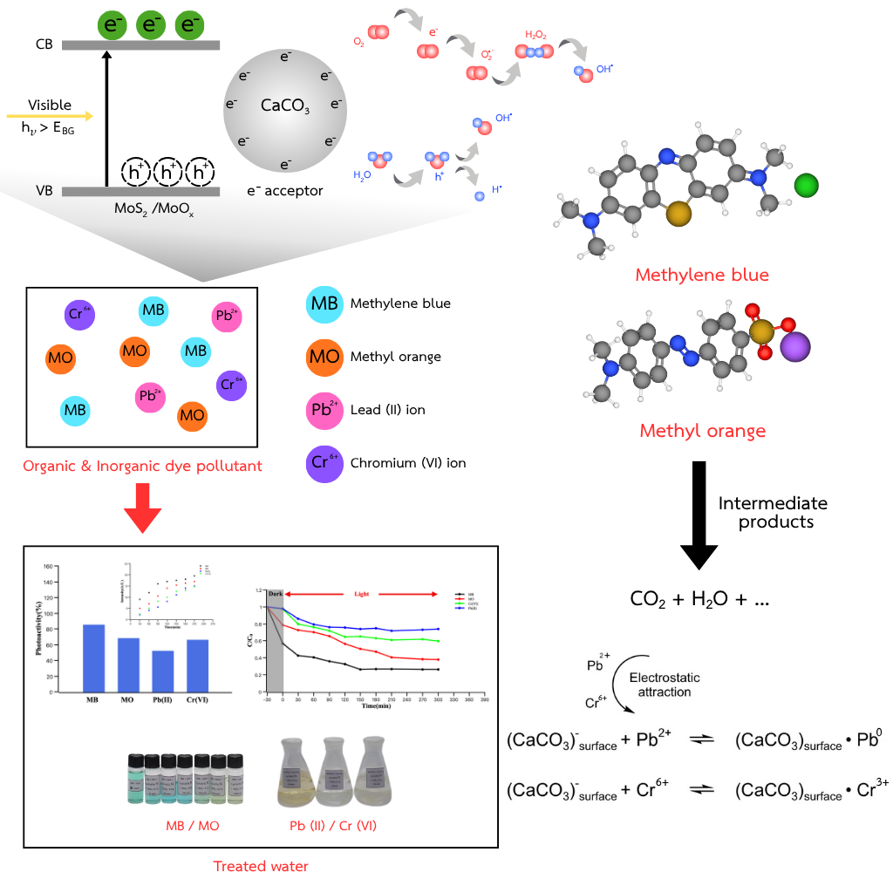
Downloads
References
AM Aljeboree, HH Ghazi, SA Hussein, MA Jawad, SA Khuder and AF Alkaim. Facile fabrication of a low-cost carboxymethyl cellulose-polyacrylamide composite for the highly efficient removal of cationic dye: Optimization, kinetic and reusability. Journal of the Iranian Chemical Society 2025; 22(1), 91-111.
AM Aljeboree, AF Alkaim, SA Hussein, FH Alsultany and MA Jawad. Ecofriendly k-carrageenan-based hydrogel with strong adsorption and higher abilities to remove crystal violet from aqueous solution: Thermodynamic, isotherm and kinetic investigation. Journal of Inorganic and Organometallic Polymers and Materials 2025; 35(4), 2921-2942.
L Saya, V Malik, A Singh, S Singh, G Gambhir, WR Singh, R Chandra and S Hooda. Guar gum based nanocomposites: Role in water purification through efficient removal of dyes and metal ions. Carbohydrate Polymers 2021; 261, 117851.
T Shi, Z Xie, X Mo, Y Feng, T Peng and D Song. Highly efficient adsorption of heavy metals and cationic dyes by smart functionalized sodium alginate hydrogels. Gels 2022; 8(6), 343.
S Ahmed, S Aktar, S Zaman, RA Jahan and ML Bari. Use of natural bio-sorbent in removing dye, heavy metal and antibiotic-resistant bacteria from industrial wastewater. Applied Water Science 2020; 10(5), 107.
TM Kathawala, KV Gayathri and PS Kumar. A performance comparison of anaerobic and an integrated anaerobic-aerobic biological reactor system for the effective treatment of textile wastewater. International Journal of Chemical Engineering 2021; 2021, 8894332.
K Paździor, L Bilińska and S Ledakowicz. A review of the existing and emerging technologies in the combination of AOPs and biological processes in industrial textile wastewater treatment. Chemical Engineering Journal 2019; 376, 120597.
M Tabish, AB Tabinda, Z Mazhar, A Yasar, J Ansar and I Wasif. Physical, chemical and biological treatment of textile wastewater for removal of dyes and heavy metals. Desalination and Water Treatment 2024; 320, 100842.
G Chandrabose, A Dey, SS Gaur, S Pitchaimuthu, H Jagadeesan, NSJ Braithwaite, V Selvaraj, V Kumar and S Krishnamurthy. Removal and degradation of mixed dye pollutants by integrated adsorption-photocatalysis technique using 2-D MoS2/TiO2. Chemosphere 2021; 279, 130467.
Y Cao, K Wang, P Zhu, X Zou, G Ma, W Zhang, D Wang, J Wan, Y Ma, X Sun and J Dong. A near-infrared triggered upconversion/MoS2 nanoplatform for tumour-targeted chemo-photodynamic combination therapy. Colloids and Surfaces B: Biointerfaces 2022; 213, 112393.
PP Singh, S Sinha, G Pandey and V Srivastava. Molybdenum disulfide (MoS2) based photoredox catalysis in chemical transformations. RSC Advances 2022; 12(46), 29826-29839.
B Balan, MM Xavier and S Mathew. MoS2-based nanocompositess for photocatalytic hydrogen evolution and carbon dioxide reduction. ACS Omega 2023; 8(29), 25649-25673.
X Li, J Wan, Y Tang, C Wang, Y Zhang, D Lv, M Guo, Y Ma and Y Yang. Boosting the UV-vis-NIR photodetection performance of MoS2 through the cavity enhancement effect and bulk heterojunction strategy. ACS Applied Materials & Interfaces 2024; 16(22), 29003-29015.
A Rahman, JR Jennings, AL Tan and MM Khan. Molybdenum disulfide-based nanomaterials for visible-light-induced photocatalysis. ACS Omega 2022; 7, 22089-22110.
N Ahmad, M Javed, MA Qamar, U Kiran, S Shahid, MB Akbar, M Sher and A Amjad. Synthesis, characterization and potential applications of Ag@ZnO nanoparticles with S@g-C3N4. Advanced Materials Research 2022; 11(3), 225-235.
M Baláž, EV Boldyreva, D Rybin, S Pavlovic, D Rodríguez-Padrón, T Mudrinic and R Luque. State-of-the-art of eggshell waste in materials science: Recent advances in catalysis, pharmaceutical applications, and mechanochemistry. Frontiers in Bioengineering and Biotechnology 2021; 8, 612567.
S Das, PK Mohanty and BK Mallik. Agricultural and pharmaceutical applications of eggshells: A comprehensive review of eggshell waste value-added products. Journal of Pharmaceutical Negative Results 2022; 13(8), 3979-3984.
RO Zonato, BR Estevam, ID Perez, VAS Ribeiro and RF Boina. Eggshell as an adsorbent for removing dyes and metallic ions in aqueous solutions. Cleaner Chemical Engineering 2022; 2, 100023.
TGS Meydan, SS Moosavi, Z Sabouri and M Darroudi. Green synthesis of CaCO3 nanoparticles for photocatalysis and cytotoxicity. Bioprocess and Biosystems Engineering 2023; 46, 727-734.
MN Mazlee and H Zunairah. Science mapping of catalyst support for gas adsorption applications. Advanced Materials Research 2024; 13(3), 203-210.
O Eskikaya, M Gun, R Bouchareb, Z Bilici, N Dizge, R Ramaraj and D Balakrishnan. Photocatalytic activity of calcined chicken eggshells for Safranin and Reactive Red 180 decolorization. Chemosphere 2022; 304, 135210.
A Manyatshe and LL Sibali. A review on egg waste-based adsorbents for the removal of organic and inorganic contaminants from aqueous solution. Heliyon 2025; 11, e42278.
A Amarasinghe and D Wanniarachchi. Eco-friendly photocatalyst derived from egg shell waste for dye degradation. Journal of Chemistry 2019; 2019, 8184732.
S Ummartyotin and H Manuspiya. A critical review of eggshell waste: An effective source of hydroxyapatite as photocatalyst. Journal of Metals, Materials and Minerals 2018; 28(1), 124-135.
QS Zhou, WT Yun, JT Xi, XB Li, TG Qi, GH Liu and ZH Peng. Molybdenite-limestone oxidizing roasting followed by calcine leaching with ammonium carbonate solution. Transactions of Nonferrous Metals Society of China 2017; 27(7), 1618-1626.
J Wang, S Sun, L Pan, Z Xu, H Ding and W Li. Preparation and properties of CaCO3-supported nano-TiO2 composite with improved photocatalytic performance materials. Materials 2019; 12, 3369.
C Liu, C Huang, C Hu, D Wang, Y Zhong and C Tang. CaCO3/BiO2-x/CdS composite with rapid photocatalytic reduction of Cr(VI) under visible light. Nanomaterials 2026; 16, 376.
H Zhang, XY Gong, WX Li, XH Ma, CY Tang and ZL Xu. Thin-film membranes containing tannic acid-Fe3+ modified MoS2 nanosheets with enhanced nanofiltration performance. Journal of Membrane Science 2020; 611, 118605.
M Minakshi, AJ Barlow, DRG Mitchell, C Baur, J Chable, M Fichtner, A Banerjee, S Chakraborty and R Ahuja. Phase evolution in calcium molybdate nanoparticles as a function of synthesis temperature and its electrochemical effect on energy storage. Nanoscale Advances 2019; 1, 565.
X Zhang, J Huang, Z Kang, DP Yang and R Luque. Eggshell-templated synthesis of PbS/CaCO3 nanocomposites for CO3− mediated efficient degradation of tetracycline under solar light irradiation. Journal of Molecular Catalysis A: Chemical 2020; 484, 110786.
DA Yaseen and M Scholz. Textile dye wastewater characteristics and constituents of synthetic effluents: A critical review. International Journal of Environmental Science and Technology 2019; 16(2), 1193-1226.
AM Nasib, S Simon, SM Rasidi, SKE Ab Rahim, HP Yong, NQ Hwa and K Johari. Coagulant bath medium effect towards polylactic acid membranes structure and methylene blue dye removal. Advanced Materials Research 2024; 13(3), 243-251.
W Wang, Y Hu, J Goebl, Z Lu, L Zhen and Y Yin. Shape- and size-controlled synthesis of calcium molybdate doughnut-shaped microstructures. Journal of Physical Chemistry C 2009; 113, 16414-16423.
M Laguna, NO Nuñez, AI Becerro and M Ocaña. Morphology control of uniform CaMoO4 microarchitectures and development of white light emitting phosphors by Ln doping (Ln = Dy3+, Eu3+). CrystEngComm 2017; 19, 1590.
E Fosso-Kankeu, M Spiro, FB Waanders, N Kumar and SS Ray. Hydrothermal synthesis, characterization and adsorption testing of MoS2-zeolite for the removal of lead in an aqueous solution. In: Proceedings of the 10th International Conference on Advances in Science, Engineering and Technology for Healthcare, Cape Town, South Africa. 2018.
DS Mallya, G Yang, W Lei, S Muthukumaran and K Baskaran. Functionalized MoS2 nanosheets enabled nanofiltration membrane with enhanced permeance and fouling resistance. Environmental Technology & Innovation 2022; 27, 102719.
GB Cai, SF Chen, L Liu, J Jiang, HB Yao, AW Xu and HS Yu. 1,3-Diamino-2-hydroxypropane-N,N,N′,N′-tetraacetic acid stabilized amorphous calcium carbonate: Nucleation, transformation and crystal growth. CrystEngComm 2010; 12(1), 234-241.
DJ Silva and H Wiebeck. ATR-FTIR spectroscopy combined with chemometric methods for the classification of polyethylene residues containing different contaminants. Journal of Polymers and the Environment 2020; 30(7), 3031-3044.
S Roobakhsh, Z Rostami and S Azizian. Can MoS2 nanosheets be used as adsorbent for water treatment? Separation and Purification Technology 2018; 200, 23-28.
Y He, X Jia, S Zhou, J Chen, S Zhang, X Li, Y Huang, T Wagberg and G Hu. Separatable MoS2 loaded biochar/CaCO3/Alginate gel beads for selective and efficient removal of Pb(II) from aqueous solution. Separation and Purification Technology 2022; 303, 122212.
CD Theerakarunwong, O Kaewthet and S Phanichphant. Potential effectiveness of visible-light-driven Fe/TiO2 photocatalysts for degradation of dyes contaminated wastewater and their antibacterial activity. ScienceAsia 2023; 49, 454-461.
LO Amaral and AL Daniel-da-Silva. MoS2 and MoS2 for adsorption and photodegradation of water pollutants: A review. Molecules 2022; 27(20), 6782.
D Nayak, A Kumar and R Thangavel. Synthesis of MoS2 nanoflowers for photocatalytic degradation of organic dyes. ACS Applied Nano Materials 2023; 6, 19476-19490.
MTL Lai, KM Lee, TC K Yang, GT Pan, CW Lai, CY Chen, MR Johan and JC Juan. The improved photocatalytic activity of highly expanded MoS2 under visible light emitting diodes. Nanoscale Advances 2024; 3, 1106.
S Wierzba, J Makuchowska Fryc, A Kłos, Z Ziembik and W Ochędzan Siodłak. Role of calcium carbonate in the process of heavy metal biosorption from solutions: Synergy of metal removal mechanisms. Scientific Reports 2022; 12, 17668.
R Liu, Y Guan, L Chen and B Lian, Adsorption and desorption characteristics of Cd2+ and Pb2+ by micro and nano-sized biogenic CaCO3. Frontiers in Microbiology 2018; 9, 41.
Y Xu, Y Han, R Zhao, J Han and L Wang. CdSe-decorated flower like CaMoO4 microspheres with enhanced hydrogen production activity. Langmuir 2022; 38, 15156-15164.
T Wang, X Chen, C Ju and C Wang. Calcium signaling in plant mineral nutrition: From uptake to transport. Plant Communications 2023; 4, 100678.
J Batchelor-McAuley, A Martinez-Marrades, PA Glaeser, DP Sigman and RG Compton. Calcium carbonate dissolution from the laboratory to the ocean: Kinetics and mechanism. Chemistry - A European Journal 2022; 28, e202202290.
MM Nazir, M Noman, T Ahmed, S Ali, Z Ulhassan, F Zeng and G Zhang. Exogenous calcium oxide nanoparticles alleviate cadmium toxicity by reducing Cd uptake and enhancing antioxidative capacity in barley seedlings. Journal of Hazardous Materials 2022; 438, 129498.
P Sharma and RS Dubey. Lead toxicity in plants. Brazilian Journal of Plant Physiology 2005; 17(1), 35-52.
SK Panda and S Choudhury. Chromium stress in plants. Brazilian Journal of Plant Physiology 2005; 17(1), 95-102.
International Molybdenum Association. Molybdenum: An essential micronutrient. International Molybdenum Association, London, 2013.
UC Gupta. Molybdenum in agriculture. Cambridge University Press, Cambridge, England, 1997.
Downloads
Published
How to Cite
Issue
Section
License
Copyright (c) 2026 Walailak University

This work is licensed under a Creative Commons Attribution-NonCommercial-NoDerivatives 4.0 International License.